Will to Heal LLC
Will to Heal LLC Facebook ad: “Conscious Parenting”
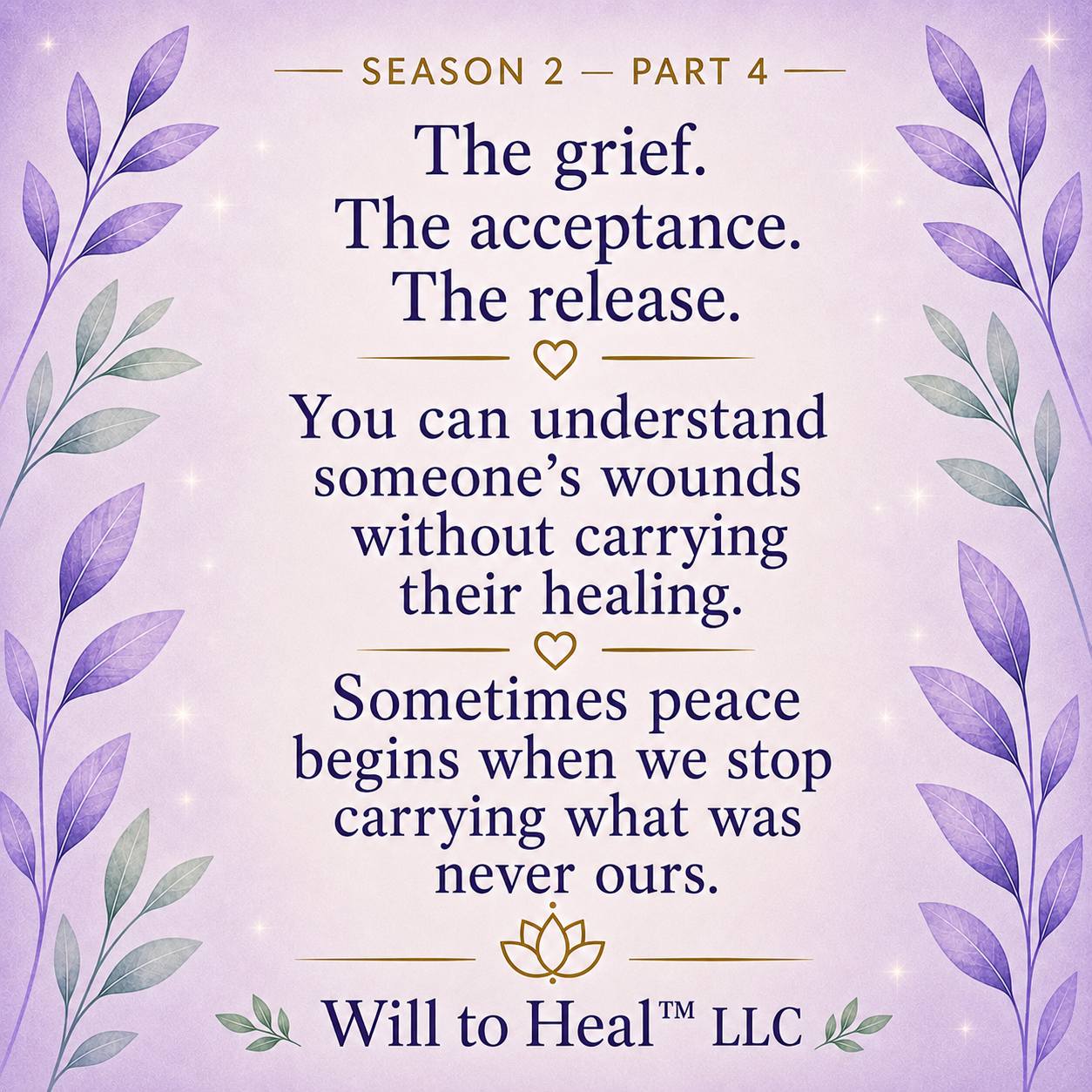
Ran for 5 days, from June 7 to June 12, 2026, the last day Crush saw it.
Run by Will to Heal LLC on Facebook. Crush is not the advertiser and does not verify its claims. See this ad in Meta's Ad Library(opens in a new tab)
Make your own version of this ad
Crush makes it, launches it in your own Meta ad account, scales the winners and pauses the losers.
About this ad
- Meta Ad Library ID
- 1383569680301627
- Platforms
- Relaunches
- 0
- EU reach
- 31
Ad text
Conscious Parenting Season 2, Part 4: Grief, Acceptance, and Letting Go of the Fantasy (Spanish translation following English) Today, I want to talk about a different kind of grief. Not the grief of losing a person, but the grief of letting go of the fantasy of who we hoped they would become. Many parents spend years trying to make difficult relationships work. We communicate, we explain, we compromise, and we try to understand. We gain insight into why people behave the way they do and we begin to see the wounds, fears, attachment styles, coping mechanisms, and unresolved trauma underneath the behavior. But eventually, many of us arrive at a painful realization: Understanding another person's behavior does not give us the power to change it. Many of us carry beliefs such as: • If I explain it differently, they'll understand. • If I find the right words, they'll listen. • If I'm patient long enough, they'll change. • If I love them enough, they'll heal. • If I show them enough evidence, they'll finally see the impact of their behavior. Sometimes that happens, but many times it doesn't. That is where grief begins. Not grief for what happened but grief for what never happened. -The healthy relationship that never developed. -The accountability that never came. -The conversations that never became honest. -The co-parenting partnership that existed in hope but not in reality. One of the hardest parts of healing is realizing that two things can be true at the same time. • A person may be acting from their wounds. • Their behavior may still be harmful. • A person may have unresolved trauma. • They are still responsible for their choices. • A person may be struggling. • They may still create instability for others. Compassion and boundaries can exist at the same time. -Understanding someone does not require us to excuse their behavior. -Setting boundaries does not require us to stop caring. For many parents, this becomes especially difficult because we don't get the luxury of simply walking away. Here is the truth: -Our child still has a relationship with the other parent. -Our child still loves that parent. -Our child is still affected by that parent's choices. The goal is not to eliminate the relationship, but to protect the child from carrying responsibilities that were never theirs to carry. Children should never become: • The messenger. • The therapist. • The peacekeeper. • The emotional caretaker. • The referee between parents. Healthy boundaries are not punishment. They are protection for everyone involved. -The child. -The parent. -The relationship itself. Many parents spend years trying to get the other parent to understand the impact of their behavior. They hope that if they can just explain it clearly enough, the other person will finally gain awareness. The reality is: -Insight cannot be given. -Awareness cannot be imposed. -Healing cannot be forced. Each person must choose their own healing journey. And eventually we have to ask ourselves a different question. Instead of: "What do I need to do to make them change?" We begin asking: "What does our child need from me?" The answer is usually much simpler. • Stability. • Consistency. • Safety. • Presence. • Emotional regulation. • Healthy boundaries. One thing I believe strongly is that children are not extensions of either parent. -They are not possessions. -They are not reflections of our worth. -They are individuals with their own thoughts, feelings, experiences, personalities, and relationships. As parents, our role is not ownership, but it is stewardship. -We guide. -We teach. -We protect. -We love. And then we allow them to become who they are meant to be. This is where acceptance becomes so important. And I want to be very clear about something: -Acceptance is not agreement. -Acceptance is simply seeing reality clearly enough to stop arguing with it. -Acceptance does not mean we approve. -Acceptance does not mean we excuse. -Acceptance does not mean we stop hoping people will grow. It simply means we stop fighting reality. We stop expecting people to become who they have repeatedly shown us they are not ready to become. We stop carrying responsibility for another adult's growth. We stop believing that our effort alone can heal someone else's wounds. That is not giving up, but letting go of a burden that was never ours to carry. When we do this something begins to shift. -We stop focusing on controlling outcomes. -We stop defining ourselves as the fixer, the mediator, or the person responsible for holding everything together. Instead, we focus on what is actually within our control: • How we show up. • How we parent. • How we communicate. • How we regulate ourselves. • How we protect our peace. • How we support our children. Peace does not always come through reconciliation. Sometimes peace comes through acceptance. -Acceptance of reality. -Acceptance of limitations. -Acceptance that another person's healing is not our responsibility. -Acceptance that we can do everything within our control and still not control the outcome. That is not failure. That is reality. And when we stop carrying what belongs to everyone else, grief slowly begins to make room for clarity, freedom, grace, and peace. Sometimes healing begins the moment we stop carrying what was never ours to carry. If this resonated, please follow the page and share with someone who could benefit. If you're new here I urge you to look back at Season 1 or the other parts of Season 2 of our Conscious Parenting Series. Many of the themes discussed tie to other series on our page. Including: -Generational Trauma -The Fire Within (based on Carl Jung) -Maslow’s Hierarchy of Needs -Erik Erikson’s Developmental Stages -The Childhood Wounds Series -Faith and CBT (Rewiring your thoughts and brain) Stay tuned for Season 3 of our Conscious Parenting Series. Will to Heal™ LLC Crianza Consciente Temporada 2, Parte 4: Duelo, Aceptación y Dejar Ir la Fantasía Hoy quiero hablar sobre un tipo diferente de duelo. No el duelo por perder a una persona, sino el duelo de dejar ir la fantasía de quién esperábamos que esa persona llegara a ser. Muchos padres pasan años intentando que las relaciones difíciles funcionen. Nos comunicamos, explicamos, negociamos y tratamos de comprender. Adquirimos una comprensión más profunda de por qué las personas se comportan como lo hacen y comenzamos a ver las heridas, los miedos, los estilos de apego, los mecanismos de afrontamiento y los traumas no resueltos que existen detrás de ese comportamiento. Pero eventualmente, muchos llegamos a una dolorosa realización: Comprender el comportamiento de otra persona no nos da el poder de cambiarla. Muchos de nosotros mantenemos creencias como: • Si lo explico de otra manera, lo entenderán. • Si encuentro las palabras correctas, escucharán. • Si tengo suficiente paciencia, cambiarán. • Si los amo lo suficiente, sanarán. • Si les muestro suficiente evidencia, finalmente verán el impacto de su comportamiento. A veces eso sucede, pero muchas veces no. Ahí es donde comienza el duelo. No el duelo por lo que sucedió, sino el duelo por lo que nunca sucedió. -La relación saludable que nunca se desarrolló. -La responsabilidad que nunca llegó. -Las conversaciones que nunca se volvieron honestas. -La relación de coparentalidad que existió en la esperanza, pero no en la realidad. Una de las partes más difíciles de la sanación es darse cuenta de que dos cosas pueden ser ciertas al mismo tiempo. • Una persona puede estar actuando desde sus heridas. • Y aun así, su comportamiento puede ser dañino. • Una persona puede tener traumas sin resolver. • Y aun así, sigue siendo responsable de sus decisiones. • Una persona puede estar luchando con sus propios problemas. • Y aun así, puede crear inestabilidad para los demás. La compasión y los límites pueden existir al mismo tiempo. -Comprender a alguien no requiere que justifiquemos su comportamiento. -Establecer límites no requiere que dejemos de preocuparnos por esa persona. Para muchos padres, esto se vuelve especialmente difícil porque no tenemos el lujo de simplemente alejarnos. Esta es la realidad: -Nuestro hijo todavía tiene una relación con el otro padre. -Nuestro hijo todavía ama a ese padre. -Nuestro hijo todavía se ve afectado por las decisiones de ese padre. El objetivo no es eliminar la relación, sino proteger al niño de cargar responsabilidades que nunca le correspondieron. Los niños nunca deberían convertirse en: • El mensajero. • El terapeuta. • El mediador de la paz. • El cuidador emocional. • El árbitro entre los padres. Los límites saludables no son un castigo. Son protección para todos los involucrados. -El niño. -El padre o la madre. -La relación en sí misma. Muchos padres pasan años intentando que el otro padre comprenda el impacto de su comportamiento. Esperan que si logran explicarlo con suficiente claridad, la otra persona finalmente tomará conciencia. La realidad es: -La comprensión no puede ser entregada. -La conciencia no puede ser impuesta. -La sanación no puede ser forzada. Cada persona debe elegir su propio camino de sanación. Y eventualmente debemos hacernos una pregunta diferente. En lugar de preguntar: "¿Qué necesito hacer para que cambie?" Comenzamos a preguntar: "¿Qué necesita nuestro hijo de mí?" La respuesta suele ser mucho más simple. • Estabilidad. • Consistencia. • Seguridad. • Presencia. • Regulación emocional. • Límites saludables. Algo en lo que creo profundamente es que los hijos no son extensiones de ninguno de los padres. -No son posesiones. -No son reflejos de nuestro valor personal. -Son individuos con sus propios pensamientos, sentimientos, experiencias, personalidades y relaciones. Como padres, nuestro papel no es la propiedad, sino la responsabilidad de guiarlos. -Guiamos. -Enseñamos. -Protegemos. -Amamos. Y luego les permitimos convertirse en quienes están destinados a ser. Aquí es donde la aceptación se vuelve tan importante. Y quiero ser muy clara sobre algo: -La aceptación no es estar de acuerdo. -La aceptación es simplemente ver la realidad con suficiente claridad como para dejar de discutir con ella. -La aceptación no significa que aprobemos. -La aceptación no significa que justifiquemos. -La aceptación no significa que dejemos de esperar que las personas crezcan. Simplemente significa que dejamos de luchar contra la realidad. Dejamos de esperar que las personas se conviertan en quienes repetidamente nos han demostrado que aún no están preparadas para ser. Dejamos de cargar con la responsabilidad del crecimiento de otro adulto. Dejamos de creer que nuestro esfuerzo por sí solo puede sanar las heridas de otra persona. Eso no es rendirse, sino dejar ir una carga que nunca nos correspondió llevar. Cuando hacemos esto, algo comienza a cambiar. -Dejamos de enfocarnos en controlar los resultados. -Dejamos de definirnos como el solucionador de problemas, el mediador o la persona responsable de mantener todo unido. En cambio, nos enfocamos en lo que realmente está bajo nuestro control: • Cómo nos presentamos. • Cómo criamos a nuestros hijos. • Cómo nos comunicamos. • Cómo nos regulamos emocionalmente. • Cómo protegemos nuestra paz. • Cómo apoyamos a nuestros hijos. La paz no siempre llega a través de la reconciliación. A veces la paz llega a través de la aceptación. -Aceptación de la realidad. -Aceptación de las limitaciones. -Aceptación de que la sanación de otra persona no es nuestra responsabilidad. -Aceptación de que podemos hacer todo lo que está bajo nuestro control y aun así no controlar el resultado. Eso no es un fracaso. Eso es la realidad. Y cuando dejamos de cargar con lo que pertenece a los demás, el duelo lentamente comienza a dar paso a la claridad, la libertad, la gracia y la paz. A veces la sanación comienza en el momento en que dejamos de cargar con lo que nunca fue nuestro. Si esto resonó contigo, por favor sigue la página y compártelo con alguien que pueda beneficiarse. Si eres nuevo aquí, te invito a revisar la Temporada 1 o las demás partes de la Temporada 2 de nuestra serie de Crianza Consciente. Muchos de los temas discutidos están conectados con otras series de nuestra página. Incluyendo: -Trauma Generacional -El Fuego Interior (basado en Carl Jung) -La Jerarquía de Necesidades de Maslow -Las Etapas del Desarrollo de Erik Erikson -La Serie de las Heridas de la Infancia -Fe y TCC (Reprogramando tus pensamientos y tu cerebro) Mantente atento a la Temporada 3 de nuestra serie de Crianza Consciente. Will to Heal™ LLC