
Inactive· since Aug 6, 2026
- 16
- days it ran
- 0
- relaunches
Ad copy
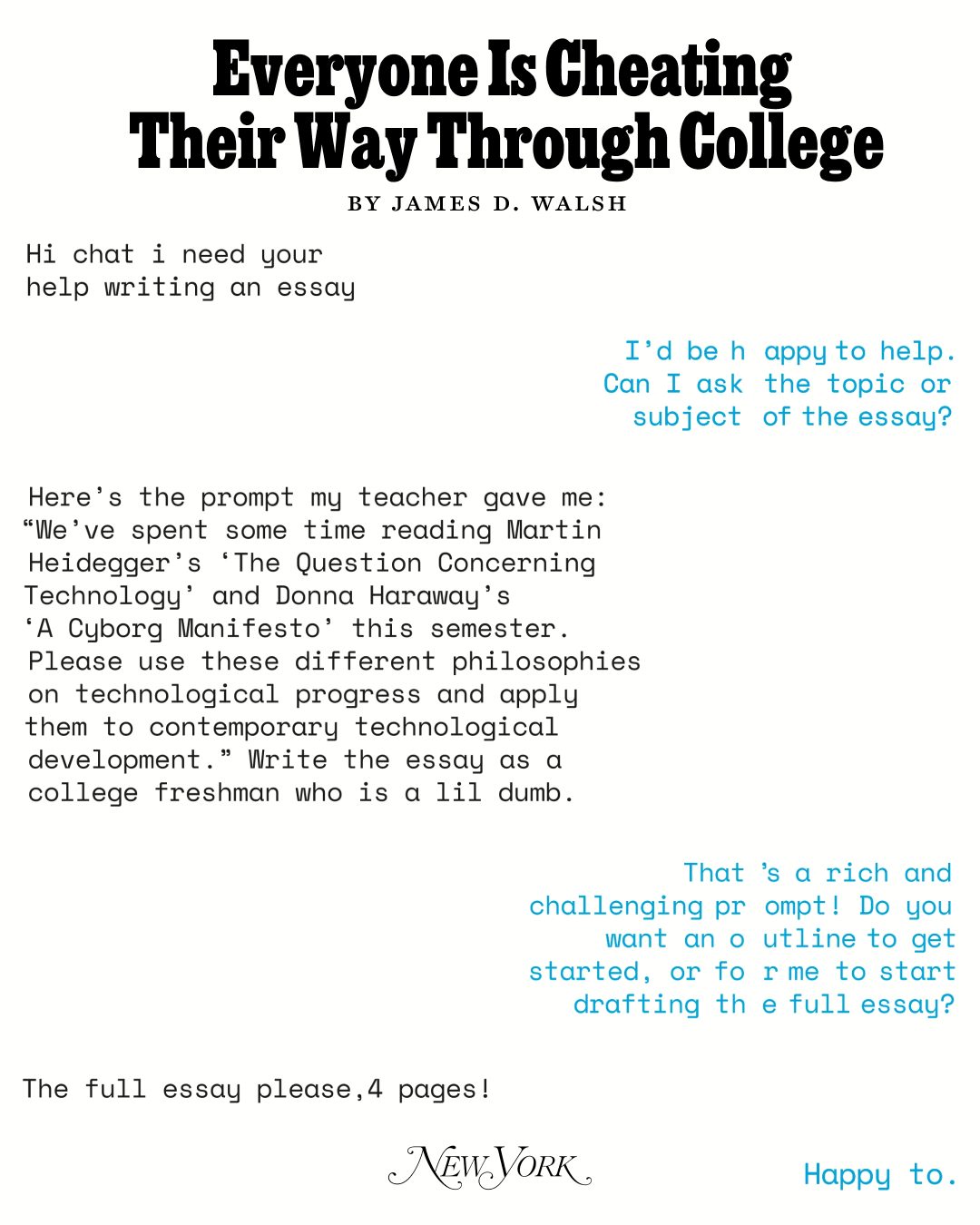
In only two years, ChatGPT has unraveled the entire academic project. Just two months after OpenAI launched ChatGPT in January 2023, a survey of 1,000 college students found that nearly 90 percent of them had used the chatbot to help with homework assignments. In its first year of existence, ChatGPT’s total monthly visits steadily increased month-over-month until June, when schools let out for the summer. (That wasn’t an anomaly: Traffic dipped again over the summer in 2024.) Professors and teaching assistants increasingly found themselves staring at essays filled with clunky, robotic phrasing that, though grammatically flawless, didn’t sound quite like a college student — or even a human. Two and a half years later, students at large state schools, the Ivies, liberal-arts schools in New England, universities abroad, professional schools, and community colleges are relying on AI to ease their way through every facet of their education. Generative-AI chatbots — ChatGPT but also Google’s Gemini, Anthropic’s Claude, Microsoft’s Copilot, and others — take their notes during class, devise their study guides and practice tests, summarize novels and textbooks, and brainstorm, outline, and draft their essays. STEM students are using AI to automate their research and data analyses and to sail through dense coding and debugging assignments. It isn’t as if cheating is new. But now, as one student put it, “the ceiling has been blown off.” Who could resist a tool that makes every assignment easier with seemingly no consequences? Read James D. Walsh's feature on the future of higher education in a world completely reliant on AI.
New York Magazine
SUBSCRIBELike this ad? Make it yours.
Crush rebuilds this exact creative around your product — your brand, your colors, your offer — in about a minute.