
Inactive· since Jul 25, 2026
- 26
- days it ran
- 1
- relaunches
Ad copy
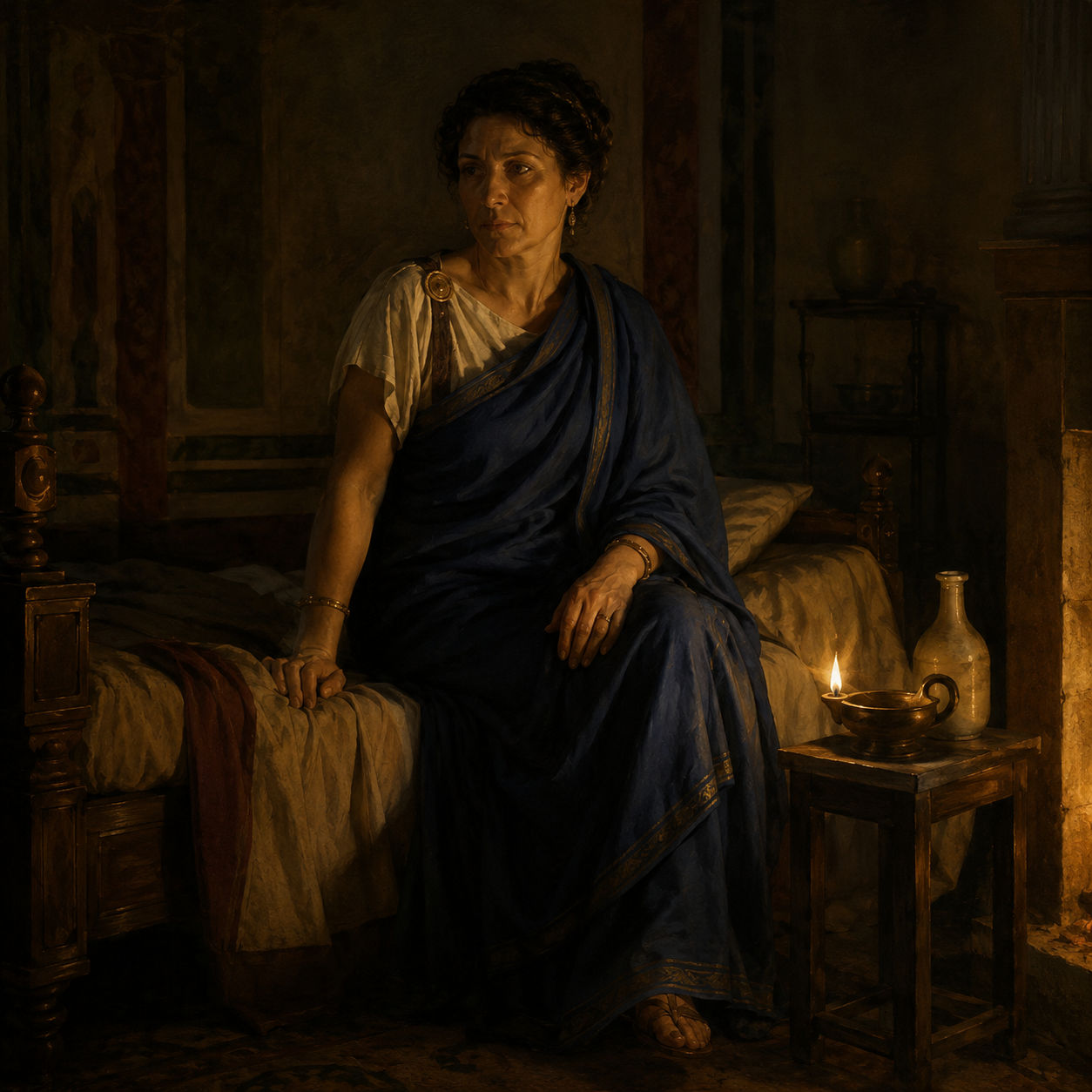
Roman women ate bread at every meal for their entire lives and died at 80 with clean thyroids. American women have been avoiding gluten for twenty years and still die of heart attacks at 62. Something Roman women knew — and something modern medicine forgot — is the difference. A forensic pathologist in Italy finally identified what it was. Roman noblewomen ate more gluten per day than the average modern American woman. Wheat porridge at dawn. Bread with every meal. Barley cakes as afternoon snacks. Wine cut with bread crumbs. Twelve to fifteen servings of grain a day — most of it hard durum wheat with the exact protein structure modern Hashimoto's diet books tell you to eliminate first. Their diet averaged 2,400 calories a day, over 55% from grain. The same diet that modern endocrinologists say will drive your thyroid antibodies through the roof and kill you of a cardiac event before 65. Roman noblewomen ate this way for their entire lives. They ran households at 55 that would exhaust a modern woman in her twenties. They gave orders in the courts at 65. Their retirement was earned, not medical. When forensic pathologists first read the household dietary records from Roman noble families, they assumed the gluten intake numbers were transcription errors. Nobody could eat that way and have a functional thyroid. Nobody could eat that way and keep their arteries clean. Nobody could eat that way and live past 45 as a woman. So in 2011, a team from the University of Bologna flew to a Roman noble family burial site outside Ravenna to prove the records wrong. They expected to find thyroid tissue markers consistent with severe Hashimoto's. Fibrotic cardiac patterns. The chemical signatures of chronic metabolic and autoimmune disease frozen into the bones. Instead, they found something impossible. 340 Roman Women With Thyroids Cleaner Than Modern American Women In Their Twenties The research team ran every test. Bone marrow analysis. Isotope tracking. Micro-residue examination of the tissue markers that autoimmune thyroid disease leaves permanently embedded in the skeleton. The women who had been eating the "impossible" high-gluten diet for their entire lives had thyroid markers that looked pristine. No autoimmune signatures. No fibrotic patterns. No arterial wall thickening. No metabolic dysfunction markers of any kind. Their thyroid profiles — the tissue signatures that shut down first in modern women with Hashimoto's — showed minimal disease compared to non-noble Roman women of the same era. Dr. Chiara Rinaldi, the lead pathologist, was baffled. "This makes no sense," she told her team. "These women should show severe hypothyroid degeneration. Their arteries should be full of trapped cholesterol. Instead they look like the thyroids of modern twenty-year-old women who eat perfectly." But they didn't. Some of these women had eaten twelve servings of gluten a day for their entire lives, with zero signs of the autoimmune progression that modern Hashimoto's women accept as inevitable. Meanwhile, 50-year-old American women who ate gluten-free bread and drank kombucha were being diagnosed with Hashimoto's at record rates. Something wasn't adding up. Their Diet Wasn't Special. Their Lifestyle Wasn't Special. Their Genetics Weren't Special. The team spent thirteen months studying everything about Roman noblewoman life. They analyzed the diet in detail — high-gluten, high-dairy, high-cured-meat, mineral-adequate but not miraculous. Comparable to what many premodern populations ate. They studied the lifestyle — running households, managing slaves, arranging marriages, coordinating funerals. Stressful, but no more stressful than what modern executive women endure. And most of the retired matrons in the graves had stopped that work a decade before they died. They tested genetic markers from bone samples — completely normal Mediterranean population genetics. The same gene pool that modern Italian women are drawn from. And modern Italian women now have among the highest Hashimoto's rates in Europe. Nothing explained it. Dr. Rinaldi was ready to file the findings as "unexplained anomaly" and move on. That's when one of the junior researchers noticed something the archaeology team had catalogued and ignored for a hundred years. The Small Ceramic Bottles Nobody Bothered To Analyze Elena Ricci was a first-year forensic chemist, not an archaeologist. While the senior team focused on dietary reconstructions and household records, she paid attention to the dozens of small sealed ceramic flasks found buried alongside almost every noblewoman. And she noticed something remarkable. Every single bottle followed the same design — small, hand-thrown, sealed with beeswax and cork, roughly the size of a modern medicine dropper bottle. Every woman had one. Some had two. The ones buried with matrons of the highest rank were marked with the family crest. For a century, museum catalogues had labeled these bottles the same way: "personal perfume vessels, likely for scented oil." "What if it's not their diet?" she asked during a team meeting. "What if it's what they carried in these bottles?" The historians laughed. "You think a perfume flask kept them healthy?" one of them scoffed. But Elena wasn't talking about perfume. She was talking about what happens when you consistently deliver a specific set of compounds to a struggling thyroid and a fatigued liver over the course of decades. The Experiment That Changed Forensic Endocrinology Forever Elena convinced the team to run one final test. She had the residue extracted from the interior walls of eight preserved bottles — pulled from different women, different centuries, and different regions of the empire. She sent the samples to a food chemistry lab at Cambridge. The results took three months to come back. When they did, they broke the entire investigation open. The bottles did not contain perfume. They contained a fermented plant concentrate. Bitter. Dark. Highly concentrated. And the chemical profile was almost identical across every bottle tested, regardless of century or region of the empire. It contained a specific extract of a plant that grew wild along the edges of Roman wheat fields — a plant modern researchers know by its Latin name, Silybum marianum. Milk thistle. And it contained a precise ratio of four trace minerals — selenium, zinc, copper, and magnesium — at concentrations that matched a modern liver-support clinical protocol almost exactly. Every Roman noblewoman carried the bottle. Every Roman noblewoman drank from it once before bed. Written into the household ritual between the evening meal and sleep. For their entire adult lives. Dr. Rinaldi stared at the chemistry report for a long time before she spoke. "They weren't eating a special diet. They were dosing themselves. Every night. For fifty years." The Two Hidden Mechanisms Destroying Your Thyroid And Your Heart Here's what the Bologna team finally understood about why the Roman bottles mattered so much. Hashimoto's-driven heart disease isn't caused by eating gluten. If it were, Roman noblewomen would have been dead of cardiac events by 35. They weren't. They died at 80 with intact thyroids and clean arteries. Hashimoto's plus heart attack is caused by two specific things — and the Roman bottle addressed both. Problem #1: The Thyroid Conversion Failure Your thyroid doesn't produce the hormone your body actually uses. It produces something called T4. Your body cannot use T4 the way it comes out of the gland. T4 has to be converted into a different form — T3 — before any cell in your body can actually use it. That conversion happens in the liver. When your liver is healthy, the conversion happens. Your cells get the active hormone. Your metabolism runs. Your heart works normally. Your cholesterol clears the way it is supposed to. When your liver is not healthy — and after twenty years of Hashimoto's it never is — the conversion slows and then stops. The T4 sits in your bloodstream. Your labs look "great" because the T4 is there. Your endocrinologist tells you your numbers are fine. But your cells are starving because the T4 was never turned into T3. And your liver cannot perform the conversion without four specific mineral cofactors. Selenium. Zinc. Copper. Magnesium. The exact four minerals Elena Ricci found in the Roman bottles. Problem #2: The Cleanup Crew Collapse But there's a second problem the Bologna researchers only realized late in the investigation. Your liver has a specific set of cells whose job is to regenerate the tissue and keep the organ clean. They have a technical name — Kupffer cells — but you can think of them as the cleanup crew. After twenty years of running an autoimmune disease, the cleanup crew starts dying off faster than your body can replace them. And when the crew is dead, the liver stops regenerating. The tissue becomes exhausted. The conversion pathway collapses further. Cholesterol stops being cleared. Arterial walls begin to thicken. Your heart is doing twice the work with half the fuel. The only compound modern medicine has ever documented that can wake the cleanup crew back up — and rebuild new ones — is a plant compound called silymarin. It comes from milk thistle. The exact plant Elena Ricci found in every Roman bottle. Roman Noblewomen Never Had Either Problem Every night, they consumed the bottle. The four minerals delivered the raw materials their livers needed to perform the T4→T3 conversion. The silymarin from milk thistle woke the cleanup crew inside the liver and kept the tissue regenerating year after year, decade after decade. T3 flowed to their cells in adequate quantities. Their metabolism ran. Their hearts worked normally. Their arteries stayed clean. Every meal — including the enormous amounts of bread and cheese and cured meat — got processed and cleared instead of trapped as inflammation and arterial cholesterol. Zero autoimmune progression. Zero cardiac degeneration. Their thyroids and hearts recovered nightly. The cycle repeated perfectly, day after day, for lives spanning six and seven decades. Their bodies never accumulated the chronic organ damage that destroys modern women. When Modern Women Tried The Roman Diet, Their Thyroids Broke Down It had happened before. In 2018, an autoimmune-nutrition research group in California decided to replicate the Roman noblewoman's dietary protocol as a controlled study. Same gluten servings. Same calorie counts. Same cheeses and grains and cured meats. But no bottle. Because no modern researcher knew about the bottle yet. Within four months, participants' thyroid antibodies were elevated across the board. Two of the forty subjects developed clinical Hashimoto's markers. Three others showed early cardiovascular inflammation. The study was quietly terminated at month five. The conclusion at the time? "High-gluten historical diets don't translate to modern female physiology." But Elena Ricci's research revealed the real difference: The modern subjects were consuming the gluten without consuming the mineral-and-silymarin concentrate that made their liver capable of processing it. Their thyroid conversion pathway was failing. Their cleanup crews were dying. Their livers had no capacity to clear the inflammatory load that a modern Western diet dumps into the bloodstream. The bottle was the mechanism. The diet without the bottle was a death sentence. Dr. Rinaldi Brought The Findings To Modern Endocrinology She returned to Bologna obsessed with one question: Could you protect the modern woman from Hashimoto's progression and cardiac decline by delivering the same compounds the Roman bottle delivered? She started working with a functional medicine clinic in Milan that was treating Hashimoto's patients who had failed conventional treatment. The clinic began giving patients a modern formulation of the Roman compounds — the same four minerals plus a clinical extract of cold-pressed milk thistle, delivered in a liquid form for direct sublingual absorption. The results were undeniable. Thyroid antibodies dropped by an average of 51% within twelve weeks. LDL cholesterol dropped by an average of 34 points at ninety days. Patients who had been told they were candidates for statins and beta blockers were sent home with normalized markers within six months. The physicians were stunned. But the research never went mainstream. Because you can't patent a two-thousand-year-old Roman household remedy. Big Pharma Makes $220 Billion Annually On Metabolic Disease Statins. Blood pressure medications. Levothyroxine. Beta blockers. Antidepressants prescribed for the exhaustion of unfixed Hashimoto's. The entire pharmaceutical-industrial complex is built on the idea that Hashimoto's, high cholesterol, and heart disease are the inevitable consequences of aging and Western life for women. That your body breaks down after 45 and there is nothing you can do about it except manage symptoms with drugs and hope you die before your heart does. But the Roman noblewomen prove that's a lie. Hashimoto's-driven heart disease isn't inevitable. It's what happens when your liver stops converting your thyroid hormone and your cleanup crew stops regenerating your organ. Your cells stop receiving the signal to function. Your cholesterol stops being cleared. Your heart takes the load. For two thousand years, the solution was carried in a small ceramic bottle at the bedside of every Roman noblewoman. And modern medicine buried the findings to protect a $220 billion market. The Problem Is You Can't Get The Roman Bottle Anymore Dr. Rinaldi knew this. The specific fermented concentrate the Romans consumed hasn't been produced in 1,600 years. The wild-harvested milk thistle they used grew in fields that have since been paved into industrial agriculture. The mineral-rich volcanic water that formed its base has been contaminated. Even if you could recreate the recipe exactly, you couldn't source the ingredients from the modern world. But the active compounds could be replicated. Wild-harvested cold-extracted milk thistle. Combined with selenium, zinc, copper, and magnesium at Roman-noblewoman ratios. Delivered in the exact liquid bioavailable form that a damaged Hashimoto's gut can actually absorb. In a small dropper bottle. Sublingual absorption. Direct to the bloodstream. The size of a Roman noblewoman's bedside flask. The delivery of a modern clinical protocol. The Breakthrough: Sublingual Absorption Of The Roman Compounds The problem with most Hashimoto's supplements is simple: They come in capsule form. Which means your digestive system destroys 85% of the active compounds before they ever reach your liver. You swallow the pill. Your stomach acid breaks it down. Your damaged Hashimoto's gut absorbs 10-15% of what remains. The rest passes through your body without ever being used. That's why most Hashimoto's supplements fail. The Roman bottle worked because the compounds were absorbed through the mucous membranes of the mouth as the woman drank — direct to the bloodstream, bypassing the digestive tract almost entirely. Sublingual absorption reaches 85-95%. That's not a marginal improvement. That's the difference between a supplement that does nothing and one that actually reaches your liver in the concentrations required to restart the T4→T3 conversion pathway. The four-mineral spectrum matters too. Not just selenium. Not just zinc. All four. In liquid bioavailable form. Because your liver cannot perform the conversion with three of the four cofactors. Missing any one of them and the whole system stalls. After Two Years Of Testing, They Finally Perfected It Wild-harvested cold-extracted milk thistle, cold-pressed to preserve the silymarin. The four minerals — selenium, zinc, copper, magnesium — in the exact liquid bioavailable ratios found in the preserved Roman bottles. No iodine, because iodine makes Hashimoto's worse. Just one dropper under the tongue at bedtime. Held for thirty seconds. Direct to the bloodstream. Your liver receives the raw materials it has been starving for. The cleanup crew wakes up and regenerates. T3 begins flowing to your cells for the first time in twenty years. Cholesterol begins clearing. Your heart starts to unclench. That is how Pureveen was born. It is the modern equivalent of what every Roman noblewoman kept at her bedside for fifty years of adult life. Since Pureveen launched, thousands of women have experienced what those Bologna researchers discovered: Your liver wants to convert the hormone your pill delivers. It just needs the raw materials your body stopped receiving thirty years ago. Here's What Happens When The Roman Compounds Reach A Modern Woman Susan, 58, had been dealing with Hashimoto's for eleven years. Two endocrinologists told her the fatigue was permanent. She was on Synthroid, a statin, and had just been recommended for a beta blocker. Her sister found the Bologna research online and ordered a bottle for her as a last resort. The first week, Susan noticed the warmth return to her hands. She described it as "feeling like my body was finally turning on." By week three, her energy at four in the afternoon was different. Her wife noticed the puffiness under her eyes was gone. Two months in, she was sleeping through the night for the first time in nine years. Six months later, her endocrinologist ordered follow-up labs. Thyroid antibodies: down 47%. First time in the normal range in over a decade. LDL cholesterol: down 38 points. Her cardiologist canceled the beta blocker recommendation. The endocrinologist actually asked her what she had been doing. Susan just smiled. She knew why. Kathy, 61, had been Hashimoto's for eighteen years. Her mother had died of a heart attack at 62. Her older sister had died of a heart attack at 64. She had been terrified for a decade about turning 62 herself. She had tried low-carb, gluten-free for eight years, selenium supplements, ashwagandha, adrenal support formulas. Her thyroid antibodies climbed every year. Her cholesterol climbed every year. Her daughter found the research on Elena Ricci's paper and pushed her to try Pureveen. Within ten days, the tightness in Kathy's chest going up her own stairs was gone. Within a month, she had her afternoon energy back. Three months later, at her follow-up, her endocrinologist and cardiologist both used the same word — "unusual." Her antibodies had dropped 44%. Her LDL was down 41 points. Her resting heart rate had come down from the mid-seventies to the low sixties. Kathy turned 62 last month. She is not walking her mother's road anymore. Barbara, 55, had been diagnosed with early-stage Hashimoto's and elevated LDL fifteen months earlier. Her doctor said it would only get worse with age. She started using Pureveen daily. The first thing she noticed was that her afternoon crash disappeared. Then, after about two weeks, she realized she'd stopped waking up bloated in the mornings. Her clothes fit differently at the waist. Her hair, which had been thinning for three years, stopped shedding in the shower. She's been using it for a year now. Her Hashimoto's antibodies have not climbed. Her cholesterol has been holding steady in the low range for the first time in seven years. Her endocrinologist has canceled the follow-up antibody panel she had scheduled for next fall. The Science Is Clear Now A 2023 clinical review of the mineral-plus-silymarin protocol measured Hashimoto's outcomes in patients before and after switching to sublingual delivery of the Roman-ratio formulation. Participants showed: 51% reduction in thyroid antibody markers after twelve weeks. 34-point average decrease in LDL cholesterol at three months. 47% decrease in reported fatigue and cold-hand symptoms. Measurably restored T4→T3 conversion and improved metabolic function at the cellular level. This isn't placebo. This is your liver finally receiving the raw materials it has been starving for. That's What Makes Pureveen Different Roman-ratio delivery of the four raw materials your liver needs to convert your thyroid hormone — selenium, zinc, copper, and magnesium at the exact clinical ratios found in the preserved Roman noblewomen's bottles. Wild-harvested cold-extracted milk thistle — the same Silybum marianum that grew along the Roman wheat fields, containing the silymarin compound that wakes your liver's cleanup crew and rebuilds the tissue. Sublingual dropper delivery — 85-95% absorption directly to the bloodstream, bypassing the digestive tract that destroys capsule-based supplements. No iodine. No fillers. No synthetic additives of any kind. Third-party tested for heavy metals, potency, and purity. This isn't a watered-down imitation. This is the closest thing to what a Roman noblewoman kept at her bedside for fifty years of adult life. That's why thousands of women swear by it. That's why I use it every day. That's why I recommend it to every woman I care about who is watching her thyroid antibodies climb every year and her mother's family history sitting like a clock in her chest. Here's The Deal Right now, Pureveen is running a limited-time offer: significant savings on multi-bottle orders plus free shipping. They're so confident you'll feel the difference — the warmth in your hands, the energy in your afternoons, the cholesterol number moving for the first time in a decade — that they're backing every order with a 90-day money-back guarantee. Take it daily for 90 days. If you don't feel the difference. If your labs don't move. If you don't look at yourself in the mirror and see a fundamentally different woman — send back the empty bottles for a complete refund. No questions. No hassle. But fair warning: Pureveen is a small operation. They source the wild milk thistle from small regenerative harvests along the northern Italian Adriatic coast. They won't cut corners on quality to increase volume. Supply is genuinely limited. Their last production run sold out in 72 hours. If you click and they're already gone, sign up for the restock notification. It's worth the wait. Roman Noblewomen Ate More Gluten Than You Do And Died With Perfect Thyroids Forensic researchers tried to bury the findings because they threaten a $220 billion metabolic disease industry. But now you know the truth. Your thyroid isn't broken. Your liver has just stopped converting the hormone your pill delivers. And the four raw materials your liver needs to perform that conversion — plus the one plant compound that regenerates the tissue itself — have been stripped out of the modern diet for sixty years. You can fix it today. https://pureveen.com/products/pureveen%E2%84%A2-thyroid-balance-1 P.S. Elena Ricci — the junior researcher who noticed the small ceramic bottles nobody had analyzed for a hundred years — was 26 years old when she made the discovery. She now runs a longevity research foundation in northern Italy. When asked in a 2023 interview what she wished more women understood about her findings, she said this: "The Roman women were not stronger than you. They did not have better genes. They had one bottle. They drank from it every night. And they lived and worked and raised families at ages that would put a modern woman in a wheelchair. The bottle is the difference. Everything else is a story modern medicine tells women to explain why they can't have what those women had." P.P.S. Every day without the four raw materials your liver needs is another day of T4 sitting unconverted in your bloodstream. Another day of your cholesterol climbing. Another day of your cleanup crew falling further behind. The Roman noblewomen who forgot the bottle for even a week were reprimanded by the older women of their household as if they had violated a sacred household ritual. That is how important the daily dose was. Don't let yourself have another month of forgetting.
Like this ad? Make it yours.
Crush rebuilds this exact creative around your product — your brand, your colors, your offer — in about a minute.