Hannah Mitchell
Hannah Mitchell Facebook ad: “What your liver's been missing”
Ran for 1 day, from July 10 to July 11, 2026, the last day Crush saw it.
Run by Hannah Mitchell on Facebook. Crush is not the advertiser and does not verify its claims. See this ad in Meta's Ad Library(opens in a new tab)
Want an ad like this for your product?
Crush makes new ad images for your product from this ad: your logo, your product photo, your offer.
Trials from $19.95 USD, then $79.95 USD a month. Cancel anytime.
About this ad
- Meta Ad Library ID
- 1565646261857540
- Platforms
- Facebook, Instagram, Audience Network, Messenger and Threads
- Relaunches
- 0
Ad text
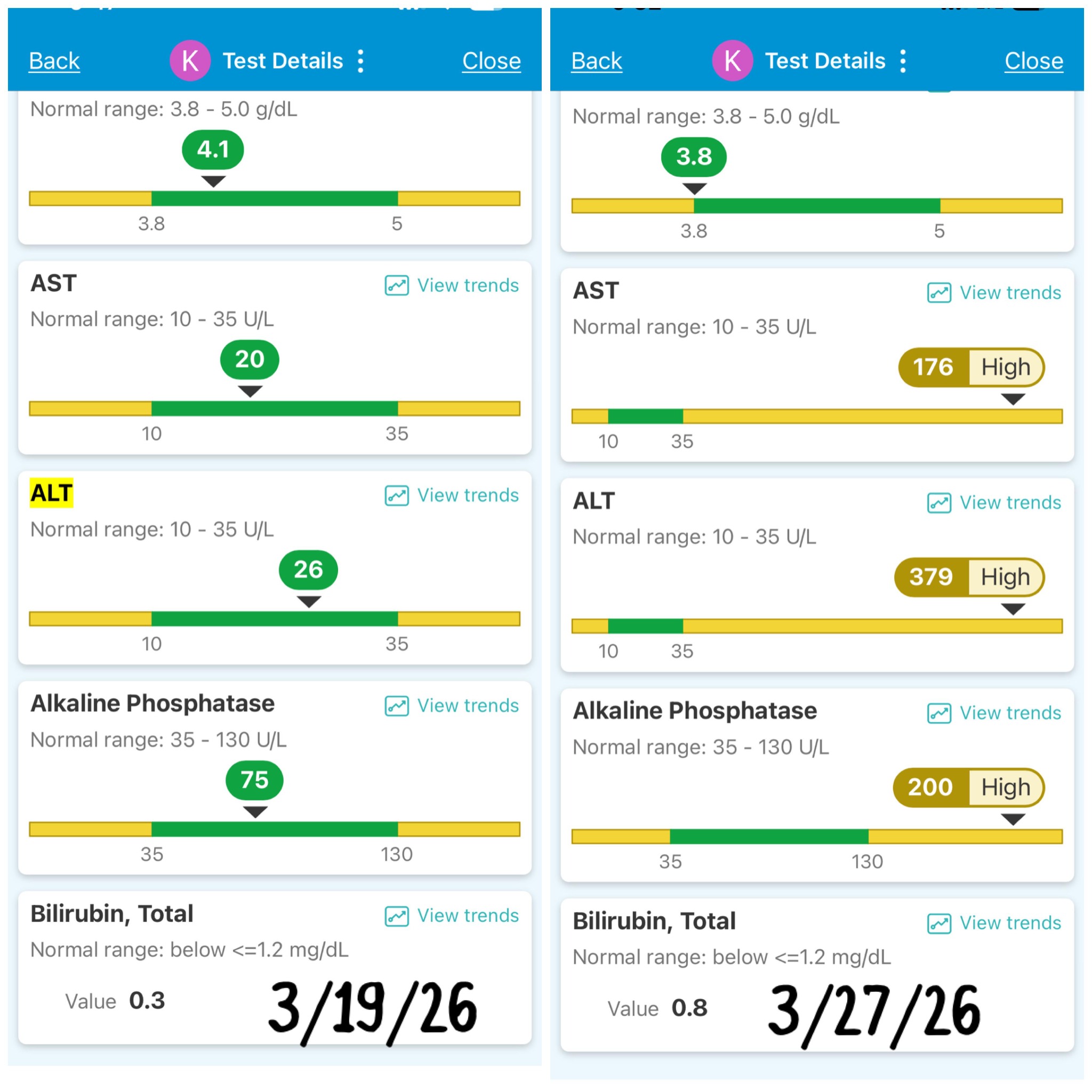
My ALT was 87 and climbing. Two years on every milk thistle supplement I could find. Generic capsules. Health-food-store brands. The high-rated Amazon bottle with 4,000 reviews. All failed. A six-month stretch on Costco milk thistle did nothing. Then I found out why — and my ALT went from 87 to 29 in four months. My mother's liver failed at 62. I'm 49. Six weeks ago, I was scrolling through my patient portal after routine bloodwork. Just a checkup. Nothing unusual. Then I saw the red flags. ALT: 87. Flagged high. In red. AST: 64. Flagged high. In red. My chest tightened. I refreshed the page. Still red. I didn't even wait for my doctor to call. I Googled "what does elevated ALT mean" at 10:47 PM sitting on the edge of my bed. The results loaded. My hands went cold. "Elevated liver enzymes may indicate inflammation or damage to cells in the liver..." "Fatty liver disease affects up to 30% of adults and often presents no symptoms until advanced stages..." "Liver damage can occur without noticeable symptoms until it's irreversible..." My mother's face flashed in my mind. She never drank. Not really. A glass of wine at Christmas. That was it. But her liver failed anyway. It started the same way. Routine bloodwork. Numbers flagged in red. Her doctor said not to worry. Said lose a few pounds and recheck in six months. Six months became a year. The year became two years of "let's keep monitoring." By year three, the monitoring turned into something else. The dull ache under her right ribs that she brushed off as gas. The exhaustion she blamed on getting older. The itching that kept her awake. The bruises that appeared from nothing. She ignored every sign. Because she felt fine. Because her doctor said not to worry. I always thought if you feel fine, everything must be okay. My mother thought that too. Her tests were fine. And then they weren't. By the time they found the scarring, it was stage 4. Compensated cirrhosis. The word hit our family like a verdict. I watched her lose her appetite. Watched her hair thin. Watched her ankles swell with fluid until she couldn't fit into her shoes. Watched her stomach bloat until a stranger on the street asked when she was due. She was 60 years old. The hospital stays. The fluid draining. The medications that multiplied every visit. The confusion that crept in — hepatic encephalopathy, they called it. Toxins backing up into the brain because the liver couldn't process them anymore. My mother — a woman who did the crossword every morning in pen — couldn't remember what day it was. She died two years later. Her liver failed despite doing everything the doctors said. They just managed the decline until there was nothing left to manage. I sat in my bathroom that night after seeing my results. Door locked. Fan running so my husband couldn't hear me crying. ALT: 87. I was 49. My mother's numbers first came back flagged when she was 51. Two years away from the same starting line. My husband knocked. "Hey. You okay in there?" I opened the door. Handed him my phone without speaking. The patient portal still glowing on the screen. He looked at it. Looked at me. His jaw tightened. "This is what your mother had." "I know." "Call your doctor. Tomorrow. First thing." I called. Got an appointment for Thursday. My doctor pulled up the results on her screen. Barely glanced at them. "Your enzymes are a bit elevated. Not dramatically. I'd recommend losing some weight, cleaning up your diet, and we'll recheck in six months." Lose weight and check again in six months. The exact words my mother's doctor said. "That's it?" I asked. "It's probably nothing. These things fluctuate. Let's not worry unless the trend continues." My doctor said not to worry. My last bloodwork said otherwise. I left the office with a printout and no plan. That night I couldn't sleep. The ceiling fan rotated. Over. And over. And over. Red numbers on the clock: 11:38 PM. Rolled over. 12:52 AM. Again. 1:44 AM. At 2:15 AM I gave up. Went downstairs. Sat at the kitchen table. Opened my laptop. The screen's blue glow hurt my eyes. I typed: *how to lower liver enzymes naturally* The search results loaded. Every site said the same thing. Lose weight. Cut sugar. Cut alcohol. Exercise more. Drink black coffee. I was already doing most of that. I barely drank — a glass of wine once a month, maybe. I walked 8,000 steps a day. I'd cut processed food six months earlier. My numbers went up anyway. I clicked deeper. Medical articles. Research papers. Why do liver supplements fail? "Silymarin, the active compound in milk thistle, has extremely poor water solubility, resulting in limited bioavailability when taken orally in standard capsule form..." "Despite evidence that glutathione depletion accelerates hepatic oxidative stress, most over-the-counter liver supplements do not provide bioavailable glutathione precursors at meaningful levels..." "Single-ingredient interventions fail to address the liver's simultaneous requirements for antioxidant replenishment, fat metabolism support, and bile flow optimization..." My mother. Her kitchen counter lined with supplement bottles. The big Costco milk thistle. The turmeric capsules. The "liver cleanse" tea that smelled like lawn clippings. None of it worked. Her enzymes kept climbing. Year after year. I searched: milk thistle didn't work liver enzymes still high Forum posts loaded. "I took standard milk thistle capsules from Costco for 6 months straight. Nothing changed." "Tried a cheap Amazon bottle. My ALT actually went up three points." "Silymarin is silymarin, right? It shouldn't matter what brand it is." — and dozens of replies explaining why that was wrong. "The form and the dose matters. Most of what you swallow in a capsule never makes it past your gut." My heart hammered. I closed the laptop. Rubbed my face with both hands. What do I do? I wasn't going to follow my mother's path without trying everything first. Three days passed. Five. Seven. I ordered milk thistle anyway. The highest-rated bottle on Amazon. 4.3 stars. Over 5,000 reviews. Standardized to 80% silymarin. $14.99. I took it every day. Didn't miss a dose. Six weeks later — bloodwork. I sat in my car outside the lab. Opened the patient portal on my phone. ALT: 91. It went up. I stared at the number. Refreshed the page. 91. Four points higher than the test that terrified me. I tried a different brand. A more expensive one. Health food store. Marketed specifically for liver support. $34 a bottle. "Premium milk thistle extract." Eight weeks. Didn't miss a single day. ALT: 88. Barely moved. My next doctor's appointment was in four weeks. Then three. Then two. Every morning when I looked in the mirror, I looked for the yellowing. Checked my eyes the way you check for a flat tire — knowing it's probably fine, but terrified of the day it isn't. I started tracking my labs in a spreadsheet. Comparing this visit's ALT to three visits ago. Drawing little arrows. Up. Up. Flat. Up. The numbers didn't move. I was doing everything right and the numbers didn't move. In the gap between now and my next blood draw, I felt trapped. No real plan. Just waiting. Just hoping the next test wouldn't be worse. Ten days before my appointment, I was standing in the supplement aisle at Whole Foods. Staring at a wall of liver-support bottles. Milk thistle. Milk thistle and turmeric. Milk thistle and dandelion. Milk thistle and artichoke. All capsules. All claiming the same thing. All useless — for me, at least. A woman next to me was reading labels. White coat. Lanyard. Hospital badge I couldn't quite read. "Looking for liver support?" she asked without looking up. "I've been on milk thistle for months. My enzymes won't come down." She set the bottle back on the shelf. Turned to face me. "Which form?" "What do you mean, which form? Milk thistle. Capsules." "That's the problem. The active compound in milk thistle — silymarin — barely dissolves in water. In a standard capsule, most of it passes straight through your digestive system without ever reaching your bloodstream. You're swallowing it. You're not absorbing it." My chest tightened. "I took it for months. Two different brands." "Doesn't matter the brand if the delivery is wrong. Silymarin in a cheap capsule is like mailing a letter with no stamp. It goes in. It doesn't arrive." "The labels don't say any of that." "They don't have to. They just say 'milk thistle extract.' Doesn't mean it's getting where it needs to go." She pulled out her phone and showed me a page. A product I'd never seen. Liquid dropper format. Not capsules. "This is what I recommend to patients who've failed on standard milk thistle. It's a liquid you hold under the tongue — sublingual delivery. Absorption doesn't depend on a capsule dissolving in your stomach and surviving digestion. The active compounds enter the bloodstream directly." "Okay, but milk thistle is just one ingredient. My liver—" "Exactly." She nodded. "That's the other thing nobody tells you. Your liver isn't doing one job. It's doing three simultaneously: neutralizing toxins, producing its own antioxidant — glutathione — and processing fat so it doesn't accumulate inside the organ. Milk thistle is like a bodyguard — it shields cells. But a bodyguard doesn't make the antioxidant. Doesn't move the fat. One herb covering one job is why one bottle rarely moves the needle." "So what else does the liver need?" "NAC — it's the raw material your body uses to produce glutathione. Hospitals actually use it for acute liver situations. It's one of the few supplement ingredients that even the skeptics acknowledge has real clinical standing. Then choline — helps your liver export fat instead of storing it. And bile-support ingredients like dandelion and artichoke, so your liver's drainage pathways stay open." She showed me the label. Every ingredient she just named. In one formula. Liquid format. Clarive Liver Restore. "How do I know it'll actually work? I'm running out of time before my next test." "Within the first few weeks, most people notice the physical signs responding — the sluggishness lifting, the discomfort under the right ribs easing, the bloating settling. Those are the signs your liver's processing load is shifting. Then at your next blood draw — usually 8 to 12 weeks — you'll see whether the enzymes have responded. Real data. Your data." I pulled out my phone. Found the site. Ordered it standing in the supplement aisle. The package arrived two days later. I held the small amber bottle. Read the label. Milk Thistle. NAC. L-Glutathione. Choline. Dandelion. Artichoke. Six ingredients. Liquid dropper. Sublingual. Everything the capsules weren't. I squeezed the dropper, held it under my tongue. Thirty seconds. Swallowed. One week: The sluggishness — that heavy, dragging feeling I'd been waking up with for months — noticeably lighter. I didn't need a second coffee before 9 AM for the first time in I don't know how long. Two weeks: That dull pressure under my right ribs. The one I'd been dismissing as "probably nothing" or "maybe I slept wrong." Easing. Not gone — but quieter than it had been in months. Three weeks: My husband noticed before I said anything. "You look different. I don't know what it is. You just look... less tired?" I didn't tell him what I was taking. Not yet. I needed to see the numbers first. I'd been burned twice. I wasn't going to celebrate before the bloodwork proved something. Six weeks in — I went for labs. Sat in my car outside the clinic. My hands were shaking. That same dread. The same portal. The same red flags that started everything. I opened the app. ALT: 87 → 52. I stared. Refreshed the page. 52. For the first time in two years, my number went down instead of up. Still flagged — barely. But moving. Moving in the right direction. I called my husband from the parking lot. "52," I said. Silence. Then his voice cracked. "Oh thank God. Rachel. Thank God." Ten weeks later. Follow-up labs. ALT: 52 → 33. Normal range. Then 33 → 29. That was three weeks ago. My ALT this morning? 29. Comfortably in normal range for the first time since my numbers were first flagged. No more red on the portal. No more comparing this visit's ALT to three visits ago and watching the arrows point up. No more lying awake at 2 AM wondering what's happening inside. No more following my mother's path. Yesterday I went for a hike with my daughter. Three miles. Uphill. Came home and cooked dinner and still had energy to read before bed. My husband found me in the kitchen that evening, laughing at something on my phone. He stopped in the doorway. Just watched me for a moment. "What?" I asked. "Nothing. You just seem like you again." My throat tightened. My eyes burned. Because he was right. I did feel like me again. If you're reading this, you see yourself in my story. Your ALT or AST came back flagged in red on your patient portal. Maybe before your doctor even called to explain it. You Googled what it meant at 11 PM. Found the words "fatty liver" and "liver damage" and "often no symptoms until advanced." Felt your stomach drop. Your doctor said not to worry. Said lose some weight and recheck in six months. Gave you a printout and no plan. You've been tracking your numbers. Comparing this visit to last visit. Watching the arrows. Feeling that dread build every time a blood draw approaches. You've tried milk thistle. The cheap Amazon bottle. The Costco capsules. Maybe two or three different brands. Nothing changed. The numbers didn't move — or they went up. You've cut sugar. Cut alcohol. Started walking more. Did everything you were told. And your last bloodwork said otherwise. Here's what I want you to know: If I hadn't had that conversation in the supplement aisle, I'd still be taking a capsule that never reached my bloodstream. Still watching my ALT climb three, four points every test. Still lying awake doing the math on how long before my numbers looked like my mother's. She felt fine too. Right up until she didn't. Her tests were fine. And then they weren't. Because the damage was happening silently — and everything she was taking to stop it was passing straight through her body without being absorbed. But I found what she never had. Not a different brand of the same thing. A completely different approach — liquid delivery that actually reaches the bloodstream, combined with the ingredients my liver was actually starving for. That's what changed everything. If you're where I was four months ago — terrified of your next blood draw, desperate for something that actually moves the number — try Clarive Liver Restore. Track your labs. Give it an honest trial through your next retest cycle. Your future self will thank you. I tried two different milk thistle supplements before Clarive. Neither worked. Here's why Clarive did: Liquid Sublingual Delivery (Not a Capsule That Passes Through) Standard capsule manufacturing is cheap and fast. But silymarin — the active compound in milk thistle — barely dissolves in water. In a capsule, most of it survives your stomach acid only to pass through your intestines without being absorbed. You're swallowing it. It's not arriving. Clarive delivers its actives as a liquid held under the tongue. Sublingual absorption bypasses the digestive bottleneck entirely. The compounds enter your bloodstream directly — not after a capsule dissolves, not after surviving stomach acid, not after fighting through poor solubility. You're not just taking it. You're actually absorbing it. Six Ingredients Covering Three Jobs (Not One Herb Doing One Thing) Your liver runs three operations simultaneously: neutralizing toxins, producing glutathione (its main cleanup antioxidant), and processing fat so it doesn't accumulate inside the organ. Milk thistle handles one of those jobs. One. It shields cells from damage — a bodyguard. But a bodyguard doesn't make the antioxidant and doesn't move the fat. Clarive covers what milk thistle alone was never doing: NAC provides the raw material to produce glutathione — the liver's own antioxidant that gets depleted under strain. NAC has genuine clinical standing; it's used in hospitals for acute liver situations. Even the skeptics who dismiss most "liver detox" products acknowledge NAC is different. Choline supports the liver's ability to export fat rather than store it — addressing the accumulation that drives fatty changes in the first place. Dandelion and artichoke support bile flow — the liver's drainage system — so processed waste actually moves out instead of backing up. L-Glutathione provides the finished antioxidant directly, supplementing what the liver can produce on its own. It's not a stronger version of milk thistle. It's the jobs milk thistle was never doing. Third-Party Tested and Transparent Most supplement companies hide behind a label and a marketing claim. You have no idea what's actually in the bottle or whether it matches what the label says. Clarive publishes what's in the formula. Every ingredient. Every purpose. No proprietary blend hiding behind a wall of mystery. You can see exactly what you're getting. No guessing. The 8–12 Week Retest Window Within the first few weeks: the physical signs respond. Sluggishness lifts. The dull pressure under the right ribs quiets. Energy comes back. Those are the early markers that the liver's processing load is shifting. At 8–12 weeks — your next blood draw — the enzymes respond. This is the window your doctor already uses for retesting. It's not a guess. It's a measurable data point. Your data. I didn't have to wonder. I could track it. See it in my own numbers. Try Clarive Liver Restore. Track your labs. If you're not satisfied for ANY reason — if the sluggishness doesn't lift — if your numbers don't respond at your next blood draw — if you don't believe this is working — you're protected by their satisfaction guarantee. You risk nothing except the cost of doing nothing. You're at a crossroads right now. One path: Continue what you're doing. Generic milk thistle capsules that never get absorbed. "Lose weight and recheck in six months." Watching the portal. Watching the red flags. Comparing this test to the last one. Hoping the next number isn't worse. Following the same path my mother followed. Test by test by test. Another path: Do what I did. Give your liver the actual compounds it needs — in a form that actually reaches it. Track your labs. Give it an honest trial through your next retest cycle. I chose the second path. It's the reason my ALT is 29 today instead of 91 and climbing. It's the reason I'm not lying awake at 2 AM wondering what's happening inside. It's the reason I'm not following my mother's path. Four months ago, I was paralyzed. My ALT was 87. My doctor said not to worry and sent me home with a printout. I was taking milk thistle capsules that were passing straight through my body without being absorbed. I was watching my numbers climb and doing the math on how long before I ended up where my mother did. I felt trapped. Like there was no good option. Just waiting. Just monitoring. Just hoping the next test wasn't worse. But I was wrong. There was an option I didn't know existed. If you're where I was — enzymes flagged, terrified of your next blood draw, exhausted from solutions that didn't work — try Clarive Liver Restore. Track your labs. Give it an honest trial. Your future self will thank you. https://clarive.co/products/liver-support — Hannah Mitchell P.S. — I noticed the sluggishness lifting within the first week. The pressure under my ribs eased by week two. My ALT dropped from 87 to 52 at first labs, then to 33, then to 29 and holding. Your timeline might be different. But you won't know unless you try. P.P.S. — Every week you spend on a capsule that isn't being absorbed is another week your liver isn't getting what it actually needs. And liver changes are silent — you won't feel them progressing until the damage is harder to address. Don't wait for your doctor to sound concerned. Order now.
Where the ad sends people
clarive.co
What your liver's been missing
Try Clarive for 60 days. If you don't see real changes in your energy, mornings, or how you feel overall, we'll refund every cent. Just an email. That's it.
Learn more: clarive.co(opens in a new tab)