Rachel Morison
Rachel Morison Facebook ad: “You Understand. But Your Body Still Braces.”

Ran for 4 days, from August 25 to August 29, 2026, the last day Crush saw it.
Run by Rachel Morison on Facebook. Crush is not the advertiser and does not verify its claims. See this ad in Meta's Ad Library(opens in a new tab)
Want an ad like this for your product?
Crush makes new ad images for your product from this ad: your logo, your product photo, your offer.
Trials from $19.95 USD, then $79.95 USD a month. Cancel anytime.
About this ad
- Meta Ad Library ID
- 1576858967515392
- Platforms
- Facebook, Instagram, Audience Network, Messenger, WhatsApp and Threads
- Relaunches
- 0
Ad text
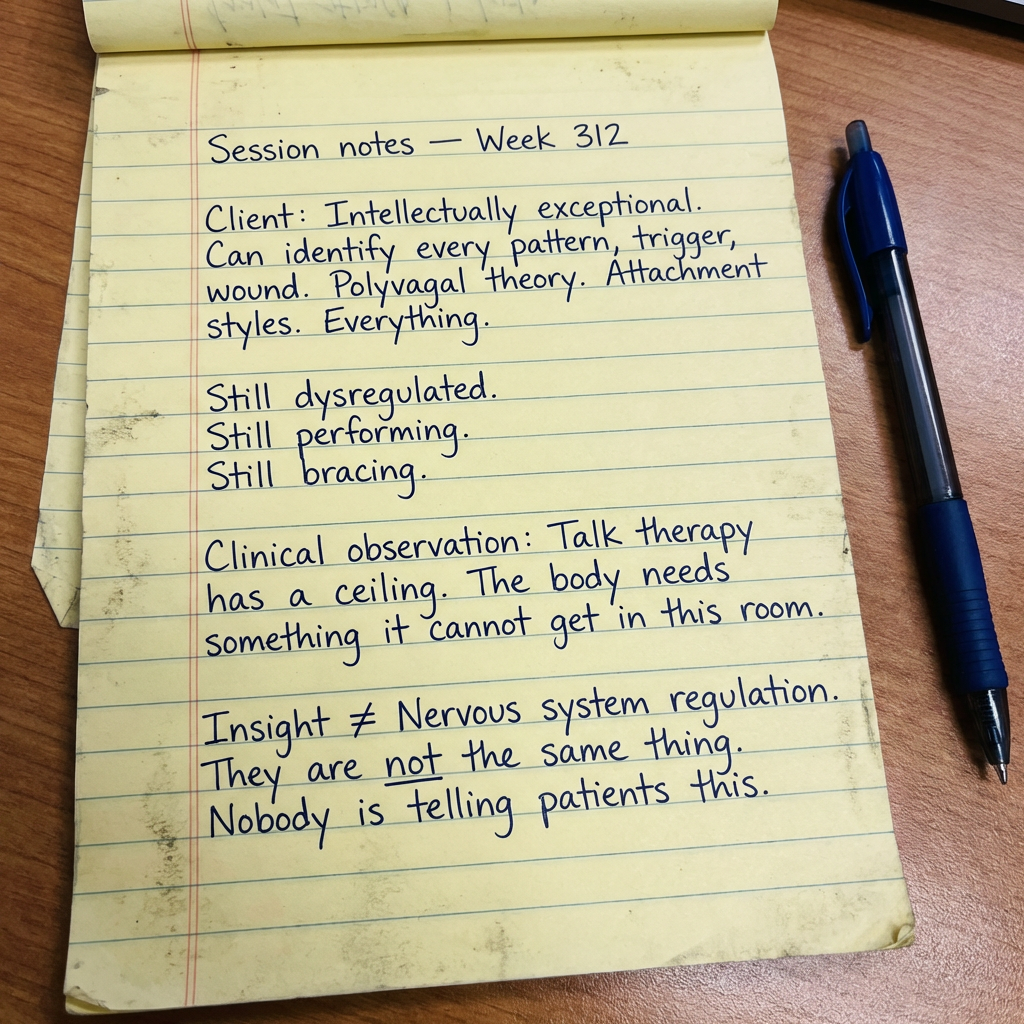
When a woman has been in therapy for years and still doesn't feel better, we tell her healing isn't linear. We tell her she needs more time. What we never tell her, what nobody in the therapy world ever says out loud, is that we've been using the wrong tool. I've watched this happen for 22 years. I finally stopped calling it the nature of trauma. My name doesn't matter. My credentials do: I'm a licensed trauma psychologist, private practice since 2003. I work almost exclusively with women who've done everything right. Years of therapy. EMDR. CBT. Somatic work. Breathwork. Meditation. Women who've read every book their therapist assigned. Women who can trace every pattern back to its origin with clinical precision. Women who use words like "hypervigilance" and "parentification" and "disorganized attachment" the way someone uses their own name. And almost none of them feel better. Not meaningfully. Not in the way that was supposed to come after all the work they'd done. For the first fifteen years of my career, I thought this was a patience problem. That integration was slower than insight and we just needed more time. Keep processing. Keep excavating. The relief will come. It didn't come. And then I started noticing something I couldn't explain away. The same women kept showing up in my office. Not because they'd regressed. Not because something new had happened. Because the understanding they'd built, real, hard-won, sometimes genuinely beautiful, was sitting completely untouched by whatever the body was still doing. They knew exactly why they couldn't sleep. They still couldn't sleep. They knew exactly why they moved through the world braced. They were still braced. They had the most complete map of themselves I've ever seen. The territory hadn't moved. I started asking why. Here's the best way I can describe what I found. Imagine your house caught fire years ago. The fire's out. It's been out for a long time. But the smoke detector is still going off. Every day. Constantly. Therapy walks you into the house and explains exactly how the fire started. What it was made of. What it burned. What the smoke meant. After enough sessions, you could teach a course on it. You understand the fire better than almost anything in your life. The smoke detector keeps going off. Because the smoke detector isn't listening. It isn't connected to your understanding. It's connected to something else, the part of you that learned, early, that the world required constant readiness. And that part doesn't speak language. It doesn't update when you gain a new insight. It doesn't update when a session finally cracks something open. It updates on one thing only: evidence. Accumulated. Repeated. Embodied. Evidence that the fire is actually out. Insight-based therapy, all of it, CBT, talk therapy, EMDR, standard journaling, speaks to the prefrontal cortex. That's where language lives. That's where your four years of therapy live. It never reaches the alarm system. That's where survival lives. The bracing. The vigilance. The 3am. The wide-awake that has no explanation. The grip that doesn't loosen no matter how much you understand it. The alarm is what's running the show. And it hasn't heard a single word. I want to be clear about something before I go further. Therapy is not the problem. Therapists who prescribe insight-based work are not doing it wrong. Understanding is the correct first step. It's necessary. It's real. It does things nothing else can do. But understanding why you're wounded is not the same as letting the wound close. You keep revisiting it. Analyzing it. Explaining it. And the wound stays open, not because you aren't trying, not because your therapist isn't skilled, but because revisiting and releasing are two completely different events and we've been treating them as one. Insight is step one. It was always only step one. What nobody in the therapy world has ever told you, because nobody built the tool that made it possible to say, is that there is a step two. A step that reaches the part of you that insight has never once reached. A step that was missing from every tool you've ever been handed. Here's what I now understand about the gap between knowing and feeling. There are four specific things happening in the nervous system of a woman who's done years of therapy and still doesn't feel better. All four are running in your body right now. The understanding system and the alarm system don't speak the same language. In 2012, a research team at Maastricht University ran a simple experiment. They told people, explicitly, truthfully, that the thing they'd been afraid of was over. The shock wasn't coming. The threat was gone. Their conscious understanding vanished the threat completely. Their startle response didn't move. Four years later, a team at Columbia confirmed it at the neural level. Instructed knowledge, being explicitly told something, understanding it completely, reshapes the cortex and the regions involved in conscious learning. But not the amygdala. The amygdala sat unchanged. Untouched. Still firing. This is not a theory. It is "insight isn't integration" in a controlled lab setting, replicated, in print. You can know everything there is to know about what happened to you. The alarm system gets none of it. Understanding is not evidence. It has never been evidence. And the alarm system only accepts evidence. Every time you revisit the wound without releasing it, you train the alarm system to stay on guard. When you go back into the story in session, when you process, explain, articulate, the alarm system doesn't distinguish between remembering and experiencing. It reads the re-activation as a signal that the threat is current. You get more fluent in the wound. You don't get more distance from it. The more precisely you can describe the fire, the more convinced your alarm system is that the fire is still burning. The understanding system is already full. After years of therapy, reading, and self-reflection, there is no more room for insight. Every new framework, every reframe, every piece of clarity is delivered to a system that is saturated. Adding more understanding doesn't close the gap between knowing and feeling. It widens it. The tank is full. The car isn't moving. Not because you haven't worked hard enough. Because the understanding was never what was supposed to move it. Nothing has ever given the body graduated evidence it's safe. This is the one that changes everything. The alarm system updates on exactly one kind of input: repeated, survivable contact with what feels threatening, in doses small enough that the body doesn't flood and lock down. Not one breakthrough session. Not one cathartic realization. Accumulated evidence, built incrementally, that the threat is not current. That you can feel this without it overtaking you. No insight tool delivers this. No gratitude journal delivers this. No reflection exercise delivers this. The body has been waiting its entire life for this specific input. Nobody built a tool that delivers it. All four. Simultaneously. All four caused by the same thing: every tool she's ever been handed was aimed at the understanding system. None of them were aimed at the alarm. Take all four away and the alarm has no reason to keep firing. The body does what it was designed to do. It stands down. Right now you're probably thinking: I've journaled before. It helped a little. Then it stopped. I've had this conversation more times than I can count. Here's what standard journaling does. It asks you why. What are you grateful for. What made you feel this way. What do you want to release. Every prompt is aimed at the understanding system. You write true answers. You feel briefly seen, by yourself. And then the next morning, the dread is back. The wide-awake is back. The brace is back. Because you were writing to the cortex. The cortex already had the answers. The answers were never the problem. The alarm system doesn't read your journal. It reads whether the contact was survivable. It reads whether you came back. It reads whether you showed up tomorrow and nothing terrible happened. Standard journaling gives insight to the part of you that's already full of it. It doesn't deliver the one input the alarm system actually accepts. This is why every journal you've tried felt like it was working and then stopped. Not because you weren't consistent enough. Because the tool was aimed at the wrong place. There's a lineage of researchers, most of them from before the modern therapy industry existed, who understood this gap before it had a name. Pierre Janet, working in Paris in the 1880s, distinguished between what he called the "narrative memory" and what he called the "traumatic memory." Narrative memory responds to language. It updates when you understand something. Traumatic memory, he wrote, "acts like a parasite." It doesn't integrate through understanding. It integrates through graduated contact with the experience, in conditions that allow the body to process rather than re-live. He wrote this in 1889. It took a hundred years for the rest of the field to catch up. W.H.R. Rivers published in The Lancet in 1918, treating shell-shocked soldiers in Britain. He found the same thing. Men who could explain their trauma in complete detail, who understood exactly what had happened and why it had affected them, were still waking screaming. The understanding was intact. The alarm was still running. The entire modern insight economy was built in the gap between what these researchers found and what was profitable to build. Talk therapy is profitable. Apps are profitable. Gratitude journals are profitable. All of them deliver understanding to the system that already has it. None of them were built to deliver what Janet and Rivers identified 130 years ago: graduated, embodied evidence that the threat is not current. I spent eighteen months looking for the tool that delivered it. A tool a woman could use at her kitchen table, without a therapist present, in doses her system could tolerate. Something sequenced, because order matters. Something with no date, no streak, no performance required. I found one. And I gave it to every client who would take it. Carol. 61. Retired school principal from Eugene, Oregon. Thirty-four years of carrying other people's emergencies. Eleven years of therapy. Could describe her childhood wound with clinical precision. Still couldn't make it through dinner without scanning the room. A few weeks in, she'd spent twenty minutes in a grocery store and realized, walking out, that she hadn't once clocked the exits. She texted me that evening: "I almost didn't notice because I was just there." By month two, her daughter called. "My mom seems different. Not happier. Just here." Carol told me she'd spent eleven years understanding why she couldn't be present. The journal didn't explain it to her. It just gave her back the room. Margaret. 63. Licensed clinical social worker, Atlanta. Thirty-one years of teaching other people how to come down from a hard day. Prescribed every tool in the trauma toolkit. Spent every evening white-knuckling through the vigilance she'd been carrying since she was seven. "I'm the person people call when they can't regulate," she told me at intake. "I have never in my life been able to do it for myself." A few weeks in, the dread she'd stopped noticing, the background weather of her life, went quiet. Not gone. Quiet. She stopped reaching for the glass of wine she'd been using to come down. Not a decision. A noticing. By month two she came home from a hard session and found herself okay. Present. "I thought I was constitutionally incapable of it," she told me. "Turns out I just needed a tool built for the right thing." Linda. 57. Phoenix, Arizona. Her husband died sixteen months ago. She knows all five stages of grief. She used to teach them. She knows exactly what her system is doing when she wakes at 4am and reaches across the bed. "I have a master's degree in what I'm going through," she told me. "It doesn't help at all." Early on, instead of lying in the dread of the 4am, she started writing, not about him, not about the grief, but about what she felt in her body at that moment. "For the first time it felt like I was doing something with it. Instead of just surviving it." By month two, her sister called me: "Linda's back. Not healed. Back." Linda told me: "I always knew grief was a process. I just didn't know there was anything you could actually do with your hands." Here's something no one has ever said to you. The fact that therapy helped, the sessions that cracked something open, the reframes that landed, the moments where something in your story finally made sense, that's proof. Real proof. Not of the journal. Of the mechanism. Those moments worked because they reached the understanding system. The system was ready. The insight landed. What couldn't happen in that room, not because your therapist wasn't skilled, but because of what the therapeutic hour is structurally capable of delivering, is graduated, repeated, survivable contact that accumulates into evidence. That's not a failure of therapy. It's a limit of any tool built for understanding. Therapy got you to step one. Completely. Correctly. Everything you know about yourself belongs to that work, and it was worth doing. The journal is step two. And you cannot reach step two from inside step one. But you can take it from exactly where you are, with everything therapy gave you, and finally give the body the input it's been waiting for. Let me explain what actually has to happen for the alarm to stand down. Because this is where every other tool has broken the chain. Graduated exposure is the first link. The contact has to be survivable, small enough that the alarm system doesn't flood and lock down. Most journaling prompts aren't graduated. They go directly at the wound. The alarm slams shut. The pen goes down. You call it not being ready. You weren't not ready. The dose was wrong. Survivable contact is the second link. The body has to experience what it's been holding, not analyze it, not explain it, and come through the other side without shutting down. That's one unit of evidence. One survivable contact. The first prompt has to do nothing more than that. Repeated contact is the third link. The alarm system doesn't update on a single session. It updates on accumulation. The second prompt says: you survived that. The fifth says: you keep surviving. The thirtieth says: nothing terrible happened. You don't tell the alarm you're safe. It figures that out from the pattern. The evidence update is the fourth link. This is what the body has been waiting its entire life for. Not understanding. Evidence. Accumulated, specific, embodied evidence that the threat is not current. That you can feel this without it overtaking you. That you can stand down. This is the only input the alarm accepts. Nothing else moves it. All four links. In order. Skip graduated and the alarm floods. Skip survivable and the contact confirms the threat. Skip repeated and you get one quiet morning and then back to the dread. Skip the evidence update and you get insight, which you already have more of than you know what to do with. You have tried tools that broke the chain at the first link. You have tried tools that had no chain at all. That's why they felt like they were working and then stopped. The Back to You Journal is 365 sequenced prompts. Not prompts that ask why. Prompts that create graduated contact, each one calibrated to be survivable, each one building on the last, each one aimed not at your understanding but at the part of you that has never once been consulted. No streak. No date. No gratitude bypass. No shame for skipping. No audience. You don't have to do it in order. You don't have to do it every day. The sequencing is built in. Each prompt sits where it does because of what comes before and after it. Your body doesn't need your discipline. It needs your presence. This was built for that. The opening page says: "You don't have to do this perfectly. You just have to show up." That isn't encouragement. That's the instruction. Because this only works if the body learns that showing up is survivable. And it learns that one day at a time, one prompt at a time, with nothing required of it except being there. I've given this journal to 214 clients over the past eighteen months. Eleven didn't see results worth calling meaningful. Some relief. Nothing they'd describe as a shift. The other 203 didn't report breakthroughs. That's important. Breakthrough is a cortex experience, sudden understanding, a moment of clarity. What they described was quieter. Slower. Things going missing that they hadn't realized were there. The dread that had been background weather, going quiet. The 4am becoming something they could do something with instead of just survive. The wide-awake starting to lift. The grip they couldn't explain starting to loosen, not because they understood it better, but because the body had finally gotten enough evidence that it could let go. Integration moments. Not transformation moments. That's exactly what they're supposed to be. And every single one of them almost didn't try it. "It's just a journal. I've tried journals." Yes. And I prescribed journals for fifteen years. Standard journals, reflection journals, gratitude journals, therapy homework journals. This is not that. The difference is what the prompts are aimed at, in what order, at what dose. It was never built to deliver more insight to the part of you that already has too much of it. It was built to deliver what insight never could. The Back to You Journal is $39.95. One time. No subscription. Consider what you've likely already spent. A single therapy session runs $150 to $250, out of pocket. Many of my clients have been in therapy for five, seven, ten years. That's not money wasted, that's step one, and it was necessary. But at once or twice a week for five years, that's between $39,000 and $130,000 in understanding that hasn't yet reached the body. $39.95 is less than a single session. For 365 prompts aimed at the one step insight never could take. You don't have to stop therapy. Most of my clients use the journal alongside our work together. Therapy gives them the map. The journal teaches the body how to walk the territory without bracing. But you don't have to be in therapy for this to work. You just have to be tired enough of understanding your pain to finally try something that's aimed at releasing it. If it doesn't feel different, not healed, not fixed, not transformed, just different, you don't pay. Full refund. Not the kind where you fill out a form and wait six weeks. You reach out and you get your money back. No fight. This isn't a hedge. I've tracked 214 women through this journal. I know what it does. The guarantee exists because it works, and because you have already bought enough things that didn't. The downside: it doesn't work, you get every penny back, and you're exactly where you are right now, with everything you've always known. The upside is what Linda's sister meant when she called me from Tucson and said: "She's back. Not healed. Back." Women who've done the work deserve to feel it. You've earned every insight you're carrying. You've read the books, done the sessions, sat with the hard things year after year. You did all of that. And it brought you to the edge of something you've never quite been able to cross. Not because you haven't tried hard enough. Because nobody told you there was a step two.
Where the ad sends people
heldhonest.com
You Understand. But Your Body Still Braces.
Held & Honest
Learn more: heldhonest.com(opens in a new tab)