
Inactive· since May 20, 2026
- 114
- days it ran
- 0
- relaunches
Ad copy
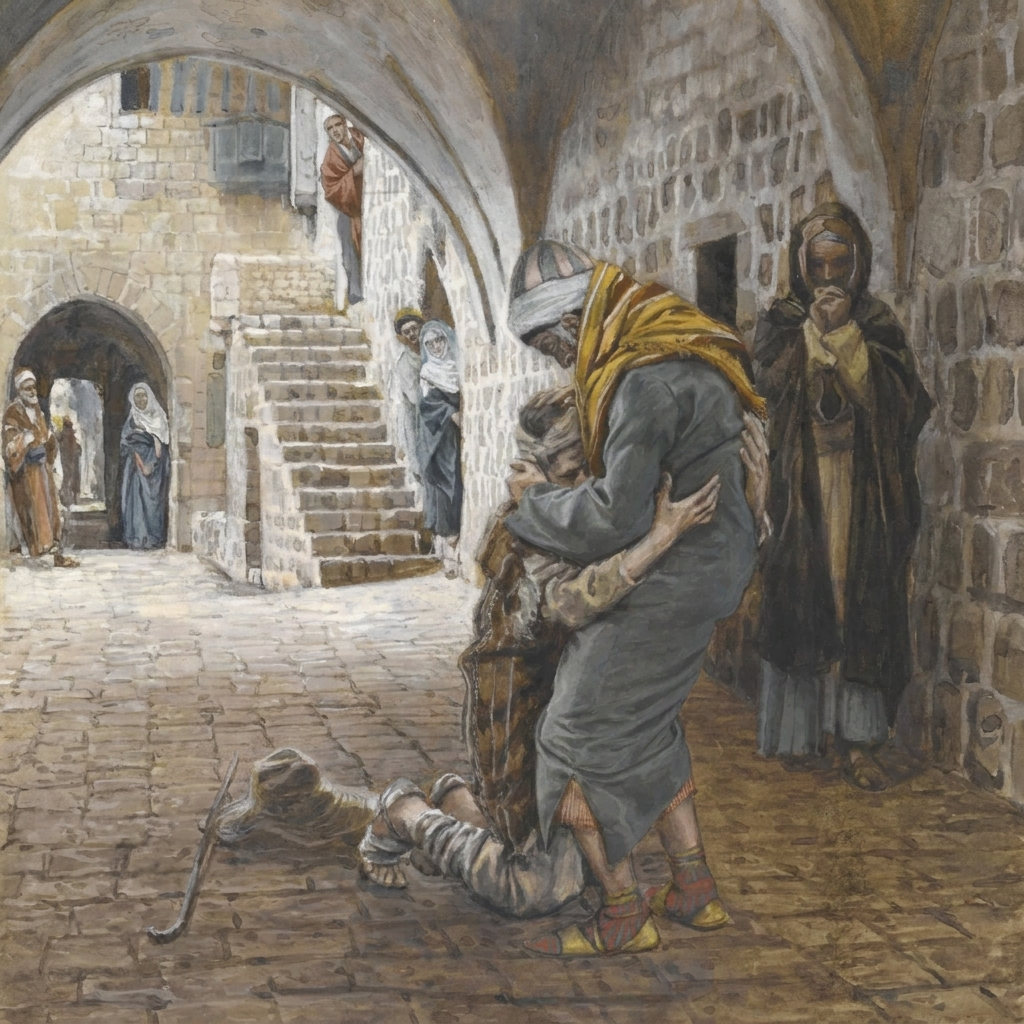
Every Christian knows the Prodigal Son. Almost no Christian has been told that Jesus did not name the story after the son. He named it after the father — and what the father did was the most scandalous act in the entire parable. In Luke 15, Jesus tells the most famous parable in Christianity. The young son who took his inheritance, blew it on wild living, ended up in a pig pen, and came crawling home in shame. Every Sunday school child can recite it. But Jesus did not call it the parable of the Prodigal Son. He called it the parable of a man who had two sons. The story was never about the son. It was about the father. And the father did something in that story that the original audience would have gasped at. To understand what happened, you have to understand what would normally have happened. In first-century Jewish culture, when a son took his inheritance from his living father, it was effectively wishing him dead. "I cannot wait for you to die — give me what is mine now." It was the deepest insult a son could deliver. When that same son returned to the village after wasting his inheritance among Gentiles, the community would perform a ceremony called the kezazah. They would gather at the village entrance, take a clay pot filled with burned nuts and corn, and break it at his feet. The breaking of the pot meant the relationship was permanently severed. The son was officially cast out from his family, his village, and his people. Forever. Everyone in the audience listening to Jesus knew this. The son in the parable was walking down the road expecting it. That is why his rehearsed speech included "make me as one of your hired servants" — he was not asking to be a son again. He was asking only not to starve. He knew the pot was going to break. But before he ever reached the village, his father saw him. Luke 15:20 says: "But while he was still a long way off, his father saw him." A long way off. Meaning the father had been watching the road every day for an unknown number of years. And the moment he saw him, the father did something culturally unthinkable. He ran. In ancient Middle Eastern patriarchal culture, a wealthy father never ran. Running required lifting his robes above his knees, exposing his legs in public. A grown man's bare legs in that culture was a profound act of personal humiliation. The father picked up his robes, exposed his legs, and ran down the road in front of the entire village. Because he knew what would happen when his son entered the village. The villagers were waiting with the clay pot. The kezazah was about to happen. The father ran to reach his son before they could. He absorbed the public shame his son was about to receive. He humiliated himself in front of the entire community so the community would never get the chance to humiliate his son. The father took the kezazah onto himself. When he reached his son, he did not slow down to interrogate him. He did not wait for the apology. He fell on his neck and kissed him before his son could even finish his rehearsed speech. Then he gave specific instructions. The best robe — the father's own. To cover his son's filthy clothes so the village could not see what he had become. A ring on his finger. The family signet ring — the symbol of full restoration to legal sonship. The son who had said "I cannot wait for you to die" was being given the legal authority of an heir again. Sandals on his feet. Slaves walked barefoot. Sons wore sandals. The father was publicly declaring this returning man was a son, not a slave. And the fattened calf. The calf kept for a special occasion. Slaughtering it meant inviting the entire village to a feast. The father was forcing the community to celebrate the son they had been planning to reject. Every detail of the father's response was designed to dismantle the kezazah before it could happen. But the parable does not end there. There is a second son. The older brother. The one who stayed home. The one who hears the music from the celebration and refuses to come in. The father comes out to him too. Twice in the same parable, the father leaves the house and goes out to a son. Once to the runaway. Once to the resentful. The Father went out twice. The older brother represents the Pharisees Jesus was telling the story to. The religious leaders standing in the crowd heard a story in which the villain — the one who could not tolerate the father's grace — was them. This was never the parable of the Prodigal Son. It was the parable of the running Father who went out twice and offered both sons the same welcome. That is what I realized at a men's Bible study one Saturday morning. I have been teaching Scripture my whole adult life. More than 18 years. And last fall I was leading our Saturday morning men's group through a study on the parables of Jesus. We came to Luke 15. One of the men in the group — a father in his sixties named Mark — read the passage aloud. Worked construction his whole life. His son had been in and out of trouble for twenty years. Drugs. Prison. Estrangement. A month before that Saturday, his son had called him from a rehab facility three states away. Mark had driven through the night to be there when his son got out. Mark was reading verse twenty. "But while he was still a long way off, his father saw him and felt compassion, and ran and embraced him and kissed him." He stopped. He lowered the Bible. He sat there with his eyes closed for a long moment. Then he said: "I ran. When he called me from rehab last month. I drove eight hundred miles through the night and ran to him in the parking lot. I knocked over a trash can. I didn't even care." He looked up at me. "Pastor, I didn't know I was acting out this story. I thought I was just being a father." I stood at the front of that room and could not speak. I had been pastoring for 18 years. I had preached the Prodigal Son countless times. And I had always preached it as a story about a son who came home. Mark had just shown me it was a story about a father who ran. The Father in the parable was the same Father who runs to every one of us, every time we turn back toward home. They could not see it. And it was not their fault. Nobody had ever given them the roots. The next morning I opened my computer and started writing. Genesis. Everything someone needs to know before reading Genesis. Who wrote it. When. Why. What was happening. The main themes. How it connects to the larger story. Not a sermon. Not a devotional. Just the roots. Then Exodus. Leviticus. Numbers. Every single book of the Bible. Sixty-six pages. One page per book. It took me three months. Three months of putting 18 years of studying into a format any believer could use completely on their own. No pastor required. I started giving copies to people in my church quietly. One at a time. Mark from the Saturday morning group was one of the first. He read it cover to cover and asked for a copy for his son. Every single person said the same thing. "This is the first time I have ever understood what I was reading." Not because I am some brilliant teacher. But because I finally gave them what they actually needed. The roots. And once you have those roots, the Bible you thought you knew becomes something you have never actually encountered before. Did you know that when Jesus said "It is finished," the Greek word tetelestai was the same word stamped on receipts in the Roman Empire to mean "paid in full"? His final declaration was not a statement of ending but of completion. Did you know that the name Barabbas literally means "son of the father" and that the crowd was given a choice between two men with the same title — the innocent Son of the Father and the guilty son of the father — and the guilty one went free? Context changes everything. Every single time. I call it FaithSprout. The 66 Roots Journey. 66 pages. One for every book of the Bible. Each page gives you what you need before you read. Who wrote it. When. Why. What was happening. The key themes. The symbolism. And how it connects to your actual life today. Written in plain language. No seminary terms. No complicated theology. Just the roots that make everything you have already read suddenly land with the full weight God intended. The Bible is not confusing because it is unclear. It is confusing because we are reading it without the foundation that made it clear to the people it was first written for. The first Christians heard the Prodigal Father parable and understood the kezazah, the running, the robe, the ring, the sandals, the fattened calf, and the older brother. They saw the Father in every detail. We read it as a children's story about a runaway and miss the Father standing at the center of every line. This guide gives you that foundation back.If you have ever read the Prodigal Son without seeing the running Father. If you have ever read a passage of Scripture and sensed there was something deeper underneath the words that you could not quite reach. If you have ever wondered what you would find in God's Word if someone just gave you the roots first. This is what you have been looking for. Jesus did not tell that parable by accident. Do not let a lack of context be the thing that keeps you from seeing the Father who is already running down the road toward you. Get closer to God by actually understanding His Word. Not just the familiar parts. All of it. The whole story. That is what The 66 Roots Journey was created for. And you can start yours by clicking below.
Read this if the Bible feels harder than it should. ☝️
Understand all 66 books of the Bible more easily
SHOP NOWLike this ad? Make it yours.
Crush rebuilds this exact creative around your product — your brand, your colors, your offer — in about a minute.