
Inactive· since May 13, 2026
- 46
- days it ran
- 3
- relaunches
Ad copy
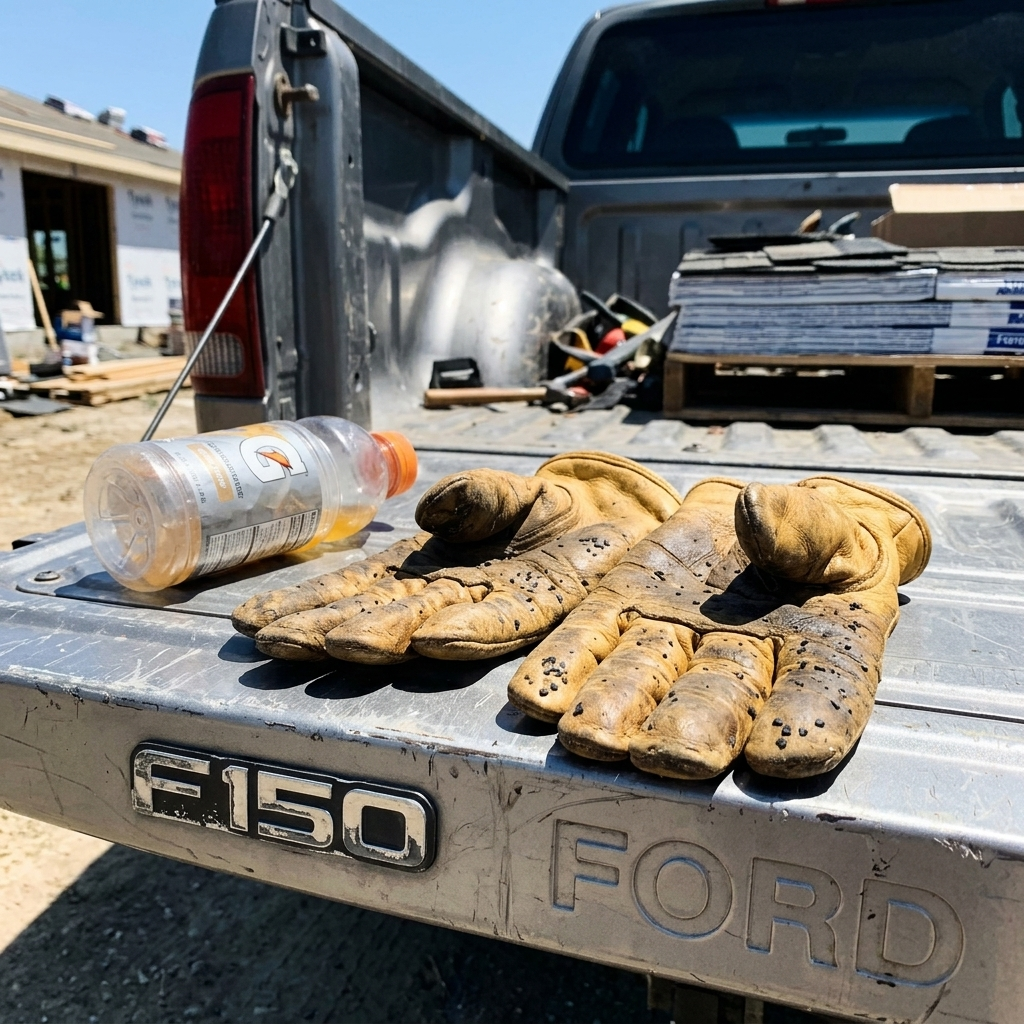
The first time I couldn't get up the ladder, I told my apprentice my back went out. It hadn't. I've torn off probably 800 roofs in my life and I know what a back going out feels like. It feels like someone shoved a knife between your spine and your kidney and twisted. This wasn't that. This was something else. This was my knees forgetting they were knees. My name is Greg. I'm 53. I'm a roofer in Fort Wayne, Indiana, and I've been on roofs since I was 17 years old. My dad was a roofer. His dad framed houses but did roofs in the summer to make extra money. I started Helton Roofing with my brother Dale in 1998 and we've been the guys you call in Allen County when a tree comes down on your garage or the shingles you put on in the 90s finally give up. I'm telling you this because I want you to understand something before I tell you the rest of the story. Roofing is not a job. It's a body. You don't roof for 36 years and have a body left over for other things. You spend your whole life giving pieces of yourself to other people's houses. Your knees go to the pitch. Your back goes to the bundles. Your shoulders go to the nail gun. Your hands go to the heat and the cold and the splinters and the cuts. You know going in that you're trading. You just don't know what the bill's going to look like when it comes due. Mine came due on a Tuesday morning in May of last year, on a tear off in Aboite Township, on a ranch house with a 6/12 pitch and three layers of shingles that had to come off before lunch. My apprentice that day was a kid named Tyler. 22 years old. Been with us about a year. Good kid, dumb in the way 22 year olds are dumb, hard worker, the kind of guy who'd jump off the truck and start tearing into something before I'd even finished telling him what we were doing. We pulled up at 7:15. Tyler dropped the trailer. I went to set the ladder. I want you to picture the ladder. 24 footer. Aluminum. The kind I've climbed maybe 40,000 times in my life. I could climb that ladder in my sleep. I have climbed it half asleep, hungover, with a fever, with a cut on my hand bleeding into my work glove, with my back so locked up I couldn't sit down. I started up. Rung one. Rung two. Rung three. Rung four, my right knee made a noise I'd never heard come out of my body before. It wasn't a pop. It wasn't a crack. It was kind of a wet sound. Like something inside the joint shifting around looking for a place to land. And then my knee just stopped working. Not painfully, exactly. It was worse than that. It just stopped responding. Like the wires between my brain and my leg got cut. I told my knee to bend. My knee did not bend. I told it again. Nothing. I was four rungs up a ladder with my left foot on rung four and my right foot trying to get to rung five and not getting there. I looked down. Tyler was at the bottom holding the ladder, staring up at me with a confused look on his face. I said, "Come up here a second." He climbed up behind me. I told him my back went out. I said I needed help getting down. He believed me because why wouldn't he. We got me down. I sat on the tailgate of the truck for 20 minutes. Tyler ran to the gas station and got me a Gatorade. I told him to call Dale and have him send another guy. I drove home that afternoon with the worst feeling I have ever had in my life sitting in the seat next to me. It wasn't pain. It was a question. The question was: Am I done? I'm going to back up and tell you about the year before, because the ladder wasn't really the moment things broke. The ladder was the moment I had to admit they'd already broken. Things had been going wrong for about 18 months. It started in my hands. I'd be holding a nail gun and my fingers would just kind of seize up around the trigger. Not painfully. Just stuck. I'd have to put the gun down and shake my hand out for a minute and then go back to it. I figured it was the cold. We were in the middle of a January and I was pulling 10 hour days in 22 degree weather. Then it was my shoulders. I'd be carrying a bundle of shingles up a ladder, 80 pounds on my shoulder, and halfway up I'd feel something in my rotator like a wet rope being pulled through a pipe. Not a tear. Something duller. I'd get to the top and have to set the bundle down and roll my shoulder for a minute before I could move. Then it was my hips. I'd be sitting on the ridge of a roof drinking coffee on a break and when I went to stand up, my hips wouldn't unfold. Like they'd locked into the position I was sitting in. I'd have to grab the ridge with both hands and kind of pull myself up like an old man getting out of a recliner. I was 52 years old. 52 is not old. My dad was working roofs at 67. My uncle Bert was on a ladder at 71. The guy who taught me how to swing a hammer, a man named Ralph who passed in 2011, was nailing down shingles at 74 and only stopped because his wife made him. 52 is not old in the roofing world. But my body was acting like 70. I went to my doctor. Dr. Reisman. He's been my doctor since the kids were in elementary school. Good guy. Late 50s. Plays golf. The kind of doctor who listens for about four minutes and then writes something down and tells you to lose weight. I told him about my hands. My shoulders. My hips. My knees, which had started doing the thing where they'd ache for the first 20 minutes of every morning and then loosen up after I got moving. He nodded. He moved my arms around. He pressed on my knees. He had me bend forward and touch my toes. I got down to my shins. He sat back on his stool and said, "Greg, I'm going to be straight with you. You're 52 years old, you've been roofing since high school, and you're paying the bill. There's nothing structurally wrong here. This is wear and tear. This is what 36 years of roofs looks like." I said, "What do I do about it?" He said, "You can take ibuprofen for the pain. You can do some stretching. You can think about getting off the roof and into the office side of the business." He said it like it was nothing. Like he was telling me to switch from a hardback to a softer chair. Get off the roof. I drove home that day in a kind of fog I'd never been in before. Get off the roof. The roof was where I lived. The roof was the only thing I'd ever been good at. My brother handles the books, the bidding, the customer calls. I do the work. I climb. I tear off. I lay down felt. I shingle. I'm the guy on the ladder. Get off the roof was the same as saying get out of your own life. I didn't tell my wife Patty. I didn't tell Dale. I just started taking the ibuprofen. Three in the morning. Three at lunch. Three before bed. Sometimes a fourth set when I got home if my knees were really yelling. For about a month it helped. Took the edge off enough that I could keep moving. Then it stopped helping. The pain came back through the medicine like water through a screen door. So I doubled the dose. Six in the morning. Six at lunch. Six at night. About six weeks into that, my stomach started bleeding. I didn't know that's what it was at first. I thought I had a stomach bug. Then the toilet bowl was black one morning and Patty saw it before I could flush. We went to the ER. They told me I had two ulcers in my stomach. They told me to stop the ibuprofen immediately or I'd be on the operating table inside a year. I stopped the ibuprofen. The pain came roaring back inside 48 hours. Worse than before, somehow, like it had been waiting in the closet the whole time and now it was loose in the house. That's when the ladder thing happened. I'm sitting on the tailgate of my truck in Aboite Township that Tuesday morning, knee not working, Gatorade in my hand, and I'm doing math in my head. The mortgage. The truck payment. Dale's kid is going to Purdue in the fall. Patty's been talking about retiring in five years. We've got a granddaughter, our daughter Megan's little girl Hailey, she's 4 years old and she calls me Pop and I am her favorite person on this earth. How am I supposed to be Pop if I can't pick her up? How am I supposed to take her fishing at Cedarville Reservoir like I told her I would, when I can't kneel down to bait the hook? How am I supposed to walk her down the aisle if she ever gets that far, when I can barely walk to the mailbox without my knees burning? I sat on that tailgate for 20 minutes and I felt every year of every roof come down on top of me at once. Then I drove home. I told Patty that night. The whole thing. The hands, the shoulders, the hips, the ladder, Reisman telling me to get off the roof. The ulcers. The math. She didn't say anything for a long time. She got up and made me a sandwich and put it in front of me. Then she sat down across from me at the kitchen table and she said something that's stuck with me. She said, "Greg, you need to stop trying to bandage this. You need to figure out what's actually going on inside you." I didn't know what she meant. I don't think she knew what she meant either. But the sentence stuck. Two weeks later, our neighbor Kenny came by to borrow the pressure washer. Kenny is 56. Lives three houses down. He used to work at the GM plant in Roanoke before they shut it down. After the plant closed he started a small landscaping operation, mowing yards and doing fall cleanups for the neighborhood. He has hands like leather and a permanent farmer's tan and a Chevy with 230,000 miles on it. I was on the porch when he came up the driveway. I was sitting because standing too long made my hips lock. He came up the steps and stopped on the second one and looked at me. He said, "You look terrible." I said, "Thanks, Kenny." He sat down on the step. He said, "What's going on with you?" So I told him. Most of it. Not the part about Hailey. The rest of it. Kenny listened. He pulled a piece of dried grass out of his pant cuff and rolled it between his fingers while he listened. When I was done he said, "Greg. You remember the year I couldn't get out of my truck?" I did remember. About four years ago Kenny had a stretch of about eight months where he was in real bad shape. Knees. Shoulders. Back. He'd be sitting in his truck at the end of a job and his wife would have to come out to the driveway to help him get the door open and his legs out. I'd forgotten about it because Kenny had been fine for years now. Mowing his yards. Climbing in and out of the truck like a 30 year old. I said, "Yeah. What happened? You ever figure that out?" He looked at me and said, "My wife's sister sent me something. From India, originally. Some kind of berry." I almost laughed. A berry. I'm sitting there with two ulcers and knees that won't bend and Kenny is telling me about a berry. He saw the look on my face. He said, "Greg. I'm telling you. I was where you are. I was about to sell the truck and the mower and the trailer. I was looking at signing up for a desk job at the Lowe's in Jefferson Pointe. My wife's sister, Linda, she lives outside of Indianapolis, she'd been on this stuff for about a year for her own joint problems and she sent me a bottle. Said try it for two months. If nothing changes, throw it out." I said, "And?" He said, "Eight weeks in, I was back in the truck. Twelve weeks in, I was mowing again. I've been on it three and a half years now. I'm 56 years old and I climbed a 12 foot ladder yesterday to clean Mrs. Henderson's gutters and my knees didn't say a word." He told me what it was. Amla. Spelled it out for me. Said it was Indian gooseberry, said the same berry had been used in traditional medicine for thousands of years, said his sister in law had told him it was one of the most studied fruits in the world that nobody in America has ever heard of. He said the brand he took was called Alevia. Said his sister in law had switched to it because the bottle was sourced and tested in the U.S. and the company had a money back guarantee. He left the pressure washer cleaner than I expected and he walked back down the driveway and I sat on the porch for another hour thinking. That night I got on my laptop after Patty went to bed. I'm going to tell you what I learned because nobody at Reisman's office ever explained any of this to me, and I think for guys like me, guys who've been told it's wear and tear and aging and there's nothing structural wrong, this stuff matters. The thing they don't tell you about joint pain is that the joint isn't the whole story. The joint is where you feel the pain. But what's causing the pain is mostly happening at a level you can't see, in the cells that surround the joint and the tissues that connect the joint to everything else. There are two big drivers. The first is inflammation. Not the kind of inflammation you see when you sprain your ankle and it puffs up. The other kind. The quiet, chronic kind that lives in your tissues for years and slowly grinds you down. Inflammatory signals running through your body all day every day, irritating cartilage, irritating tendons, irritating the lining of the joint capsule itself. You can't feel it directly. But you feel its effects. Stiffness in the morning. Aches that don't quit. Joints that lock up after you sit too long. Hands that won't unclench. The second is oxidative stress. The fancy way of saying your cells are getting rusted. Free radicals are produced naturally by your body, but as you age, especially if you've been hard on your body for decades, the rate of damage outruns the rate of repair. Cartilage cells take the hit. Tendon cells take the hit. The synovial fluid that's supposed to lubricate the joint thins out. The whole system starts running rough. What ibuprofen does is shut down one inflammatory pathway. It works in the short term. But it doesn't do anything about the oxidative damage. And it tears holes in your stomach lining as the price of admission, which is how I ended up with two ulcers. Amla is interesting because it works on both sides of the problem. It's been studied for a long time as one of the most concentrated natural sources of antioxidants on earth. Loaded with vitamin C, polyphenols, tannins. The kind of compounds that have been linked to quieting oxidative stress at the cellular level. It's also been associated with supporting a healthy inflammatory response in the body. Not by shutting down inflammation entirely, which is what ibuprofen does. By helping the body's own systems regulate the inflammatory signaling more naturally. What that translates to in plain English is that Amla has been linked to supporting joint comfort, supporting connective tissue, and supporting the cellular environment that keeps your knees bending and your hands gripping and your shoulders moving. I read about it for three nights straight. Down the rabbit hole. Studies from India. Studies from Europe. Reviews in mainstream medical journals. The information was just sitting there. Nobody had ever told me about it. Not Reisman. Not the ER doctor who told me to stop the ibuprofen. Not a single person in 36 years of working a body to the bone. I ordered a bottle of Alevia Amla on a Friday night. It came the following Wednesday. Two capsules with breakfast. That's it. The first two weeks I was honestly waiting for nothing to happen. I'd been let down by enough things at that point that I was already planning on returning the bottle. Week three, something changed in my hands. I noticed it on a Monday morning, getting dressed. Buttoning my shirt. The buttons used to be a small daily fight. That morning I just buttoned my shirt and walked out of the bedroom. I didn't realize I'd done it until I was halfway through breakfast. I told Patty. She said, "Don't jinx it." Week five, the morning stiffness in my knees got shorter. Used to be 20 minutes of walking it off before I felt human. Then it was 15. Then it was 10. Week seven, I climbed a ladder. I want to tell you about that ladder because it's the moment my life pivoted. It was a small job. A neighbor down the street, Mrs. Cordova, asked me to look at a leak around her chimney. I told Patty I was just going to look. I drove over with Tyler. I was honestly going to climb up two rungs, take a picture with my phone, and come back down. I went up two rungs. Then four. Then six. Then I was on the roof. I walked the perimeter. I crouched down at the chimney flashing. I crouched down. My knees bent. They bent without complaining. They bent like I was 35 years old. I sat down on the ridge of Mrs. Cordova's roof and I looked out over the neighborhood and I cried. Tyler was at the bottom of the ladder. He didn't see me. I'm glad. I came down the ladder one rung at a time, slow, the way I'd been coming down ladders for two years, but my knees weren't yelling. My hips weren't locking. My shoulders weren't burning. I came down a ladder like a man. That was nine months ago. I'm still on the roof. I picked up Hailey at her preschool last Thursday. She runs at me when I come into the lobby and I scoop her up and put her on my hip and walk out to the truck. I haven't done that in three years. Megan watched me do it and she got quiet in the kind of way mothers get quiet when something they didn't think would happen happens. Patty asked me on Sunday if I was thinking about retiring early. I said, "Patty, I just got back to work." I want to say one more thing. There's a particular kind of feeling that comes with being a man who works with his hands and starts losing them. It's not just the pain. It's the identity. You spend your whole life being the guy who can fix it, lift it, climb it, carry it. And then one day you're standing four rungs up a ladder and your knee won't bend and you realize you're becoming somebody you don't recognize. Somebody who needs help. Somebody who watches. That's worse than the pain. I lost about 18 months to that feeling. I don't get those months back. I don't get the day Hailey wanted me to lift her up onto the kitchen counter to help bake cookies and I had to tell her Pop's back hurt. I don't get the day my brother had to take a job I should have been on because I couldn't climb the ladder. But I get the rest. And if you're a roofer or a plumber or a mechanic or a framer or anybody whose body is the tool you use to feed your family, and your knees are starting to talk to you in the morning, and your hands are starting to seize up, and your doctor is telling you it's wear and tear and to think about a desk job, I want you to know there's another way to think about this. The pain in your joints isn't the whole story. The story is the inflammation and the oxidation that's been quietly running through your body for years while you were giving everything you had to other people's houses. Alevia Amla supports the system that's supposed to keep that under control. Two capsules a day. 90 day money back guarantee. If your body doesn't tell you something is different inside two months, you send the bottle back and you don't pay a dime. Kenny told me to try it for two months. I'm telling you the same thing. You traded a lot for the work you do. It doesn't have to be the trade you thought it was. 👉 alevia.com/amla/33 P.S. Tyler is on the roof beside me again. He never asked me what really happened that day in Aboite Township. I think he knew. He's a good kid. I told him on a roof in Huntington a couple weeks ago, both of us sitting on the ridge eating a sandwich, what had actually been going on. I told him about the berry. He laughed. Then he stopped laughing. He told me his dad, who's a millwright in Decatur, has been having the same kind of year I had. Hands. Shoulders. Hips. He asked me to write the name down for him. I wrote it on the back of a Helton Roofing card and he put it in his wallet. He texted me last week. His dad's been on it three weeks. His dad walked the dog Saturday morning for the first time since November. P.P.S. The 90 day money back guarantee is what got me to try it and it's what I want you to think about. When Reisman told me to take ibuprofen and the ibuprofen tore holes in my stomach, nobody offered me a refund on the ulcers. When I lost 18 months of work to a body that quit on me, nobody offered me a refund on the months. The supplement aisle at Walgreens doesn't offer refunds. Doctors don't offer refunds. The only people I've ever found who offer to refund a thing that doesn't work are the people who actually believe in what they're selling. Try it for two months. If it doesn't move the needle, send it back. You're risking nothing. I risked 18 months. Don't do that. P.P.P.S. If you're a tradesman and you've been quietly thinking about getting off the tools, if you've been telling your wife your back is fine when it isn't, if you've been letting the younger guy on the crew do the work you used to do, if you've been sitting in the truck at the end of the day for an extra ten minutes before you can stand up, this is what I want to tell you. You traded your body for your work. You don't get to undo the trade. But you might be able to renegotiate it. Two capsules. A glass of water. A small green berry from a tree on the other side of the world. 36 years of roofs. A 4 year old granddaughter who calls me Pop. A ladder I climbed last Thursday on a tear off in New Haven, all the way up, no help, no story to tell my apprentice. That's the renegotiation. That's what's available. 👉 alevia.com/amla/33
Like this ad? Make it yours.
Crush rebuilds this exact creative around your product — your brand, your colors, your offer — in about a minute.