
Inactive· since Apr 23, 2026
- 60
- days it ran
- 0
- relaunches
Ad copy
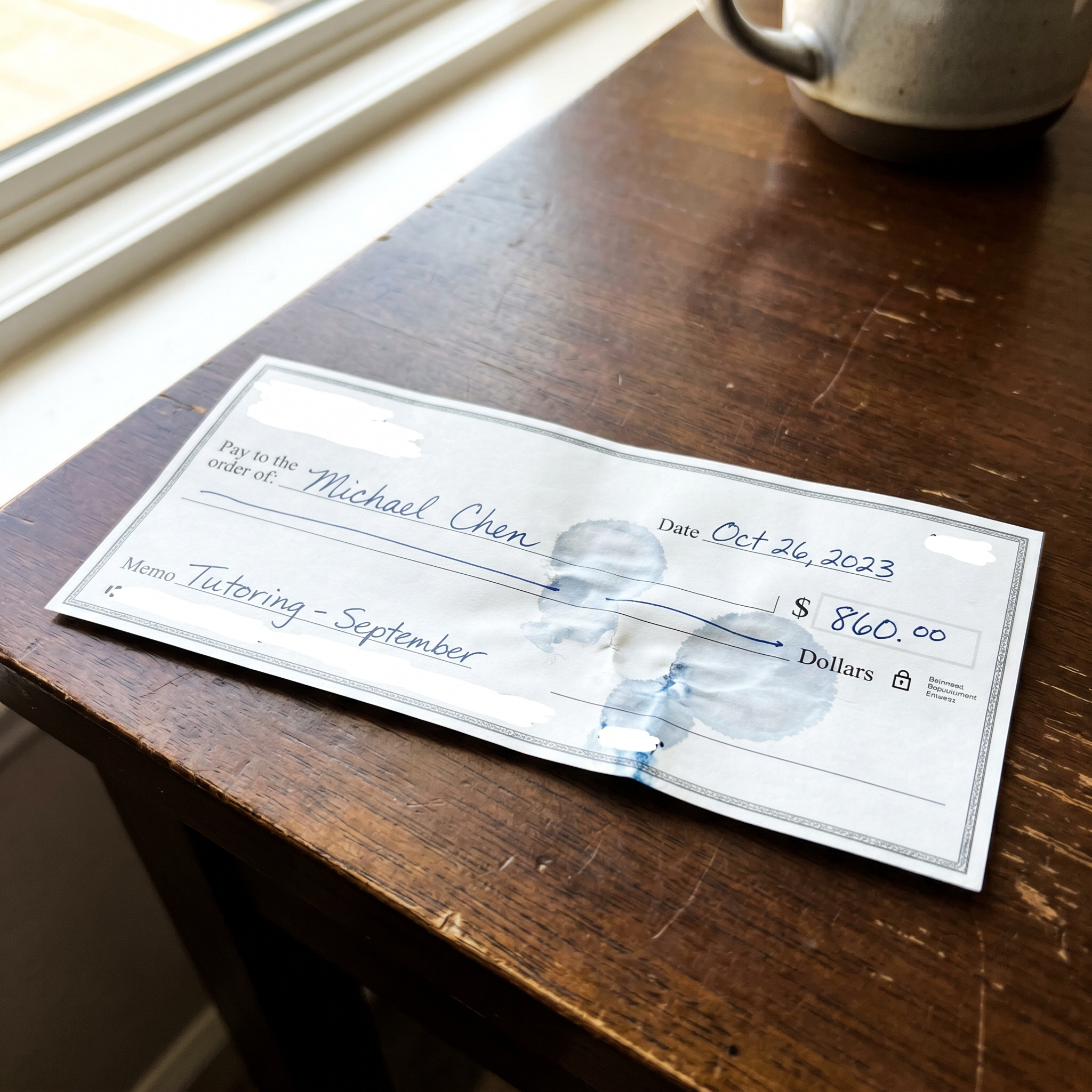
I've been a private tutor for 8 years. Last Tuesday I asked my client's 10-year-old son a simple question: Why do things fall down instead of up? His parents pay me $720 a week. That's $17,280 a year. And their son still can't think through why things fall down for thirty seconds. My name is Mike. I've been tutoring children for 8 years. Most of my clients are professionals. Doctors. Business owners. Tech workers. People who can afford to pay someone to make sure their kids don't fall behind. They pay me $180 per session. Twice a week. Forty-eight weeks a year. $17,280 per year. Per child. That's what they invest to keep their children ahead. Last Tuesday I was at the Mitchells' house. Their son Connor is 10. Straight A's. Private academy. Advanced math. Reading four grade levels ahead. His parents are proud. I sat down across from him for our session. Before we started the planned material, I asked him something simple. Not a memorization question. A thinking question. "Connor, why do things fall down instead of up?" He looked at me. "Gravity." "Right. But WHY does gravity pull things down? What is gravity actually doing?" Seven seconds of silence. Then: "I don't know. Does that matter for the test?" I sat back. $17,280 a year. Two years of tutoring. Connor could solve complex equations. He could diagram sentences. He knew the capitals of countries I couldn't find on a map. But he couldn't think about why things fall down for thirty seconds. I looked at the iPad on the table. Latest model. $1,200. I looked at the shelf behind him. Every educational subscription. Every learning app. Thousands of dollars. Everything his family had invested to make Connor smarter had made him better at performing intelligence. Not practicing it. That night I went to my brother's house for dinner. My brother Tom is a plumber. His son Danny is 9. Public school. Hand-me-down clothes. One iPad shared between three kids. Tom used to apologize for not being able to afford tutors. I was sitting at their kitchen table when Danny came in from school. He put his backpack down. Looked at me. "Uncle Mike, I've been thinking about something. If gravity pulls everything down, why doesn't the moon fall into the Earth?" I stopped mid-sip of coffee. "What do you think?" "I think it's because it's moving sideways so fast that it keeps missing. Like if you throw a ball really hard it goes far before it hits the ground. The moon is going so fast sideways that by the time it would hit the Earth, the Earth has curved away underneath it. So it just keeps falling around the Earth forever." I stared at this 9-year-old in public school. He'd just explained orbital mechanics. Connor couldn't explain why things fall down. "Where did you learn that?" Danny shrugged. "A book Grandma got me for my birthday. It explains why everything works. We read two pages every night before bed." He ran to get it. 100,000 Whys. Tom said: "My mom bought it for his birthday. Forty-five dollars. Best thing anyone's ever gotten him. He doesn't even ask for the iPad anymore. He wants to understand things." I looked at that book. $45. I had clients paying me $17,280 a year. And this $45 encyclopedia was doing what I couldn't. It was teaching children how to think, not just what to know. Monday morning I brought it to the Mitchells'. I put it on the table. "I want to try something different today." Connor looked skeptical. I opened to a random page. "Why do we have seasons?" "Because the Earth is tilted," Connor said immediately. He'd memorized that for a test. "Right. But WHY does tilt create seasons? Walk me through what's actually happening." He stared at the page. Then he started reading. Not memorizing. Thinking. "Wait. So when the northern half is tilted toward the sun, we get more direct sunlight for more hours. That's summer. But the southern half gets less direct light. That's why it's winter in Australia when it's summer here?" "Keep going." "And six months later the Earth is on the other side of the sun, so the tilt points the other way. The TILT doesn't change. Our position does." He looked up at me. His eyes were different. "That's actually really cool. I never knew that." Week 4: Connor asked his first "why" question without being prompted. We were working on math problems. He stopped. "Mr. Mike, why do ice cubes float? I was thinking about it last night. Solid things should sink. But ice floats." We stopped the math completely. Worked through it together. Molecular structure. Water's weird expansion when it freezes. Density. He sat there reasoning through it out loud for eleven minutes. I'd been tutoring him for two years. This was the first time I'd ever heard him think. Week 6: Connor's mother called me on a Tuesday. "Mike, his science teacher emailed me. She wanted to know what had changed. She said Connor raised his hand yesterday and explained why the sky is blue using wavelengths and atmospheric scattering. She asked if we'd hired a science tutor." I could hear her smiling. "I told her we'd kept the same tutor. But you'd changed your approach." She paused. "Whatever you're doing—thank you. He's asking questions at dinner now. Real questions. About how things work." "Mrs. Mitchell, can I tell you something honestly?" "For two years I've been teaching Connor how to pass tests and get good grades. A forty-five dollar encyclopedia is teaching him how to think. I recommend you keep both. But the book is doing more than I can do alone." Silence. "Forty-five dollars?" Week 8: Connor's father pulled me aside. "I wanted you to know something. Last week Connor asked me a question about my work. I'm a software engineer. He wanted to know why computers need ones and zeros. Why they can't just use regular numbers." He looked at me. "I've worked in tech for twenty years. My son has never asked me how anything I do actually works. We spent an hour at the whiteboard. Drew diagrams. It was the best conversation I've ever had with him." His voice caught. "I've been paying you seventeen thousand dollars a year thinking that was how you build a brilliant child. But he was always brilliant. He just needed permission to wonder." Last month I did something I've never done. I sent an email to all my clients. Told them about the encyclopedia. Told them it wasn't a replacement for tutoring. But it was teaching their children something I couldn't teach in a $180 session. How to be curious instead of just correct. I have 14 active clients. Eleven have ordered it. Eight have called me within six weeks. Every single one said something changed. Not grades. The child. One grandmother called me crying. She'd been paying for her grandson's tutoring. $860 a month for a year. She said: "I bought him that book you mentioned. Forty-five dollars. Last Sunday he explained ocean currents to me for twenty minutes. He'd never explained anything to me before. I've been spending nine hundred dollars a month. A forty-five dollar book did what all that money couldn't." A smart kid isn't one who knows the most facts. A smart kid is one who knows why the facts are true. If you've invested thousands in their education and realized you've built a performance instead of a mind... I need you to know something. The tutoring isn't failing because your child isn't smart enough. It's failing because your child has been trained to perform intelligence instead of practice it. Between ages 6 and 13, children's brains either build curiosity pathways or skip them entirely. After 13, what wasn't built is very hard to add later. Your child is in that window right now. You can keep paying for tutoring. Many of my clients do. I recommend it. But the encyclopedia costs $45. And it's teaching children to think in ways I can't replicate in $180 sessions. The book that's transforming my clients' children is called 100,000 Whys. Over 200 topics. More than 1,000 illustrated entries. Organized by the questions kids actually ask. Available worldwide. Perfect for ages 6-13. Two pages a night. Fifteen minutes. When I was growing up, encyclopedias were how you learned. Not because you had to. Because you wanted to know. This brings that back. You don't need to choose between tutoring and thinking. You need both. But if you could only afford one, I'd tell you to buy the book. I make my living teaching children. This teaches them something I can't. How to be curious about the world instead of afraid of being wrong. Connor is 10. He has three years before the window closes. I've tutored him for two of those years. The encyclopedia did more in eight weeks than I did in two years. $17,280 a year taught Connor to perform. $45 taught him to wonder. There's a difference.
read this if you have kids or grandkids 👆
INTELLECTUAL ADVANTAGE DAILY Children's Encyclopedia ➡ Children's Intellectual Development Report Top Educator Exposes the "Cognitive Window": Why Most 8-Year-Olds Lose Their Intellectual Edge (And the "Elite Secret" to Getting It Back) By David Sterling, Retired Academy Director April 01, 2026 at...
SHOP NOWLike this ad? Make it yours.
Crush rebuilds this exact creative around your product — your brand, your colors, your offer — in about a minute.