
Active· since Jul 2, 2026
- 77
- days running
- 0
- relaunches
Ad copy
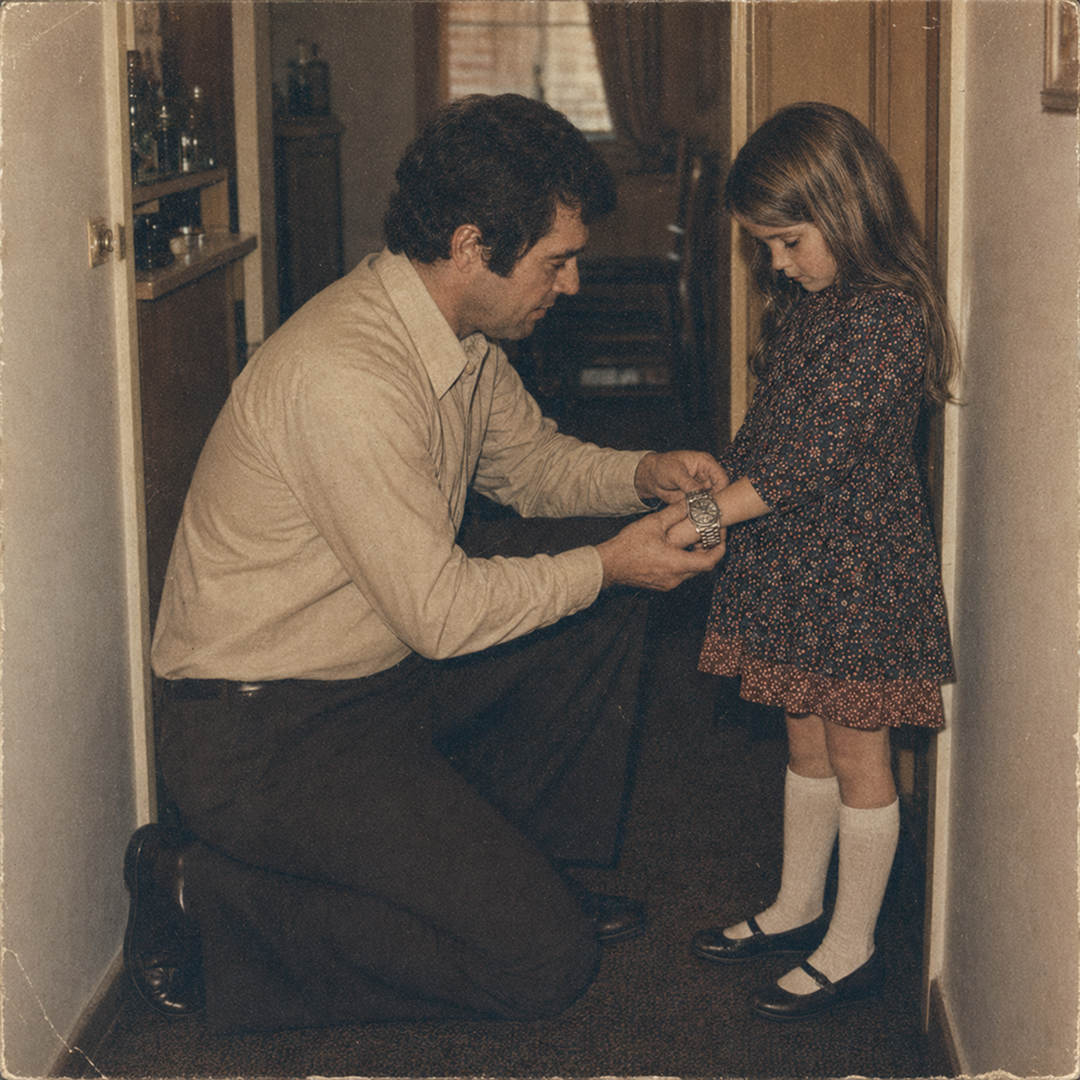
When I was seven, my father knelt down, pressed his watch into my hand, and said, "Hold onto this for me. I'll come back for it." He never did. Fifty-two years later I walked into a pawn shop to sell it. And the old man behind the counter told me why. What he said saved my life. To understand what he told me, you have to know the watch. Silver. Heavier than it looks. Scratched across the face in a way that means someone wore it every day for years. There's an engraving on the back, small, almost worn smooth, that I spent my childhood tracing with my thumb when no one was looking. My mother told me he left. That's all she ever said. She didn't explain. She didn't cry, at least not where I could see. She took his photograph off the mantle and put it in a box in the closet and that box never came out again. I learned early that asking about Thomas Smith was the one thing that could turn my mother's face to stone. So I stopped asking. Kept the watch. Kept it in a drawer, first in my childhood bedroom, then in every apartment I rented in my twenties, then in the nightstand of the house where I raised my own daughter. Fifty-two years in a drawer. I never wore it. Never displayed it. Never threw it away. Just kept it close enough to feel and far enough to ignore. That's a long time to carry something you don't understand. I should tell you where I was when I decided to sell it. I'm 59. My daughter Beth is 32. Single mom. My grandson Liam just turned six. A wild, loud, beautiful boy who runs everywhere instead of walking and asks why the sky is blue at least once a week. And I'd just gotten bloodwork back for the third time in two years that made my doctor frown. A1C: 7.9. Six months ago it was 7.5. Before that, 7.2. A line going in one direction. Fasting glucose was sitting at 168 most mornings. Some days it crept past 170 without me eating a thing the night before. I'd check at 6am with nothing in my stomach since dinner and the meter would read 174, 168, 172. I'd tried. Between every draw, I'd tried. Cut out bread and pasta. Switched to greens and lean protein. Walked three miles every morning before Beth dropped Liam off. Took berberine for six months, the kind everyone in the Facebook groups was talking about, nature's metformin they called it. My fasting numbers came down for about a month, then crept right back up. Like my body had figured out the trick. I tried apple cider vinegar. Magnesium. Cinnamon capsules. The keto thing for almost five months until I couldn't look at another piece of bacon. My fasting glucose kept climbing anyway. My A1C went up. As if my body hadn't gotten the message. Dr. Hendricks pulled off her glasses and looked at me. "Jessica, we've given lifestyle modifications and the natural supplements a fair chance. Your A1C has increased at every draw. I'd like to start you on metformin. The standard starting dose, twice daily." I sat there. I knew this conversation was coming. I'd known it for a year. The way you know a storm is coming when the air pressure drops, not because anyone told you, but because something in your body registers the change before your mind catches up. "What are the side effects?" She listed them. Stomach issues. Fatigue. B12 depletion over time. Some patients get brain fog. The standard speech. "How long would I take it?" "Typically, indefinitely. Metformin works as long as you take it. If you stop, your numbers come right back. Usually higher than where they started." Indefinitely. I told her I wanted more time. She wrote the prescription anyway and told me to fill it when I was ready. I drove home with the prescription in my purse and a feeling in my chest that I couldn't name. Not quite fear. Something older than fear. Something inherited. My father had diabetes. That's the one medical fact I knew about Thomas Smith. My mother mentioned it exactly once. I was fourteen, asking about family health history for a school assignment. "Your father had diabetes," she said. Then closed the subject. Diabetes. And now my A1C was climbing toward a number that would put me on medication for the rest of my life. That night, after Beth took Liam home, I opened the nightstand drawer. Looked at the watch. Picked it up. Turned it over. Traced the engraving with my thumb the way I had a thousand times as a child. And I thought: I'm done carrying this. Fifty-two years. He never came back for it. He never came back for me. Whatever this watch meant to Thomas Smith, it meant nothing compared to what he left behind. I was going to sell it. Use the money to help Beth. She'd been stretching to cover Liam's after-school program, and an extra few hundred dollars would take the pressure off for a month or two. The watch would finally do something useful for someone. There's a pawn shop on Garfield Avenue that I pass on my way to the grocery store. I've driven past it for fifteen years and never gone in. The kind of place with a faded awning and a bell on the door and gold lettering on the window that's been there so long it's flaking. I parked. Sat in the car. Held the watch in my lap. Then I went in. The shop was dim. Dusty in a way that felt permanent. Not dirty, just settled. Glass cases full of rings and bracelets and old cameras. A clock on the wall that was ten minutes slow. Light coming through the front window at an angle that caught the dust in the air and made it look like the room was breathing. There was a man behind the counter. Old. Late seventies at least. White hair combed back. Thick glasses. A cardigan with leather buttons that he'd probably owned for thirty years. He was reading a newspaper, an actual newspaper, folded in quarters, and he looked up when the bell rang. "Help you?" "I'd like to sell a watch." I set it on the counter. He put the newspaper down. Picked up the watch the way people pick up watches in pawn shops. Casually, professionally. Turned it over to check the brand. Held it under the desk lamp. Then he went still. Not the kind of still where someone pauses. The kind of still where everything stops. His hands. His breathing. The way his eyes moved. He turned the watch over again. Found the engraving. Brought it closer to his face. His hands started trembling. "Where did you get this?" His voice had changed. It wasn't the voice of a man buying merchandise. It was the voice of a man who had just seen something he'd been waiting decades to see. "It was my father's." He set the watch down on the counter. Very carefully. Like it was made of glass. Then he reached beneath the counter. Not to the register, not to a drawer full of tools or tags. Further back. To a place he'd clearly been reaching for years. He pulled out a photograph. Old. Creased down the middle. The kind of photograph that's been handled so many times the surface has gone soft. Two men. Younger. Standing in front of this very shop. I recognized the awning, the gold lettering on the window, twenty or thirty years less faded. One of them was him. Thinner. Darker hair. Smiling. The other man was my father. I knew him immediately. Not from memory. I was seven when he left, and memory at that age is unreliable. I knew him because I'd found the box in my mother's closet when I was sixteen and studied that photograph until I'd memorized every line of his face. My father. Standing next to this man. In front of this shop. Smiling like he belonged somewhere. The room tilted. "You don't remember me," the old man said. His voice was shaking now. "You were too young. But I remember you. He brought you in here once. You couldn't have been more than four or five. You sat on that stool right there." He pointed to a wooden stool by the window. "And you played with a compass from one of these cases for an hour while your father and I talked." I looked at the stool. Tried to remember. Nothing. "My name is Arthur Brennan. I was your father's closest friend for the last four years of his life." The last four years. "He's dead?" Arthur closed his eyes. Opened them. "I'm sorry. Yes. Thomas died in 1979. He was forty-three years old." Forty-three. My father died at forty-three. I'm fifty-nine. I've been alive sixteen years longer than he was. "How?" "Heart attack. In his sleep." I sat down on the stool by the window. The same stool, apparently, where I'd sat as a child playing with a compass I don't remember. "I need you to tell me everything." Arthur came around the counter. Slowly. He moved like a man whose body had been asking him to slow down for years and he'd been politely declining. He pulled a second stool from behind a display case and sat down across from me. The dust floated between us in the window light. "Your father had diabetes. Diagnosed in his early thirties, young for it, but it ran in his family. His father died of a heart attack at forty-nine, the kind they call diabetic heart disease. His uncle at fifty-one from a stroke. Thomas knew the line he was standing in." "His doctor put him on medication. Metformin. Same medication your doctor wants to put you on. The idea was the same. Lower the number. Protect him from what took his father." He paused. Looked at the photograph. "For the first year it seemed to work. His A1C came down. His doctor was pleased. Thomas thought he'd beaten it." "Then the side effects started." "Stomach issues first. He couldn't sit through a long lunch without excusing himself. Lost weight he didn't want to lose. Then the fatigue. Thomas was a carpenter, he built furniture. Beautiful work. Had a workshop behind his apartment. But by the second year on the medication, he was falling asleep at five o'clock. Couldn't keep his eyes open." "Then his hands. The man could dovetail a joint freehand, his hands were everything. They started going numb at the fingertips. Tingling at night. Cramping in the mornings. By thirty-nine he'd closed the workshop. Couldn't hold a saw steady." "Then the fog. He'd be talking to me right here in this shop and stop mid-sentence. Look around like he'd forgotten where he was. Ten, fifteen seconds. Then come back and pretend it didn't happen." "He told his doctor about all of it. Every time. And every time: 'Thomas, your A1C looks excellent. Some of these symptoms are just part of aging. We may need to add a B12 supplement.'" Arthur's jaw tightened. "Aging. He was thirty-six years old." I was gripping the edges of the stool. "And through all of it, his A1C numbers were perfect. His doctor kept telling him the medication was working. The number was down. He was protected." Arthur looked at me. "He wasn't protected, Jessica. He was deteriorating. The medication was lowering a number on a chart while his body fell apart. And he couldn't stand the idea of you watching it happen." The room was very quiet. "That's why he left?" "He didn't leave you. I need you to understand that. Your father loved you more than anything in his life. More than his work, more than his own health, more than the dignity he was losing piece by piece. He left because the alternative was letting a seven-year-old girl watch her father forget her name." I pressed my palm against my mouth. "He moved into a room above this shop. I gave it to him. He lived there for the last four years of his life. And he spent every one of those years thinking about you." "Why didn't he come back?" "Because he kept getting worse. The fog got deeper. The fatigue got heavier. He thought, he believed, that the medication would eventually work. That if he just stayed on it long enough, the numbers would save him. His doctor kept telling him they would." Arthur's hands were folded on the counter. He was looking at the photograph. "He had a heart attack in his sleep. Forty-three years old. His A1C was 5.8 at his last blood draw. 5.8. A number his doctor called excellent." He looked up at me. "The medication that was supposed to prevent a heart attack, that's what he died of. A heart attack. With perfect numbers." The shop was so quiet I could hear the clock ticking. The one on the wall. Ten minutes slow. "Did my mother know?" Arthur looked down at his hands. "I called her. After Thomas passed. I found the number in his things. He'd kept it written on a piece of paper in his wallet the whole time. Worn through at the creases." He paused. "She listened for about thirty seconds. Then she said: 'He made his choice. I made mine. My daughter has a father who left. That's the only story she needs.' And she hung up." "I called again the next week. She said if I called again she'd change the number. She said she was protecting you. That the truth would only make it worse." I thought about my mother. The box in the closet. The face like stone. Fourteen years old, asking about family health history, and all she gave me was: Your father had diabetes. She knew. She'd known since I was eleven that he was dead. That he'd died of a heart attack in a room above a pawn shop. And she chose to let me believe he'd simply walked away. I don't know if she was right. I don't know if knowing would have been better or worse for a little girl. But I know this: she never told me about the diabetes running in the family. She never told me the line I was standing in. And now I was fifty-nine years old, finding out from a stranger on a stool that the reason my father disappeared was the same reason my own doctor was reaching for a prescription pad. I drove home. Pulled into the driveway. Turned off the engine. I thought about Liam. Six years old. Runs everywhere instead of walking. Asks why the sky is blue. I was seven when my father vanished. Liam is six. I sat in that driveway until the streetlights came on. I could hear the TV through the kitchen window. Liam was probably on the couch with Beth, fighting sleep, asking for one more episode. I thought about what it would mean for him to grow up asking where his grandmother went. To spend fifty-two years carrying a question with no answer. To trace an engraving on a watch and never know why it was given to him or what it was supposed to mean. My father ran. I won't. I went back to Arthur's shop three days later. I didn't call ahead. Didn't know if the shop had a phone number. Just drove there, parked, walked in. The bell rang. He looked up from his newspaper like he'd been expecting me. "I need to tell you something," I said. I sat on the stool by the window. The same stool. And I told him about my A1C. The numbers climbing. The prescription in my purse. The trajectory I could see now with a clarity that hadn't existed four days ago. "My A1C is 7.9. My fasting glucose is sitting at 168. My doctor wants me on metformin. The same medication that took my father." "I know," he said. But his face did something I hadn't expected. He took off his glasses. Set them on the counter. Pressed the heels of his hands against his eyes. "Arthur?" "Fifty-two years," he said. His voice was barely a whisper. "I kept that box for nearly half a century hoping you'd never need it. Hoping whatever Thomas had, whatever ran in his family, skipped you. Skipped your children." He put his glasses back on. His eyes were red. "It didn't skip me." "No." He stood. Slowly. Walked to the back room, a door behind the counter I hadn't noticed before, half-hidden behind a rack of guitars. When he came back he was carrying a wooden box. He held it with both hands, the way you hold something that's been in your care so long it feels like a part of you. "I should have given you this the first time," he said. "But you were in shock. And I was, I was hoping you'd come back and tell me your numbers were fine. That you'd dodged it." He set the box on the counter. Opened it. Inside were letters. A dozen of them, maybe more. Handwritten. My father's handwriting. I recognized it from the single birthday card I'd found in my mother's box when I was sixteen. "Your father spent the last year of his life writing to a researcher. A doctor in Germany. Someone who was studying why diabetes medications failed. Not just in rare cases, but in people like Thomas. People whose A1C numbers looked perfect while their bodies were still falling apart." He spread the letters out on the counter. "Thomas was trying to understand why the medication didn't work. Why his numbers were excellent and his body was deteriorating. He thought he was close to something. He told me, the last time we talked, a week before he died, he said, 'Arthur, I think I found the answer. I think I understand what's actually happening. I just need more time.'" Arthur's voice broke on the last word. "He didn't get the time. But he asked me to keep these letters. He said: 'If Jessica ever comes looking for me, if she ever needs them, give her these.'" He looked at me. "He didn't know if you'd ever come. He just said he couldn't die without leaving something behind for you. In case the line caught up." I looked at the letters on the counter. My father's handwriting. His questions. His research. The last year of a dying man's life, spent not giving up. Spent trying to leave a trail for a daughter he'd already said goodbye to. He gave me the watch so I'd come find Arthur. He gave Arthur the letters in case I ever needed them. Fifty-two years. And the trail still worked. The letters were addressed to a Dr. Heinrich Vogel. Department of Hepatology and Metabolic Medicine, University of Heidelberg. My father had found him through a journal article. Something published in 1978 about hepatic insulin resistance and the role of the liver in glucose regulation. The letters were a correspondence. My father asking questions. Dr. Vogel answering. Back and forth over the course of a year. I read every letter that night. Some of the medical language was beyond me, but the thread was clear: my father had stopped believing his A1C number told the full story. He was asking Dr. Vogel about the liver. About what was happening to the organ that was supposed to regulate blood sugar. About a process that the medication wasn't addressing. I found Dr. Vogel through the university's website. He was still there. Emeritus now, semi-retired. Eighty-four years old. Still publishing. I wrote him an email at 2am. Explained who I was. Attached a photograph of one of my father's letters. He responded within six hours. "Ms. Smith, I remember your father clearly. His questions were extraordinary for a layperson. He understood what most physicians at the time did not. I would be honored to speak with you." We scheduled a video call for 7am my time. 1pm his. His face appeared on my laptop screen. An older man. Thin. Wire-rimmed glasses. A bookshelf behind him so packed with journals it seemed to be bowing under the weight. "Your father was asking the right questions," he said. "He just ran out of time." I told him about my A1C. My fasting glucose. The prescription sitting in my purse. He nodded like he'd heard this story a thousand times. "May I explain what your father was beginning to understand? It will help you see why the medication failed him. And why it may not protect you the way you've been told." "Please." He pulled up a diagram on his screen. Shared it. A simple illustration of a liver, an artery, and a pancreas. "Blood sugar is not regulated by your pancreas." He let that sit. "I need you to hear this, because everything your doctor has told you assumes the opposite. The pancreas produces insulin. Yes. But insulin is just a signal. A messenger. The organ that actually does the work of regulating blood sugar, storing it, releasing it, deciding moment by moment how much glucose belongs in your bloodstream, is your liver." "My liver?" "Your liver is your body's glucose reservoir. After every meal, it pulls sugar out of your bloodstream and stores it. Between meals, while you sleep, while you go without eating for hours, it releases glucose back in slow, controlled amounts to keep your levels steady. A healthy liver does this automatically. Every minute of every day. Without you ever thinking about it." He drew a circle on his screen around the liver. "A healthy liver regulates blood sugar automatically." He let that line hang there. "And when this organ becomes overloaded, when years of accumulated burden congest its tissues and dull its responsiveness to insulin signals, the regulation breaks down. The liver stops storing glucose properly after meals. And worse, it keeps producing glucose between meals when it shouldn't. While you sleep. While you fast. Your fasting numbers climb. Not because you ate anything. Because the organ that's supposed to be holding the line has lost its grip." I thought about my own meter. Reading 168, 172 at 6am. Without eating anything since dinner. The number that made no sense. "Now. Here is the critical point." He leaned forward. "Metformin, the medication your father took, the medication your doctor wants you to take, works by forcing your liver to produce less glucose. It does this effectively. Your doctor tests your A1C, sees a lower number, and says you are protected." He paused. "But the medication does not restore the liver's function. It overrides it. It suppresses the symptom while the underlying organ continues to deteriorate. The congestion that broke the signaling in the first place is still there. Worsening. Year by year. And eventually the medication needs to be increased. Then a second medication is added. Then a third. Because the liver keeps losing precision and the suppression has to grow to compensate." The room was silent except for the hum of my laptop fan. "Your father's A1C was 5.8 when he died. His doctor called that number excellent. But nobody tested whether his liver was still functioning. Nobody measured his insulin resistance. They watched the A1C go down and assumed that meant safety." "It didn't?" "It didn't. Your father's liver was deteriorating the entire time. The metformin lowered how much glucose his liver produced. But the regulatory damage, the real damage, continued where no standard blood test was looking. By the time of his death, his insulin resistance was, in the language we use now, severe. His cells had stopped listening to insulin. His liver had lost almost all of its ability to self-regulate. His pancreas was working twice as hard. His blood vessels were under chronic metabolic stress. The heart attack didn't come from nowhere. It came from a body that had been quietly breaking for years while a single number on a chart looked excellent." I thought about Arthur's words. His A1C was 5.8. Excellent numbers. Heart attack in his sleep. They were watching the wrong number. For eight years. While the real damage happened where no one was looking. "Your father understood this," Dr. Vogel said. "His letters to me, he was asking exactly these questions. Why did his numbers look good while his body deteriorated? What was the medication missing? He had read an early paper of mine on hepatic insulin resistance. His instincts were correct." "What did he find?" Dr. Vogel leaned back. "In 1978, the research was still early. We knew the liver was central. We knew standard medications didn't restore its function, only suppressed its output. But we didn't yet have a clear answer for how to restore the organ itself." "And now?" "Now we do." He clicked to a new slide. A photograph this time. A milk thistle plant. The spiny purple flower, the deep green leaves. "This is silymarin. The compound extracted from the seeds of this plant. And I need you to understand something it took our field decades to take seriously." "Researchers here in Germany, and in Italy, and in the Mayo Clinic in the United States, have studied silymarin for over thirty years. 16 clinical trials in patients with metabolic disease. 1,358 patients. Published in the same journals your doctor references when choosing medications." "Silymarin is what we call a hepatoprotective compound. It does two things at once. It protects the liver cells, the hepatocytes, from the oxidative damage that drives the congestion. And it actively regenerates damaged hepatocytes. The Mayo Clinic gives it a Grade B evidence rating for liver protection. In a six-month trial of diabetic patients, insulin requirements dropped 20 percent. Not because the medication was changed. Because the liver started responding to insulin again." He brought up another image. A molecular diagram. "But silymarin alone is not enough. The liver does not just need protection. It needs to clear what years of overload have deposited inside its tissues. For that, you need NAC. N-acetyl cysteine. The precursor to glutathione, which is the master antioxidant your liver uses to do its clearing work. In a 12-week clinical trial, NAC at clinical dose reduced insulin resistance in patients with metabolic syndrome by 37 percent. By itself. Without changing diet, without changing medication." "And there's a third compound. The one most supplements skip entirely. Choline. Over 80 percent of adults in your country are deficient in it. Choline is what the liver physically uses to package and export what has been broken down. Without choline, the clearing begins but cannot finish. There is nowhere to send what was broken down." He paused. Looked at me through the screen. "Silymarin protects. NAC clears. Choline exports. Studied together at clinical doses, in 16 trials covering 1,358 patients, A1C came down by an average of 1.8 points over 12 weeks. Insulin resistance scores fell by more than half. Side effects were not significant in any arm. Because these compounds are not blocking anything. They are restoring what years of overload broke." He looked at me. "Alongside metformin if your doctor prescribes it. Never instead. The point is not to stop the medication. The point is to give your liver a chance to do its job again so the medication has less and less to suppress. As the liver regulates, the numbers come down on their own. The dose can come down. In some patients, with their doctor's supervision, the medication can come off entirely. Not because they stopped it on their own. Because the organ behind the disease started working again." "This is what your father was looking for, Jessica. He found the question. The research has since found the answer." I sat in my kitchen for a long time after the call ended. My father spent the last year of his life writing letters to a man in Heidelberg, trying to understand why a medication that was supposed to save him was lowering a number while his body deteriorated. He found the right question, why are my numbers perfect while my body falls apart, and he ran out of time before the answer existed. Nearly half a century later, the answer exists. A mechanism that explains everything. His deterioration, his heart attack, his "excellent" A1C that meant nothing. And sitting at that kitchen table, staring at his letters spread out next to my laptop, I realized what I was about to do. I wasn't shopping for a supplement. I was finishing my father's research. The work he started in 1978, the questions he mailed across the Atlantic in handwritten letters because there was no email and no internet and no way to know if anyone on the other end would answer, I was picking up exactly where he left off. With better tools. With more research. With something he didn't have. Time. I spent the next three days the way you spend time when something matters more than sleep. Laptop open. Coffee cold. Tabs multiplying. Dr. Vogel had said the three compounds, silymarin, NAC, choline, and I'd typed them into a search bar before the video call screen had finished closing. That's how I found the Facebook group. It wasn't a brand page or a sponsored ad. It was a private group. People, mostly women but a fair number of men too, sharing bloodwork screenshots and asking questions I recognized. "My A1C won't come down no matter what I do." "My doctor wants to add a second medication and I'm terrified." "Has anyone tried milk thistle for blood sugar? I keep seeing it mentioned." I read for two hours without posting. Scrolled through hundreds of conversations. There were people in that group who sounded exactly like me. Same numbers. Same fear. Same prescription sitting unfilled in a purse. And some of them were posting follow-up bloodwork. A1C dropping. Fasting glucose moving for the first time in years. Insulin resistance scores their doctors didn't even know they could test for. People saying their doctors had told them to keep doing whatever they were doing. I ordered the brand most of them seemed to be using at first glance. The top-rated milk thistle on Amazon, a brown bottle, nearly forty thousand reviews, "liver detox formula" stamped across the front in the kind of font that wants you to feel like you're buying science. Two-day shipping. I took two capsules every morning for two and a half weeks. I felt, something. Maybe. A slight lift in the afternoons. Possibly placebo. Possibly wanting it to work so badly that I was narrating my own improvement. But the home monitor didn't move. Fasting glucose: 165. Then 168. Then 162. Then 170. Four readings that were basically noise. I went back to the group. Typed out a post for the first time: "I've been using a top-rated milk thistle supplement for almost three weeks. Feeling slightly better but my numbers haven't budged. Am I doing something wrong?" Sixteen responses within an hour. The first one stopped me cold. A woman named Deborah had posted a photograph. A lab report. She'd paid to have the exact supplement I'd been taking independently tested. She'd circled one line in red. The silymarin content. "I've had eight brands tested," she wrote. "The label says milk thistle. But when you actually measure the active compound, almost every American brand on the market is between 20 and 50 percent silymarin content. The European Pharmacopoeia standard, the one all the actual research is done on, is 80 percent standardized. The American supply is often years old and has oxidized in warehouses by the time it reaches your bottle. You're taking expensive sawdust." I stared at my bottle. The one sitting on my kitchen counter. The one I'd been faithfully taking every morning while my fasting glucose didn't move. Someone else responded with a link to one of Dr. Vogel's published papers. I recognized his name immediately. The trials that showed results, the ones where A1C actually came down and insulin resistance fell by more than half, used European-grade silymarin standardized to the 80 percent concentration. The American supply most brands use was never going to deliver those numbers. But there was more. "It's not just the silymarin," Deborah wrote in a follow-up. "Most of these brands are silymarin only. The trials Dr. Vogel and others ran weren't on silymarin alone. They were on silymarin paired with clinical-dose NAC and choline. Three compounds together. The brands selling milk thistle as a standalone are giving you a third of the formula. Even if their silymarin were the right strength, which it isn't, they'd still be missing two-thirds of what makes it work." I sat at that kitchen table and felt something worse than disappointment. I felt like my father. Trying the thing his doctor gave him. Watching the numbers. Believing the label. Trusting that the treatment matched the science. And it didn't. But this time the gap wasn't fifty years of missing research. It was a standardization problem. And a combination problem. The compounds worked. The supplement I'd bought was the wrong version of one of them and was missing the other two entirely. I went back to Dr. Vogel's advice. The part I'd written down on a notepad during our call and stuck to the refrigerator with a magnet shaped like a lobster that Liam had given me. European-grade fresh-harvested silymarin standardized to 80 percent. Clinical-dose NAC. Choline at a dose that actually does the export job. All three together. Anything less and you were paying for a label. I spent the next two days reading every independent test I could find. Forum threads where people had paid to have brands tested and posted the results. Third-party analyses. Certificates of analysis from brands willing to publish them versus brands that weren't. Most brands weren't. One brand kept surfacing. In Deborah's posts. In the independent tests. In the discussions where people who actually checked the lab numbers shared data instead of opinions. Happy Liver. Made by a small company called Ritual Labs. European-grade silymarin sourced fresh from a single supplier in the foothills of the Alps, standardized to the full 80 percent. Paired with NAC at the dose the trials actually used and choline at the dose research shows actually finishes the job. Tested in batch. Made in small runs. Two capsules a day. And the third-party lab certificate was published right on their website. Not buried behind a customer service email. I could check the silymarin number myself instead of trusting a label. I almost didn't order it. I was angry at myself for the weeks I'd wasted on the Amazon bottle. For the hope I'd spent. For the mornings I'd stood at my counter swallowing capsules of expensive sawdust. But then I thought about my father. He didn't quit when the first answer wasn't the right answer. He wrote another letter. Asked another question. Mailed another envelope across the Atlantic to a researcher who might not write back. I ordered Happy Liver that night. The bottle arrived on a Tuesday. I stood at the kitchen counter. Shook two capsules into my palm. Filled a glass with water and swallowed them. Sat down at the kitchen table. The same table where Liam eats his cereal in the morning and draws pictures of dinosaurs with broken crayons. I waited. Nineteen minutes. That's when I felt it. Not dramatic. Not a lightning bolt. More like someone had adjusted the sharpness on a lens I didn't know was blurry. A clarity in my thinking. A lift in the fog that I'd attributed to stress and aging and not sleeping well, the fog I'd been carrying so long I'd stopped recognizing it as fog. The heaviness in my shoulders, a low-grade exhaustion that had been my baseline for months, eased. Not gone. Lighter. I wasn't imagining it. Not this time. I'd spent weeks on the Amazon bottle feeling almost nothing. This was different. This was immediate. And I knew the difference because I'd earned the comparison. I checked the home monitor the next morning. Fasting glucose: 162. Close enough to my last week of readings to trust it as baseline. I took Happy Liver every morning. Two capsules. A glass of water. I tracked everything. Day 4: 154 fasting. The first time the number had moved in a direction I hadn't worked for. I'd done nothing differently. Same dinner. Same walk. The liver was starting to do its job. Week 1: 148 fasting. The clarity I'd felt the first day wasn't a fluke. It held. I was remembering things without writing them down. Names. Appointments. Where I'd put my reading glasses. Small things that I'd been blaming on age. Week 3: 132 fasting. Beth called one evening and we talked for an hour. When we hung up she texted me: "Mom, you sounded different tonight. You sounded like YOU." Week 4: 118 fasting. I read the meter twice to make sure. Week 8: 102 fasting. I cried when I saw the number. It was the first time in eleven years that I'd seen a 1 followed by a 0 in the morning. Week 12: 95 fasting. Three mornings in a row. My follow-up with Dr. Hendricks was the same week. She pulled up my chart. Logged into the system. Looked at the screen. Looked at me. Back at the screen. "Jessica." "Yes?" "Your A1C is 5.8." She scrolled. Clicked something. Scrolled again. "Twelve weeks ago you were at 7.9." "I know." "That's a 2.1 point drop. In twelve weeks. Without metformin." She took off her glasses. Put them back on. Looked at the screen again. "And your fasting glucose is sitting in the 90s consistently. You brought me a log this morning showing 95, 97, 94. I don't see numbers move like that. Not from anything I prescribe at this stage." "What changed?" I told her. The research. The liver as the regulator. Silymarin, NAC, choline. Insulin resistance. The fact that the standard A1C number doesn't capture what's happening inside the organ that's actually doing the regulating. She typed notes. Slowly. The way someone types when they're thinking harder than they're typing. Then she stopped. "There's a panel for that," she said. "HOMA-IR. Insulin resistance. It's not standard. Most doctors don't run it because there's nothing in the standard prescribing pathway that addresses it directly. But if what you're describing is real, that's where it would show. Given your numbers, I want to see it." A week later, the results came back. HOMA-IR: 1.4. Dr. Hendricks pulled up the reference range. "Below 1.5 is considered normal insulin sensitivity. For someone with your starting A1C of 7.9, your HOMA-IR three months ago would have been somewhere in the 4 to 6 range. Probably higher. We didn't measure it then because there was no point. The textbook said to put you on metformin and watch the A1C come down." She closed the laptop. "I don't know what these three compounds are doing at the cellular level. But it's not just lowering your A1C. It's restoring the way your body responds to insulin. That's the difference between managing a disease and reversing the conditions underneath it. I see managed every day. I almost never see reversed." She looked at me for a long time. "No metformin necessary. Whatever you're doing, keep doing it. We'll recheck in three months." I reached into my purse. Found the prescription she'd written three months ago. The one I'd been carrying since the day this started. Folded in quarters, tucked behind my wallet, a piece of paper I'd touched every time I reached for my keys. I set it on her desk. "I won't be needing this." She looked at it. Looked at me. And for the first time in three years of appointments, Dr. Hendricks smiled. I called Beth from the parking lot. "5.8. And my HOMA-IR is 1.4. She said no medication." Silence. "Mom." "I'm here." "Oh my God. Mom." Her voice cracked. And then mine did. Last Saturday I took Liam to Arthur's shop. I didn't plan it. Beth had dropped him off for the afternoon and he was restless, running laps around my kitchen, opening drawers, asking what everything was for. I'd been carrying an envelope of cash for weeks anyway, trying to find a way to pay Arthur for something he'd never put a price on. The bell rang when we walked in. Arthur looked up from his newspaper. Saw me. Then saw Liam. His face did something I wasn't ready for. A softness. A recognition. Like he was seeing a photograph come to life. Liam was already past the counter. Already at the glass cases. Already pointing. "Grandma, what's THAT?" He was pointing at a brass compass in one of the display cases. Old. Heavy-looking. The kind of thing a six-year-old boy finds irresistible for reasons he can't explain. Arthur came around the counter. Slowly. Opened the case. Took the compass out and handed it to Liam. "You can hold it. Sit right there." He pointed to the stool by the window. Liam climbed onto the stool. Turned the compass over in his hands. Held it up to the light. Watched the needle swing. I stood there. Watching my grandson sit on the same stool where I'd sat at his age, playing with a compass from the same glass case while my father talked to the same man in the same shop over fifty years ago. Arthur was watching him too. "He looks like Thomas," Arthur said quietly. "The eyes." I tried to hand him the envelope. He pushed it back. "Jessica, I'm going to tell you something your father said to me the day he gave me those letters." He reached under the counter and pulled out the photograph one more time. The two of them. In front of the shop. Smiling. "He said: 'Arthur, I don't know if she'll ever come. I don't know if she'll ever need this. But if she does, if the line catches up to her, I need her to know I didn't stop looking. I need her to know her father was still fighting for her at the end.'" Arthur set the photograph on the counter. Looked over at Liam, who was spinning the compass needle with his finger, completely absorbed. "Take the watch home. It did what he hoped it would." When we left, Liam was holding the compass. Arthur had given it to him. "It was in the case the day your father brought you in," Arthur said at the door. "Nobody's ever bought it. I think it was waiting for the right person." Liam held it the entire drive home. Fell asleep in the car seat with it in his lap. I'm wearing the watch now. Every day. The scratches. The worn engraving. The weight of it on my wrist. It's not a reminder of the father who left. It's a reminder of the father who spent his last year leaving a trail so his daughter wouldn't follow him into the dark. The cycle is broken. I'm writing this because my father searched for this answer for a year and ran out of time. He died at forty-three with an A1C of 5.8 and a body that had been quietly breaking for years while a single number on a chart looked excellent. His promise to Arthur reached me fifty-two years late. But it reached me at the exact moment I needed it. Sitting in a doctor's office with a prescription for metformin, watching my A1C climb toward a destination I could finally see clearly. If you're reading this, you're standing where I stood. You have two paths in front of you. One path: you fill the prescription. You take the pill twice a day. Your A1C comes down. Your doctor smiles at the chart. Says you're protected. And for a while, you believe it. But the liver doesn't get restored. The medication forces it to produce less glucose while the underlying organ continues to lose precision. The congestion that broke the signaling in the first place keeps growing in the background. The dose creeps up. The doctor adds a second medication. Then a third. The fatigue sets in. The fog. The numbness in the fingertips, the stiff mornings, the projects that stop, the conversations that get shorter. You tell yourself it's aging. Your doctor tells you it's aging. And every year the number on the chart looks better while the damage underneath grows. That's the path my father walked. For eight years. With excellent numbers. Until a heart attack took him at forty-three in a room above a pawn shop. Another path: you address the liver. You give it the three compounds that protect, clear, and export, the ones the research has been pointing to for thirty years. You stay alongside whatever your doctor has you on. You track your numbers. Watch them improve. Feel the clarity. Feel your body come back. Sit across from your doctor and watch her face when she sees what changed. Walk out of that office without a prescription in your purse. Or with one your doctor is tapering, under her supervision, because the organ behind the numbers finally started doing its job again. And be there. For the people who need you. For the afternoons that matter. Without wondering how many you have left. My father didn't have this choice. The answer didn't exist in 1978. He spent his last year searching for it and ran out of time. You have the answer. You have time. And there's a 60-day money-back guarantee on every bottle that means you risk nothing. If your numbers don't move, every dollar comes back to your card. My father didn't get a guarantee. Nobody offered to refund the eight years the medication took from him. I chose the second path. My father would have too. Happy Liver. Two capsules. A glass of water. The compounds reach your bloodstream in minutes. Silymarin protects the hepatocytes that years of overload damaged. NAC raises glutathione and lets the liver clear what's been deposited inside it. Choline finishes the export. Together they restore the organ that's supposed to be regulating your blood sugar automatically. The way it did before the line caught up. My father found the question. I found the answer. And I'm not keeping it in a box. https://rituallabs.shop/products/happy-liver P.S. If your doctor has been watching your A1C climb and the word "metformin" has entered the conversation, trust what you're feeling. That hesitation isn't ignorance. It's instinct. My father trusted his doctor for eight years and died with excellent numbers and a body that had been falling apart while those numbers were supposed to prevent it. You're closer to the truth than the chart is. You've always been. P.P.S. Here's what I'd tell you to do. Take two capsules with a glass of water. Set a timer for twenty minutes. You're going to feel something shift. A clarity, a lightness, like someone adjusted the focus on a lens you didn't realize was blurry. I felt it at my kitchen table on a Tuesday afternoon. Dr. Vogel told me I would. He said it's the three compounds reaching your liver for the first time and starting the work of restoring the organ that's been quietly losing precision for years. That's not placebo. That's thirty years of research landing in your body in nineteen minutes. P.P.P.S. Happy Liver has a 60-day money-back guarantee. If your numbers don't improve, every dollar back. No questions. No fighting with insurance. No calling a pharmacy to dispute a charge. You take it, you track your numbers, you bring your bloodwork to your next appointment, and if nothing has changed, every penny comes back. In eight years of my father's medication, nobody offered him that. Not once. The system doesn't do refunds. Happy Liver does. P.P.P.P.S. Ritual Labs is a small company. They source the silymarin fresh from a single supplier in Europe and make this in small batches. They sell out. I tried to reorder my second bottle and waited eleven days. If your next A1C draw is in 60 to 90 days, check availability now. I keep two bottles in the house at all times. One for me, one as backup. My father ran out of time because the answer didn't exist yet. You have the answer. Don't run out of supply. They have a Buy 2 Get 1 Free deal I used to stock up. P.P.P.P.P.S. For the men reading this, my father was a man. His diabetes was the same diabetes yours is. The hepatic insulin resistance that killed him is the same process happening in your liver right now. The mechanism doesn't care about gender. If your own A1C is climbing, if your own doctor is pushing metformin, if you watched your own father or grandfather decline on the same medication, this is for you too. The same three compounds. The same answer. The same 60-day guarantee. And don't forget, 60 days, full refund, no questions. https://rituallabs.shop/products/happy-liver
Like this ad? Make it yours.
Crush rebuilds this exact creative around your product — your brand, your colors, your offer — in about a minute.