The Pet Ear Health Foundation
The Pet Ear Health Foundation Facebook ad: “I Clapped - My Cat Didn't Turn…”
Ran for 2 days, from June 14 to June 16, 2026, the last day Crush saw it.
Run by The Pet Ear Health Foundation on Facebook. Crush is not the advertiser and does not verify its claims. See this ad in Meta's Ad Library(opens in a new tab)
Want an ad like this for your product?
Crush makes new ad images for your product from this ad: your logo, your product photo, your offer.
Trials from $19.95 USD, then $79.95 USD a month. Cancel anytime.
About this ad
- Meta Ad Library ID
- 2099861574219341
- Platforms
- Facebook, Instagram, Messenger and Threads
- Relaunches
- 0
Ad text
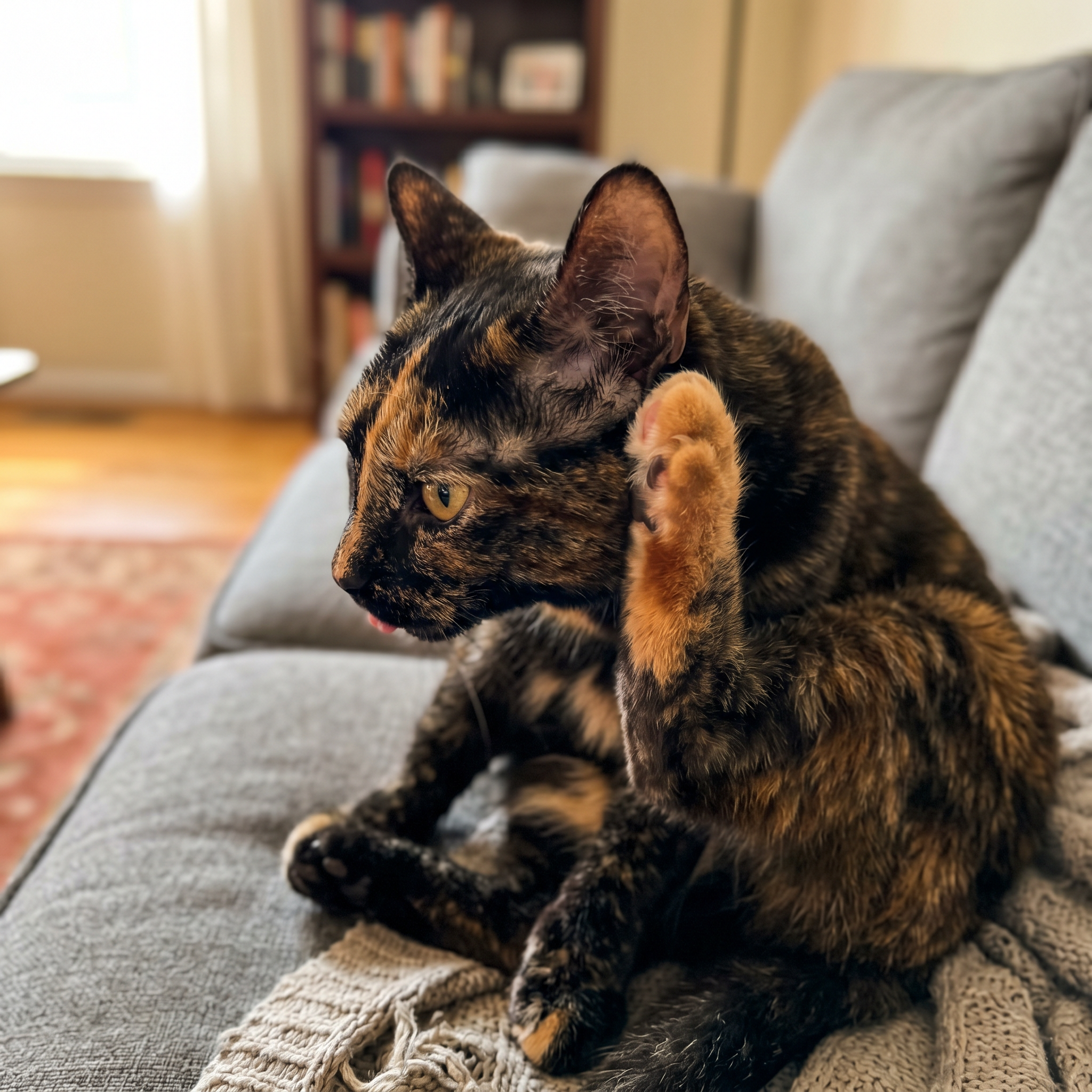
Your cat is not going to show you an ear problem the way a dog would, and I am telling you this as a vet tech who has worked in feline practice for nine years and still missed it on her own cat. By the time you see the coffee-ground gunk or smell something off when you bend down to kiss her head, the colonization has been building silently for weeks, sometimes for months, sometimes for over a year, the way it did in my house. Please don't do what I did. I've been a certified vet tech for 9 years, all of it at a feline-only practice in Tampa, with rotations through small-animal medicine that put me in rooms with dogs almost as often as cats. I see somewhere around 40 animals a week between exam rooms, treatment, and surgery prep, and over the years, I've held cats and dogs for hundreds of ear flushes, dozens of ear cytologies, and more sedated deep cleans than I want to count. I am the person in that clinic whose job is literally to notice when something is off. And last March, on a Saturday morning on my own couch, I figured out I had missed the most important ear case of my entire career, on my own pet, in my own house. This is that story, and the reason I'm telling it to you is because what happened to Marcie can happen to any dog or cat, and most pet parents don't find out until it's already too late to undo. Her name is Marcie, she's a tortoiseshell, I've had her since she was eight weeks old, and last March I was sitting on the couch with a bag of Temptations in my hand, trying to get her attention for a photo. I clapped on her left side. She didn't turn. I clapped on her right side, and she turned immediately, the way she always had, and I sat there on the couch with the treats in my hand, and I didn't move for a long time, because I already knew what it meant and I didn't want to know yet. I had missed hearing loss in my own cat in my own living room. The person whose job is literally to notice when something is off had missed it on the animal she sleeps next to every night. I took her into the clinic the next morning, before we opened, and I asked the DVM I work under to otoscope both ears. He looked in the right one first and said, that one looks okay, and then he looked in the left one, and he was quiet for a beat longer than I wanted him to be, and then he said, “Marisela, how long has this been going on? And I said, I don't know. She never told me. That sentence has stayed with me. She never told me. Here is what the otoscope showed, in language I can actually explain to you. The left canal was thickened, narrowed, scarred from years of low-grade ceruminous otitis that I, the vet tech, had never caught, because Marcie had never given me a single overt sign. No head-shaking, no pawing, no whining when I touched the base of her ear. The only thing in retrospect, the only thing, was that about a year earlier, she had stopped sleeping on her left side. She used to curl up on the left arm of the couch every night, and at some point, she switched to the right, and I had noticed it the way you notice a small change in someone you love, and I had filed it under, she just likes the right side now. She wasn't choosing the right side. She was avoiding pressure on an ear that hurt. I want to take a minute and explain what I've learned since then, because the whole reason I'm writing this is so that you don't have the conversation I had with my DVM about your own pet. Dogs and cats develop ceruminous otitis through the same mechanism. The two main organisms are Malassezia, which is a yeast, and Staphylococcus, which is a bacterium. Both of them live at low background levels in a healthy ear canal, and both of them feed on the same substrate, which is the ceruminous wax your pet's ear naturally produces, plus the dead skin cells that slough off the canal wall. When something shifts the balance, a humid stretch of weather, a small skin allergy, an immune dip, sometimes nothing you can point to, those background populations start to climb. The published veterinary dermatology literature puts that rise at up to 10,000-fold above baseline before any visible symptom shows up. Here is what I want you to understand, and I'm going to explain it for both cats and dogs, because the mechanism is similar, but the warning signs are completely different. For a dog, the signs eventually show up. The head shake, the paw at the ear, the brown wax on the couch, the smell when you bend down to kiss the top of his head. They're delayed, often by weeks past the threshold where the colonization started, but the signs do eventually arrive, and most dog owners catch it within a few weeks of the threshold being crossed. For a cat, you may never see a sign at all. Cats do two things dogs don't. They groom obsessively, which means any discharge that does come out of the canal gets cleaned off the side of the face before you ever see it. And they don't head-shake the way dogs do, which means the debris stays inside the canal. The colony sits there undisturbed, anchored to the canal wall by a biofilm, and it keeps building, sometimes for months, sometimes for over a year, the way it did in Marcie's left ear. That's the asymmetry I want you to walk away with. If you have a dog, you have a warning system, but it's later than you think. If you have a cat, you may not have a warning system at all. Either way, prevention isn't about catching the signs - it's about not letting the substrate accumulate in the first place. And the structural damage from chronic low-grade inflammation, the canal thickening, the scarring, the narrowing, that damage is not reversible. The hearing in Marcie's left ear is not coming back. I sat in our break room at the clinic for a long time after that appointment, and I cried in the way you cry when you've done a thing you can't undo, and then I went back out and held three cats for their afternoon appointments and didn't say anything to anyone for the rest of the day. A few weeks later, a sales rep came into the clinic, not for ear products, but for something completely unrelated, dental, I think, and we got to talking the way you do when you're waiting for the DVM to finish up a surgery. I told her about Marcie. She got quiet, and then she told me that her own dog had had something similar, and that her sister, who runs a dog-grooming business in Sarasota, had started using a textured finger-shaped wipe on her chronic ceruminous cases because it didn't require liquid and the animals actually tolerated it. I wrote the name of the product down on the back of a prescription pad, and I stuck it in my scrub pocket, and I forgot about it for a week, until I came home one night and saw Marcie curled up on the right side of the couch again, and I thought, I am not waiting on this. Liquid cleaners are the standard recommendation for both dogs and cats, and here's the honest truth about them. For most dogs, they work okay if the owner can actually execute the protocol consistently, which, in real life, on the bathroom floor with a squirming dog and a squeeze bottle, most pet parents cannot. For most cats, they don't work at all, because a cat won't tolerate liquid in her ear. You can try, and some of you have tried, and you have the scars on your forearms to prove it. The standard liquid ear cleaners that work fine on a Lab will turn your cat into a small, furious, four-legged escape artist, and the experience is bad enough for both of you that you stop after the second attempt, which is exactly what I had done with Marcie when she was three years old, and exactly why she went the next decade with no real ear maintenance from me at all. A flat wipe doesn't work either, for either species, because the pinna, the visible ear flap, has folds and ridges and a deep cup at the base, and a flat wipe slides over those folds instead of into them. You end up wiping the outer surface and leaving the substrate exactly where it was. The product the rep wrote down for me is a finger-shaped wipe. You slide your index finger inside it like a small thimble, and the wipe itself is pre-soaked with two ingredients that actually do work on the ear microbiome, caprylhydroxamic acid, which the literature shortens to CHA, and tetrasodium GLDA. CHA works by binding up the iron and copper that Malassezia and Staph need to metabolize, so they can't replicate. And GLDA is a chelator that breaks apart the mineral scaffold biofilms use to anchor themselves to the canal wall. The texture of the wipe does the physical part that a liquid alone cannot do, because in a cat, there is no head-shake to eject anything, and in a dog, the head-shake only ejects a fraction of what gets softened. The finger has to do it. I started using it on Marcie twice a week, on Sunday nights and Wednesday nights, while she was eating, because she's the most docile she'll ever be when there is wet food in front of her. The first time, she let me do 30 seconds in each ear before she gave me a look that meant we were done, and that was enough. By the end of the second week, she didn't even pause from eating when I did it. A month later, I had the DVM otoscope her again. The right ear, the ear that still had hearing, looked better than it had looked in years. No discharge buildup, no inflammation at the canal opening, the lining a healthy pale pink instead of the slightly thickened red I had stopped noticing because it had been that way for as long as I could remember. The left ear was unchanged because the structural damage was already there, but at least it wasn't progressing. He looked at me over the otoscope, and he said, what are you doing, and I told him, and he wrote the name down on a sticky note and stuck it on his monitor, and now he recommends it to the chronic ceruminous cases that come through our clinic, dogs and cats both. So look, if you have a pet, dog or cat, and you have ever, even once, seen brown gunk in her ear, or smelled something a little off when you kissed the top of her head, or noticed she's started favoring one side when she sleeps, or watched her shake her head a little more than usual after a bath, I need you to hear me on this. Your pet is not going to tell you what's happening in her ear until it is too late to undo. That is not your fault. Nobody teaches us this. I'm a vet tech with 9 years in feline practice and rotations through small-animal medicine, and nobody taught me either, until Marcie did. What I want for you is what I now have for Marcie's right ear. A pet who sleeps through the night without scratching. A house that doesn't carry the slightly off smell you stopped consciously noticing because it had been there for so long. An annual checkup where the vet looks in the otoscope and tells you the canal lining is healthy pink instead of the thickened red that becomes irreversible scarring. And the quiet certainty, every Sunday and Wednesday night, that you are not waiting for a warning sign that may never come. The product I use on Marcie and recommend to every chronic case that walks through our clinic is called Uproot Ear Wipes. It's a textured wipe shaped to fit your index finger. You slide it on like a small thimble. The two ingredients pre-soaked into it, CHA and tetrasodium GLDA, do the chemistry your dog or cat's ear has been asking for. CHA starves the yeast and bacteria of the iron and copper they need to replicate, and GLDA breaks apart the biofilm scaffold that anchors microbial colonies to the canal wall. The texture does what no liquid and no flat wipe can, it physically lifts the substrate out of the L-bend of the canal in about thirty seconds per ear, while your pet is eating dinner or sitting next to you on the couch. For a dog, that means the seven-to-fourteen-day post-bath or post-groom infection window stops being a calendar event. For a cat, it means the silent 10,000-fold colonization that you would never have seen coming doesn't get to start. Tap the link below to see the wipe and the two-nights-a-week routine I use on Marcie [LINK] The brand stands behind it with a 60-day money-back guarantee, so if your pet won't tolerate it or you just don't notice a difference, you send it back. There's no real downside to finding out. I'm not telling you this to sell you something. I'm telling you because Marcie is curled up on my lap as I type this, and she cannot hear me when I talk to her on her left side, and that is a thing I have to live with for the rest of her life. I don't want you to live with it too. Go try the clap test right now. Stand on your pet's left side and clap once, then her right side and clap once. If she turns both times, you have time. Use it. Your pet will not tell you. Mine didn't. P.S. For context on what you're preventing - a single ear-related vet visit at our clinic runs $250 to $400 by the time you add the exam, cytology, ear flush, and medication. A sedated deep clean, which is what we end up doing on the advanced ceruminous otitis cases, runs $600 to $800. The wipes run about $15 a canister on subscription, roughly $60 a year. The math is not subtle. >> Tap here to try it https://uprootclean.com/products/uproot-ear-wipes
Where the ad sends people
uprootclean.com
I Clapped - My Cat Didn't Turn…
Ingredients and Their Benefits Aqua/Water/Eau: Base for a smooth, gentle formula. Propylene Glycol: Hydrates and prevents dryness. Caprylyl Glycol: Moisturizes with antimicrobial benefits. Glycerin: Softens and conditions sensitive ear skin. Citric Acid: Balances pH for gentle, non-irritating cleani...
Shop now: uprootclean.com(opens in a new tab)