Daily Bread
Daily Bread Facebook ad: “DAILY BREAD | INDUCTIVE BIBLE STUDY”
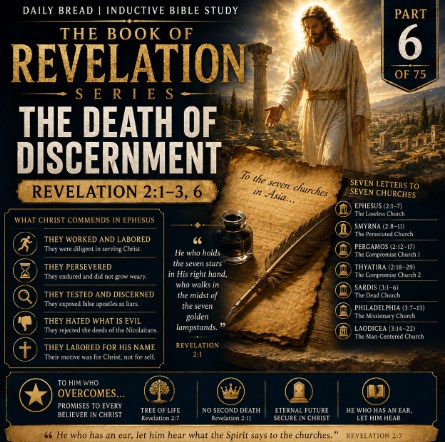
Ran for 4 days, from August 17 to August 21, 2026, the last day Crush saw it.
Run by Daily Bread on Facebook. Crush is not the advertiser and does not verify its claims. See this ad in Meta's Ad Library(opens in a new tab)
Want an ad like this for your product?
Crush makes new ad images for your product from this ad: your logo, your product photo, your offer.
Trials from $19.95 USD, then $79.95 USD a month. Cancel anytime.
About this ad
- Meta Ad Library ID
- 2132261551050730
- Platforms
- Facebook, Instagram and Messenger
- Relaunches
- 0
Ad text
🌾 DAILY BREAD | INDUCTIVE BIBLE STUDY August 16, 2026 THE BOOK OF REVELATION SERIES | PART 6 OF 75 THE DEATH OF DISCERNMENT 📖 PRIMARY TEXT: REVELATION 2:1–3, 6 We have completed the first major section of Revelation, “the things which you have seen,” and now enter the second: “the things which are” (Revelation 1:19). Revelation 2–3 contains seven letters dictated by Jesus Christ to seven actual first-century churches in Asia Minor. These letters are sometimes overlooked as we hurry toward the prophetic events beginning in chapter 4, but we would miss something tremendously important by doing so. Before Revelation shows us Christ judging the world, it shows us Christ examining His churches. The seven churches are Ephesus, Smyrna, Pergamos, Thyatira, Sardis, Philadelphia, and Laodicea. They were real churches with real circumstances, strengths, weaknesses, and needs. Yet the principles Christ gives them reach beyond the first century. The conditions found in these congregations can appear in churches and individual believers throughout the Church Age. As we study them, the question is not merely, “What was happening in Ephesus?” but also, “What does Christ want us to learn from what He said to Ephesus?” 🔎 OBSERVATION 1. SEVEN LETTERS TO SEVEN CHURCHES These seven letters generally follow an identifiable pattern: destination, description of Christ, commendation, rebuke, exhortation to change, consequence if that change does not occur, exhortation to listen, and promise to the overcomer. There are important exceptions. Smyrna and Philadelphia receive no rebuke. Both are suffering persecution. Laodicea, by contrast, receives no commendation. These differences remind us that Christ does not evaluate every church according to some mechanical formula. He knows each one intimately and addresses its actual spiritual condition. Each description Christ gives of Himself also reaches back into the vision of the glorified Christ in Revelation 1. He selects the aspect of His character particularly relevant to the church He is addressing. At the conclusion of each letter, He reaches forward to glorious promises that will ultimately be fulfilled in the future. Christ reminds His people not only of who He is, but also of where their story is going. 2. WHO ARE THE OVERCOMERS? Each letter contains a promise “to him who overcomes.” Scripture identifies the overcomer as every believer in Jesus Christ. Our position as overcomers rests upon Christ, not our performance. Jesus said, “I have overcome the world” (John 16:33). First John 4:4 says, “He who is in you is greater than he who is in the world,” and 1 John 5:4–5 identifies the one who overcomes the world as the one who believes that Jesus is the Son of God. The promises themselves support this understanding. The overcomer is promised access to the tree of life (Revelation 2:7), freedom from the second death (Revelation 2:11), and a secure place in God's eternal future. These are not privileges reserved only for unusually mature Christians. They belong to those who are in Christ. This does not mean every Christian lives an overcoming Christian life. A believer may fail, compromise, or remain spiritually immature by failing to grow in sound doctrine and discipleship. We must distinguish between identity and behavior. A prince may behave in a way completely inconsistent with his position, but his poor behavior does not change the fact that he is a prince. In the same way, a believer’s behavior may fail to reflect who he is in Christ, but our identity as overcomers rests in Christ, not in our level of maturity or faithfulness. 3. SEVEN CHURCHES, NOT SEVEN ERAS OF CHURCH HISTORY Some interpret the seven churches as seven successive periods of Church history, beginning with Ephesus as the apostolic era and ending with Laodicea as the final condition of the Church before the Rapture. This is commonly called the historical-prophetic interpretation. While interesting parallels can certainly be drawn, there are important reasons not to make this the primary interpretation of Revelation 2–3. First, it creates difficulty with the imminency of the Rapture. If seven predetermined eras of Church history had to unfold first, earlier generations could not genuinely have expected Christ's return at any moment. Scripture presents no prophetic event that must occur before the Rapture. Second, the interpretation can become ethnocentric, evaluating the entire worldwide Church through the condition of Western Christianity. A Laodicean condition may characterize many churches in prosperous societies while believers elsewhere are suffering persecution and displaying characteristics much more like Smyrna or Philadelphia. Third, the proposed historical periods do not always fit the descriptions naturally. Most importantly, the text itself never tells us that the seven churches represent seven consecutive eras. A consistent grammatical-historical interpretation begins with what the text actually says: Jesus addressed seven letters to seven actual churches. We should not create an allegorical meaning where Scripture does not give us one. 4. THE DESTINATION: EPHESUS “To the angel of the church of Ephesus write…” Revelation 2:1 (NKJV) Ephesus was one of the most prominent churches of the first century. Its beginnings are recorded in Acts 19 during Paul's third missionary journey. Paul taught there for two years so effectively that Acts 19:10 says “all who dwelt in Asia heard the word of the Lord Jesus, both Jews and Greeks.” Ephesus had an extraordinary spiritual heritage. Paul ministered there. Timothy served there. John himself was associated with Ephesus. The church received Paul's letter to the Ephesians, and Timothy received two inspired letters while ministering there. Now the glorified Christ Himself addresses this congregation. But an impressive history does not guarantee future faithfulness. That should immediately get our attention. A church can have tremendous teachers, sound doctrine, years of fruitful ministry, and a remarkable history and still drift spiritually. No congregation can live indefinitely on yesterday's faithfulness. 5. THE MESSENGER OF THE CHURCH The letter is addressed “to the angel of the church of Ephesus.” The Greek word angelos means messenger and can refer to either angelic or human messengers depending upon context. Here these messengers are understood as the human leaders responsible for communicating God's Word to the congregations. Revelation 1:20 identified the seven stars with these seven messengers, and Christ holds them in His right hand, the position associated with honor. Why does Scripture place such importance upon those who faithfully teach God's Word? Ephesians 4:11–12 explains that pastor-teachers are given “for the equipping of the saints for the work of ministry, for the edifying of the body of Christ.” The pastor's primary calling is not to entertain, market, build a personal platform, or function as a corporate executive. It is to faithfully teach God's Word so believers are equipped to do the work of ministry. The Church desperately needs faithful Bible teachers because when the plumb line of God's Word disappears, discernment soon disappears with it. 📖 INTERPRETATION 6. CHRIST WALKS AMONG HIS CHURCHES Jesus describes Himself as: “He who holds the seven stars in His right hand, who walks in the midst of the seven golden lampstands.” Revelation 2:1 (NKJV) We do not have to guess what these symbols mean. Revelation 1:20 has already told us. The stars are the messengers, and the lampstands are the seven churches. Notice where Christ is. He walks among them. Christ is not a distant observer of His Church. He is the Head of the Church, the Bridegroom of the Church, the Builder of the Church, and the One who purchased the Church with His own blood. He knows exactly what is happening within His Body. No reputation impresses Him. No outward appearance deceives Him. No hidden compromise escapes Him. 7. “I KNOW” Christ begins His evaluation of Ephesus with two powerful words: “I know.” “I know your works, your labor, your patience…” Revelation 2:2 (NKJV) This is the omniscience of Christ. Jesus sees beneath appearances into motives and hearts. First Samuel 16:7 reminds us, “For man looks at the outward appearance, but the LORD looks at the heart.” We may be able to create an appearance of spirituality before other people. We cannot create one before Christ. But His knowledge should not only sober us. It should also encourage us. Christ sees the acts of faithfulness nobody else notices. He knows the unseen sacrifices, the quiet obedience, the labor that receives no recognition, and the perseverance required simply to remain faithful. He knows. 8. CHRIST COMMENDS THEIR WORKS The Ephesian church was busy serving Christ. Jesus commends their “works” and their “labor.” The word translated labor carries the idea of exhausting toil. These were not passive Christians. They worked hard for the cause of Christ. Scripture is absolutely clear that good works do not save us. “For by grace you have been saved through faith…not of works.” Ephesians 2:8–9 (NKJV) But the very next verse says believers are “created in Christ Jesus for good works” (Ephesians 2:10). We are not saved by good works, but we are saved unto good works. Grace does not make good works irrelevant. It puts them in their proper place. Works are not the condition for receiving eternal life. They are part of God's purpose for those who already possess it. James 2:26 says, “faith without works is dead.” This does not mean a believer without works never possessed eternal life. A dead faith is unproductive and useless in accomplishing the practical purposes God desires to accomplish through us. There is much more to the Christian life than simply knowing we are going to heaven. God desires to work through His children. 9. CHRIST COMMENDS THEIR DISCERNMENT Jesus continues: “…you cannot bear those who are evil. And you have tested those who say they are apostles and are not, and have found them liars.” Revelation 2:2 (NKJV) This is striking. The Ephesians tested teachers who claimed divine authority. And Jesus commended them for doing it. Biblical discernment is not arrogance. It is not being unloving. It is not automatically “judging” someone in the sinful sense simply because we examine what they teach. God expects His people to test spiritual claims against what He has already revealed. Deuteronomy 13:1–5 warned Israel that even if someone produced an impressive sign that came to pass, that experience was never allowed to override God's revealed Word. If the message contradicted what God had already said, Israel was to reject the messenger. A supernatural experience does not authenticate truth. A miracle does not authenticate truth. A title does not authenticate truth. A large following does not authenticate truth. God's Word tests all of them. The Ephesian church encountered people claiming to be apostles. Instead of being impressed by the title, they examined the claim and “found them liars.” Christ did not rebuke their discernment. He commended it. 10. DISCERNMENT REQUIRES A STANDARD We live in a culture that increasingly treats certainty as arrogance and discernment as intolerance. But if truth exists, error exists. And if God has revealed truth, His people must be able to distinguish between the two. The question is not whether a teaching feels spiritual, produces an emotional experience, appears miraculous, or comes from someone claiming divine authority. The question is: Does it agree with the Word of God? God cannot contradict Himself. Therefore, no experience, vision, prophecy, teacher, apostle, pastor, movement, or miracle has authority to overturn what God has already revealed in Scripture. This is why serious Bible study matters. Without knowledge of truth, there can be no discernment of error. 11. THEY PERSEVERED Jesus also commends the Ephesians for perseverance: “And you have persevered and have patience, and have labored for My name’s sake and have not become weary.” Revelation 2:3 (NKJV) The word translated patience or perseverance is hupomonē, the ability to remain steadfast under difficult circumstances. It is easy to appear faithful when everything is comfortable. Perseverance becomes visible when obedience becomes costly. The Ephesians had experienced difficulty but continued serving. Even more importantly, notice their motive: “for My name’s sake.” They were not laboring for applause, popularity, recognition, or personal advancement. Their service was connected to the name of Christ. Galatians 6:9 says: “And let us not grow weary while doing good, for in due season we shall reap if we do not lose heart.” There are blessings we may never experience if we simply quit too soon. Weariness is real, but Scripture repeatedly calls us to remain faithful. 12. THEY HATED WHAT CHRIST HATED Jesus adds another commendation in Revelation 2:6: “But this you have, that you hate the deeds of the Nicolaitans, which I also hate.” (NKJV) Notice carefully what Jesus says. He does not commend hatred of people. He commends hatred of deeds that He Himself hates. Biblical love does not require us to approve of everything. God loves people perfectly, yet God also hates sin because sin destroys the people He created. There are behaviors, teachings, and practices that Christians should reject precisely because they are contrary to God's character and harmful to people. We should never use discernment as permission for cruelty. But neither should we redefine love so that it becomes incapable of identifying evil. Jesus Himself says there are deeds “which I also hate.” 13. HOW CAN SO MUCH BE RIGHT AND SOMETHING STILL BE TERRIBLY WRONG? Look at everything Ephesus had going for it. They worked. They labored. They persevered. They tested false apostles. They rejected evil. They endured for Christ's name. They had not grown weary. They hated deeds Christ hated. From the outside, this church could have looked extraordinarily successful. Yet Christ is about to tell them something is seriously wrong. That is one of the most sobering lessons in this passage. Human beings measure success largely by what can be seen. Christ looks deeper. Activity for Christ can never replace intimacy with Christ. It is possible to become so occupied with defending truth, serving, working, persevering, studying, and identifying error that our relationship with Christ quietly becomes something different than it once was. Ephesus did not have a problem with inactivity. They had a heart problem. And that is where Christ will turn next. ❤️ APPLICATION TEST EVERYTHING BY SCRIPTURE. We are commanded to exercise discernment. Never surrender biblical judgment because someone has an impressive title, testimony, experience, following, or claim of supernatural power. God's Word remains the standard. DO NOT CONFUSE DISCERNMENT WITH BEING UNLOVING. Jesus commended Ephesus for testing false apostles. Love and discernment are not enemies. Biblical love cares enough about truth to identify what can spiritually harm people. KNOW THE WORD WELL ENOUGH TO RECOGNIZE ERROR. Counterfeit teaching is most dangerous when it resembles truth. The better we know Scripture in context, the less dependent we become upon someone else telling us what to believe. REMEMBER THAT WORKS HAVE THEIR PROPER PLACE. We are saved by grace through faith, apart from works. But once saved, God desires to work through us. Good works are not the root of eternal life. They are part of God's purpose for the life He has already given us. PERSEVERE WHEN FAITHFULNESS BECOMES DIFFICULT. The Ephesians had not grown weary. Do not assume difficulty means God has abandoned what He called you to do. Sometimes perseverance means continuing faithfully when the excitement has disappeared. HATE WHAT DESTROYS WITHOUT HATING PEOPLE. Christ Himself distinguished between people and sinful deeds. Biblical love does not celebrate what God calls evil, but our opposition to sin should never become hatred toward the sinner. NEVER MEASURE SPIRITUAL HEALTH BY ACTIVITY ALONE. A church can be busy, doctrinally discerning, hardworking, and outwardly successful while something essential is dying inside. Christ does not merely count our activities. He examines our hearts. ❤️ FINAL THOUGHT Ephesus should make every serious student of Scripture stop and think. This was not a careless church. They knew doctrine. They tested teachers. They exposed false apostles. They worked hard. They persevered. They stood against evil. And Jesus commended them for all of it. Discernment mattered to Christ then, and it matters to Him now. In an age when we are often encouraged to accept spiritual claims without testing them, Christ's words to Ephesus remind us that truth matters, doctrine matters, and testing what we hear against God's Word matters. But Ephesus also gives us a warning. We can become so occupied with working for Christ and defending truth about Christ that we neglect our fellowship with Christ. The Lord who sees our doctrine also sees our devotion. The Lord who sees our works also sees our hearts. And in Part 7, we will discover the one thing Christ had against this remarkably discerning church: They had left their first love. ❤️📖
Where the ad sends people
fb.com
www.fb.com
Visit profile: fb.com(opens in a new tab)