Dr. James Carter, MD
Dr. James Carter, MD Facebook ad: “I was being robbed, and I had a receipt for it”
Ran for 55 days, from June 17 to August 11, 2026, the last day Crush saw it.
Run by Dr. James Carter, MD on Facebook. Crush is not the advertiser and does not verify its claims. See this ad in Meta's Ad Library(opens in a new tab)
Want an ad like this for your product?
Crush makes new ad images for your product from this ad: your logo, your product photo, your offer.
Trials from $19.95 USD, then $79.95 USD a month. Cancel anytime.
About this ad
- Meta Ad Library ID
- 2229647551181100
- Platforms
- Facebook, Instagram, Messenger and Threads
- Relaunches
- 0
Ad text
My sister-in-law said the shot was the lazy way out. Eleven months and $13,200 later, I watched her try to lift my carry-on into the overhead bin. She couldn't. I did it one-handed. She didn't know I'd been counting. I had. I want to tell you exactly how I got here, because if you are on the shot, paying what I'm paying, someone in your life has already decided what your weight loss means. And they are wrong about it in a way that could cost you the one thing you can't buy back. Let me start where it actually started. I'm 44. I live outside Columbus. I manage the billing office for a dental group, three locations, and I have done it for nineteen years. I have two kids, a husband named Pete who is kind and useless with feelings, and a sister-in-law named Renee who has been thin her whole life and has never once let me forget it. For most of my adult life I was the big one at the table. Not in a way anyone said out loud. In the way where someone always took the photo from above. In the way where I knew which chairs at restaurants had arms and which didn't. In the way where I bought the dress in two sizes and quietly returned the smaller one before anyone saw it in the bag. I had tried everything. I want you to hear that before I tell you the rest, because the order matters. Weight Watchers, twice. Noom. The one with the shakes. A trainer named Brandon I paid $75 an hour to watch me cry on a rowing machine. Whole30. The cabbage thing. A nutritionist who told me to "honor my hunger" while my A1C climbed. I lost the same fourteen pounds maybe nine times. I gained back the same fourteen pounds maybe nine times. By 43 my doctor said the word prediabetic and then said the other word, the one that's a brand name, the one everybody whispers like it's a diet pill from the back of a magazine. I started in July of last year. And here is the part nobody warns you about. The weight came off. And the second it started coming off, the people around me decided it didn't count. This is not a story about my shot failing me. I need to be very clear about that, because the easy version of this is a woman who got burned by the drug and warns you off it. That is not me. The shot did exactly what it promised. The scale moved. The cravings that ran my whole life for thirty years went quiet for the first time since I was a girl. My bloodwork is the best it has been in a decade. My doctor is thrilled. The shot kept its word. The people did not. Renee was the first. She is Pete's older sister and she has the kind of metabolism that lets her say cruel things and call them honesty. We were at Easter. I'd lost about thirty pounds by then. My mother-in-law said I looked wonderful, and Renee waited until the room was quiet and said, "Well sure. Anyone can lose weight when a needle does it for you." She smiled when she said it. That's the part. She smiled. I didn't say anything. I never say anything. I went and refilled the iced tea pitcher nobody had touched. But it didn't stop with Renee. A woman at work, Donna, who has been on every cleanse Goop has ever invented, started calling it "the cheat." As in, "Oh you're doing the cheat, good for you, I could never." My cousin asked if I was "worried about, you know, the face thing." A man at the dental group, a hygienist's husband I'd met twice, told me at the holiday party that his wife "did it the real way, with discipline." The real way. With discipline. I had spent thirty years doing it the real way. I had the discipline of a monk and the body of someone who'd never tried. And the one time something finally worked, the whole world lined up to tell me it didn't count, it wasn't real, I'd cheated, I'd taken the lazy way, I'd bought my way out. Do you know what $1,200 a month is, in my house? It is the difference between the family vacation and no vacation. It's the thing Pete and I had the worst fight of our marriage about, standing in the kitchen at eleven at night, him saying we can't afford it and me saying I can't afford not to. It's me picking up Saturday shifts I don't tell anyone about. It is the most expensive, most deliberate, least lazy thing I have ever done in my life. And they called it the easy way out. Here's the thing about being underestimated by people who are wrong. It does something to you. It goes in quiet and it sits there. I started keeping a list in my head of every single one of them. Not because I'm proud of that. Because it's true and I told you I'd tell you the truth. So that's the wound. Now here's the part that almost let them win. Somewhere around month four, the weight was still coming off, and I started to feel something I didn't have a word for yet. Smaller. But less. I'd reach for the big stock pot on the top shelf, the one I'd hauled down a thousand times, and my arm would shake. I carried a case of water from the car and had to set it down on the porch step to rest, a thing I had never once done at my heaviest. I went to open a new jar of the marinara my son will only eat, and I couldn't. I ran it under hot water, I used the rubber thing, I handed it to my fourteen-year-old and he opened it like it was nothing and looked at me funny. That look. From my own kid. I told myself it was the deficit. You eat less, you're tired, everyone knows that. I told myself it would pass. It did not pass. It got quieter and worse. I noticed I was using the railing on the stairs. I noticed I planned my day around not having to carry things. I noticed that I, a woman who had just lost forty-some pounds and should have felt like she could run through a wall, was moving through my own house like someone fragile. And then came the day at the airport, and I have to tell you about it, because it is the day the whole thing turned. We flew to Phoenix in March for Pete's father's seventieth. Renee was on the same flight. Of course she was. I had a single carry-on. I'd packed light on purpose, some proud little part of me that wanted to breeze through, the new smaller me, no checked bag, no fuss. I got to my row and went to lift the bag into the overhead bin. And I couldn't get it up there. I'm forty-some pounds down, in jeans I hadn't worn since my twenties, and I am standing in the aisle straining at a bag I had carried through three airports the year before at my heaviest. My arms had nothing in them. The line backed up behind me. A man reached past me and pushed it in without a word, the way you'd help a child or someone elderly, and said "there you go" and didn't look at me again. There you go. And from two rows back, I heard it. Renee's voice, to whoever she was sitting with, not even quiet about it: "She's lost all this weight and she still can't lift a bag. I told Pete this would happen." I told Pete this would happen. I sat down in 18C and I looked out the window and I did not cry, because I was past crying, I had moved into the cold clear place past crying. Because she was about to be right. That was the thing I could not stand. Not the bag. Not the man. The fact that Renee, who called my hardest year lazy, who smiled when she said a needle did it for me, was going to get to be right. The story was going to come true. "She lost the weight and look at her, she's weaker than ever, see, it wasn't real, it was the easy way and now she's paying for it." Thirty pounds of evidence that they'd been correct all along. I was paying twelve hundred dollars a month to hand them the verdict. I want to tell you what I did with that on the flight home, because it's the part I'm least proud of and the most honest. I tried to fix it the only way I knew how. The way I'd fixed everything for thirty years. By trying harder. I doubled my protein. I bought the powder, the bars, the little shaker cup that smelled like vanilla and chalk. I went back to Brandon, the trainer, and told him to be hard on me. I ate chicken until I never wanted to see a chicken again. I did everything you're supposed to do, everything the internet swears will save your muscle on the shot. And it barely moved the needle. I'd come home from the gym, go to put the protein powder back on the top shelf, and my arm would still shake. I'd hit my protein number to the gram and still hand my son the jar. I was doing the real way, the discipline way, the exact thing they all swore by, and my body was still letting the muscle go like it was nothing. That's when I started to think maybe they were right after all. Maybe I had broken something. Maybe this was just the price, and I'd signed up for it, and I'd deserve the look on Renee's face. I want to grab that woman on the plane by the shoulders now and tell her what I'm about to tell you. Because she wasn't failing. She was missing one piece, and not one single person in her life knew it existed, and it had nothing to do with how hard she tried. Here is what I want you to understand, because this is the trap and almost nobody sees it in time. When you lose weight, you don't just lose fat. You lose weight. And a piece of that weight, every single time, is muscle. On the shot, with the appetite gone and the pounds coming off faster than you've ever seen them move, that piece is bigger than anyone tells you. The number people in the studies kept landing on was that somewhere between a quarter and forty percent of the weight you lose can be lean mass. Muscle. The exact tissue that lifts the bag, opens the jar, climbs the stairs, holds you upright as a strong person and not a fragile one. Read that again. Up to forty percent. So picture what I was actually buying. I was paying twelve hundred dollars a month, and for roughly every three pounds I lost, one of them was muscle I'd spent my whole life carrying. I was spending a fortune to get smaller, and a third of that fortune was going to make me weaker. I was paying, with my own hard-won money, to become the exact frail thing Renee was telling everyone I'd become. That is not a side effect. That is the math of losing weight fast. The drug strips the fat. It does not know to spare the muscle. Nobody is steering. And I will say the thing I needed to hear and nobody said to me, so I'll say it to you. This was not my fault, and it was not the shot's fault. The shot sends a signal to your body, an extraordinary one, the best signal money can buy. But a signal has to be carried out by your cells. And after about forty, in a deficit, your cells are not in any shape to carry it out the way you need them to. Let me tell you who finally explained this to me, because it wasn't a doctor, and it wasn't the internet at 2am, which is where I'd been living. It was a woman named Priya. Priya is a physician's assistant. She is also forty-one and she is also on the shot, and I met her because she is the new wife of an old college friend of Pete's and we got stuck next to each other at a barbecue in May while the men talked about a deck nobody was going to build. I don't know what made me tell her. The wine, maybe. The fact that she'd mentioned, casually, that she was on it too, and she said it without flinching, like it was a blood pressure pill, which it basically is. I told her about the airport. The bag. Renee. The jar. The railing. She didn't say "that's just the deficit." She put her drink down. She said, "How old are you?" I said forty-four. She said, "Okay. So here's what's happening, and almost no one on the shot understands it, and it makes me crazy." And she explained it to me the way I'm going to explain it to you, because it is the thing that changed everything. She said the shot is a signal. A loud, clear, brilliant signal that tells your body to stop eating, burn the fat, lose the weight. The signal is real and it's working. That's why the scale moves. But the muscle on your body doesn't hold itself up for free. Muscle is expensive tissue. Your body keeps it alive with energy, actual cellular energy, made by little engines inside every cell called mitochondria. And when you're past forty, and you're in a steep deficit, and the pounds are flying off, those little engines are old and clogged and slow. A lot of them are worn out and just sitting there dead, taking up space, making nothing. So your body does the brutal accounting. It looks at this muscle it can barely afford to power. And it lets it go. Because keeping it costs energy the worn-out engines can't make. "You're not losing muscle because the shot is bad," Priya said. "You're losing muscle because your cells can't pay the energy bill to keep it. The signal says hold the muscle. Your cells can't cash the check." I sat there with my plastic cup and I felt the whole thing click into place. That was it. That was the airport. That was the jar. I wasn't fragile because I'd lost weight. I was fragile because the engines that were supposed to power my muscle through the weight loss were too worn out to do their job, so my body was burning the muscle for parts. I had been blaming myself. I'd been half-believing Renee. And the actual answer was a clogged engine I'd never heard of. "So what do I do," I said. "Eat more protein? I'm already eating protein until I want to scream." She said protein and lifting are the tools, yes, do those, they matter. "But you can eat all the protein in the world and lift four days a week, and if the engines in your cells are too worn out to make the energy, your body still won't hold the muscle. You can't build on a dead engine. You have to clear out the dead ones so the good ones can actually run." And that was the first time I heard the word. She said there's a compound. It's called Urolithin A. She said your body is supposed to make it from pomegranates and certain foods, but after forty most people barely make any, because it depends on gut bacteria most of us don't have anymore. She said what it does is very specific, and she was careful about this, so I'll be careful too. It does not raise the signal. It is not another shot, it is not a hormone, it is not a drug, it doesn't touch your appetite or the number on the scale. It works one layer underneath all of that. It clears out the worn-out, dead mitochondria, the clogged engines, so your cells can run on the good ones. It's like cleaning out a fleet of broken-down trucks so the working trucks can finally move. "The shot writes the check," she said. "This is what lets your cells cash it. It doesn't do the weight loss. It protects what the weight loss is supposed to leave you with." I want to tell you I bought it that night, but I didn't, because I am a billing manager and I have heard a thousand pitches and I trust nothing. So I went home and I looked it up myself. There's a human trial. Real one, published, with a year on it, 2022, the ingredient is called Mitopure. They gave it to people and measured their muscle, actually measured it. Their muscle strength improved and the worn-out parts of their cells got cleared out. It wasn't a supplement-aisle pixie-dust thing. There was a number behind it and a journal behind the number. That mattered to me more than I can say. Because the whole reason I was in this mess was a thing nobody had measured, that everyone had an opinion about. And here was a thing somebody had actually measured. I ordered it. It's a company called Onset. It comes as a gummy, which felt almost too simple after everything, two a day, that's the whole thing. And then nothing happened. I have to be honest about this part because if I'm not, you won't believe the rest. For about two weeks, nothing. I took the two gummies in the morning with my coffee and I felt exactly like a woman taking a gummy. No lightning. No surge. I almost stopped, honestly, because the part of me that's been burned by every diet promise was sitting there with its arms crossed saying "here it is, here's the part where it does nothing." I am not going to tell you a gummy fixed my life. I changed three things at once, that's the truth. I started the gummies. I added a real protein target and actually hit it. And I started lifting with the trainer Brandon again, the rowing-machine one, twice a week, because Priya scared me into it. So I can't sit here and swear to you it was the gummy alone. Anyone who swears that to you is selling you something. But I can tell you the order things came back in. And I can tell you which one I will not stop taking. The jar was first. It was the marinara again, a new jar, my son in the next room. And I went to hand it to him out of habit, and then I didn't. I just opened it. It gave under my hand like jars are supposed to. I stood in the kitchen holding an open jar of marinara like a crazy person, because I knew exactly what it meant. Then the water. A case of water from the car, all the way to the kitchen counter, no porch step, no setting it down. I didn't even notice until I'd already done it, which is the whole point. The thing I'd been planning my days around had stopped being a thing. Then the stairs. I caught myself halfway up one morning, no hand on the railing, two cups of coffee, one in each hand, not thinking about it at all. I stopped on the landing. I'd been gripping that railing for months like an old woman. And I'd just walked up it like I owned the house. I am not telling you my bloodwork. I'm not telling you a number off a scale. I'm telling you I can carry my own life again, and I had stopped being able to, and that came back. The weight kept coming off, by the way. That never stopped. The shot kept doing its job the whole time. But now I was getting smaller without getting less. I was losing the fat and keeping the woman. I called Priya to tell her about the jar. She laughed and said, "Yeah. That's your cells holding the muscle. That's what it's supposed to feel like. The signal finally has the power behind it to do what it's saying." Now I have to tell you about Phoenix again. Because the airport story has a second half, and the second half is the whole reason I'm writing this. We flew back out in September. Pete's mother's birthday this time. Same airport. And, because the universe has a sense of humor, the same flight as Renee. I had a carry-on. I'd packed it myself. I got to my row. And I put it up into the overhead bin one-handed, smooth, the way you put away something light, and I sat down and buckled my belt and I had not even broken the rhythm of walking down the aisle. Renee came down the aisle a minute later. She had a roller bag she'd checked the size limit on and a tote and she was struggling to get the roller up over the lip of the bin. She got it about halfway and it slid back and a flight attendant came to help her. I watched her not be able to lift her own bag. I did not help. I want to be honest about that. There was a version of me that would have jumped up. I stayed in my seat. She got it up there eventually and turned and saw me, and her eyes went to the bin over my seat, where my bag was already sitting, the one I'd put up like it weighed nothing. "You got that up there okay?" she said. A little surprised. A little something else. "Easy," I said. That's all. Easy. She sat down two rows back and I looked out the window at the jet bridge and I felt the whole eleven months land in my chest at once. Because here is what she didn't know, sitting back there with her checked-size roller and her opinions. She thought she'd watched me cheat my way thin and then crumble, proof she'd been right. What she actually watched was me spend the most deliberate money of my life, get told it was lazy by people who'd never tried what I tried, nearly lose the strength to lift my own bag, find out why, and fix it. She thought I bought a shortcut. I bought a fight, and then I bought the one thing that made sure I'd win it whole. The shot didn't make me strong. It cleared the way for me to be the strong thing I already was, under forty pounds I never needed. And I refused to pay a fortune to come out of it smaller and weaker, just so the people who called it the easy way could be right. I'm telling you all of this because I think you might be me. I think you might be the woman on the shot who is doing the hardest, most expensive thing of your life, and being told by someone with a fast metabolism and a cruel streak that it doesn't count. I think you might have noticed it too. The bag that's suddenly heavy. The jar you handed to someone. The railing your hand keeps finding. The way you feel smaller in the mirror and somehow less in your own body. I think you've told yourself it's just the deficit. And I think there is someone in your life who has already decided how this story ends. That you took the easy way, and look, now you're frail, now you're fragile, see, it was never real. You are paying too much money to hand them that ending. You did not buy a shortcut. You bought the hardest thing you've ever done. Do not let it leave you weaker than it found you. Do not pay to lose the muscle. That's the one part of this you can actually protect. So here is exactly what it is, with no story around it. It's called Onset. The compound is Urolithin A, the studied form, Mitopure. It comes as two gummies a day. That's the entire protocol. You take them in the morning. There's nothing to measure, nothing to inject, nothing to think about. It is not a weight loss product. It will not move your scale and it will not touch your appetite. Your shot does that, and your shot is doing it well. This does one thing. It clears the worn-out engines in your cells so your body can hold the muscle while the fat comes off. It protects the return on what you're already paying for. Now let me put the money next to itself, because I do this for a living. You are spending somewhere around twelve hundred dollars a month on the shot. Fourteen thousand dollars a year, give or take. That is the most expensive, most important purchase in your life right now, and a quarter to forty percent of what it's buying you is at risk of being muscle you never get back. You're protecting a fourteen-thousand-dollar-a-year investment. Onset costs a fraction of a single month of your shot. Per day, it's less than what you spend on coffee. You are already paying for the demolition. This is the few dollars that make sure you keep the house and not just the empty lot. A few things you should know before you decide. They run out. I don't say that to rush you. It's a small company and the studied form of this is not something you can swap with a cheap version off a shelf, the gut-bacteria thing means most of what's sold as pomegranate extract does nothing, and they make it in batches. When a batch is gone it's gone for a while. I went to reorder in August and waited eleven days, which does not sound like a lot until you've had the strength back and felt it start to slip again. And here is the part that made me actually do it, after everything. It comes with a 90-day money-back guarantee. Any reason. You take it for three months, you do the protein, you do the lifting, and if you don't feel the difference in the things you carry, you send it back and you get your money back. After thirty years of paying full price for things that did nothing and gave me nothing back, that sentence is the only reason I trusted the first bottle. The risk is theirs, not yours. I think about that airport a lot. The first time, a stranger pushed my bag into the bin like I was made of glass, and Renee told the whole plane she'd seen it coming. The second time, I put it up myself and said one word. The shot got me onto that plane forty pounds lighter. It did what I paid it to do. But the day I put that bag up one-handed, that wasn't the shot. That was the muscle I refused to let it take from me. That was the few dollars a day I spent to make sure the most expensive year of my life left me stronger than it found me, and not weaker, no matter how badly certain people wanted the other ending. I paid to get smaller. I will not pay to get weaker. Neither should you. T. P.S. If you read nothing else, read this. The shot is the signal and it's working, that's why the scale moves. But a signal has to be carried out by your cells, and after forty, in a deficit, the worn-out engines in your cells let the muscle go because they can't power it. Urolithin A clears the worn-out engines so your body can hold the muscle while the fat comes off. It does not do the weight loss. It protects what the weight loss should leave you with. That's the whole thing in four sentences. P.S. Two. On the money. You are spending around fourteen thousand dollars a year on the shot, and up to forty percent of what you're losing can be muscle. Onset costs less per day than your coffee. You are not adding a new expense. You are protecting the biggest one you have. Do the math the way I had to do it standing in my own kitchen. P.S. Three. The 90-day guarantee is the real reason to start now instead of "thinking about it." You take it for three months alongside your protein and your lifting, and if the bag is still heavy and the jar still won't give, you send it back for a full refund. You will know inside three months. The only way to lose is to keep handing the muscle away while you decide. P.S. Four. The batches do sell out, and the studied form is not the cheap pomegranate extract on the shelf, so there's no quick substitute when it's gone. If you've felt it, the bag, the jar, the railing, don't wait for the next batch to be the thing that decides it for you. I waited eleven days once. I won't again. P.S. Five. Somewhere there's a person who decided what your weight loss means. That you took the easy way. That it doesn't count. That you'll end up frail and they'll be proven right. A year from now you are either the woman who lifts her own bag and says one word, or the woman who hands them the ending they already wrote. You spent too much, and fought too hard, to give them that. Protect the muscle. Keep the win whole.
Where the ad sends people
tryonset.com
I was being robbed, and I had a receipt for it
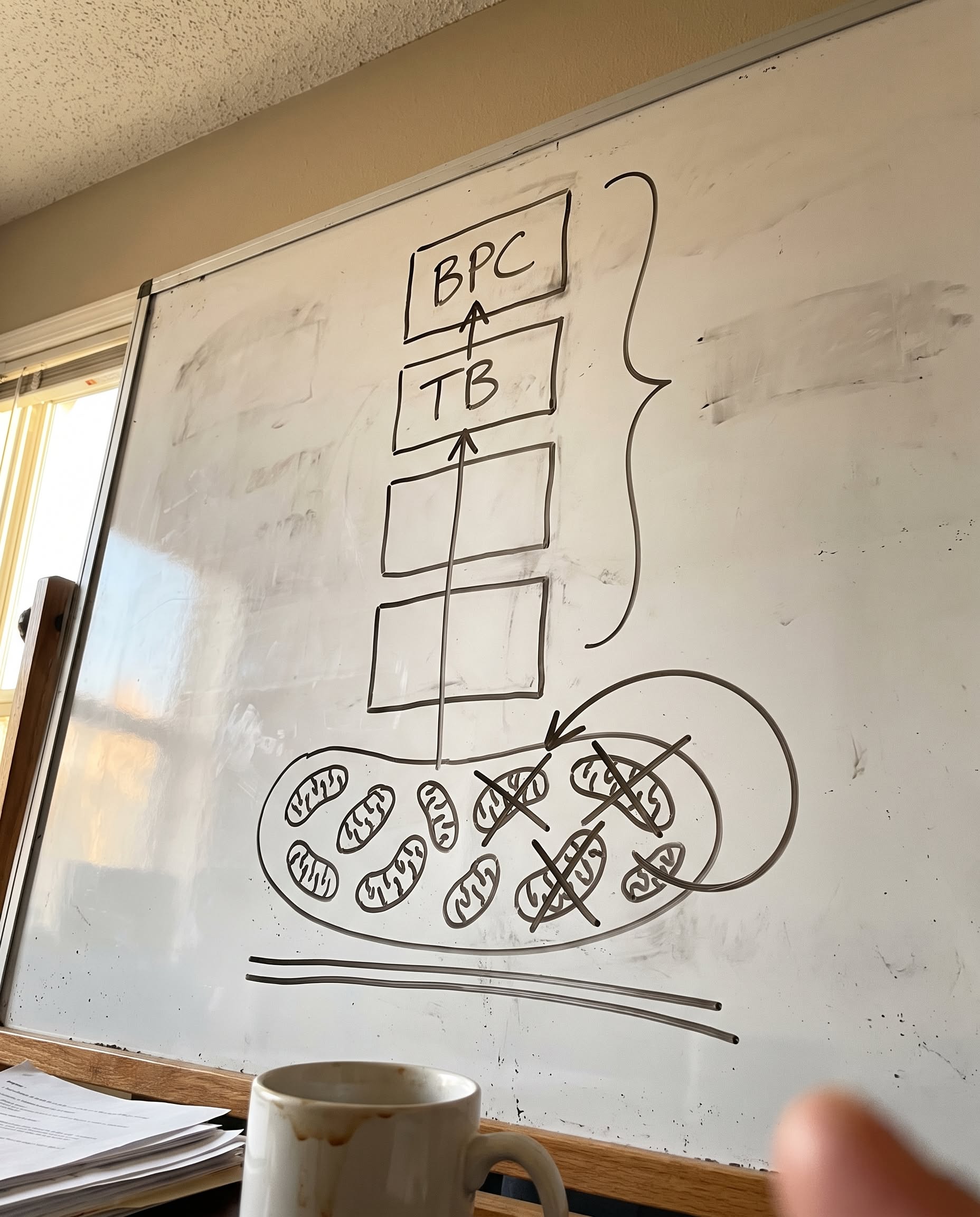
On a GLP-1, your whole body runs on far less fuel — and after 35, your mitochondria can't keep up. That's the crash, the muscle loss, the "aged 10 years" feeling. Urolithin A clears out the damaged ones so your cells thrive on less, not just survive it.
Learn more: tryonset.com(opens in a new tab)