Daily Bread
Daily Bread Facebook ad: “DAILY BREAD | INDUCTIVE BIBLE STUDY”
Ran for 4 days, from August 25 to August 29, 2026, the last day Crush saw it.
Run by Daily Bread on Facebook. Crush is not the advertiser and does not verify its claims. See this ad in Meta's Ad Library(opens in a new tab)
Want an ad like this for your product?
Crush makes new ad images for your product from this ad: your logo, your product photo, your offer.
Trials from $19.95 USD, then $79.95 USD a month. Cancel anytime.
About this ad
- Meta Ad Library ID
- 4141922896108480
- Platforms
- Facebook, Instagram, Audience Network and Messenger
- Relaunches
- 0
Ad text
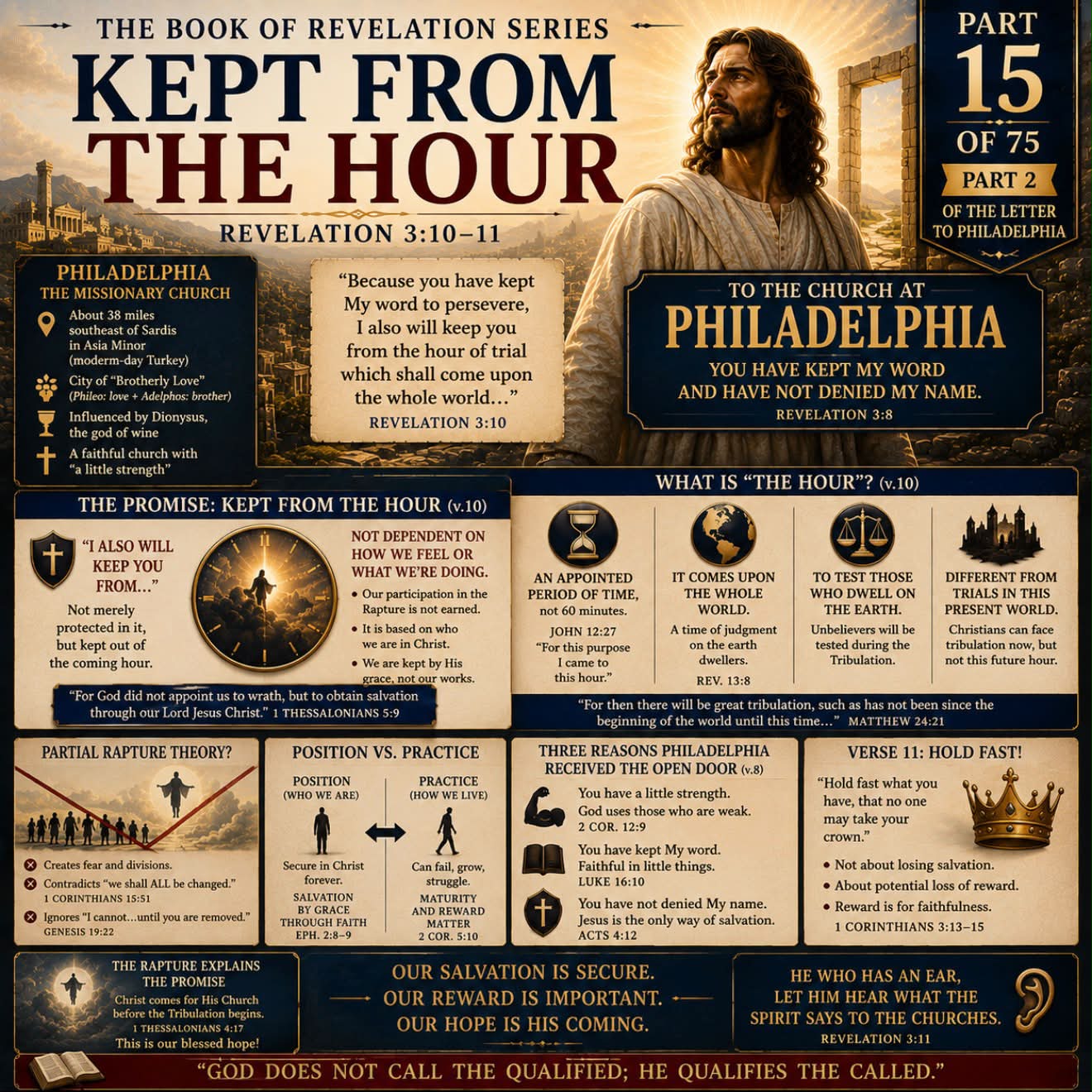
🌾 DAILY BREAD | INDUCTIVE BIBLE STUDY August 25, 2026 THE BOOK OF REVELATION SERIES | PART 15 OF 75 KEPT FROM THE HOUR THE LETTER TO PHILADELPHIA | PART 2 📖 PRIMARY TEXT: REVELATION 3:10–11 Part 14 introduced Philadelphia, a church with “a little strength” that had kept Christ’s Word and had not denied His name. Now we come to one of the most important promises Christ gives His Church concerning the coming Tribulation: “I also will keep you from the hour of trial which shall come upon the whole world, to test those who dwell on the earth.” Revelation 3:10 NKJV Does Jesus promise to preserve the Church through this coming hour, or to keep the Church from the hour itself? And is participation in the Rapture dependent upon how faithfully a believer is living when Christ comes? Revelation 3:10–11 gives us important answers. 🔎 OBSERVATION 1. THE PROMISE IS TO BE KEPT “FROM THE HOUR” Notice carefully what Jesus says: “I also will keep you from the hour of trial…” Revelation 3:10 NKJV He does not simply promise protection from certain judgments occurring during this period. He promises to keep them from the hour in which those judgments occur. That distinction matters. The promise is not merely, “I will protect you from the trial.” It is: “I will keep you from the hour of trial.” The focus includes the time period itself. 2. WHAT ABOUT “BECAUSE YOU HAVE KEPT”? At first glance, Revelation 3:10 can sound as though participation in the Rapture is conditioned upon Christian perseverance: “Because you have kept My command to persevere, I also will keep you…” This has contributed to what is called the partial Rapture theory, which teaches that only sufficiently faithful or spiritually mature Christians will be taken when Christ comes, while carnal believers will be left behind. But that creates serious problems with other passages of Scripture. Paul told the deeply troubled and often carnal Corinthian church: “Behold, I tell you a mystery: We shall not all sleep, but we shall all be changed.” 1 Corinthians 15:51 NKJV Notice the word: ALL. Participation in the Rapture rests upon our position in Christ, not upon achieving a certain level of Christian maturity. Our faithfulness matters tremendously, but Scripture places the evaluation of the believer’s Christian life at the Judgment Seat of Christ, where reward or loss of reward is determined. Salvation is not being judged there, nor is inclusion in the Rapture earned through faithful behavior. 3. POSITION AND PRACTICE MUST NOT BE CONFUSED This is another place where distinguishing our identity from our behavior becomes essential. A believer may remain immature because they fail to grow in sound doctrine and does not learn to walk faithfully with Christ. That failure can have serious consequences in this life and at the Judgment Seat of Christ. But failure in discipleship does not undo our identity in Christ. The Rapture is not a reward earned by mature Christians. It belongs to those who belong to Christ. Lot gives us an important biblical picture. His conduct in Genesis certainly does not present him as a model of spiritual maturity, yet the New Testament identifies him as “righteous Lot” (2 Peter 2:7). Before judgment fell upon Sodom, Lot was removed. Genesis 19:22 records the angel saying: “Hurry, escape there. For I cannot do anything until you arrive there.” Judgment waited until Lot had been removed. 4. THE BODY OF CHRIST WILL NOT BE DIVIDED Partial Rapturism would also divide the Body of Christ, taking faithful believers while leaving other members of Christ’s Body behind. Yet Scripture describes believers collectively as one body. “For by one Spirit we were all baptized into one body…” 1 Corinthians 12:13 NKJV Christ does not Rapture part of His Body. When He comes for His Church, the Body goes together. 5. THE CHURCH IS NOT APPOINTED TO GOD’S WRATH Paul writes: “…Jesus who delivers us from the wrath to come.” 1 Thessalonians 1:10 NKJV And: “For God did not appoint us to wrath, but to obtain salvation through our Lord Jesus Christ.” 1 Thessalonians 5:9 NKJV This becomes increasingly important as Revelation moves into chapters 6–19. The judgments described there are not merely ordinary difficulties associated with living in a fallen world. They belong to a unique future period of divine judgment. Believers absolutely experience tribulation in this present world. Jesus told His disciples: “In the world you will have tribulation…” John 16:33 NKJV But experiencing tribulation in the world is not the same thing as being placed into the Tribulation, the future period of divine judgment described in prophecy. 📖 INTERPRETATION 6. DOES “BECAUSE YOU HAVE KEPT” BELONG WITH VERSE 9? An important grammatical observation is raised concerning the way Revelation 3:9–10 is punctuated. The earliest Greek manuscripts did not contain the chapter divisions, verse numbers, and modern punctuation appearing in our English Bibles. Those were supplied later to assist readers. This means punctuation itself should not control interpretation. The teaching presented here understands the thought this way: “…and to know that I have loved you, because you have kept My command to persevere.” Then a new promise begins: “I also will keep you from the hour of trial…” Under this understanding, Philadelphia’s faithfulness explains the future reversal described in verse 9, when their persecutors will recognize that Christ loved them. The promise beginning in the latter portion of verse 10 is then understood as an unconditional promise concerning the Church’s removal before the coming hour of trial, rather than a reward for sufficiently faithful Christian living. 7. “KEEP YOU FROM” The Greek construction behind “keep you from” uses the verb tēreō with the preposition ek. The question is whether this means protection within the Tribulation or preservation by being kept out of it. If the intended meaning were simply preservation in or through the Tribulation, other Greek prepositions could have communicated that idea more directly. Instead, Christ promises to keep His people from the hour. The same basic idea of removal or separation can be seen elsewhere. Jesus said: “First remove the plank from your own eye, and then you will see clearly to remove the speck from your brother’s eye.” Matthew 7:5 NKJV The idea is taking something out of something else. Colossians 1:13 gives another helpful comparison: “He has delivered us from the power of darkness and conveyed us into the kingdom of the Son of His love.” The believer’s position has actually changed. We have been removed from one domain and transferred to another. Revelation 3:10 therefore points not merely toward protection while remaining inside the coming hour, but toward being kept out of that hour. 8. WHAT IS “THE HOUR”? The Greek word translated hour does not always mean sixty literal minutes. It can describe an appointed period of time. Jesus used the word this way when approaching the cross: “Now My soul is troubled, and what shall I say? ‘Father, save Me from this hour’? But for this purpose I came to this hour.” John 12:27 NKJV The crucifixion involved more than sixty minutes. “Hour” describes the appointed ordeal. Revelation 3:10 also says “the hour,” pointing to a particular identifiable period. Daniel described a future period unlike anything previously experienced: “And there shall be a time of trouble, such as never was since there was a nation…” Daniel 12:1 NKJV Jesus likewise described the coming Great Tribulation: “For then there will be great tribulation, such as has not been since the beginning of the world until this time…” Matthew 24:21 NKJV Revelation 3:10 is pointing toward this coming period of worldwide judgment. 9. THE PROMISE CONCERNS THE TIME, NOT MERELY THE JUDGMENTS This distinction is crucial. Jesus does not say: “I will keep you from some of the judgments occurring during the hour.” He says: “I will keep you from the hour.” That argues against the idea that the Church enters the Tribulation and is removed only before some later portion of divine wrath. The promise concerns exemption from the period itself. 10. WHY IS THIS HOUR COMING? Christ tells us directly: “…to test those who dwell on the earth.” Revelation 3:10 NKJV The expression “those who dwell on the earth” becomes an important description throughout Revelation. These “earth dwellers” are consistently presented as unbelievers whose allegiance belongs to this world and who remain in rebellion against God. Revelation 13:8 describes earth dwellers worshiping the beast and identifies them as those whose names have not been written in the Book of Life. This tells us something significant about the purpose of the coming hour. It is not designed to purify the Church. It is a period of judgment upon an unbelieving world. 11. ISRAEL AND THE CHURCH HAVE DIFFERENT PROGRAMS Jeremiah describes the coming Tribulation as: “…the time of Jacob’s trouble…” Jeremiah 30:7 NKJV Jacob means Israel. The Tribulation has a particular purpose within God’s prophetic program for Israel. Israel will enter that period nationally in unbelief, and through those events God will bring a believing remnant to Himself. Zechariah 13:8–9 describes a remnant being refined and ultimately calling upon God’s name. The Church is different. Every genuine member of Christ’s Church is already a believer. There is therefore no purpose for placing the Church into the Tribulation to bring it from unbelief to faith. Keeping Israel and the Church distinct allows these passages to fit together without forcing one program into the other. 12. WILL BELIEVERS EXIST DURING THE TRIBULATION? Yes. Revelation clearly describes people coming to faith during this future period. But these Tribulation believers should not be confused with the Church that existed before the Tribulation began. Many will suffer martyrdom. Revelation 6:9–11 describes martyrs beneath the altar. Revelation 7:14 describes those “who come out of the great tribulation.” Revelation 13 describes persecution and death directed toward the saints. This creates another problem with interpreting Revelation 3:10 as a promise that the Church will simply be protected through the Tribulation. The Tribulation saints are repeatedly shown suffering and dying. Christ’s promise to Philadelphia is different: “I will keep you from the hour.” 13. THE WHOLE WORLD MEANS THE WHOLE WORLD Christ says this hour will come: “…upon the whole world.” Context determines how words should be understood. Here, the context soon moves into the worldwide judgments beginning in Revelation 6. The seal, trumpet, and bowl judgments are not merely local events confined to one ancient city or empire. Revelation 3:10 anticipates a coming judgment affecting the whole inhabited earth. That also means the promise cannot simply refer to Philadelphia escaping some local first-century persecution. The scope is worldwide. 14. THE RAPTURE EXPLAINS HOW CHRIST KEEPS HIS PROMISE Verse 10 promises: “I will keep you from the hour…” Then verse 11 immediately says: “Behold, I am coming quickly!” How will Christ keep His Church from this coming worldwide hour? By coming for His Church before that hour begins. Paul describes this event: “Then we who are alive and remain shall be caught up together with them in the clouds to meet the Lord in the air.” 1 Thessalonians 4:17 NKJV This is why the Rapture is presented as comfort: “Therefore comfort one another with these words.” 1 Thessalonians 4:18 NKJV It is our blessed hope, not a warning that believers must survive a portion of God’s coming wrath before Christ receives His Church. 15. “HOLD FAST WHAT YOU HAVE” Jesus continues: “Behold, I am coming quickly! Hold fast what you have, that no one may take your crown.” Revelation 3:11 NKJV Notice carefully what is at stake here. He does not say: “Hold fast so that you do not lose eternal life.” Nor does He say: “Hold fast so that you qualify for the Rapture.” He says: “…that no one may take your crown.” The issue is reward. This beautifully preserves the distinction between salvation and discipleship. Salvation is received by faith. Reward is connected with faithfulness. The believer’s entrance into heaven is not being threatened. The believer’s potential reward is in view. 16. THE JUDGMENT SEAT OF CHRIST STILL MATTERS Paul writes: “For we must all appear before the judgment seat of Christ…” 2 Corinthians 5:10 NKJV And: “…each one’s work will become clear…” 1 Corinthians 3:13 NKJV Some works endure and receive reward. Others are burned: “If anyone’s work is burned, he will suffer loss; but he himself will be saved…” 1 Corinthians 3:15 NKJV That verse could hardly make the distinction clearer. Loss of reward is not loss of salvation. Revelation 3:11 fits perfectly with this truth. Christ tells believers to remain faithful because His coming is imminent and our faithfulness matters eternally. 17. THE PROMISE EXTENDS BEYOND PHILADELPHIA This promise cannot be restricted only to the ancient congregation at Philadelphia. Each letter concludes with the broader instruction: “He who has an ear, let him hear what the Spirit says to the churches.” Notice the plural: churches. The same exemption from divine wrath appears elsewhere in New Testament letters written to believers. The promise belongs to Christ’s Church. 18. THE STRUCTURE OF REVELATION SUPPORTS THIS Revelation itself provides an important structural observation. Christ told John: “Write the things which you have seen, and the things which are, and the things which will take place after this.” Revelation 1:19 NKJV This gives us a natural outline: “The things which you have seen” — Revelation 1. “The things which are” — the seven churches of Revelation 2–3. “The things which will take place after this” — the future section beginning in Revelation 4. The word church appears repeatedly throughout the opening chapters. Yet when the future Tribulation judgments begin, the Church is conspicuously absent from the earth. The language also changes. Revelation 2–3 repeatedly says: “He who has an ear, let him hear what the Spirit says to the churches.” But Revelation 13:9 says simply: “If anyone has an ear, let him hear.” The reference to the churches disappears. At the same time, God’s prophetic dealings with Israel become increasingly prominent: the 144,000 from the tribes of Israel, the two witnesses, and the woman whose imagery reaches back to Joseph’s dream in Genesis 37. The Church has not been forgotten. The Church has been removed before the Tribulation begins. ❤️ APPLICATION DO NOT LIVE IN FEAR OF BEING LEFT BEHIND. If you have trusted in Jesus Christ, your participation in the Rapture does not depend upon whether Christ happens to catch you during your best spiritual moment. The Rapture belongs to those who are in Christ. DO TAKE YOUR CHRISTIAN WALK SERIOUSLY. Grace does not make faithfulness unimportant. Quite the opposite. Christ says, “Hold fast what you have, that no one may take your crown.” Our salvation is secure, but our faithfulness has eternal consequences concerning reward. KEEP SALVATION AND REWARD DISTINCT. Eternal life is the free gift of God received through faith in Christ. Crowns and rewards concern how believers live after receiving that gift. DO NOT CONFUSE PRESENT TRIALS WITH THE COMING TRIBULATION. Christians can suffer deeply in this life. Scripture never promises us freedom from suffering, persecution, grief, or hardship. But those trials are not the future worldwide hour of divine judgment described in Revelation. LET THE RAPTURE COMFORT YOU. Paul did not tell believers to terrify one another with these words. He said, “comfort one another.” Our expectation is Christ Himself. ❤️ FINAL THOUGHT Jesus did not tell Philadelphia: “I will preserve you through part of the hour.” He said: “I also will keep you from the hour of trial which shall come upon the whole world.” That hour has a particular purpose. It comes upon the whole world. It tests the earth dwellers. It belongs to God’s future prophetic program of judgment and His dealings with Israel. And Christ promises His Church that we will be kept from the hour itself. Then He immediately says: “Behold, I am coming quickly!” That is our expectation. Not the Antichrist. Not the seals. Not the trumpets. Not the bowls. Christ. And while we wait, His instruction is simple: “Hold fast what you have.” Not because we are trying to earn the Rapture. Not because eternal life hangs in the balance. But because He is coming, and how we live as His children matters. Our salvation rests upon His finished work. Our reward concerns our faithfulness. Our hope is His coming. In Part 16, we will continue Philadelphia and examine Christ’s promises to the overcomer as this remarkable letter comes to its conclusion.
Where the ad sends people
fb.com
www.fb.com
Visit profile: fb.com(opens in a new tab)