Daily Bread
 Facebook ad: “ANOTHER GOSPEL AND CHRISTIAN NARCISSISM”

Ran for 5 days, from October 9 to October 14, 2026, the last day Crush saw it.
Run by Daily Bread on Facebook. Crush is not the advertiser and does not verify its claims. See this ad in Meta's Ad Library(opens in a new tab)
Make your own version of this ad
Crush makes it, launches it in your own Meta ad account, scales the winners and pauses the losers.
About this ad
- Meta Ad Library ID
- 1115423834683996
- Platforms
- Facebook, Instagram and Audience Network
- Relaunches
- 0
Ad text
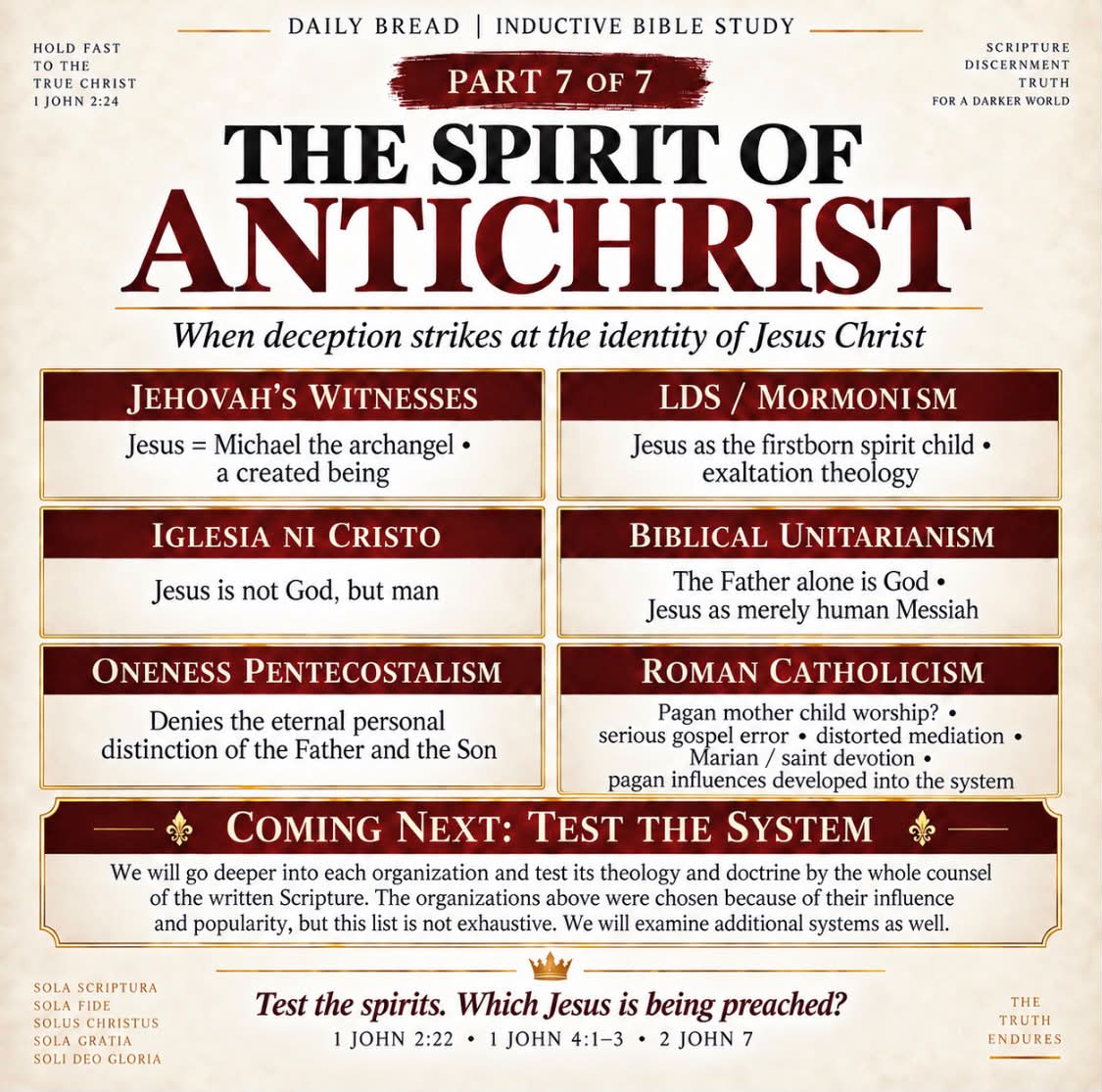
🌾 ANOTHER GOSPEL AND CHRISTIAN NARCISSISM —When human religion exalts man and teaches as doctrine the commandments of men instead of the truth of Jesus Christ. (Matthew 15:9) One of the most dangerous errors in Christianity is the idea that Jesus begins our salvation, but somehow we must finish it. Whether it appears in the doctrines and practices of Roman Catholicism that developed as the institutional church became increasingly intertwined with Rome, absorbing and Christianizing elements from the already powerful pagan religious culture around it, especially under and after Constantine, and eventually building a system of baptismal regeneration, sacramental grace, priestly absolution, penance, the Mass, indulgences, purgatory, and the requirement to remain in a state of grace. Or in Protestant legalism that makes perseverance, obedience, repentance, or holiness the final measure of salvation, the underlying error is the same: Jesus is no longer treated as sufficient by Himself.” Human religion adds something man must do, maintain, complete, or suffer before Christ’s saving work is considered enough. And honestly, it is SHOCKING how deeply this thinking still runs through Protestantism. Sometimes I look at Protestant legalism and think: You can take the person out of Rome, but Rome’s paganism was never completely taken out of the doctrine. Different terminology. Different churches. Different traditions. But whenever the message becomes, “Christ died for you, but your final acceptance before God still depends upon what YOU do afterward,” human merit has been brought right back into the equation. Scripture tells us exactly what to do with that kind of thinking: “Casting down arguments and every high thing that exalts itself against the knowledge of God, bringing every thought into captivity to the obedience of Christ.” — 2 Corinthians 10:5 NKJV Any doctrine, imagination, religious system, or argument that exalts itself against the WRITTEN WORD OF GOD, which REVEALS the KNOWLEDGE OF GOD, must be brought into submission to Christ. Christ’s finished work is sufficient. Man does not complete what Jesus already finished. Jesus destroyed those very doctrines at Calvary. A dying criminal hung beside Him with absolutely nothing to offer. He could not come down from the cross and get baptized. He could not join a church. He could not tithe. He could not serve in ministry. He could not spend the next twenty years proving the sincerity of his faith. He could not accumulate a lifetime of good works. He could not demonstrate perseverance until death because death was already upon him. He recognized that Jesus was innocent, that He did not deserve the death He was dying, and he appealed to Him: “Lord, remember me when You come into Your kingdom.” And Jesus answered: “Assuredly, I say to you, today you will be with Me in Paradise.” — Luke 23:42–43 NKJV TODAY. Jesus did not say, “After you undergo final purification in a place called purgatory.” He did not say, “After you compensate for the sins of your life.” He did not say, “After you prove yourself.” He did not say, “After baptism.” He said: TODAY YOU WILL BE WITH ME IN PARADISE. That one encounter should make us extremely careful about attaching human performance to justification. Is baptism important? Certainly. Water baptism is a public act of obedience that symbolizes a believer’s faith in Christ. It does not save. Salvation is by the grace of God, received through faith alone in Christ alone. Are good works important? Absolutely. God saved us unto good works. “For we are His workmanship, created in Christ Jesus for good works…” — Ephesians 2:10 NKJV But notice what comes immediately before it: “For by grace you have been saved through faith, and that not of yourselves; it is the gift of God, not of works, lest anyone should boast.” — Ephesians 2:8–9 NKJV Works belong to the Christian life. They do not become the basis of justification. Paul makes the distinction even sharper: “Now to him who works, the wages are not counted as grace but as debt. But to him who does not work but believes on Him who justifies the ungodly, his faith is accounted for righteousness.” — Romans 4:4–5 NKJV Read that carefully. Him who does not work, but believes. That is justification. And this is where religious legalism reveals something else that I think needs to be talked about much more openly. It often produces what I would most certainly call Christian narcissistic thinking. I am not talking about making a clinical diagnosis of narcissistic personality disorder. I am talking about a pattern of thinking that is everywhere today: Constantly examining everybody else while refusing to apply the same examination to yourself. People love to talk about narcissism. They analyze someone else’s pride. Someone else’s failures. Someone else’s sins. Someone else’s lack of repentance. Someone else’s lack of fruit. Someone else’s salvation. But suddenly, when the exact same measuring stick is turned around and pointed at them, the standard changes. Ask the legalist: How do YOU know you have repented enough? How obedient is obedient enough? How holy is holy enough? How much fruit is enough? How many sins can you commit before you fail the test? How perfectly must you persevere? At what point can you finally know that you have performed well enough to escape eternal condemnation? And very often the answer suddenly becomes: “Well, I did the best I could.” “I sincerely tried.” “God knows my heart.” “I wasn’t perfect, but I tried to live right.” Do you see what just happened? The impossible standard they confidently apply to everyone else suddenly becomes a sliding scale when applied to themselves. That is narcissistic thinking. The fault is always out there. The deficiency is always somebody else’s. The spiritual microscope is always pointed outward. But when the same standard exposes their own insufficiency, suddenly there are excuses, qualifications, explanations, and appeals to good intentions. Sorry, but the BEST of your ability is NOT GOOD ENOUGH. Mine is not either. That is the entire reason we needed a Savior. If “doing your best” could satisfy the righteousness of God, then Christ did not need to die. God’s standard is not “better than the next person.” God’s standard is HIS RIGHTEOUSNESS. The PERFECTION God REQUIRES IS THE PERFECTION GOD PROVIDES IN JESUS CHRIST’S FINISHED WORK. That is why we need Christ’s righteousness, not an improved version of our own. Paul said: “And be found in Him, not having my own righteousness, which is from the law, but that which is through faith in Christ…” — Philippians 3:9 NKJV And then legalistic narcissistic thinking reaches its astonishing climax in Matthew 7. Because there we see people attempting to do something almost unbelievable: They try to gaslight the Lord Jesus Christ Himself. They stand before Him and begin presenting their case: “Lord, Lord, have we not prophesied in Your name, cast out demons in Your name, and done many wonders in Your name?” Listen to the argument. Look what WE did. Did we not prophesy? Did we not cast out demons? Did we not perform mighty works? They present themselves as though their spiritual résumé should override Christ’s judgment. They appeal to their own accomplishments as evidence that He should receive them. It is the ultimate expression of religious self-deception. They are effectively saying: “Look at the evidence, Lord. Surely You can see that we qualify.” And Jesus does not accept their self-assessment. He does not negotiate. He does not say, “You almost did enough.” He does not say, “You once belonged to Me, but you failed to maintain it.” He says: “I never knew you; depart from Me, you who practice lawlessness!” — Matthew 7:23 NKJV I NEVER KNEW YOU. And here is the staggering part: They presented what they believed were righteous works. Prophecy. Casting out demons. Mighty works. Religious activity. And Jesus calls them lawlessness. The very people who were apparently confident enough in their works to present them before Christ discover that their own evaluation of themselves was completely wrong. They pronounced themselves acceptable. Christ pronounced them guilty. They presented their works as evidence of righteousness. Christ identified their condition as lawlessness. That is why legalism is so spiritually dangerous. It trains people to scrutinize everybody else while quietly trusting in themselves. It encourages comparison. It encourages boasting. It encourages spiritual superiority. It encourages people to believe they can measure another person’s salvation while remaining strangely generous when evaluating their own performance. And eventually the message moves from: “Look what Christ has done.” to: “Look what I have done.” That is not humility. That is religious pride wearing holy clothing. Paul said: “Where is boasting then? It is excluded.” — Romans 3:27 NKJV The Christian life absolutely involves discipleship, obedience, chastening, maturity, fruit, rewards, loss of rewards, fellowship, confession, and spiritual growth. Those things matter tremendously. But we must stop confusing discipleship with justification. We must stop confusing spiritual maturity with eternal life. We must stop confusing rewards with salvation. And we must stop making human performance the finishing work of something Jesus declared: “It is finished!” — John 19:30 NKJV Paul desired: “to be absent from the body and to be present with the Lord.” — 2 Corinthians 5:8 NKJV The believer’s hope is not: “I hope I become good enough before I die.” Our hope is: Jesus Christ was good enough for me. Legalism says: Christ plus my performance. Grace says: Christ. Legalism asks: Have I done enough? Grace points to Calvary and answers: HE DID ENOUGH! And that does not make me want to sin. It makes me want to worship the Savior who accomplished for me what I could never accomplish for myself. Salvation is not Jesus giving us an opportunity to save ourselves. It is Jesus Christ saving the one who believes in Him. And when He promised that dying thief: “TODAY you will be with Me in Paradise,” He left that man absolutely nothing to boast in except the Savior hanging beside him. We should be eager to present the Lord Jesus Christ to a lost and dying world, not the teachings of man and their VAIN and silly doctrines that are contrary to the TRUTH.
Where the ad sends people
fb.com
www.fb.com
Visit profile: fb.com(opens in a new tab)