Mariam Ansari
Mariam Ansari Facebook ad: “Read This Before Your Child Loses Faith”
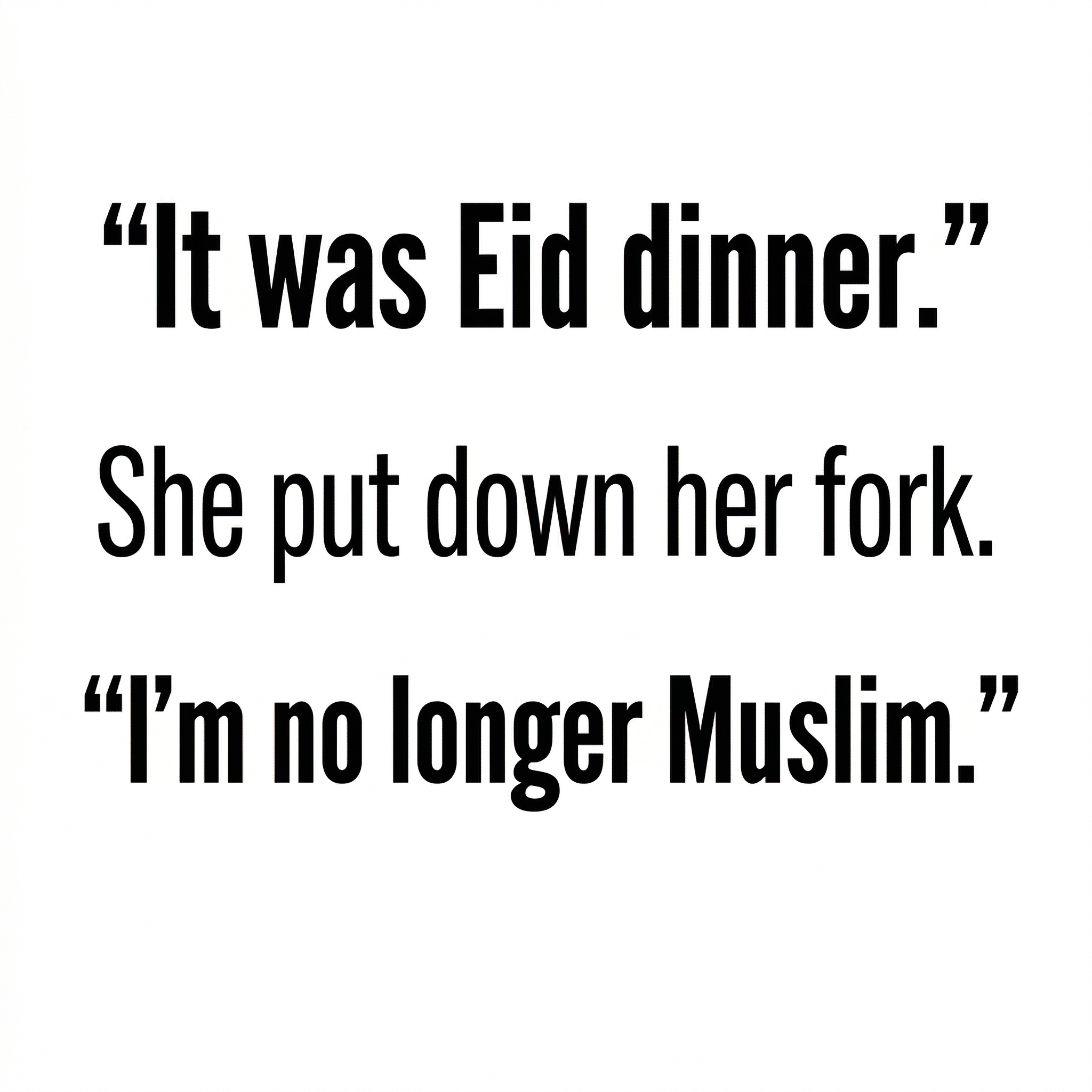
Ran for 59 days, from April 15 to June 13, 2026, the last day Crush saw it.
Run by Mariam Ansari on Facebook. Crush is not the advertiser and does not verify its claims. See this ad in Meta's Ad Library(opens in a new tab)
Want an ad like this for your product?
Crush makes new ad images for your product from this ad: your logo, your product photo, your offer.
Trials from $19.95 USD, then $79.95 USD a month. Cancel anytime.
About this ad
- Meta Ad Library ID
- 791199480462019
- Platforms
- Relaunches
- 1
- EU reach
- 5,591
- Niche
- Parenting & Kids
Ad text
That was our Eid dinner. Twenty-four people. Two long tables pushed together. The tablecloth my mother brought from Egypt, used for twenty years, only taken out on important days. Halfway through the meal, my daughter put down her fork. “I have something to tell everyone.” The table went quiet. I don’t know why, but my heart suddenly started beating faster. I didn’t know what she was going to say, but I felt it would hurt. “I’m no longer Muslim.” What happened next, I don’t remember the sounds, I remember the images. My mother placed her spoon into her bowl, didn’t set it properly. It slipped onto the tablecloth, leaving a brown stain. My husband’s chair scraped the floor as he stood up, then sat back down. My oldest son, the hafiz, turned his head and looked out the window, saying nothing. My younger son, fourteen, looked at his sister, then at me, then lowered his head and stared at his plate. On that twenty-year-old tablecloth, the brown soup stain slowly spread. I sat there, feeling my heartbeat loud in my ears. Twenty-four people. Not one person spoke. Then my daughter picked up her fork and continued eating. As if she had just commented on the weather. That night, after everyone left, I sat alone in the kitchen. The tablecloth was still there. I looked at the stain and realized something. When she said those words, she wasn’t afraid. Not provoking, not testing, not trying to get a reaction. It was the calm of someone who had thought it through for a long time, already accepted it, and was simply informing us. How long had that sentence lived inside her? Six months? A year? Two years? I was with her every day. I taught Islamic weekend school for ten years. I was the mother people in the community came to for parenting advice. And right under my eyes, she walked step by step to that place. I saw nothing. Or maybe I saw it, but didn’t recognize it. Eight months ago, she stopped joining family prayer after dinner. I told myself she had too much homework. Six months ago, she took off her hijab, saying it felt uncomfortable at school. I told myself it was a phase. Four months ago, I saw her search history: “Why does Islam discriminate against women” “Stories of ex-Muslims” I closed the page. I told myself if I didn’t touch it, it wasn’t real. Now, at the Eid table. Twenty-four people. That brown stain. My daughter’s calm face. It was real. It had always been real. I just let it grow in the dark for too long. In the next two months, I did everything wrong. I took her to a respected scholar. He was sincere, kind, using the traditional language I had trusted my whole life. But as he spoke, I watched my daughter’s eyes slowly lose focus. She nodded politely, but she wasn’t there anymore. For a child raised on YouTube and TikTok, dense, text-heavy explanations don’t create understanding. They create shutdown. The more he spoke, the more she closed. Then I started buying books. Classic English tafsir. Heavy, respected, strongly recommended. She forced herself to read two pages, looked up at me, half joking, half exhausted: “Mom, why does the word of Allah read like a vacuum cleaner manual?” She closed the book and never touched it again. Then there was that dinner. She asked about inheritance law. I was tired, I was scared, and I said the worst thing I could say. “Because it’s Allah’s will. It’s a test of faith.” She didn’t argue. She stood up, went to her room, and locked the door. Not out of anger. But because she got exactly the answer she expected. Standing outside that door, I understood something for the first time. Every time I said “because Allah says so,” someone online was saying, “let me explain why that doesn’t make sense.” The people answering our children online are there 24 hours a day. They have patience. They have resources. They walk them step by step through the entire thinking process. And I was standing outside a locked door, holding a book she couldn’t read. Three weeks later, at a small parents’ gathering, I met a friend I deeply trust. She has worked in education for years and raised a child who went through the same crisis and came back. I told her everything. The Eid table. The stain. The closed door. She didn’t quote scripture. She didn’t preach. She took a book out of her bag, placed it on the table, and asked me one question. “Have you ever considered that the problem isn’t your daughter, and it isn’t Islam, but that kids today don’t adapt to high-density text?” She explained that this generation grew up in a visual environment. Not that they are shallow, not that they aren’t serious. But the way they process information is fundamentally different. They grew up with images, timelines, dynamic content, zoomable maps. Their brains learned to extract meaning from visual structures. Dense text doesn’t create understanding for them. It creates resistance. This isn’t attitude. It’s neurological reality. “So when we put the Qur’an into heavy commentary books,” she said, “we think we’re giving them depth. But their brain only receives one signal: this is not for me.” “Then they go to YouTube. YouTube gives them visuals, timelines, logical chains they can see. Their brain immediately says: this I understand.” “We didn’t lose a theological debate. We lost the format.” She pointed to the book. “The content of the Qur’an was never the problem. But we’re using a thousand-year-old delivery method to reach a 2026 brain.” I looked down at the book. It wasn’t black-and-white. It looked like a modern textbook, almost like a DK-style encyclopedia. The title was Qur’an Made Simple. I immediately asked, “Who made this? Is it reliable?” She explained it wasn’t one person’s opinion. It was carefully developed by a UK-based Islamic education team with years of curriculum experience. The English is adapted from the Saheeh International translation, approved by Abul Qasim Publishing, staying true to the original Arabic meaning while being genuinely readable. The goal isn’t to simplify the Qur’an itself, but to remove unnecessary barriers. Clear modern English. Short explanations right next to the verses. Visual aids to support understanding, without depicting prophets or violating Islamic values. “This is one of the most careful and trustworthy versions I’ve seen for families, new Muslims, and non-Arabic speakers,” she said. “I have no personal interest in it. I just think you should know it exists.” I opened it. I flipped to Surah Al-Fil. Instead of long paragraphs, there was a tactical map. Abraha’s route, terrain, distance, political context. A story I had memorized for forty years suddenly felt real instead of abstract. Standing there, I had one thought. Eight months ago, when my daughter was searching for answers online, if this is what she had seen instead of those heavy books, would she still be here today? That night, I didn’t hand it to her. I just left it on the kitchen table where she does homework. Day one, she ignored it. Day two, she flipped a page while eating breakfast. Day three, I walked past her room and stopped. She wasn’t on TikTok. She was reading. A week later, at dinner, she looked up and casually said: “Mom, did you know the inheritance system in the Qur’an was actually revolutionary for its time?” I just stared at her. She took the book, pointed to a detailed chart. “Before this, women got nothing. This system guaranteed women assets without financial obligation. It actually protects women more than men. It’s kind of genius.” Genius. Not because it’s sacred. Not because “Allah said so.” But because she actually understood. She still has many questions. She didn’t come back overnight. But the door opened a crack again. And this time, she opened it herself. I still teach weekend school. But I don’t hand parents those dry, unread books anymore. I give them Qur’an Made Simple, and I say: “This is a language their brain understands.” Because our children don’t need more commands. They need a map. If your child is asking questions that make your heart race, If you feel them drifting somewhere you can’t reach, If you know they’re looking for answers online but don’t know what they’re finding, Don’t wait. The voices pulling our children away are online 24 hours a day. We should be using a 2026 way to pass on faith too. This book is the answer I found. Not the only answer. But the first one that truly reached her. Update: https://tryterre.com/products/qur-an-made-simple-illustrated-guide A lot of people asked me for the link. This is the official place I bought it.
Where the ad sends people
tryterre.com
Read This Before Your Child Loses Faith 👆
Don't just recite. Understand. Your journey to connecting with the Quran starts here. Many of us struggle to move beyond recitation. We want to understand the message, but traditional texts can feel overwhelming or complex. The TERRE Edition is thoughtfully compiled to solve this. We have bridged th...
Shop now: tryterre.com(opens in a new tab)