Health Insiders
Health Insiders Facebook ad: “Read This If You Use Plastic Utensils”
Ran for 68 days, from January 15 to March 24, 2026, the last day Crush saw it.
Run by Health Insiders on Facebook. Crush is not the advertiser and does not verify its claims. See this ad in Meta's Ad Library(opens in a new tab)
Want an ad like this for your product?
Crush makes new ad images for your product from this ad: your logo, your product photo, your offer.
Trials from $19.95 USD, then $79.95 USD a month. Cancel anytime.
About this ad
- Meta Ad Library ID
- 886301243867899
- Platforms
- Facebook, Instagram, Audience Network, Messenger and Threads
- Relaunches
- 0
Ad text
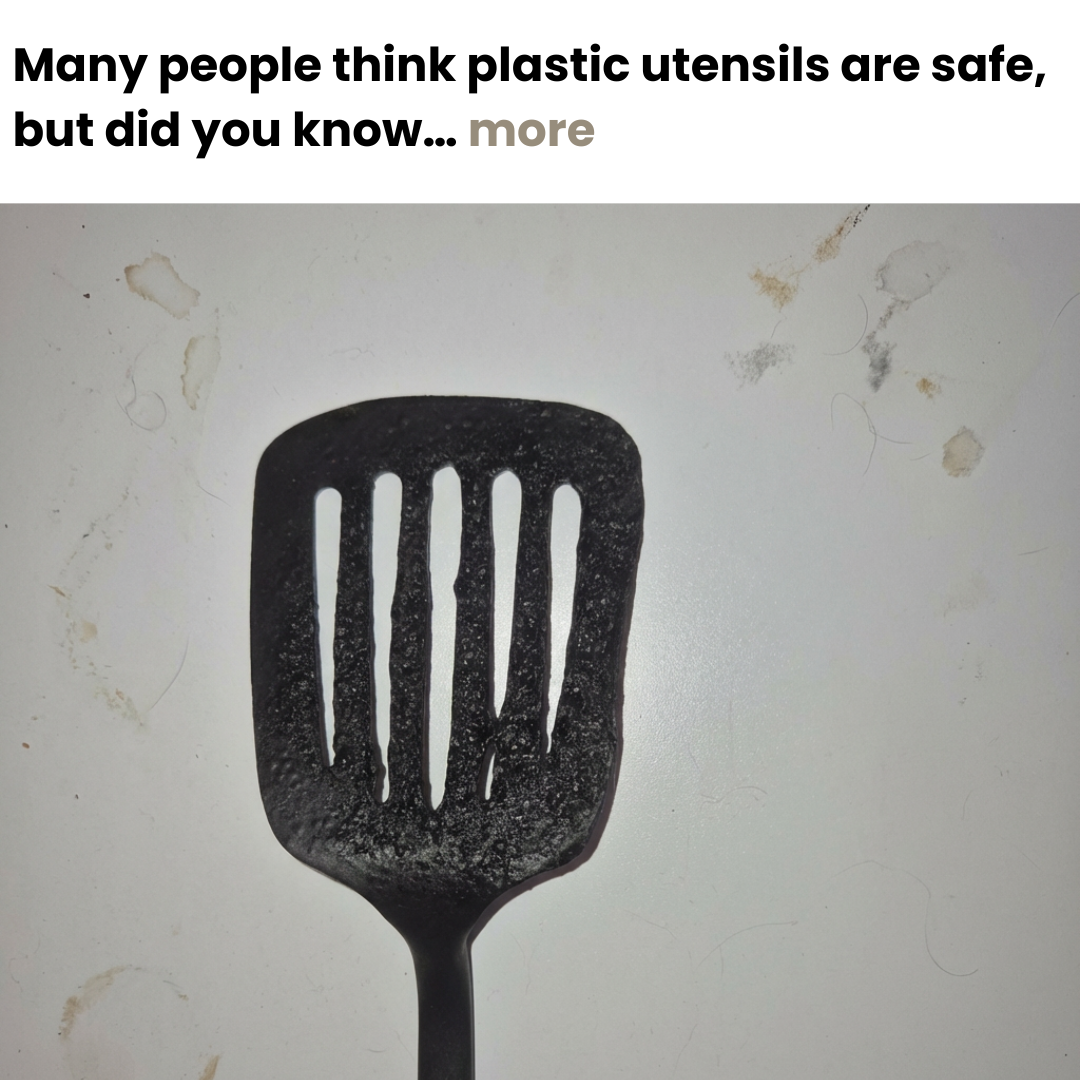
I didn't think anything of the grey scratch marks on my black spatula until my GP told me what those 'missing pieces' of plastic actually become inside the body. I was there for my daughter's six-month check-up. Routine appointment. Growth charts. Developmental milestones. The usual. Dr. Patel was making notes when she glanced up and asked, almost casually, "What are you cooking with at home?" Odd question. "Um, normal stuff? Pots and pans?" "I mean your utensils. Spatulas. Spoons. What material?" I had to think about it. "Plastic ones, mostly. The black ones from Tesco. Why?" She put her pen down. "I'm going to show you something, and I don't want you to panic." She pulled up a study on her computer. Recent publication. September 2024. Researchers had tested common black plastic kitchen utensils sold in the UK and found them contaminated with flame retardants originally used in electronic waste. Not just traces. Significant levels. "When you heat these utensils," Dr. Patel explained, "especially above 70 degrees Celsius, these chemicals migrate into your food. Into the oils and fats particularly." I felt my stomach drop. "But they're kitchen utensils. They're meant to be heated. How is this legal?" "The regulations haven't caught up with the manufacturing practices. Companies are using recycled plastics from computers and TVs to make kitchen products. It's cheaper. And technically, the utensils themselves aren't regulated the same way food packaging is." She turned the screen toward me so I could read it myself. Brominated flame retardants. Endocrine disruptors. Linked to thyroid problems, developmental delays in children, and increased cancer risk. My daughter was six months old. Still exclusively breastfed, but I'd just started weaning her. Making her first purees. Steaming vegetables and mashing them with those exact plastic spoons. "How long have I been using these?" I asked, though I was really asking myself. "That's not the question to focus on," Dr. Patel said gently. "The question is what you're going to use going forward." I drove home in a daze. Pulled into the driveway. Sat in the car with the engine off. I thought about every meal I'd cooked in the last three years. Since my son was born. Scrambled eggs in the morning. The black spatula scraping across the non-stick pan. Bolognese sauce simmering for hours. The black spoon resting against the side of the pot, the handle getting warm. Stir-fries on high heat. The plastic turner pressing against the hot wok. How many times had I noticed the grey marks? The worn edges? The slight melting at the tips? And how many times had I just kept using them because they were right there in the drawer and dinner needed to be made? I went straight to the kitchen when I got inside. Pulled out every utensil. Lined them up on the counter. Nine pieces. All black plastic. All damaged in some way. The spatula had a chunk missing from the corner. Like something had bitten it. The slotted spoon was covered in hairline cracks. The ladle's edge was rough, no longer smooth. I grabbed my phone and took a photo. Needed to document this. Needed proof that I wasn't overreacting. Then I opened the bin and threw them all away. My husband came home from work an hour later and found me sitting at the kitchen table, staring at an empty drawer. "What happened to all the spoons?" "They were poisoning us." I didn't sleep that night. Every time I closed my eyes, I saw those grey scratch marks. Saw my daughter's tiny mouth opening for a spoonful of pureed carrots. At 2:47 AM, I was on my laptop at the kitchen table, scrolling through study after study. The research was damning. One paper showed that a single black plastic utensil could contain up to 1,200 parts per million of flame retardant chemicals. The recommended safe limit for children's toys was 1,000 ppm. Our cooking utensils had higher chemical loads than toys. And unlike toys, these utensils were being heated and stirred directly into food. I found a visualization in one study that showed how heat accelerates chemical migration. At 200 degrees Celsius—normal cooking temperature—the migration rate increased by 300%. Every time I'd made a stir-fry. Every time I'd seared chicken. Every time I'd scraped the bottom of a hot pan. I was extracting chemicals and folding them directly into our dinner. The next morning, I did what everyone does when they panic. I went to Amazon and ordered replacements. Silicone utensils. Five-star reviews. "Heat resistant to 600 degrees!" "Non-toxic!" "FDA approved!" They arrived two days later. I used them that same evening. Made a simple pasta sauce. The spatula felt… wrong. Too soft. It folded when I tried to scrape the bottom of the pan. I couldn't get the bits of garlic and onion that were starting to stick. And it smelled. This faint rubbery smell that got stronger as it heated up. I served dinner anyway. Told myself I was being paranoid. A week later, I noticed the silicone turner had developed a white film. Like a powder coating the surface. I scrubbed it. It came back. I googled it at midnight, sitting on the bathroom floor while my husband slept. Turns out cheaper silicone contains fillers. Calcium carbonate. Talc. Other materials to bulk out the product and reduce costs. And those fillers can leach when exposed to heat and detergents. I'd swapped one leaching problem for another. I tried stainless steel next. Lasted exactly three dinners. The first night, the sound of metal on metal made my skin crawl. My son covered his ears. The second night, I accidentally left the steel spatula in the pan while the burner was on. Grabbed the handle thirty seconds later and burned my palm. The third night, I looked down at my ceramic pan—the expensive GreenPan I'd bought specifically because it was non-toxic—and saw deep scratches across the bottom. Metal utensils were destroying the one thing I'd invested in to keep my family safe. I sat down on the kitchen floor and cried. Not dramatic sobbing. Just quiet tears of frustration. It felt like I was trapped in an impossible choice. Poison my family with plastic. Use questionable silicone. Ruin my expensive pans with metal. There had to be something else. I found the answer in the most unexpected place. I was at my mother-in-law's house for Sunday lunch. She'd made a roast. I was helping her in the kitchen when I noticed her utensils. Wooden. Beautiful dark wood with rich grain patterns. Worn smooth from years of use. "How long have you had these?" I asked, picking one up. "Oh, those were my mother's. So, must be fifty years at least? Maybe more." Fifty years. I was throwing away utensils every few months and she'd been using the same ones for half a century. "What kind of wood is this?" "Teak, I think. That's what Mum always said. She got them when she and Dad lived in Malaysia for a bit." I turned the spoon over in my hands. Not a single crack. No splinters. The surface was smooth and slightly warm to the touch. "Do you ever worry about them? Like, bacteria or chemicals or anything?" She laughed. "Teak's naturally antibacterial, love. That's why they use it for boat decks. It has oils in it that repel water and stop rot. I just wash them like normal and oil them once in a while." She showed me how she used one to stir her gravy. The way it moved through the thick liquid with ease. The way it didn't scratch against the bottom of her old stainless steel pan. "You can't buy stuff like this anymore," she said. "Everything now is cheap plastic rubbish." She was wrong about that last part. That night, I searched for teak utensils online. There weren't many options. Most of the results were bamboo—which I quickly learned was completely different. Bamboo is technically a grass. It's laminated together in strips with adhesive. Industrial glue. Often formaldehyde-based in cheaper products. So bamboo had the same problem as plastic, just hidden better. But teak. Real teak. That was different. Solid hardwood. Carved from a single piece. No glues. No adhesives. No synthetic coatings. And the natural oil content meant it didn't dry out, didn't crack, didn't harbor bacteria the way softer woods like pine or beech would. I found a set. Seven pieces. Not cheap, but not outrageous either. About the same price as the ceramic pan I'd bought to replace my Teflon one. I ordered them at 11:30 PM on a Tuesday. They arrived four days later. I opened the box in the kitchen. Pulled out the first spoon. The weight of it surprised me. It had substance. Presence. I ran my thumb along the grain. Perfectly smooth. No rough edges. No coating to chip off. I made dinner that night. Nothing fancy. Just chicken and vegetables. But when I picked up that wooden spatula and started cooking, something shifted. It was quiet. The scrape of wood against my pan was soft. Almost soothing. It moved through the food effortlessly. I could feel the texture of what I was cooking through the handle. And there was no smell. No chemical off-gassing. No rubber scent. Just wood. And food. The way it should be. My son noticed immediately. "New spoons, Mummy?" "Yes, darling. These ones are going to last forever." He ran his finger along one, fascinated by the grain pattern. "Like Granny's?" "Exactly like Granny's." It's been four months now. The utensils look exactly the same as the day they arrived. I oil them once a month with food-grade mineral oil—takes two minutes—and they stay beautiful. No scratches on my pans. No melted edges. No grey marks that make me wonder where the missing plastic went. Just tools that work. That last. That don't make me second-guess every meal. Last week, I made my daughter's first birthday cake. Mixed the batter with a wooden spoon. As I stirred, I thought about all the meals ahead of us. All the dinners I'll make for her over the years. And I felt this deep, quiet relief. Because I'm not gambling anymore. I'm not hoping the utensils are safe. I'm not worrying about invisible chemicals migrating into her food. I know they're safe. The way my mother-in-law knew. The way her mother knew. If you're reading this because you noticed the grey marks on your spatula and it made you feel sick inside—I understand. If you've been lying awake at night, adding up all the meals you've cooked, wondering what damage has already been done—I've been there. You're not paranoid. You're not overreacting. Your instincts are telling you something is wrong because something IS wrong. And there's a solution that works. That actually, properly works. Not a compromise. Not a "better than plastic but still questionable" option. Just what your grandmother already knew was right. One purchase. One decision. Done. No more cycle of buying, discovering problems, throwing away, searching again. Just cooking. Just feeding your family. The way it's meant to be.
Where the ad sends people
vtlfx.com
Read This If You Use Plastic Utensils☝️
✔️ Fri for plastik og skadelige kemikalier ✔️ Varmebestandig og ridsefri ✔️ Langtidsholdbar og bæredygtigt fremstillet
Learn more: vtlfx.com(opens in a new tab)