Dr. Greg D Raymond
Dr. Greg D Raymond Facebook ad: “Support your liver today”
Ran for 5 days, from September 22 to September 27, 2026, the last day Crush saw it.
Run by Dr. Greg D Raymond on Facebook. Crush is not the advertiser and does not verify its claims. See this ad in Meta's Ad Library(opens in a new tab)
Want an ad like this for your product?
Crush makes new ad images for your product from this ad: your logo, your product photo, your offer.
Trials from $19.95 USD, then $79.95 USD a month. Cancel anytime.
About this ad
- Meta Ad Library ID
- 956313793542595
- Platforms
- Facebook, Instagram, Audience Network, WhatsApp and Threads
- Relaunches
- 1
Ad text
I'm an endocrinologist. I've spent 12 years studying type 2 diabetes and blood sugar. The first thing you learn in my field is that sugar is one of the fastest ways to take a body apart. Then I traveled to Sweden. The country that eats more candy and pastry per person than almost anywhere on earth. What I found there broke everything I thought I knew. Let me back up. I run a diabetes clinic at a large hospital. Doctors send patients to me when they have been on metformin for years and their A1C will not come down, or their blood sugar looks controlled on paper and their bodies are still getting worse. Patients who have done everything they were told and are now sitting in front of a specialist wondering why. By the time a chart hits my desk, I already know what it is going to say. Because it always says the same thing. Patient presents with elevated fasting glucose. Doctor's notes: prediabetes. Cut out bread and sugar. Patient returns. Morning number down a little. Not enough. Doctor's notes: start metformin 500mg. Try harder on the diet. Patient returns. Fatigue that sleep does not fix. Up three times a night. Doctor's notes: probably stress. Recommend more exercise. Patient returns. Numbness in the feet that carried him through twenty years on a factory floor. A1C "managed". Doctor's notes: probably aging. Add a second pill. Patient returns. Brain fog. Protein showing up in his urine. Wife is worried. Doctor's notes: discuss starting insulin at next visit. Patient does not make the next visit. He is brought in on a stretcher at 4 AM. Blood sugar over six hundred in his sleep. His wife is crying in the waiting room. Five visits. Five years. Five dismissals. And a sixth visit he did not walk into on his own. Then the ultrasound lands on my screen. I pull it up. And in under a minute I see what explains every one of those visits. Fat. Packed into the cells of an organ that stopped doing its job years ago. A liver too full to hold another gram of sugar after a meal. That is the morning number that would not come down. Liver cells no longer answering insulin's signal. That is the dose going up, and up. Enzymes elevated on every panel for three years, tracking with the fat. That is the fatigue nobody could explain. And an organ still manufacturing sugar at 3 AM, dumping it into a bloodstream with nowhere to put it. That is the stretcher at 4 AM. "Nobody saw it coming." Except it was clear as day. Every visit. And nobody ever bothered to look. I see this every single day. It never changes. So when I got invited to an endocrinology conference in Stockholm last spring, I added a week to the trip. Something had been bothering me for years. Sweden eats sweet. Cinnamon buns. Chocolate. Pastry twice a day with coffee. A bowl of pick-and-mix candy on Saturday that the whole family works through. That is the exact diet we tell American patients is giving them diabetes. But Sweden has some of the lowest rates of diabetic complications in the developed world. Their elderly walk into their nineties on their own two legs. Their endocrinologists are treating a fraction of the amputations and the kidney failures American endocrinologists are treating every week. Based on my training, that makes no sense. They should have more of what I see every day. Not less. I needed to understand why. After the conference I took a train north to Uppsala to spend three days shadowing a senior endocrinologist a colleague had introduced me to. His name is Dr. Anders Rosling. He is 68 years old. Still practicing four days a week at a hospital just outside Uppsala where he has been for over 30 years. His father was a physician before him and lived to 92 on his own feet. Dr. Rosling is precise. Sharp. Not the warm handshake type. He shook my hand at the front of the clinic and told me to stay quiet, watch, and ask questions in the coffee break. I sat in on his morning appointments. What I saw shocked me. Patient after patient came in with the kind of numbers that would have earned an American metformin escalation in the first ten minutes. A1C climbing. Morning numbers that would not hold. Family history of type 2. The pattern I know cold. Dr. Rosling did not reach for the prescription pad once. He asked about their meals. He asked about their sleep. He asked what their liver was being asked to do every day. And in every consultation, he pulled out a small photograph of a healthy liver cross-section and a fat-packed one and pointed at the difference. "Your blood sugar is not the disease," he told a 61-year-old man in the second appointment I sat in on. "Your blood sugar is what is left over because the disease is here." He tapped the fat-packed photograph. "Nobody has emptied this in you for twenty years. We start with this today." At the coffee break I could not hold my questions anymore. "Anders, how are your patients not on insulin?" He looked at me for a moment. Then he laughed. Actually laughed. "Of course some are. When the organ is damaged badly enough that we cannot wait for it to empty, yes. But most of my patients? No. Because we treat the liver first. The number comes down on its own once the liver is doing its job again." He gestured for me to sit down. "Do you know why Swedes eat pastry twice a day and live to 92? Because we learned a long time ago that sugar is not the enemy of the body. An organ with nowhere left to put it is. Sugar comes and goes. A liver packed with fat stays packed for decades if nobody helps it empty." He shook his head. "In America you have taken the number on the chart and made it the enemy. So you spend every consultation lowering the number. In Sweden we take the liver and make it the priority. We ask what filled it. We help it empty. Then the number takes care of itself." "You must lower AND empty. Two jobs. Always." I sat there staring at him. I have spent 12 years studying glucose metabolism. Published on insulin resistance. And this 68-year-old man had just described in one sentence what the entire American diabetes protocol misses. He continued. "Metformin quiets the sugar your liver lets out. Yes. Good. But if the organ is still packed with fat, every gram of sugar that comes in still has nowhere to be stored. Metformin turns the tap down. It does not empty the tank. Every one of my American colleagues knows this and keeps prescribing anyway. Because there is no drug for the tank." He reached into the drawer of his desk and pulled out a small brown glass jar. Amber. Label in Swedish. Milk thistle extract. Standardized. With NAC and choline beside it. "This," he said. "This is what I take every morning. What my father took. What most of my colleagues in this hospital take. Not the ground seed from the grocery store. That is a decoration. This is the concentrated extract with the three things the organ actually needs." He set the jar on the desk between us. "There are three things in that jar. Not one. Three. And they do two different jobs. Which is why one alone will not work, and why the pill your colleagues want to prescribe will not either." "First, the organ. Ask an American doctor what pulls the sugar out of your blood and he will say the pancreas. The pancreas makes the signal. The liver does the work, hour after hour, awake and asleep. Fill it with fat and there is nowhere left to put what keeps arriving, so the sugar stays in your blood. The number you write down every morning is not a report on what you ate. It is a report on how full the organ is." "The first is NAC. It is what hospitals put in an IV when a liver is failing, and it rebuilds glutathione, which is what the organ runs on to break the trapped fat apart. Nothing else in that jar can move fat that has not been broken up first." "The second is choline. This is the one your training does not emphasize enough. Choline is what the liver uses to package fat and carry it out of the cell. It is the truck. Without it the fat is broken up and sits exactly where it was, because nothing comes to take it away. Eight out of ten adults do not get enough from food, and none of them know." "The third is silymarin. The active compound in milk thistle." He said it slowly. He knew I was an endocrinologist and he knew I would want to hear it exactly. "Silymarin protects the cells while they empty. An organ that has carried fat for twenty years is under load the entire time it is clearing, and a cell that cannot repair cannot finish the job. Silymarin is what lets it empty and recover at the same time." He picked up the jar. "Three things. One jar. Two of them empty what filled the organ. The third rebuilds it while it empties. That is why the men in my hospital walk into their nineties with their sugar in range. Not because we prescribe better metformin. Because we know an organ with two problems needs two solutions." I sat there for a long time. Because I had spent 12 years chasing one number while three ingredients in a jar on a Swedish endocrinologist's desk were doing the two things my prescription pad could not. I flew home the following week. I had known about milk thistle academically for a long time. European journals ran papers on silymarin and liver function every year. I had skimmed them for headlines and never opened them. I opened them that week. The peer-reviewed research documented exactly what Dr. Rosling had described. A randomized, double-blind trial published in Phytotherapy Research in 2006 gave standardized silymarin to type 2 patients for four months and saw significant drops in both A1C and fasting glucose against placebo. A 2016 systematic review in the Journal of Diabetes Research, pooling randomized controlled trials, confirmed the same direction across the pooled data. And choline, the ingredient nobody puts in the bottle, had already been settled decades earlier. Controlled feeding studies published in the American Journal of Clinical Nutrition showed that adults deprived of choline accumulated fat in the liver and saw their enzymes climb within weeks, and that both reversed when choline was restored. Not a theory about what the liver might do. A demonstration of what happens to the organ when the truck never shows up. Three ingredients. Two jobs. One organ. I sat at my desk with the studies open and thought about the man on the stretcher at 4 AM. Every one of my patients whose A1C I have been chasing for years while the organ underneath kept filling. There was something that could have been helping them this whole time. And nobody told them. Before you go and buy milk thistle capsules from the drugstore, I tried that first. Here is what happened. I bought two different brands from Amazon my first month back. Highly rated. Thousands of reviews. Six weeks. My panel did not budge. I was ready to conclude that Dr. Rosling had oversold it. Then I actually looked at what I had bought. Ninety percent of what is sold as milk thistle in America is not the standardized extract those trials used. It is ground seed. The whole seed, dried, milled, packed into a capsule. Cheaper. And it carries four percent of the compound the organ needs, against the eighty percent of the European extract. I ran one of the bottles in the hospital lab. Four percent. You would have to swallow twenty of those capsules every morning to reach the dose in the published research. In Europe milk thistle is sold through pharmacies, which means the extract is legally obliged to be standardized and the number printed on the box. In the United States it is a food supplement, which means it is obliged to nothing at all. Nobody enforces the difference. So the bottle most of my American patients buy to help their liver is four percent of the dose every study was run on. And that is before the second problem. Even when the extract is the real standardized kind, it arrives alone. Milk thistle by itself. No choline anywhere on the label. Which means nothing in that bottle can move a gram of fat out of the organ. It protects the cell and leaves the fat where it is. The two brands I tried had failed for one reason or both. I needed a formula with the European standardized extract at eighty percent, at the dose used in the published research, with NAC and choline beside it. The brand Dr. Rosling recommended when I called him from home was called Happy Liver. I called the company directly before I ordered. That is how I was trained. You do not put your name behind a supplement the way you would not put your name behind a medication. You verify the source. You read the lab work. I asked for the Certificate of Analysis. I asked how the silymarin percentage was verified. I asked for the choline dose in milligrams. I asked who tested the batches. They sent me everything within the day. European pharmaceutical grade milk thistle, standardized to eighty percent silymarin and HPLC-verified per batch. NAC at pharmaceutical purity. Choline at the dose the organ needs to export fat, not a token amount on a label. Third-party tested. No fillers. That was the brand I ordered. I started the following Monday. Two capsules with breakfast. That was the whole protocol. Week 1. The thirst eased off. The two o'clock wall I had been hitting every afternoon for months was gone within four days. Week 2. Sleeping through the night without getting up. And one morning I ran my own fasting glucose at the hospital, the way I have run it a thousand times for other people. It had come down. Not by a little. Enough that I ran it again the next morning to be certain it was not an error. It was not an error. Week 4. The tingling I had started noticing in my own feet at the end of a long ward day was clearing. I kept testing every few mornings, because part of me still did not believe it, and the line that had bounced up and down for years no matter what I put in front of it finally started to bend in one direction, and to stay there. Week 6. My cravings for anything sweet after dinner had gone quiet. I had dropped four pounds without changing anything else I was doing. Week 12. My A1C came back. I sat in my office and pulled it up on the screen. I stared at it for a full minute before I believed what I was looking at. The number I had been chasing in other people for 12 years, the one that had refused to move for me no matter what I forced onto it, had finally come down on its own. My liver enzymes, elevated on every panel for three years, were sitting in the normal range for the first time since I had been paying attention. I brought the panel to my colleague. He looked at it. Then he looked at me. Then he looked at it again. "What did you do?" I told him. Two capsules every morning with breakfast. That was it. He listened without interrupting. Then he wrote it down. I am 12 weeks in. My energy is steady through the whole day. My feet are quiet at night. My A1C came back lower again four weeks ago, and it is still moving in the same direction. I never filled the metformin that was written for me. My own doctor rechecks me at six months instead of six weeks. I am writing this because after 12 years of watching the same blind spot hurt the same people I cannot stay quiet anymore. If your morning number keeps climbing no matter what you cut. If your metformin dose keeps rising and your A1C still will not hold. If your feet buzz at night and your doctor keeps telling you it is aging. If you have been told your blood sugar is well-controlled but your body knows better. I hear you. I told my patients that line for 12 years before I understood what I was missing. Happy Liver. Two capsules every morning with breakfast. It supports the two things a decade of processed food and daily sugar have been quietly doing to the organ that runs your blood sugar. The fat that filled the storage. And the repair the cells cannot finish while it sits there. Happy Liver has a 60-day money-back guarantee. If you do not see a difference, you get a full refund. No questions asked. In 12 years of medicine I have never once seen a drug company offer to give your money back if their medication did not work. Think about that for a second. Here is what I would do with that guarantee. Get your A1C and your fasting glucose drawn this week, before you start. Then get them drawn again at eight weeks. You will know, with a number, whether it worked. And if it has not moved, you send the bottles back and every dollar comes back. That is what your doctor's plan never gives you. Twelve weeks of waiting and no way to tell whether anything is happening. Happy Liver is made in small batches in Europe and they sell out regularly. If you have an endocrinology appointment or a physical in the next 30 to 60 days and you want to give your body a real shot before that visit, check availability now. Do not wait. Every day the organ stays packed is another day the sugar has nowhere to go. Another day closer to the 4 AM nobody sees coming. You still have time. Do not wait until the conversation with your doctor is about insulin instead of the number. 👉 https://rituallabs.shop/products/happy-liver ~ Dr. Greg Reymon, MD, Endocrinology, 12 years P.S. About the wrong milk thistle. Almost all of it on Amazon and at the drugstore is ground seed at four percent, with no choline anywhere next to it. Twenty of those capsules do not add up to the two I take every morning. Do not think you are doing the same thing I did by buying the cheap version. You are swallowing the dust of the seed and leaving the fat exactly where it was. P.P.S. Do not stop your metformin on your own if you are on it. Tell your doctor you are adding Happy Liver and ask them to recheck your A1C in eight weeks. The point is not to fight your doctor. The point is to give your body the one thing the prescription pad was never designed to reach. The organ itself.
Where the ad sends people
https://rituallabs.shop/
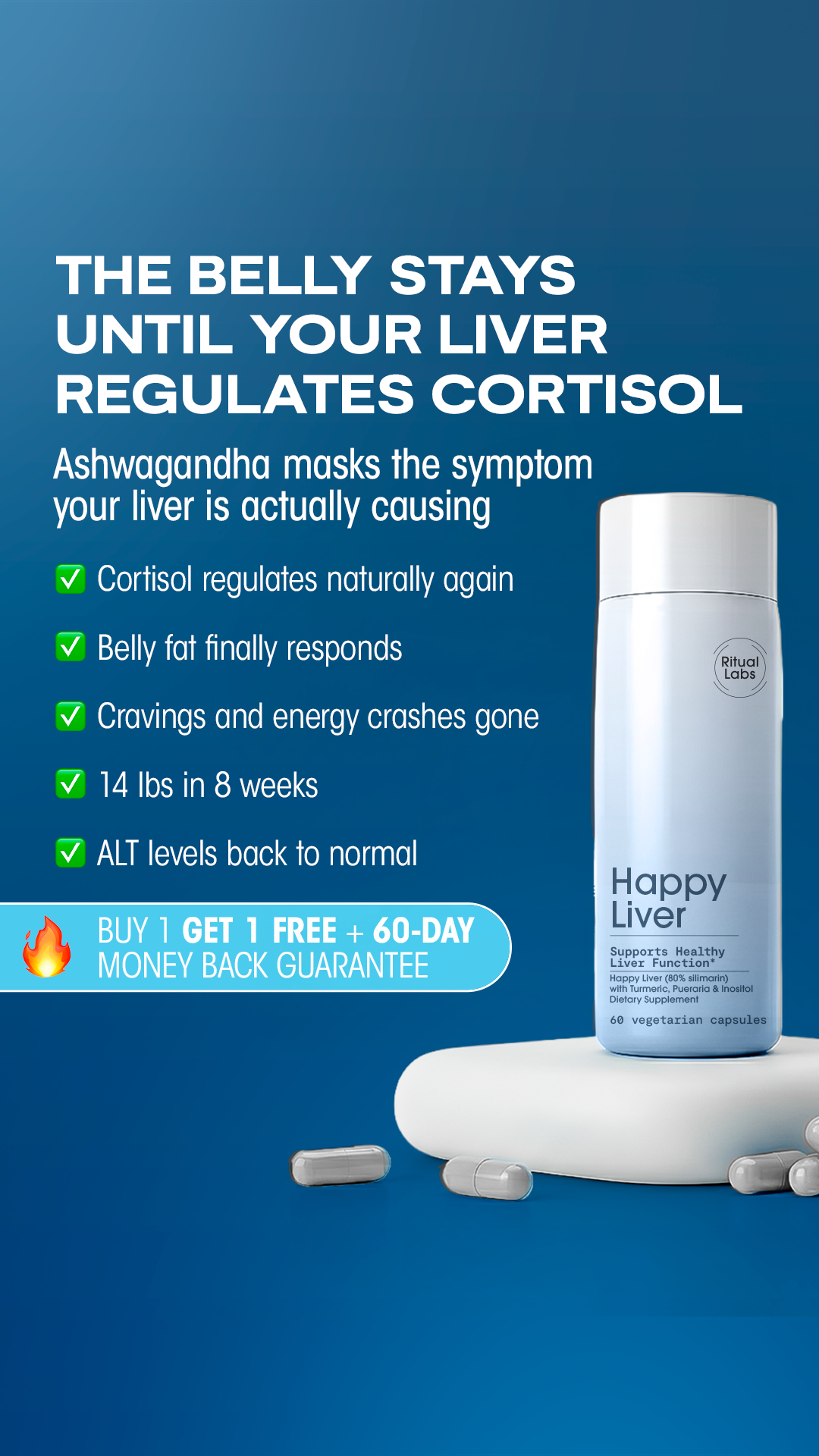
Support your liver today
Your liver processes everything - alcohol, medications, junk food, environmental toxins. Happy Liver provides daily protection with clinical doses of Milk Thistle, NAC, and Choline
Learn more: rituallabs.shop(opens in a new tab)