
Key Takeaways
- 1An AI marketing agent takes a goal and limits and acts on its own, a copilot suggests and waits for you, and an automation rule repeats one if-then you wrote.
- 2In vendor documentation read in November 2026, agents act alone on one small action at a time and wait for approval before an email, post or page reaches many people.
- 3Agents are weakest on long, multi-step work: the best agent fully completed 30% of 175 tasks in the TheAgentCompany benchmark.
- 4Before connecting an agent to a live account, demand a hard budget cap, an approval step for public actions, a full action log and a stop switch you have tested.
- 5Choose an agent by job: Crush for Meta ads, Google's Ask Advisor for Google Ads, Klaviyo Composer for email, and Intercom Fin or HubSpot's customer agent for support.
An AI marketing agent decides and acts toward a goal inside limits you set. What agents really do today by marketing job, where they fail, the controls to demand and eight products checked in November 2026.
An AI marketing agent is software that is given a marketing goal and limits, then decides what to do and does it: it launches the ad, moves the budget or answers the customer. An assistant or copilot only suggests and waits for you, and an automation rule only follows a fixed if-then you wrote.
Most products sold as agents in 2026 sit somewhere between those three. We read the vendors' own documentation for eight of them in November 2026. The pattern: agents act alone on one small action at a time, such as one customer reply or one losing ad, and stop for your approval before anything that reaches your whole list or your whole account.
What is an AI marketing agent?
IBM defines an AI agent as a system that performs tasks autonomously by designing its own workflow with the tools it has. Anthropic's engineering team, in a guide published in December 2024, separates two things that often share the name: workflows, where a model is run through code paths someone wrote in advance, and agents, where the model directs its own process and its own use of tools.
In marketing terms, a product is an agent when it passes three tests:
- It takes a goal, not a prompt. "Get purchases at or below my target cost" is a goal. "Write five headlines" is a prompt.
- It has write access to a tool. It can change something in your ad account, email platform or help desk, not only describe the change.
- It chooses the next step itself. It reads the result of its last action and decides what to do next, inside the limits you set.
The label is used loosely, so test the product, not the name. Ask the vendor one question: what happens in my account when nobody clicks anything?
AI agent vs copilot vs automation rule: what is the difference?
IBM's comparison of assistants and agents puts the line at who moves first. An assistant is reactive: it starts from your prompt and waits for permission before acting on its own recommendation. An agent is proactive: after one kickoff instruction it plans and takes actions toward a defined goal. An automation rule is older and simpler than both: one condition and one action, written by you.
| Automation rule | Assistant or copilot | Agent | |
|---|---|---|---|
| What you give it | A condition and an action | A prompt | A goal and limits |
| Who decides the next step | You, in advance | You, every time | The software, inside your limits |
| What it does without you | The one action you defined | Nothing: it recommends and waits | Several steps in a row, adjusting as results come in |
| Marketing example | Pause an ad set when cost per purchase passes your threshold | Draft five subject lines, or explain why conversions dropped | Test new ads, move budget to the winners, turn off the losers |
| How it fails | Conditions change and the rule no longer fits | Good advice sits unused because nobody has time to act on it | A wrong goal or bad data gets acted on, and errors build across steps |
| What keeps it safe | A short, reviewed list of rules | Your own judgment | Budget caps, approval steps, logs and undo |
These are not ranks. A rule is the right tool when the decision never changes, and Anthropic's guide advises starting with the simplest solution and keeping agents for open-ended problems where you cannot predict the number of steps. It also names the price of autonomy: higher costs and the chance that one error feeds the next.
What can AI marketing agents do today, job by job?
Every claim below comes from the vendor's own product page or help center, read in November 2026.
Ads
Paid ads are where agents act most directly, because each action has a number attached and can be reversed: an ad can be turned back on and a budget moved back.
Google's ads agent is now called Ask Advisor. Google introduced it on May 20, 2026 as one agent across Google Ads, Google Analytics and Google Marketing Platform, in beta for English-language accounts. Its Google Ads help page lists reports, performance and policy diagnosis, keyword and creative suggestions, and setting changes such as pausing a campaign or adjusting its daily budget, all applied "with your approval." The page marks it beta and says it is not available in manager (MCC) accounts.
On Meta, Crush is built to act for online stores: it creates the ads, launches the campaigns in the store's own Meta ad account, scales winning ads and turns off losing ones, and its Autopilot mode runs the testing hands-off. Our guide to Facebook ads automation covers the mechanics.
Email and lifecycle
Email agents plan and build, and people press send. Klaviyo's Composer drafts campaigns, flows and segments, proposes changes to drafts, audits what you already run, and runs analysis or reports on a schedule you choose. The Klaviyo help center is plain about the boundary: "Composer does not send or publish campaigns, flows, or messages without your sign-off."
Salesforce shows why you should read the help center and not only the landing page. Its Marketing Cloud overview page says agents handle the full campaign lifecycle without waiting for a human to trigger the next step. Its help article describes a narrower flow: the agent drafts a brief and a campaign preview, and the marketer reviews, refines and saves them. For conversational campaigns it adds a step that forwards customer replies to an agent.
Content and SEO
Content agents research, draft and optimize. Jasper lists more than 100 agents for jobs such as research, blog posts, rewriting pages for search and AI answers, and schema markup. Jasper says its agents work autonomously inside defined guardrails while people set the intent and approve the outputs. The decision to publish stays with a person, and it should: an agent that writes fluently can also state a wrong number fluently.
Social
Social agents today mostly read and draft. Sprout Social's Trellis answers questions from your social data, briefs you on what is waiting in the inbox, summarizes reports with competitor comparisons, and drafts replies and post variations. Drafts are the operative word: a person still picks what goes out under the brand's name.
Analytics
Analytics agents are the lowest-risk place to start because they read data and change nothing. In Google Analytics, Ask Advisor answers questions about your data and, per Google's announcement, combines Ads and Analytics data to explain results and suggest next steps. Google describes guidance there, not changes made for you.
Customer conversations
Customer conversations are the job where agents finish the most work alone. Intercom's Fin answers customers across chat, email and voice, takes actions in connected systems such as updating accounts and processing payments and refunds, and hands the conversation to your team with its context when a person is needed. Intercom reports an average resolution rate of 76% across more than 12,000 customers. That is the vendor's own figure, not an independent test.
HubSpot's customer agent works the same way inside HubSpot and bills $0.50 per resolution for messaging and $0.50 per minute for voice, a resolution being support from the agent with no handoff to a human rep for 72 hours (checked November 2026). Billing per result, not per seat, is a sign of where vendors trust their agents most.
Put the six jobs side by side and the rule is visible. Agents act alone when one action touches one thing and its result is measured: one customer reply, one losing ad. They draft and wait when one action reaches many people at once or cannot be taken back: an email to the whole list, a post, a published page. Google goes further and asks before it pauses a campaign.
What do AI marketing agents still do badly?
- Long, multi-step work. In TheAgentCompany, a benchmark by researchers at Carnegie Mellon University and Duke University, the best agent, built on Gemini 2.5 Pro, fully completed 30% of 175 tasks (paper revised September 2025). The tasks are general workplace tasks, not marketing, and agents had the most trouble with document-heavy admin work, complex web interfaces and following up with colleagues.
- Multi-turn conversations and confidentiality. CRMArena-Pro, a May 2025 benchmark from Salesforce AI Research, found leading agents succeeding on about 58% of single-turn tasks and about 35% of multi-turn ones, with near-zero built-in awareness of what is confidential. It covers customer service, sales and quoting, and it tested models available in May 2025, such as o1 and Gemini 2.5 Pro.
- Commercial judgment. When Anthropic let Claude Sonnet 3.7 run a small office shop for about a month, it priced items below cost, handed out discount codes when pushed, and for a time told customers to pay into an account it had made up. Anthropic's write-up from June 2025 says it would not hire the agent. This was one experiment with an older model.
- Working from thin data. In Salesforce's State of Marketing survey of 4,450 marketing decision makers (fielded October 8 to November 17, 2025), 84% admitted to running generic campaigns, and 81% said they would trust AI to reply to customers but are held back by disjointed or irrelevant data. This is a vendor survey of self-reported answers. The point still holds: an agent with poor data acts on poor data.
Which controls should you demand from an AI marketing agent?
Limits belong outside the agent, where it cannot talk itself past them. Before you connect an agent to a live account, check for these six:
- Spending caps. A daily and a total budget the agent cannot exceed. For agents billed per outcome, a monthly ceiling on the bill.
- Approval steps. IBM calls it best practice to require human approval before an agent takes a high-impact action, and gives sending mass emails as an example. Ask which actions you can set to "ask first."
- Scope. A list of exactly which accounts, apps and actions the agent can touch. An ads agent needs your ad account, not your whole business manager.
- An action log. Every action with its time and its reason. IBM notes that a log of agent actions lets users find errors and builds trust.
- Undo and stop. One switch that pauses the agent, and a clear answer on what can be reversed. A budget change can. A sent email cannot.
- A test mode. Anthropic recommends extensive testing in sandboxed environments with guardrails. For a buyer, that means a preview or draft mode before the agent goes live.
Add one ownership check: the agent should work inside the ad account, customer list and data that you own, so the history stays with you if you leave the tool. With these in place your job changes from making each change to setting the goal and the limits, a shift we describe in Stop Being a Media Buyer.
How do you trial an AI marketing agent safely?
- Pick one job with one number. Cost per purchase for ads, revenue per send for email, resolution rate for support. An agent without a metric cannot be judged.
- Record your baseline. Write down the last 30 days of that number before the agent starts. For ads, work out your break-even point first with a ROAS calculator so the agent's target is a real figure.
- Start in the most restricted mode. Use draft or approval mode if the product has one. Approve every action yourself for the first week and note which ones you would have rejected.
- Cap the money. Give the agent a budget you can afford to lose entirely. Raise it only after the results beat your baseline.
- Read the log daily at first. You are looking for actions you cannot explain, not only for bad results.
- Test the stop switch. Pause the agent once on purpose and confirm that everything it runs stops.
- Widen autonomy in order of reversibility. Let it pause and adjust on its own before you let it launch, and let it launch before you let it send or publish.
- Decide at 30 days. Compare against the baseline, count the hours you spent supervising, and keep the agent only if both the number and the hours improved.
The best AI marketing agents in 2026, by job
How we chose
We started from the products named on the pages that rank for this topic and in vendor announcements. We kept a product only when its own product page or help center states what the agent does by itself, and we read each vendor's pricing page in November 2026. We did not run hands-on tests of the other products, so nothing here is a performance ranking.
Crush is our own product. It is listed first because Meta ads is the job we know best, and it is held to the same test. The list is short on purpose: one or two products per job that a small team can start without an implementation project.
| Product | Job | Acts by itself | Waits for you, or limits | Price (checked November 2026) |
|---|---|---|---|---|
| Crush | Meta ads for online stores | Creates ads, launches campaigns in your own Meta ad account, scales winners, turns off losers | Meta only; built for online stores | Plans are shown after a short quiz |
| Google Ask Advisor | Google Ads and analytics | Reports, diagnoses performance and policy issues, suggests keywords and creatives | Setting changes only with your approval; beta; not in manager accounts | No price listed on Google's pages |
| Klaviyo Composer | Email and SMS | Runs analysis and reports on a schedule; drafts campaigns and flows | Nothing customer-facing goes out without your sign-off | Free Composer plan: 500 credits a month; paid: $20 a month for 2,000 credits |
| Jasper | Content | Researches, writes and optimizes content inside set guardrails | People approve the outputs | Pro: $69 per seat a month, or $59 billed yearly |
| Sprout Social Trellis | Social | Answers questions from social data, briefs the inbox, summarizes reports | Replies and posts are drafts; monthly credits | Included in every plan; Plus add-on $35 per seat a month billed monthly |
| Intercom Fin | Customer conversations | Answers customers, updates accounts, processes refunds, hands off to people | Minimum monthly commitment | $0.99 per outcome |
| HubSpot customer agent | Customer conversations in HubSpot | Answers inquiries, resolves tickets, takes CRM actions, escalates hard cases | Needs a Professional or Enterprise edition | $0.50 per resolution (messaging), $0.50 per minute (voice) |
| Zapier Agents | Build your own | Runs the job you describe across the apps you connect | You design, test and maintain it | Free: 400 activities a month; Pro: about $33.33 a month billed annually |
1. Crush: Meta ads for online stores
What it does: Crush creates ad creatives and copy for a store, including new versions of proven ads picked from its ad library, launches the campaigns in the store's own Meta ad account, scales winning ads and turns off losing ones. Autopilot runs the testing hands-off. It also tracks competitors through the Meta Ad Library, keeping their history including ads that were taken down, and publishes daily organic posts to the store's own TikTok, Instagram and Facebook.
Best for: online stores that want Facebook and Instagram ads tested and managed without hiring a media buyer.
Where it falls short: ads on Meta only. It does not run Google, TikTok, LinkedIn or Pinterest ads, it is built for online stores, and it is not a general content suite. If you need other channels, compare it with other AI media buyer tools.
Price: plans are shown after a short quiz at trycrush.ai, with a 14-day money-back guarantee. You can research what competitors run first in the free Crush Ad Library, with no signup.
2. Google Ask Advisor: Google Ads and analytics
What it does: inside Google Ads, Ask Advisor builds reports, explains why performance changed, helps with disapproved ads and appeals, suggests keywords and creatives, and changes campaign settings after you approve them. Inside Google Analytics it answers questions about your data and suggests next steps.
Best for: advertisers already on Google Ads who want an approval-first helper inside the account.
Where it falls short: it is in beta for English-language accounts, Google's help page limits it to eligible accounts and excludes manager accounts, and Google tells you to always review the content it suggests. It works on Google's own products only.
Price: Google's announcement and help page list no price (checked November 2026).
3. Klaviyo Composer: email and SMS
What it does: drafts campaigns, flows and segments, proposes changes to drafts, audits your account, and runs scheduled analysis inside Klaviyo.
Best for: stores on Klaviyo that want campaigns built faster and still want the last word.
Where it falls short: by design it does not send or publish without your approval, so it will not run your lifecycle program unattended. Most actions draw down monthly credits, and unused credits do not roll over.
Price: every Klaviyo account gets a free Composer plan with 500 credits a month. The paid Composer plan is $20 a month for 2,000 credits, and optional overages add 1,000 credits for $10, per Klaviyo's Composer plan article (checked November 2026).
4. Jasper: content
What it does: more than 100 purpose-built agents research topics, write long-form content and rewrite pages for search and AI answers.
Best for: content teams that produce a lot of copy and have an editor to approve it.
Where it falls short: Jasper's page describes people approving outputs and does not say an agent publishes without review. Custom agents and the no-code builder sit on the custom-priced Business plan.
Price: Pro is $69 per seat a month billed monthly or $59 billed yearly, per Jasper's pricing page (checked November 2026).
5. Sprout Social Trellis: social
What it does: answers plain-language questions from your social data, briefs the inbox, summarizes reports and drafts replies and post variations.
Best for: social teams that need answers and reports quickly and already use Sprout.
Where it falls short: it is an analyst and drafter, not a publisher, and it runs on credits: 100 per seat a month included.
Price: included in every plan. Sprout's Essentials plan is $79 per seat a month, or $99 billed monthly. The Trellis Plus add-on, with 1,000 credits per seat, is $28 per seat a month, or $35 billed monthly (checked November 2026).
6. Intercom Fin: customer conversations
What it does: answers customers across channels, takes actions such as account updates and refunds through connected systems, and hands off to your team.
Best for: support teams with high ticket volume and a documented knowledge base.
Where it falls short: a minimum monthly commitment applies (Intercom's example is 50 outcomes), and per Intercom's pricing page an outcome also counts when Fin completes a procedure that ends in a handoff. Read the outcome definition before you forecast the bill.
Price: $0.99 per outcome (checked November 2026).
7. HubSpot customer agent: customer conversations in HubSpot
What it does: answers customer inquiries, resolves tickets, takes actions in the CRM and escalates complex issues to your team, across chat, email, social and voice.
Best for: companies that already keep customer records in HubSpot.
Where it falls short: it needs a Professional or Enterprise edition and runs on HubSpot Credits, so it is not a standalone purchase. If you want a copilot first, HubSpot's guide to the agent explains how reps can review and send its suggested replies before you deploy it to live channels.
Price: $0.50 per resolution for messaging and $0.50 per minute for voice (checked November 2026).
8. Zapier Agents: build your own
What it does: you describe a job, such as enriching leads or drafting support replies, and a Zapier agent runs it across the apps you connect.
Best for: a workflow specific to your business that no packaged agent covers.
Where it falls short: you are the designer and the tester. Every action the agent takes counts as an activity against your plan.
Price: free for 400 activities a month. Pro starts at about $33.33 a month on annual billing with 1,500 activities, per Zapier's pricing page (checked November 2026).
If Meta ads is the job you want handled, our list of the best AI tools for Facebook ads compares more options for that one channel.
Frequently Asked Questions
Common questions about this topic
1What is an AI agent in marketing?
2Can an AI marketing agent run my ads without me?
3How much do AI marketing agents cost?
4Are AI marketing agents safe to use with a real budget?
5Will AI marketing agents replace marketers?
6Do you need to build your own AI marketing agent?
About this article
This article was written with AI assistance and researched against the sources listed below. It was reviewed by our automated editorial checks before publishing. Ad examples and ad data come from the Crush ad library.
Sources
- IBM: What are AI agents? (ibm.com)
- IBM: AI agents vs. AI assistants (ibm.com)
- Anthropic: Building effective agents (December 19, 2024) (anthropic.com)
- Google: Meet Ask Advisor, your new AI-powered collaborator (May 20, 2026) (blog.google)
- Google Ads Help: Ask Advisor in Google Ads (beta) (support.google.com)
- Klaviyo Help Center: Getting started with Composer (help.klaviyo.com)
- Klaviyo Help Center: How your Composer plan works (help.klaviyo.com)
- Salesforce Help: Agentforce agents in Marketing Cloud Next (help.salesforce.com)
- Salesforce: What is Marketing Cloud? (Marketing Cloud overview) (salesforce.com)
- Jasper: Agents (jasper.ai)
- Jasper pricing (jasper.ai)
- Sprout Social pricing (Trellis and Trellis Plus) (sproutsocial.com)
- Fin, Intercom's AI agent (fin.ai)
- Intercom pricing (intercom.com)
- HubSpot: Customer agent (hubspot.com)
- Zapier pricing (Agents plans) (zapier.com)
- TheAgentCompany: Benchmarking LLM Agents on Consequential Real World Tasks (arXiv 2412.14161) (arxiv.org)
- CRMArena-Pro: Holistic Assessment of LLM Agents Across Diverse Business Scenarios and Interactions (arXiv 2505.18878) (arxiv.org)
- Anthropic: Project Vend (June 27, 2025) (anthropic.com)
- Salesforce: State of Marketing, tenth edition, news release (February 19, 2026) (salesforce.com)
Written by

Rokas Steponavičius
Founder, CEORokas is the Founder and CEO of TryCrush.ai, an ex-IBM professional turned entrepreneur focused on building AI-driven growth platforms. With a strong background in ecommerce, performance marketing, media buying, and artificial intelligence, Rokas specializes in creating scalable, data-led systems that drive measurable revenue. His mission is to help modern businesses leverage AI to optimize acquisition, conversions, and long-term profitability.
Stop Guessing.
Start Crushing.
AI Ad Manager trained by world-class media buyers to generate your creatives and optimize your ads 24/7.
Learn more
Related articles

Small Business, Big Impact: How AI Levels the Playing Field in 2026
Big budgets no longer guarantee success. In 2026, artificial intelligence is the ultimate equalizer. Learn how agile e-commerce brands use autonomous AI agents to automate ad testing, optimize budgets, and outmaneuver slow-moving corporate giants.

"My Ads Are Dead": How to Revive Fatigued Campaigns with AI
Ad fatigue kills more businesses than bad products. Discover how autonomous AI agents can bring dead campaigns back to life using the "CPR Protocol" instead of starting from scratch.
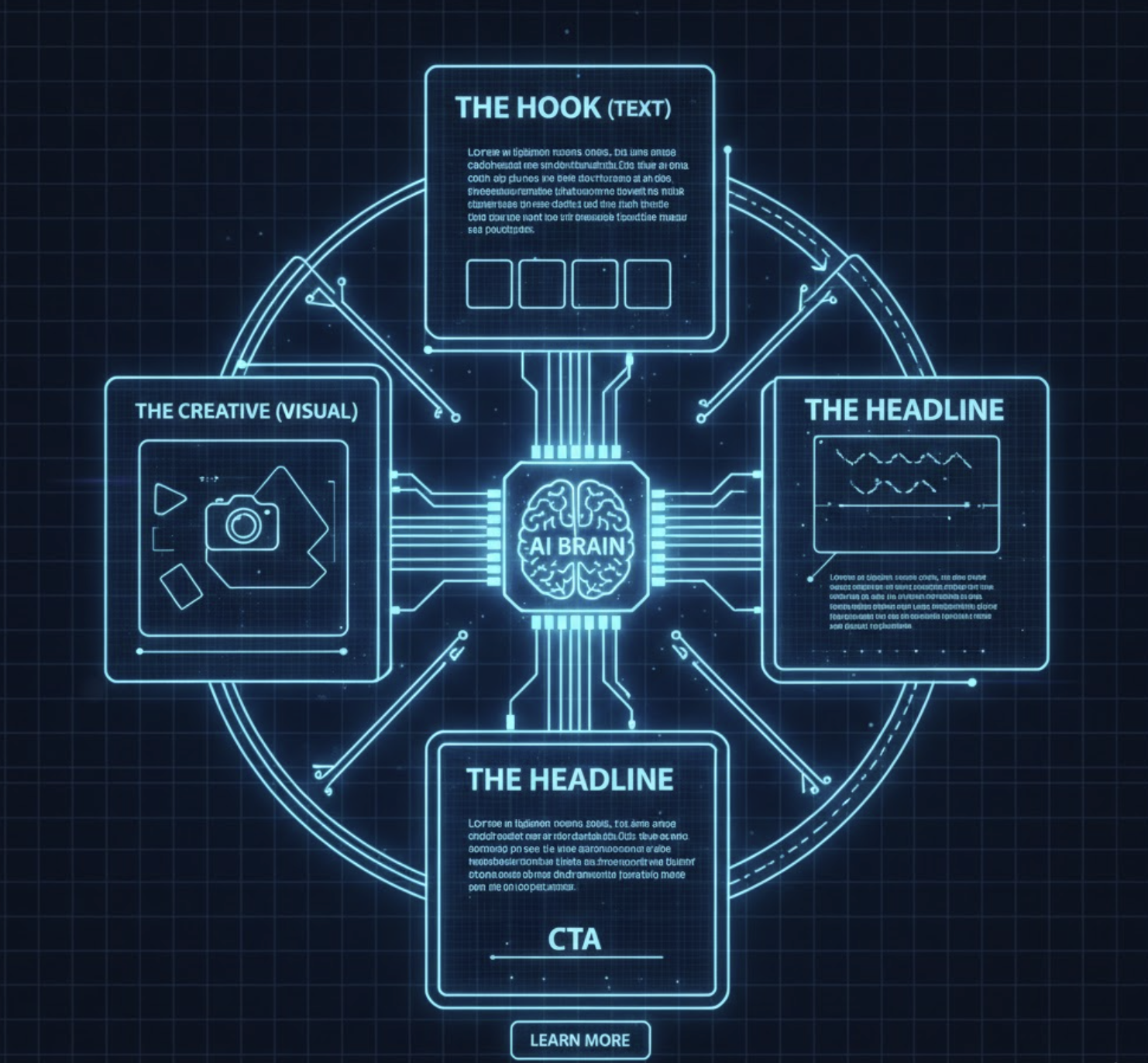
The Anatomy of a High-Converting AI Facebook Ad
Winning ads aren't magic; they're math. We analyzed 10,000 high converting Facebook ads to reveal the 3-part structure that scales ROI. Learn the blueprint now.
Best AI Marketing Tools in 2026: 15 Picks by Job and Price
Fifteen AI marketing tools, one or two per job, with what each does, where it falls short and the US price on the vendor's own pages in November 2026.