Key Takeaways
- 1Prioritize 'ugly' UGC-style visuals over studio quality to stop the scroll
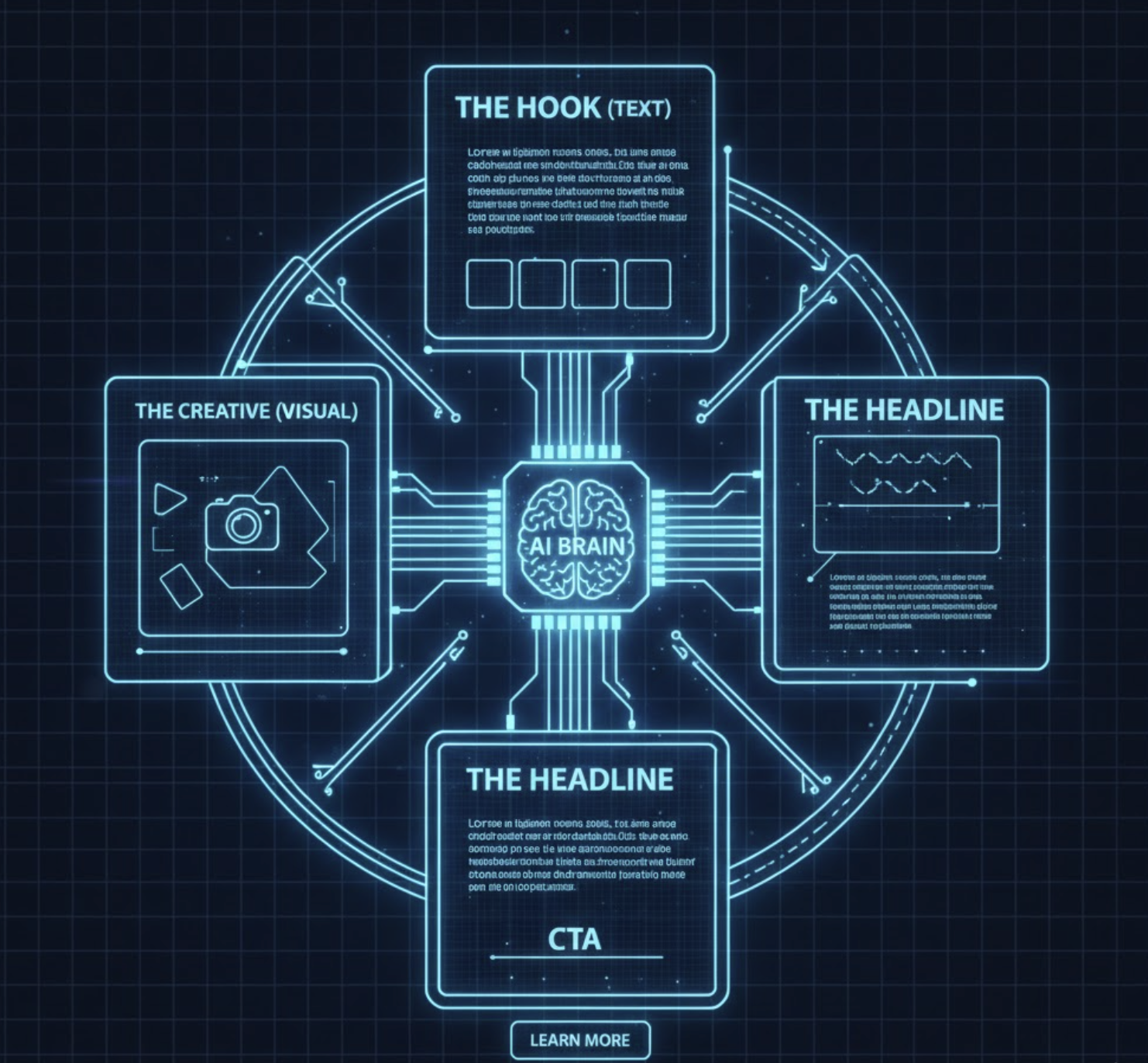
- 2Implement the 3 pillars: Pattern Interrupt, Curiosity Gap, and Payoff
- 3Use the 'Us vs. Them' split-screen framework to instantly show value
- 4Direct AI tools with emotional prompts to avoid plastic-looking results
- 5Scale ROI by testing 100+ AI-generated variations rather than one big idea
Winning ads aren't magic; they're math. We analyzed 10,000 high converting Facebook ads to reveal the 3-part structure that scales ROI. Learn the blueprint now.
There is a myth in the advertising world that "creativity" is magic.
People think that a winning ad comes from a stroke of genius. A copywriter sits in a room, stares at the ceiling, and suddenly, Eureka!, they come up with the perfect tagline.
This is romantic. It is also completely false.
In 2026, a winning ad is not a work of art. It is a math equation. It is a predictable structure. And thanks to AI, we can now reverse-engineer that structure with frightening precision.
We analyzed over 10,000 high converting facebook ad examples to find the common DNA. We didn't look at "likes" or "shares." We looked at ROI. We looked at ads that actually put money in the bank.
What we found was surprising. The best ads didn't look like ads at all.
The 3 Pillars of a Perfect Ad
Every single winning ad we analyzed had three specific components working in harmony. If you miss one, the ad fails. If you nail all three, you scale.
1. The Pattern Interrupt (The Creative)
The average user scrolls through 300 feet of content every day. That is the height of the Statue of Liberty. Your ad is just a speed bump on that highway.
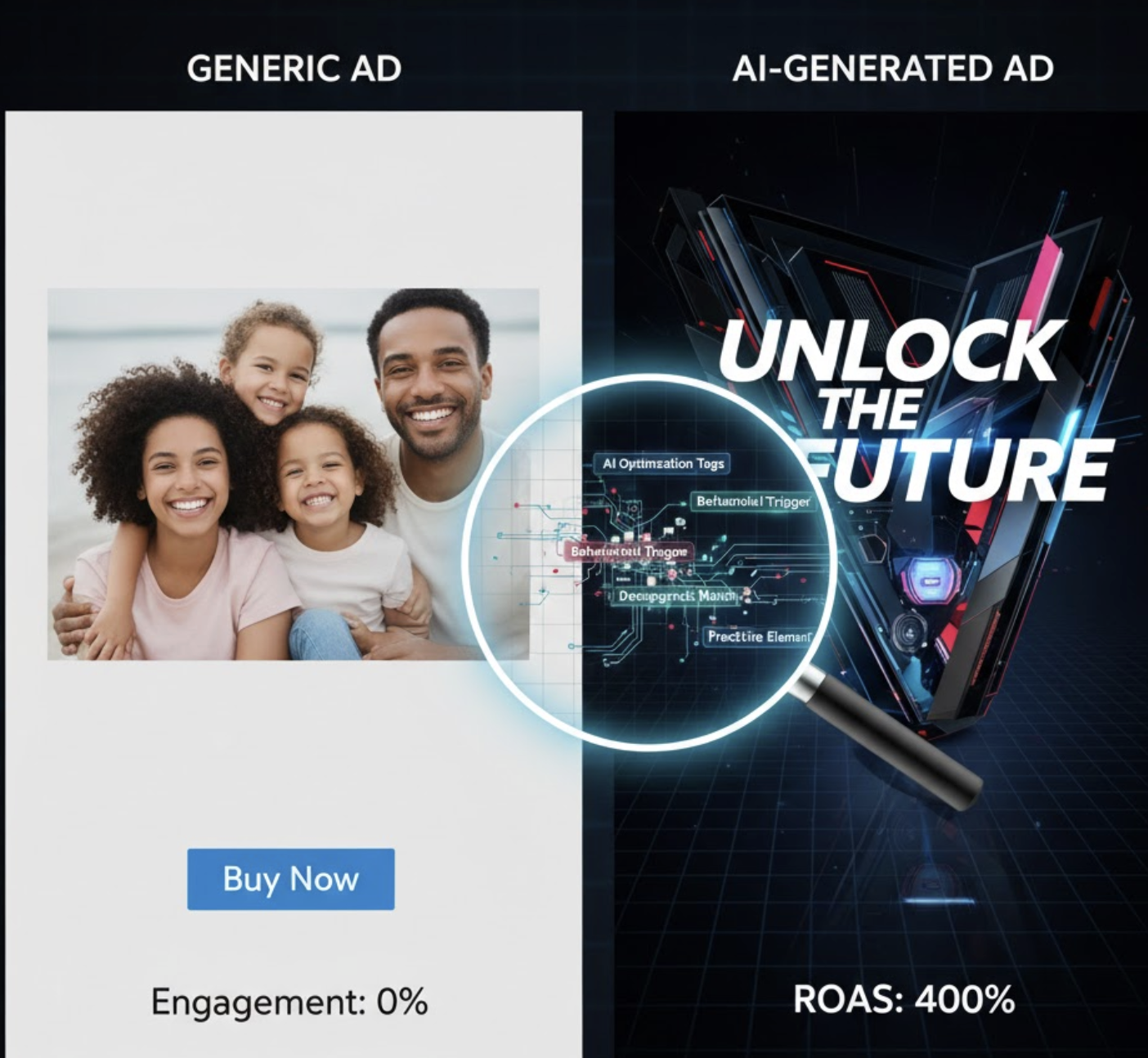
Most brands try to make their ads look "professional." They use high-quality studio photos and perfect lighting. This is a mistake. Professional ads blend in. They look like ads. And people ignore ads.
The best Facebook ads examples we found were "ugly." They looked like user-generated content (UGC). They were shot on iPhones. They had messy lighting.
Why? Because they looked like content. They stopped the scroll because the brain didn't immediately filter them out as "marketing."
2. The Curiosity Gap (The Hook)
Once you stop the scroll, you have 0.7 seconds to get their attention. This is where the headline comes in.
- Bad headlines make statements: "Buy our shoes."
- Good headlines ask questions: "Are your shoes ruining your back?"
- Great headlines open a loop: "The 3-second trick to fix your back pain (it's not what you think)."
This is where ad copy AI tools shine. An AI doesn't just guess what's interesting. It analyzes millions of data points to find the specific psychological triggers that make people click.
3. The Payoff (The CTA)
You have their attention. You have their curiosity. Now, what do you want them to do?
The biggest mistake is being vague. "Learn More" is weak. "Get Your Free Guide" is strong. If you want to maximize conversions, studying proven call to action examples can help you craft the perfect final push.
Deconstructing a Winner: The "Us vs. Them" Ad
Let's look at a specific framework you can use today. We call this the "Us vs. Them" split screen.
- Visual: A split screen image. On the left, a person struggling with the "Old Way" (e.g., struggling to open a jar). On the right, a person effortlessly using the "New Way" (your product).
- Headline: "Stop doing THIS. Start doing THIS."
- Copy: A short story about the frustration of the old way, followed by the liberation of the new way.
Why does this work? Because the brain loves contrast. It instantly understands the value proposition without reading a word.
When you create ads with AI, you can generate hundreds of variations of this format in minutes. You can test different "struggles" on the left and different "solutions" on the right.
How to Generate Ads with AI That Actually Convert
Many people try to use AI tools like Midjourney or DALL-E and get weird results. The faces look plastic. The text is gibberish.
The secret to high-converting AI Facebook ads is in the prompting. You have to think like a director, not a designer.
Instead of asking for "a photo of a shoe," ask for "a frantic POV shot of a runner tying their shoe in the rain, mud on the laces, high drama, cinematic lighting."
The more emotion you put into the prompt, the more emotion you get out of the ad. And emotion sells.
The Speed of Iteration
The real power of using an autonomous AI media buying agent isn't just in making one good ad. It's in making 100 ads.
In the old days, you would bet your entire budget on one "Big Idea." If it failed, you were fired. Today, you don't bet. You test.
You generate ads with AI, lots of them. You throw them all into the algorithm. You let the data decide which one is the winner.
Maybe the "ugly" ad wins. Maybe the "beautiful" ad wins. Maybe the ad with the blue background beats the red background by 50%.
You don't know. You can't know. Only the market knows. And the only way to ask the market is to show them options.
The Future is Automated Creativity
We are entering an era where the barrier to entry for high-quality creative is zero. You don't need a $50,000 production budget. You don't need a camera crew. You need a laptop and an AI.
This levels the playing field. The small e-commerce brand can now out-test major competitors. The local service provider can out-market the national franchise.
But it also raises the bar. Because if everyone can create high-quality ads instantly, then "good" is no longer good enough.
You have to be great. You have to be prolific. You have to be relentless.
The anatomy of a winning ad hasn't changed. It's still about attention, interest, and desire. But the tools we use to build it have changed forever.
Frequently Asked Questions
Common questions about this topic
1What are the 3 pillars of a high converting Facebook ad?
2Why do 'ugly' ads often perform better on Facebook?
3How can AI help with Facebook ad creation?
Written by

Ignas Obulaitis
Head of ITIgnas Obulaitis is the head of IT for TryCrush.ai, leading the platform’s engineering and AI innovation. With a strong background in product-driven development, Ignas has built and scaled complex systems across fintech, SaaS, and AI-focused companies. An ex-IBM engineer and former Head of Development at Fluensure, Ignas combines deep technical expertise with a sharp product mindset to turn ambitious ideas into scalable, production-ready technology.
Stop Guessing.
Start Crushing.
AI Ad Manager trained by world-class media buyers to generate your creatives and optimize your ads 24/7.
Learn more
Related articles

The Psychology of the "Perfect" Ad (And How AI Replicates It)
Marketing is about psychology, not just pixels. Discover how AI analyzes emotional patterns to target the "Lizard Brain" and drive conversions. We reveal the 5 core psychological triggers and copywriting frameworks used to create the perfect ad.

Secrets of High Converting Facebook Ads: Deconstructing Top Performers
Stop burning budget on ads that don't convert. We reverse-engineered thousands of top Facebook ads to find the psychology behind the winners. Learn the "Hook, Hold, Payoff" structure and the 3 creative archetypes that drive sales on autopilot.

The Art of the Algorithm: Mastering AI Creative Advertising
The era of the subjective Creative Director is over. Discover how AI creative advertising replaces human opinion with objective data to generate high-converting ads. Learn the H.E.R.O framework and modern testing methodologies to scale your campaigns efficiently.
Scaling Dropshipping Shopify Stores: 2026 Ad Data
Most guides just show you pretty storefronts. We analyze the actual Facebook ad data that successful Shopify dropshipping stores use to scale profitability in 2026.