Big Cartel vs Etsy: Features, Fees, and Ad Strategies in 2026
•10 min read
Big Cartel vs Etsy: Features, Fees, and Ad Strategies in 2026 (Crush blog cover)
Key Takeaways
1Big Cartel provides a standalone cloud-based storefront starting with a free 5-product tier.
2Etsy operates as a search engine that heavily integrates CPC onsite advertising and 15 percent offsite ad fees.
3Big Cartel limits payment gateways to Stripe, PayPal, PayPal Credit, and Venmo, entirely excluding Afterpay.
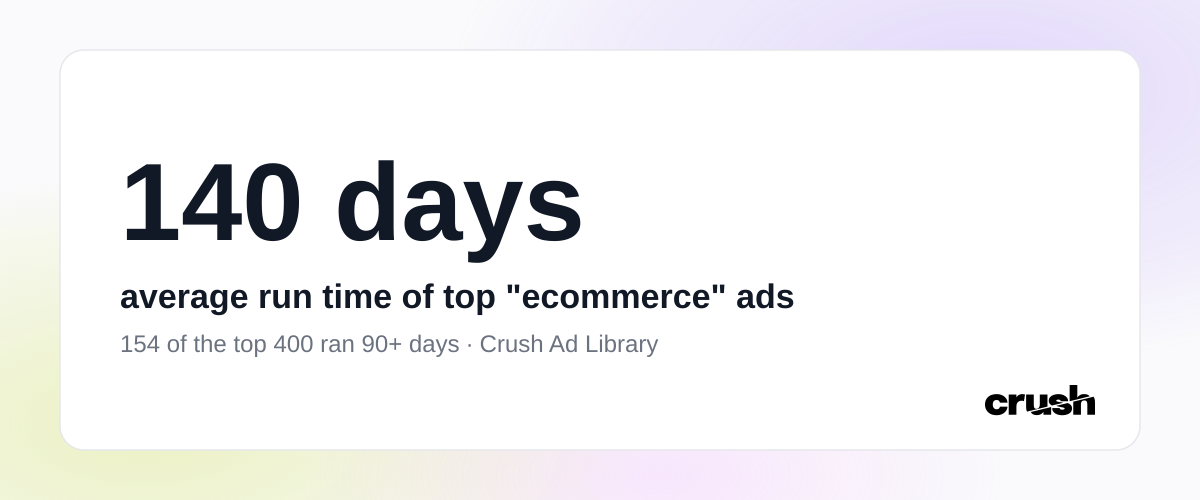
4Top Facebook e-commerce ads average 140 days of continuous runtime, indicating strong creative scaling.
5Crush automates Facebook ad campaigns to help you drive independent traffic without relying on marketplace fees.
We analyze the exact costs, features, and user feedback of Big Cartel and Etsy in 2026. Discover which platform aligns with your inventory size and traffic strategy.
Choosing between Big Cartel vs Etsy comes down to owning your storefront versus renting marketplace search visibility. According to Host Merchant Services, Big Cartel provides a cloud-based platform designed for artists to sell handmade and custom products online. Etsy acts as a massive marketplace where sellers use internal ads to capture built-in buyer demand.
What Are The Core Differences Between Big Cartel And Etsy?
The primary difference is that Big Cartel provides an isolated digital storefront, while Etsy provides a shared marketplace ecosystem heavily reliant on internal and external advertising systems.
Big Cartel Storefront Capabilities
Sellers on Big Cartel can access 19 diverse customizable store templates to build their brand presence. For users on paid plans, the platform enables full code editing for deeper customization, according to LitExtension.
The platform also caters to sellers who operate both online and offline. Big Cartel offers iOS and Android applications for managing the store remotely. This includes a mobile point of sale (POS) system for selling goods directly at physical events, based on research from Host Merchant Services.
Etsy Marketing and Promotion Tools
Etsy focuses heavily on helping sellers promote items within its existing search engine. Sellers can use Etsy's Targeted Offers, a free marketing tool that enables them to send coupons to specific buyer segments.
This includes targeting users who have favorited an item, abandoned a cart, or made a previous purchase, according to Etsy's advertising policy.
Etsy also provides a dedicated Social Media tool within the Shop Manager dashboard. This allows sellers to share new product listings, shop milestones, sales, and buyer reviews directly to external platforms like Facebook, Instagram, Pinterest, and X, per Etsy's seller handbook.
How Do The Selling Features Actually Compare?
Both platforms place hard limits on how many products and images you can display, depending on your account tier.
Big Cartel Image and Inventory Limits
Big Cartel limits visual presentation based on the subscription tier. It offers a free Gold plan that allows users to list up to 5 products with exactly one image each, according to Shift4Shop. This free tier includes basic selling features like order management and shipment tracking.
To showcase more inventory, sellers must upgrade. Big Cartel supports product listings with multiple photos, allowing up to 5 images per product on the Platinum plan and 25 images on the Diamond plan, per Big Cartel's documentation.
Paid plans unlock essential scaling features including inventory tracking, bulk editing, product variant groups, and the ability to run promotions.
Etsy Ad Structures and Placements
Etsy handles visibility differently by heavily integrating paid advertising. Etsy Ads enables sellers to advertise their products prominently within Etsy's search results and on other high-traffic pages across the Etsy website and mobile applications, as detailed by Etsy.
For external reach, Etsy's Offsite Ads program promotes seller listings across platforms such as Google, Facebook, Instagram, Pinterest, and various partner networks, according to Etsy's Offsite Ads guide. For Offsite Ads, sellers only incur a fee when a buyer clicks an ad and subsequently completes a purchase from their shop within 30 days.
Longevity of top "ecommerce" ads: the strongest profitability signal.
What Are The Verified Pricing Structures In 2026?
Big Cartel structures its pricing around fixed catalog limits, whereas Etsy advertising costs scale continuously with your ad budgets and sales volume.
Big Cartel Tier Costs
Big Cartel offers a free tier called the Gold plan, as noted by Bootstrapping Ecommerce. To move beyond the 5-product limit, sellers can upgrade to the Platinum plan which supports up to 50 products.
If you are testing the platform, a 7-day free trial is available for the Platinum monthly plan, noted by Homegrown.
Etsy Ad Cost Metrics
Etsy Ads operate on a straightforward cost-per-click (CPC) model, where sellers pay each time someone clicks on their listing ad. Sellers can set a daily budget for these onsite ads ranging from $1 to $25, and the average cost per click typically ranges between $0.20 and $0.50, according to Printify.
For Offsite Ads, the fee structure is tied strictly to revenue. The fee is 15 percent for shops with less than $10,000 USD in revenue over a 365-day period. It drops to a discounted 12 percent for shops earning $10,000 USD or more, with a strict maximum fee of $100 USD per order, according to Etsy.
Feature Comparison Matrix
This table breaks down how the platforms compare on core capabilities, alongside Crush (our product) for stores looking to scale their own ad traffic independently.
Feature
Big Cartel
Etsy
Crush (our product)
Primary Function
Digital storefront builder
Global marketplace
AI Facebook Ads platform
Traffic Model
Bring your own audience
Built-in search engine
Automated Meta campaign scaling
Free Option
Gold plan (5 products)
None (transaction based)
Free ad tracking library
Ad Targeting
None built-in
Basic CPC and Offsite Ads
Competitor tracking and history
What Do Sellers Actually Praise About These Platforms?
Both platforms have proven use cases for different stages of online retail growth.
Etsy Ads Visibility and Returns
Etsy Ads can be worth it for new shops to gain visibility and boost sales. This holds particularly true for small digital items, even with a minimum budget of $1 per day, according to sellers on Reddit r/EtsySellers.
When listings are dialed in, some sellers achieve a highly profitable Return on Ad Spend (ROAS). One user on Reddit reported a 4.0 ROAS, effectively spending $10,000 to acquire $40,000 in sales through Etsy Ads.
Etsy also rewards larger budgets. For Etsy Ads campaigns with a daily budget of $25 or more, sellers can choose specific listing strategies such as "Greater visibility," "Lower click cost," or "Efficient spending," based on guidance from Etsy's seller handbook.
Big Cartel Professional Integrations
Big Cartel earns praise for handling core transactions reliably. The platform seamlessly integrates with payment gateways such as Stripe and PayPal, which also allows for accepting PayPal Credit and Venmo, according to Big Cartel's features page.
Where Do Sellers Experience Frustration?
Limitations surface quickly when sellers try to scale operations or customize their brand presentation without writing code.
Etsy Ads Inefficiency and Black Box Metrics
A significant complaint from users is the lack of detailed statistics from Etsy regarding ad performance, per discussions on Reddit.
Many users find Etsy Ads to be less effective recently, with some draining money. One seller spent approximately $28 in ad fees just to sell an $11 item.
The Etsy Ad budget gets spent on clicks even if those clicks do not result in a sale, leading some users on Reddit r/Etsy to label the ads a waste of money if product listings are not already optimized.
There is also a perception among some sellers that Etsy might "punish" them for lowering their ad spending, as sales can decline after reducing the daily budget from a higher amount, according to Reddit r/EtsySellers.
Big Cartel Customization and Fulfillment Limits
Customization options on Big Cartel are often cited as limited. Sellers report minimal design flexibility unless users are adept at editing code, according to Ecomm.Design.
Backend logistics present additional hurdles. Inventory tracking on Big Cartel can only be turned on for the entire store rather than specific items. There is also no customizable option for local pickup or delivery, forcing sellers to process manual refunds for customers, according to G2 Reviews.
Furthermore, Big Cartel offers a limited number of payment gateways and does not support "buy now, pay later" options like Afterpay, which frustrates some users. Some buyers on Reddit have even reported issues with not receiving orders, noting a lack of a review system or direct refund process on the platform.
How Do Independent Brands Break Free From Native Platform Limits?
Once stores outgrow basic marketplace search, they scale using standalone storefronts paired with external Facebook advertising. This is where Crush, our platform, bridges the gap to achieve eCommerce success.
Crush is an AI Facebook-ads platform that fully automatically runs Facebook ads. Our platform creates campaigns, scales proven winners, and kills losers so you can drive your own targeted traffic directly to your storefront.
Our ad library contains millions of Facebook ads across niches, with longevity data and duplicate counts to signal proven winners.
When you rely on external traffic, the creative dictates your success. We pull our data directly from the Meta Ad Library, keeping full history including ads that Meta takes down. According to our proprietary data at Crush:
We currently track 1,741,554 unique Facebook ads, with 445,620 active right now.
Among these, 842 tracked ads match the "ecommerce" niche specifically, with 358 active today.
The average run time for top "ecommerce" ads is exactly 140 days.
154 of the top 400 e-commerce ads ran for 90 or more days, passing our strict proven winner threshold.
We also track what actions drive buyers. The most common call-to-action buttons on "ecommerce" ads are "learn more" (24 percent), "whatsapp message" (14 percent), and "shop now" (13 percent).
Real Examples of Winning E-commerce Creatives
Instead of guessing what creative will perform, you can verify what is already working. You can search these metrics directly at our free public ad library.
Here are active e-commerce ads currently tracked in our database:
Justine's Jewels Mtl: Running for 1,655 days with zero relaunches using a "shop now" CTA. The opening line simply reads, "Beautiful pink stone earrings in rose sterling Italian silver".
Chikigo: Ran for 1,506 days with a "book travel" CTA. The ad opens with social proof, stating, "Spotted @__auliafitri__ in our polo knit - earthy blue 🤍 Grab yours now at our ecommerce store! 😃".
It Expert Service's: Ran for 1,292 days with a "message page" CTA. The opening line states, "𝘼𝙙𝙫𝙚𝙧𝙩𝙞𝙨𝙚 𝙮𝙤𝙪𝙧 𝘽𝙪𝙨𝙞𝙣𝙚𝙨𝙨 𝙖𝙣𝙙 𝙞𝙣𝙘𝙧𝙚𝙖𝙨𝙚 𝙩𝙝𝙚 𝙨𝙖𝙡𝙚𝙨 👉DO YOU KNOW THE SECRET TO SUCCESSFUL ONLINE BUSINESSES? ✔️YES, Facebook".
BmxWrld: Ran for 1,177 days using the "message page" CTA. The ad reads, "Striving to be the Best E-commerce store for all your BMX needs!".
Once you find a high-performing ad in your niche, Crush can generate ad-creative iterations from a winning reference ad. You can view our subscription tiers at our pricing page to see how our automated scaling works.
Big Cartel vs Etsy: Which Should You Pick?
Your choice depends entirely on your current audience size, inventory complexity, and willingness to manage external marketing.
Use Etsy if:
You are starting from zero and need buyers actively searching for handmade goods to find you natively.
You want to utilize Targeted Offers to automatically retarget abandoned carts and previous buyers.
You are comfortable paying up to a 15 percent fee on Offsite Ads just to acquire a customer.
Use Big Cartel if:
You already possess an engaged social media following and simply need a lightweight, clean checkout process.
You sell locally at physical events and need a mobile POS integration that syncs with your digital inventory.
You plan to run your own paid social campaigns through tools like Crush and want to send that traffic to a standalone URL.
How we got this data
The numbers in this article come from Crush’s ad library: 1,741,554 unique Facebook ads tracked via the Meta Ad Library, 445,620 of them active at the time of writing. Ad examples reference real advertisers and their public ads. Data queried on 2026-08-07. Third-party product facts are attributed inline to their sources.
Frequently Asked Questions
Common questions about this topic
1Does Big Cartel have a free plan?
Yes, Big Cartel offers a free Gold plan. This tier allows users to list up to 5 products with exactly one image per product and includes basic order management features.
2How much do Etsy Offsite Ads cost?
Etsy charges a 15 percent fee on the order total for shops making under $10,000 USD annually. Shops exceeding that revenue pay a discounted 12 percent fee, capped at a maximum of $100 USD per order.
3Can I use Afterpay on Big Cartel?
No, Big Cartel does not support Afterpay. The platform only supports payment gateways through Stripe and PayPal, which includes options like PayPal Credit and Venmo.
4How much do Etsy onsite ads cost per click?
Sellers can set a daily budget for Etsy Ads ranging from $1 to $25. The average cost per click typically ranges between $0.20 and $0.50, and you pay even if the click does not result in a sale.
Rokas is the Founder and CEO of TryCrush.ai, an ex-IBM professional turned entrepreneur focused on building AI-driven growth platforms. With a strong background in ecommerce, performance marketing, media buying, and artificial intelligence, Rokas specializes in creating scalable, data-led systems that drive measurable revenue. His mission is to help modern businesses leverage AI to optimize acquisition, conversions, and long-term profitability.
Stop Guessing. Start Crushing.
AI Ad Manager trained by world-class media buyers to generate your creatives and optimize your ads 24/7.