

Key Takeaways
- 1Replace fixed ad budgets with infinite budgets constrained by target CPA.
- 2Shift from manual audience targeting to a creative-first testing approach.
- 3Use micro-budgets and a kill switch protocol to ruthlessly test ads.
- 4Leverage AI algorithms to dynamically execute your media buying strategy.
The traditional media buyer is dead, and static spreadsheets are obsolete. Learn how successful eCommerce brands scale past $1M a month by merging media planning and buying with AI, dynamic creative testing, and strict unit economics.
In the high-stakes world of eCommerce, the difference between a brand that plateaus at $10k a month and a brand that scales past $1M a month usually comes down to one core competency: mastery of media planning and buying.
While often grouped together, these two disciplines represent the "thinking" and the "doing" of customer acquisition. Historically, they were handled by entirely different departments. Today, driven by the relentless pace of algorithmic advertising, the lines have blurred. The modern marketer must be both a strategic planner and an executioner, signaling that the traditional media buyer is dead.
However, the way we approach media planning and buying has fundamentally shifted. If you are still using static spreadsheets to forecast your quarterly spend on Facebook, you are already behind. In this article, we will dissect how successful brands are engineering their growth in 2026.
The Difference Between Planning and Buying
To master the process, we first need to define the roles clearly.
What is Media Planning?
Media planning is the architectural phase. It is the process of defining your target audience, establishing your core messaging angles, selecting the optimal channels (e.g., Meta, TikTok, Google Search), and determining how to allocate your budget to achieve a specific business objective (like lowering your overall Customer Acquisition Cost).
Good media planning answers the "Who," "Where," and "Why."
What is Media Buying?
Media buying is the execution phase. It is the day-to-day management of the ad accounts. It involves setting up the campaigns, launching the creative tests, monitoring the spend, killing underperforming ads, and scaling the winners.
Good media buying answers the "How much" and "When."
The Death of the Static Media Plan
In the past, a brand might spend a month developing a "Q3 Media Plan." They would decide to allocate $50,000 to Facebook, $30,000 to Google, and $20,000 to YouTube, and they would stick to that plan regardless of what happened on a daily basis.
This rigid, inflexible method relies on assumptions made weeks or months in advance. The problem is that digital advertising is a living, breathing marketplace. Consumer behavior shifts rapidly, platform algorithms update without warning, and competitors can launch disruptive campaigns overnight.
If your media plan cannot adapt to these real-time changes, you are essentially flying blind, unable to seize emerging opportunities or mitigate sudden risks. This approach is catastrophic in today's environment.
The modern digital auction is too volatile. A creative asset on TikTok might suddenly go viral, meaning you need to shift $10,000 from Google to TikTok immediately to capitalize on the momentum. Conversely, your Facebook ROAS might tank due to an algorithm update, requiring an instant reduction in spend.
Modern media planning and buying is not static; it is dynamic and fluid. It requires a system that can react to real-time data.
The 3 Pillars of Modern Media Strategy
To build a fluid strategy that actually generates profit, you need to focus on three core pillars.
1. Unit Economics Over Arbitrary Budgets
You should never have a "fixed monthly ad budget." Instead, your budget should be infinite, constrained only by your unit economics.
If you know your product costs $20 to make and ship, and it sells for $100, you have $80 of gross margin. If you decide you need to make $30 profit per sale, your maximum allowable CAC is $50. This constraint is exactly why we optimize for Target CPA over ROAS.
Your media plan should simply state: "We will spend as much money as possible, on any platform, as long as the CAC remains under $50."
2. The Creative-First Approach
As we've established in previous articles, manual audience targeting is dead. Your creative is your targeting. Therefore, media planning today is actually creative planning.
Instead of planning which audiences to target, you should be planning which psychological angles to test. Your media plan should look like a hypothesis board:
Hypothesis 1: Will focusing on the "status" benefit lower CPA compared to the "utility" benefit?
Hypothesis 2: Will user-generated content (UGC) outperform high-production video for retargeting?
3. High-Frequency Micro-Testing
The media buying execution then becomes a rigorous process of testing these hypotheses. You deploy micro-budgets to test the creatives. The key here is ruthless objectivity. You must kill the losers quickly and scale the winners aggressively. If you struggle with this, implementing a kill switch protocol is essential to stop wasting budget on unprofitable ads.
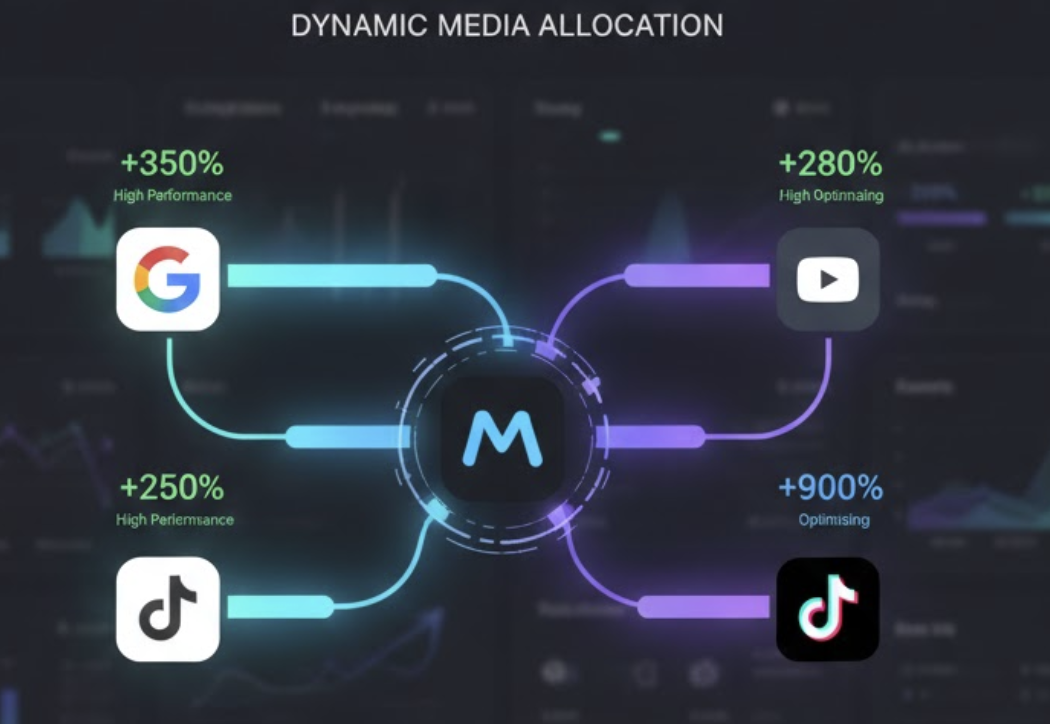
How AI is Merging Media Planning and Buying
The fluidity required for modern media planning and buying is incredibly difficult for humans to manage at scale. You cannot physically monitor performance across 5 platforms 24 hours a day and make instantaneous budget shifts. It is no secret why algorithms beat humans at media buying every single time.
This is where AI operating systems like TryCrush become the central nervous system of your business.
TryCrush effectively merges the planning and buying phases. You input your overarching strategy, your core offer, your maximum allowable CAC, and your target ROAS. TryCrush then handles the execution:
Algorithmic Planning: TryCrush analyzes historical data to suggest which creative angles and formats are mathematically most likely to succeed.
Automated Execution: It generates the creatives and deploys them into the ad accounts without manual setup.
Dynamic Budget Allocation: This is the crucial part. TryCrush monitors the live performance. If an ad isn't hitting your required unit economics, TryCrush kills it. If it is highly profitable, TryCrush scales it. It does the media buying for you, strictly adhering to the media plan you established.
Conclusion: Becoming an Architect
The days of guessing where to spend your marketing budget are over. Media planning and buying is now a hard science, governed by unit economics and executed by algorithms.
To succeed, you must stop acting like a dashboard operator. Stop worrying about manual bid adjustments and arbitrary daily budgets. Instead, become an architect.
Build a solid foundation of unit economics, engineer brilliant creative hypotheses, and let an AI system like TryCrush execute the buying, manage the risk, and scale the profit. When you stop fighting the algorithms and start leveraging them, profitable scaling becomes inevitable.
Frequently Asked Questions
Common questions about this topic
1What is media planning in eCommerce?
2What is media buying?
3Why are static media plans no longer effective?
Written by
Albertas Pocius
Co-founder, CMOAlbertas is the Co-Founder and CMO of TryCrush.ai, bringing elite-level performance marketing expertise to the platform. With over $50M+ in combined Facebook and TikTok ad spend, Albertas has launched and scaled dozens of projects from zero, driven by a deep obsession with data and experimentation. He has trained 20+ media buyers, consulted 100+ companies, and is widely recognized as one of Europe’s early TikTok pioneers, likely the first to scale campaigns beyond $100K per day. Today, he also teaches advertising strategy at two colleges, shaping the next generation of media buyers.
Stop Guessing.
Start Crushing.
AI Ad Manager trained by world-class media buyers to generate your creatives and optimize your ads 24/7.
Learn more
Related articles

"My Ads Are Dead": How to Revive Fatigued Campaigns with AI
Ad fatigue kills more businesses than bad products. Discover how autonomous AI agents can bring dead campaigns back to life using the "CPR Protocol" instead of starting from scratch.
What is a Creative Strategist? The 2026 Data Guide
A creative strategist bridges the gap between media buying and ad design. Discover the exact frameworks they use to build and scale winning Facebook campaigns.

The 48-Hour Rule: A Data-Driven Framework for Validating Facebook Ad Creatives
Most marketers test Facebook ads incorrectly, either killing them too fast or too slow. The 48-Hour Rule provides a data-driven framework to identify winning creatives, ensuring you only scale profitable assets while minimizing wasted spend.
Dynamic Creative Ads Masterclass: The AI Advantage
Static ads are dead. Discover how the "3-2-2" Dynamic Creative framework leverages Facebook's AI to automate testing, improve targeting, and eliminate manual guesswork.