Key Takeaways
- 1Historical ad tracking reveals true campaign longevity, which is the strongest signal of a profitable creative.
- 2Over 185 top Instagram ads in our dataset ran for more than 90 days, establishing a clear benchmark for success.
- 3The most successful Facebook ads often run for over 1000 days without ever being relaunched or duplicated.
- 4Avoiding brand new competitor campaigns prevents you from copying unproven and unprofitable test creatives.
An ad library is the ultimate tool for reverse-engineering your competitors' most profitable campaigns. Learn how to filter out failed tests and identify ads that scale for years.
Ad Library Definition: What is an Ad Library?
An ad library is a searchable database where marketers view active and historical advertisements from competitors. Platforms provide these public directories for transparency.
In the context of media buying in 2026, professionals use advanced libraries to study competitor creatives, conduct thorough audience analysis, calculate campaign longevity, and reverse-engineer proven marketing angles for their own accounts.
Standard Ad Library Data: What Can You See?
A standard ad library from Meta or Google provides a baseline look at what your competitors are currently testing. You can view the creative asset, the primary text, the headline, and the launch date. This basic transparency helps you understand the current messaging of any brand in your market.
Native Ad Transparency Tools: The Major Limitations
The official transparency tools have a fatal flaw for media buyers. They do not show you deleted or paused ads. Once a competitor turns off a campaign, that creative vanishes entirely from the public database.
You cannot tell if an ad was a massive winner that just suffered audience fatigue, or a total failure killed after two days. The native Meta library focuses on political transparency rather than performance marketing, protecting advertiser privacy by hiding historical data.
To actually build a swipe file of proven winners, you need historical tracking. If you only look at the official native tools, you are looking at a snapshot of today. You miss the graveyard of failed tests and the hall of fame of exhausted winners.
Ad Longevity: Why It Completely Changes Competitor Research
Ad longevity is the ultimate proxy for profitability, because media buyers do not leave unprofitable ads running for months. If a campaign is active for hundreds of days, it is making the advertiser money. We built Crush, our own AI Facebook ads platform, entirely around this core principle.
Our product Crush tracks competitors' Facebook ads via the native directories and keeps a permanent history of the data, including ads that were taken down. You can access our free public database directly at trycrush.ai/ad-library to see this in action.
Proprietary Database Analysis: Tracking Facebook Ads
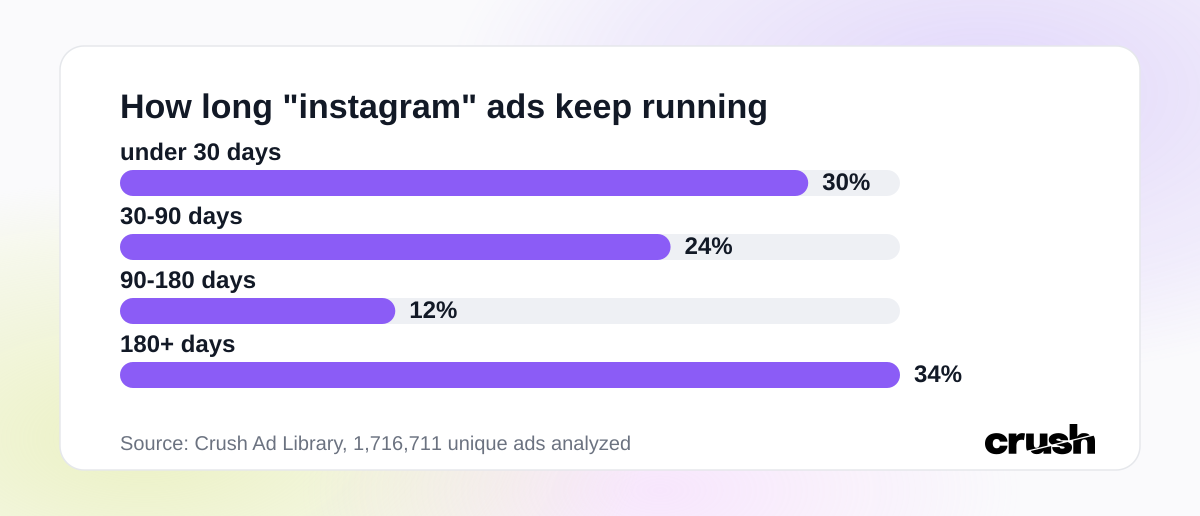
We can look at the raw data to prove the power of longevity. Crush's ad library tracks 1,716,711 unique Facebook ads (456,459 currently active). This massive scale allows us to see exactly what works across different niches.
Let us look at a specific subset of this data. Currently, 1,504 tracked ads match "instagram" (117 active right now). When we filter these for longevity, a clear pattern emerges.
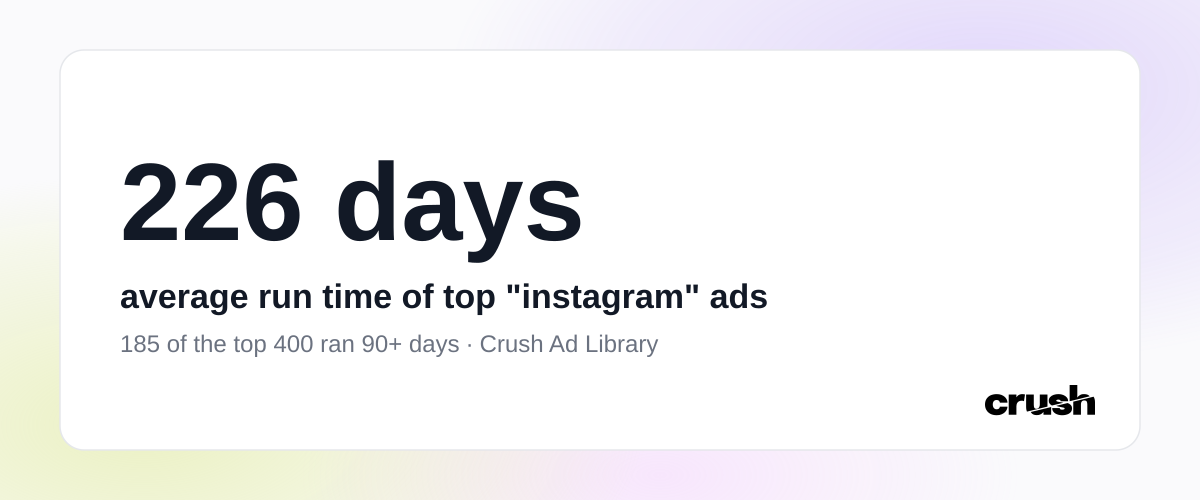
Among top "instagram" ads, average run time is 226 days; 185 of the top 400 ran 90+ days (the "proven winner" threshold).
Think about that from a media buying perspective. The baseline for a successful creative in this cohort is nearly eight months of continuous spend. If you want to decode winning concepts before your competitors do, you should completely ignore anything with less than three months of history when scraping an Instagram ad library for inspiration.
CTA Performance: Decoding Call-to-Action Buttons
We also track the specific call-to-action buttons these winning ads use. The most common CTA buttons on "instagram" ads include:
- Learn more (36%)
- Shop now (19%)
- WhatsApp message (17%)
Why does "learn more" beat "shop now" almost two to one? It comes down to friction. Users on social media are scrolling for entertainment. "Learn more" is a low-friction request that invites curiosity, whereas "Shop now" demands high intent and often scares away cold traffic.
The 17 percent share for "whatsapp message" highlights the massive rise of conversational commerce in 2026. If you default to "shop now" for every single campaign, you are fighting against the mathematical reality of user behavior.
Winning Ads Extraction: How Media Buyers Filter Data
If you want to know how to search the Facebook ad library like a pro, you must extract winning ads by filtering for long run times, zero relaunches, and specific call-to-action buttons. Searching random competitor names will just leave you confused. You must look for strict signals of profitability.
Profitable Creatives Checklist for Ad Libraries
Follow this exact methodology when analyzing any ad library to find concepts worth testing:
- Filter for run time: Set your minimum threshold to 90 days. Ignore everything that launched this month.
- Check duplicate counts: Look at how many times an advertiser relaunched the same creative. A high duplicate count means the ad is a distressed winner fighting fatigue.
- Isolate zero-relaunch unicorns: Some ads run for years without ever being paused or duplicated. These are your foundational templates.
- Analyze the text hook: Strip away the visual and read the first 125 characters of the primary text. This is what stops the scroll.
- Match the CTA: Verify that the call-to-action button aligns with the offer type.
Long-Term Winning Ads: Real Examples and Formulas
Verified long-term winning ads look like clear, direct offers that address objections immediately, as seen in the top performers from our database. We pulled five proven Facebook advertising examples to show what true longevity looks like in practice.
Top Performing Ads by Run Time
These are campaigns that ran for years without being relaunched a single time. Their duplicate counts are zero.
| Advertiser | Active Days | CTA Button | Opening Line Hook |
|---|---|---|---|
| KlickPiloten | 2216 | Contact us | Die Digital-Marketing KlickPiloten Beratung & Agentur aus #Stuttgart, #Hamburg und #Berln: SEO, SEA, Social und Amazon Kampagnen für B2B & B2C. |
| wilov | 2189 | Learn more | wilov, la 1ère assurance auto à l’usage pour arrêter de payer plein pot. Nous résilions votre ancienne assurance pour vous. Sans engagement. |
| Genera Studios | 1857 | Learn more | (Visual dominant, text highly varied) |
| ALEC at the University of Tennessee | 1367 | Learn more | Our highly flexible programs will allow you to obtain a degree through traditional coursework or entirely online. |
| LGCY Power | 1334 | Learn more | LGCY Power has been recognized by @bestcompanyUSA's 2022 Companies to Watch! We're experiencing unprecedented growth and have been consistently recognized as on |
Text Formulas: Dissecting Ad Hooks
- KlickPiloten (2216 days, CTA "contact us"): Look at their German opening line. They immediately list their physical locations and exact services. B2B buyers want immediate clarity, and this ad delivers it instantly.
- wilov (2189 days, CTA "learn more"): Their French opening line promises to stop users from paying full price for car insurance. They follow it up by removing friction entirely, stating they will cancel your old insurance for you.
- ALEC at the University of Tennessee (1367 days, CTA "learn more"): They address the primary objection of adult learners in the very first sentence, highlighting that programs can be completed entirely online.
- LGCY Power (1334 days, CTA "learn more"): Trust is the hardest thing to build in solar sales. Their opening line bypasses this barrier by renting authority from a recognized publication.
YouTube vs. Meta: How Does a YouTube Ad Library Compare?
A YouTube ad library focuses heavily on video retention metrics, whereas Meta platforms require testing a mix of static and video formats. To understand these differences, our Google ad library guide explains how to use the Google Ads Transparency Center to reverse engineer competitor campaigns. The core mechanics of a winning hook differ between these ecosystems.
When you analyze YouTube campaigns, you are looking for visual retention strategies in the first five seconds. If a viewer skips the ad, the advertiser pays nothing. Therefore, the hooks on YouTube are often much more aggressive than Facebook feed ads.
Cross-Platform Creative Arbitrage
Media buyers often pull concepts from video platforms to test as reels on Instagram. This creative arbitrage works because short-form video consumption habits are universal. The underlying psychological triggers remain the same across every network.
If you spot a competitor running a video ad for over 90 days, rip the transcript. Re-record that exact script in a vertical aspect ratio. Knowing exactly how to pause a video on Instagram is crucial here, as it allows you to analyze fast-moving text overlays and specific frame transitions of winning reels.
To further enhance these short-form assets with engaging visual elements, learning how to put GIFs on Instagram can help you create dynamic, native-feeling overlays. Test the optimized concept in your own account, and let the data tell you if it transfers.
Competitor Ad Research: Common Mistakes to Avoid
The biggest mistake that ruins competitor ad research and comprehensive audience analysis is copying brand new campaigns that have zero proven longevity. Most novice media buyers use transparency tools completely wrong, treating them like a mood board for graphic design.
Four Research Errors to Avoid
Your goal is financial analysis, not artistic inspiration. Avoid these critical errors:
- Copying unproven tests: Just because a massive brand launched a video yesterday does not mean it is profitable. They might turn it off tomorrow.
- Ignoring the opening text: Beginners focus solely on the video or image asset. The opening text hook often drives the actual conversion rate.
- Falling for vanity metrics: Engagement does not equal a low cost per acquisition. Focus purely on active run days.
- Testing without iteration: Taking a competitor's concept is just step one. You must test multiple variations to find the version that resonates with your specific audience.
Campaign Automation: Scaling From Winning Concepts
You can automate campaign creation by using a platform that leverages generative AI for Facebook ads to create iterations and manage daily optimizations. Finding a winning ad is only half the battle. You still have to build the campaigns and monitor the daily performance.
Our platform fully automatically runs Facebook ads for you. It creates campaigns, scales the winners, and kills the losers without manual intervention. You feed the system the winning concepts you found during your research, and the AI handles the execution.
Moving From Research to Profitable Scale
If you find an ad like the Genera Studios example that ran 1857 days, relaunched 0x, with the CTA "learn more", you know the visual concept is sound. Your next step is to build variations of that exact concept.
Crush can generate ad-creative iterations from a winning reference ad automatically. Instead of spending hours in video editing software, you let the system generate 100 ad variations for you to build out a robust testing matrix.
Media buying requires speed and aggressive testing. You cannot rely on guessing what creatives will work, but must base your strategy on historical data. Our paid plans start with a trial, allowing you to test this automated workflow yourself. Visit trycrush.ai/pricing for current rates.
How We Got This Data
The numbers in this article come from Crush’s ad library: 1,716,711 unique Facebook ads tracked via the Meta Ad Library, 456,459 of them active at the time of writing. Ad examples reference real advertisers and their public ads. Data queried on 2026-08-02. Third-party product facts are attributed inline to their sources.
Frequently Asked Questions
Common questions about this topic
1What is an ad library?
2How do you find deleted Facebook ads?
3What is a good run time for a Facebook ad?
4Can I see competitor ad spend?
5Why do advertisers relaunch ads?
Written by
Albertas Pocius
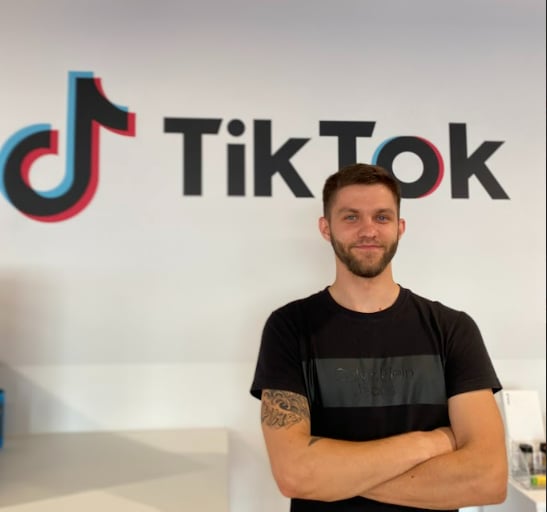
Co-founder, CMOAlbertas is the Co-Founder and CMO of TryCrush.ai, bringing elite-level performance marketing expertise to the platform. With over $50M+ in combined Facebook and TikTok ad spend, Albertas has launched and scaled dozens of projects from zero, driven by a deep obsession with data and experimentation. He has trained 20+ media buyers, consulted 100+ companies, and is widely recognized as one of Europe’s early TikTok pioneers, likely the first to scale campaigns beyond $100K per day. Today, he also teaches advertising strategy at two colleges, shaping the next generation of media buyers.
Stop Guessing.
Start Crushing.
AI Ad Manager trained by world-class media buyers to generate your creatives and optimize your ads 24/7.
Learn more
Continue Reading
5 Web Banner Ad Examples That Converted (2026 Data)
We analyzed millions of Facebook ads to find the best web banner ad examples. Here is exactly what top advertisers do to drive profitable conversions.
Proven Online Ad Examples Based on Meta Ad Longevity Data
Stop guessing what works. We analyzed millions of active campaigns to bring you the best online ad examples based on pure longevity and profitability data.
How to Add Branding to Meta Ads That Actually Convert
Most advertisers ruin their return on ad spend by overcomplicating their visual identity. Here is how to integrate branding into your creatives to drive direct response.