Google Ad Library Guide: Competitor Research In 2026
•10 min read
Google Ad Library Guide: Competitor Research In 2026 (Crush blog cover)
Key Takeaways
1The Google Ads Transparency Center shows active text and video ads but completely hides historical performance and longevity data.
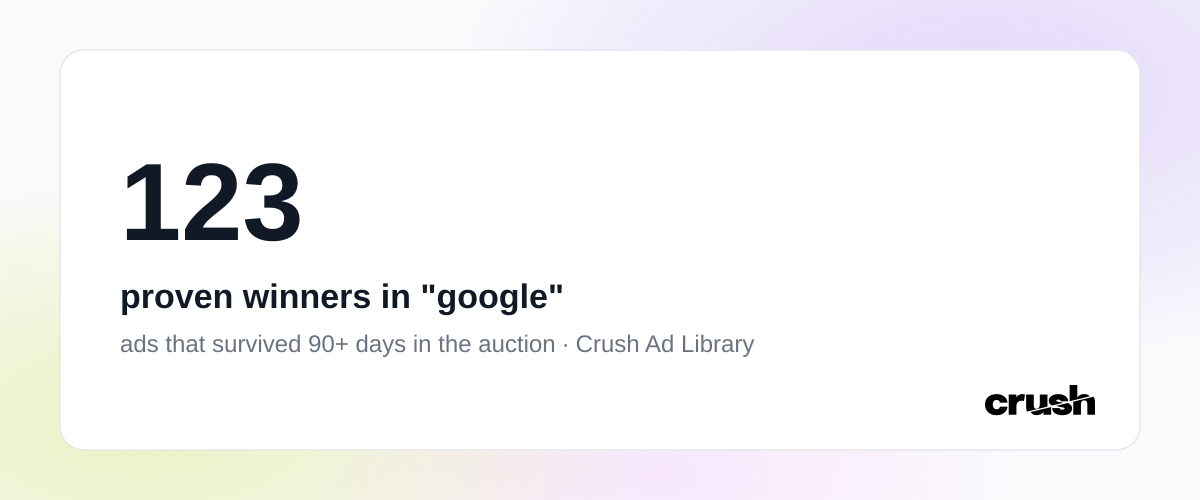
2Cross-referencing Google ads with social platforms reveals true profitability, as 123 of the top 400 Google-related ads in our database ran for 90 days or more.
3A high duplicate count on a creative is a massive signal that an advertiser is scaling a proven winner.
4The most successful call to action buttons focus on low friction, with learn more making up 44 percent of top ads.
5Manual ad spying is obsolete because modern AI platforms can track deleted ads, measure run times, and automatically iterate winning creatives.
Learn how to use the Google Ads Transparency Center to reverse engineer competitor campaigns and cross-reference data to spot proven winners.
What Is The Google Ad Library?
The google ad library is officially named the Google Ads Transparency Center. It is a free public database where you can search any verified advertiser and view their currently active Search, Display, and YouTube campaigns.
Modern media buyers use this tool to reverse engineer competitor creatives, analyze copywriting structures, and uncover the ultimate tools for finding 1000-day winning ads across various platforms.
How To Access The Google Ads Transparency Center
Finding the tool is straightforward. You navigate to adstransparency.google.com in your browser. From there, you can type in any brand name or website URL.
Google requires all advertisers to verify their identity. Because of this verification process, you can see the legal entity behind any active advertisement. This transparency helps you map out exact corporate ownership networks running multiple brands.
Navigating The Ad Search Interface
Once you enter a domain, the platform displays a grid of active ads. You can filter these results by date range, geographic region, and ad format.
This filtering system is crucial for localizing your research. If you are launching a product in the United Kingdom, you can isolate exactly what creatives your top competitor runs exclusively in that region.
What Information Does The Google Ads Library Provide?
The platform reveals the exact text, images, and videos a brand currently spends money to promote. You can inspect headline variations, description copy, and the visual assets deployed across the Google Display Network.
Text Ads And Search Copy Strategies
Search ads are the foundation of Google marketing. The transparency center shows you the precise combinations of headlines and descriptions your competitors use.
By studying these text blocks, you can identify their primary selling angles. Notice whether they focus on price, features, or urgency. If every competitor pushes a specific guarantee in their headline, you know that angle is required to compete in the auction.
Video Assets And YouTube Creatives
You can watch the exact video assets running as YouTube ads. The tool lets you play the video and see the thumbnails used.
Pay attention to the first five seconds of these videos. The hook is the most expensive part of a video ad to test. By watching what major brands leave active, you can borrow proven hook frameworks for your own campaigns.
Google ads past the 90-day proven-winner threshold.
Where Does The Google Ads Transparency Center Fall Short?
The biggest limitation of the google ads library is the complete lack of performance data and historical longevity. Google only shows you what is active right now, giving you zero context on whether an ad actually generates profitable conversions.
The Missing Metric Problem
You cannot see how much money an advertiser spends on a specific creative. You also cannot see impression counts or click-through rates.
Most importantly, Google hides how long an ad has been running. Without longevity data, you cannot distinguish between a proven winner that has run for months and a failed test launched yesterday.
Active Status Does Not Equal Profitability
Just because an ad is currently active in the google ads library does not mean it works. Media buyers test dozens of variations weekly.
If you blindly copy active ads from the transparency center, you might copy a losing test. This is exactly why decoding winning concepts with data is a much safer strategy for scaling campaigns than relying purely on Google's public database.
How Does Cross-Platform Research Beat The Google Ads Library?
Cross-platform research eliminates the guesswork by validating Google creatives against Meta's data ecosystem. When you see a brand pushing a specific angle on Search, you must check if they also spend heavily on that same angle across social channels.
Introducing Proprietary Ad Insights
To solve the missing data problem, smart buyers look at cross-channel behavior. This is exactly why we built Crush, our platform for AI Facebook-ads management and competitive intelligence.
Our product Crush tracks competitors' Facebook ads via the Meta Ad Library and keeps a permanent history. This includes ads that were taken down, giving you the historical context Google refuses to share.
Understanding Longevity Data
Our database contains millions of Facebook ads across niches with precise longevity data. We track exactly how many days an ad has been running and duplicate counts, showing how many times an advertiser relaunched the same creative.
A high duplicate count is a massive signal. If an advertiser relaunches the same video eight times, they are scaling a proven winner. Google offers no equivalent metric.
What Does Our Proprietary Data Say About Advertising Offers?
Our internal metrics reveal exactly how aggressively media buyers test and scale campaigns in 2026. Crush's ad library currently tracks 1,736,003 unique Facebook ads, with 446,480 currently active.
Analyzing B2B And Search Marketing Offers
We tracked specific patterns for marketing agencies and software companies selling search services. Currently, 2,365 tracked ads match the keyword google in our database, with 423 active right now.
Crush data shows that among top google ads, the average run time is exactly 90 days.
We consider 90 days the proven winner threshold. Out of the top 400 ads matching this criteria, 123 ran for 90 days or more. This proves that while testing is rapid, winning concepts scale for months.
Real Case Studies From The Database
Historical data separates the amateurs from the professionals. Let us look at specific examples from our free database that prove why longevity tracking is vital.
Cloud Media: This campaign is currently running after 704 days and has been relaunched 8 times. The opening line is highly specific: “🔥𝐓𝐢𝐤𝐓𝐨𝐤 (+) 𝐅𝐚𝐜𝐞𝐛𝐨𝐨𝐤 & 𝐈𝐧𝐬𝐭𝐚𝐠𝐫𝐚𝐦 (+) 𝐆𝐨𝐨𝐠𝐥𝐞 𝐀𝐝𝐬 & 𝐘𝐨𝐮𝐓𝐮𝐛𝐞 𝐇𝐚𝐧𝐝𝐬-𝐨𝐧 𝐀𝐝𝐯𝐞𝐫𝐭𝐢𝐬𝐢𝐧𝐠 𝐖𝐨𝐫𝐤𝐬𝐡𝐨𝐩🔥 Elev”.
OAK & SAND: A luxury bedding crafter running a campaign for 756 days with 1 relaunch. Their opening copy focuses heavily on proprietary design: “We design and engineer our own fabrics and sheet features, allowing us to craft bedsheets that are truly meant for our climate and Asian skin. We're not just a”.
Destiny Agency: Ran an ad for a massive 798 days with 1 relaunch before taking it down.
Most Marketing by Barry: Ran a proven concept for 565 days with 1 relaunch.
Reportei: Currently running for 519 days with 4 distinct relaunches.
None of this historical depth is visible in the standard google ads library. You can browse our free public ad library to see these metrics yourself.
How Do You Build A Competitor Analysis Routine In 2026?
A systematic research routine prevents you from launching campaigns blindly. You must document competitor strategies across both search and social networks before spending a single dollar on new creatives.
Phase One: Documenting The Search Baseline
Start in the Google Ads Transparency Center. Enter your top three direct competitors. Filter their ads by text format to isolate their search copy.
Document their core value propositions in a spreadsheet. Note the specific numbers, guarantees, or risk-reversals they use in their headlines. This gives you the baseline of what searchers currently see when looking for your product category.
Phase Two: Validating Strategies With Social Data
Take those core value propositions and search for the same brands in our database. You want to see if the angles they run on Google are also surviving the brutal testing environment of Facebook feeds.
If you find a competitor pushing a discount offer on Google, but their longest-running Facebook ad focuses on product quality, you know the quality angle is likely their most profitable core message.
Phase Three: Iterating Ad Creatives (Not Copying)
Never rip a competitor's creative exactly as is. Instead, isolate the variables making it work. If their winning YouTube ad uses a customer testimonial as the hook, you need to test a testimonial hook.
Our product Crush can automatically generate ad-creative iterations from a winning reference ad. This allows you to launch fresh variations of proven concepts without stealing, tying perfectly into a data-driven creative strategy based on 2026 data.
What Does The Data Say About Call To Action Strategies?
Choosing the right button can drastically alter your conversion rate. The google ads library shows you what buttons are active, but our cross-referenced data reveals what actually scales long-term.
Analyzing Ad Button Distribution
We analyzed the call-to-action distribution across the top scaling ads in our database. The results show a clear preference for low-friction commitments early in the funnel.
The most common CTA buttons on google related ads are learn more at 44 percent, followed by sign up at 23 percent.
Direct communication is also carving out a distinct market share. The whatsapp message button accounts for 7 percent of top ads, showing a massive shift toward immediate conversational commerce in specific regions.
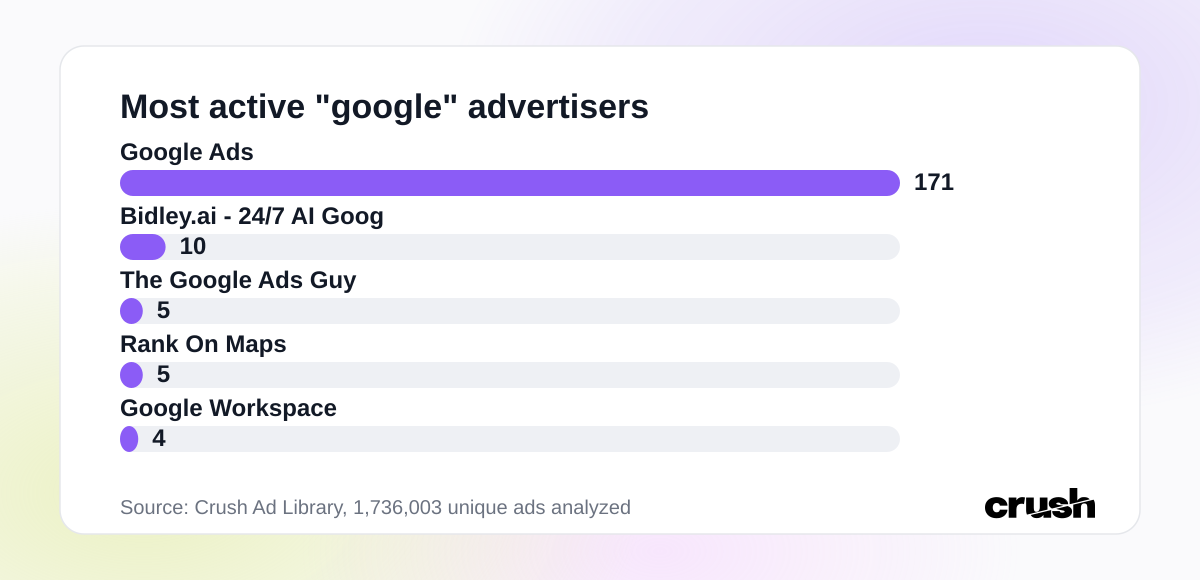
Advertisers with the most tracked google ads in the Crush Ad Library.
How Do The Major Ad Libraries Compare Functionally?
Understanding the technical differences between public databases helps you extract better data. Each platform is built with a different goal regarding public transparency.
Ad Library Feature Breakdown
Google built their center purely for regulatory compliance, while third-party tools are built for media buyers. Here is how the core capabilities stack up.
Feature
Google Ads Transparency Center
Meta Ad Library
Crush Ad Library
Active Ads Visibility
Yes
Yes
Yes
Historical Deleted Ads
No
No
Yes
Longevity Tracking (Days Active)
No
No
Yes
Creative Relaunch Count
No
No
Yes
Automated Creative Iteration
No
No
Yes
This table highlights exactly why relying only on official transparency centers leaves you blind to historical performance.
Why Is Automation Replacing Manual Ad Spy Methods?
Manual ad spying requires hours of saving links and checking daily to see if an ad is still active. Many marketers wonder if tools like PowerAdSpy are worth the cost when modern automation can eliminate this busywork and directly tie research to campaign execution.
To truly understand what media buying is in 2026, you have to embrace the AI revolution that automates this entire pipeline.
Scaling Winners Without The Grind
A senior media buyer should spend time on strategy, not refreshing web pages. Once you identify a proven angle, the next step is building the campaign.
Our product Crush fully automatically runs Facebook ads. It creates the campaigns, scales the winners, and kills the losers without manual intervention. You can view our paid plans to see how we structure automated scaling.
The Final Competitor Research Checklist For 2026
Before you launch your next campaign, run through this required intelligence checklist.
Search your top competitor in the Ads Transparency Center.
Identify their primary video hook and search text angles.
Cross-reference their domain in a historical tracking database.
Verify if their active concepts have run longer than the 90-day proven threshold.
Generate iterative variations using AI rather than copying their assets directly.
Launch with a low-friction CTA like learn more.
Mastering the google ads library is just the first step. True competitive advantage comes from combining that transparency with historical longevity data to guarantee you only scale proven concepts.
How we got this data
The numbers in this article come from Crush’s ad library: 1,736,003 unique Facebook ads tracked via the Meta Ad Library, 446,480 of them active at the time of writing. Ad examples reference real advertisers and their public ads. Data queried on 2026-08-06. Third-party product facts are attributed inline to their sources.
Frequently Asked Questions
Common questions about this topic
1Is the Google ad library free to use?
Yes. The Ads Transparency Center is completely free. Anyone can access it via a web browser to search for verified advertisers and view their currently active campaigns.
2Can I see how much competitors spend on Google Ads?
No. Google does not disclose ad spend, impression counts, or click-through rates. You can only see the creative assets that are currently active in the auction.
3How do I find older ads that are no longer running?
The official Google tool removes ads once they are paused. To view historical or deleted ads, you must use a third-party tracking platform that constantly archives active creatives over time.
4How long should an ad run before it is considered a winner?
Data shows that hitting the 90-day mark is a strong indicator of a proven winner. Advertisers rarely spend money on a losing creative for three consecutive months.
Rokas is the Founder and CEO of TryCrush.ai, an ex-IBM professional turned entrepreneur focused on building AI-driven growth platforms. With a strong background in ecommerce, performance marketing, media buying, and artificial intelligence, Rokas specializes in creating scalable, data-led systems that drive measurable revenue. His mission is to help modern businesses leverage AI to optimize acquisition, conversions, and long-term profitability.
Stop Guessing. Start Crushing.
AI Ad Manager trained by world-class media buyers to generate your creatives and optimize your ads 24/7.