Key Takeaways
- 1A profitable product trend is verified by ad longevity, with top performers averaging 123 days active.
- 2The strongest signal of a scaling product trend is a high creative duplicate count in the ad library.
- 3The 'Shop Now' CTA dominates e-commerce trends, accounting for 45% of top product ads.
- 4Testing a product trend requires strict mathematical rules to kill losing ads before they drain your budget.
A real product trend is not defined by search volume, but by how long advertisers are willing to spend money promoting it.
A product trend is a sustained shift in consumer demand for a specific item, verifiable through actual sales or long-running advertising data. Instead of relying on search volume spikes, media buyers identify real product trends by tracking competitor ad spend and longevity in the Meta Ad Library.
What Actually Defines a Winning Product Trend in 2026?
A winning product trend is defined by the amount of money advertisers are willing to spend to promote it over an extended period. Generic marketing blogs tell you to look at search volume charts to find what to sell. As a media buyer, I look entirely at ad longevity and active spend.
If an ad runs for months, the product is profitable. Nobody leaves a losing campaign turned on for half a year.
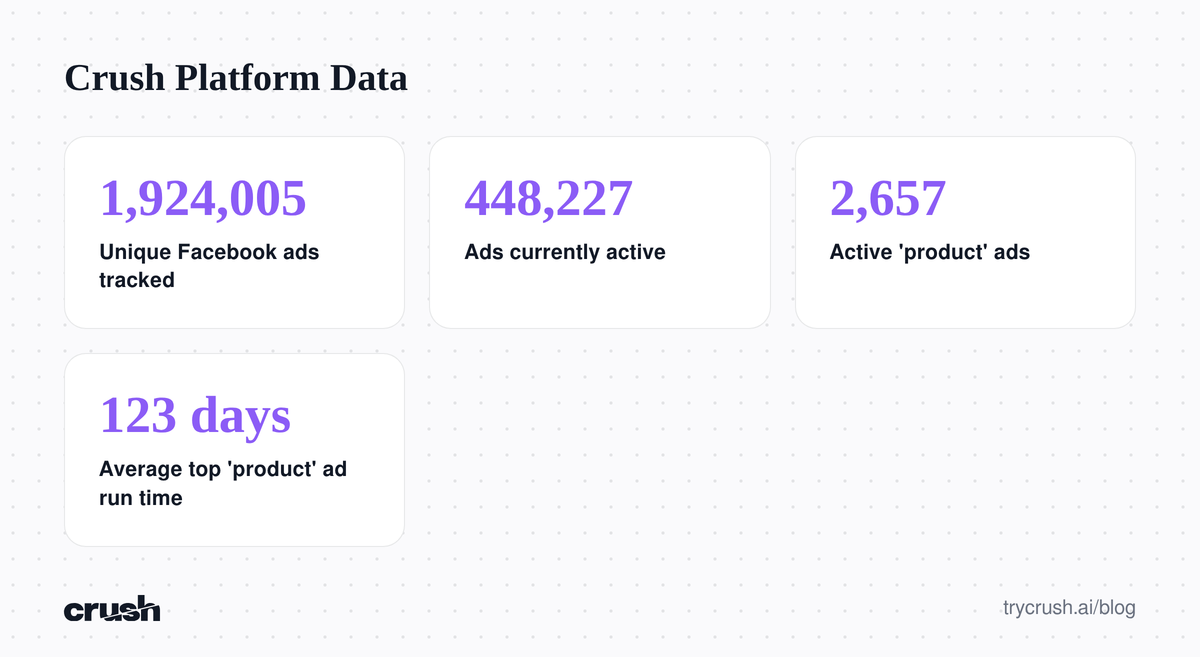
This is where data separates real product trends from fleeting fads. Crush, our AI Facebook-ads platform, monitors exactly what is happening in the market. Crush's ad library tracks 1,924,005 unique Facebook ads (448,227 currently active).
Out of that massive dataset, 8,718 tracked ads match "product" (2,657 active right now). We know exactly what is selling today because we track the competitor ad spend directly. We see the history, including the campaigns that were taken down.
How Long Do Trending Product Ads Actually Run?
Profitable product ads run for an average of four months, proving that real trends have serious staying power. We measure a product trend not by how many views a social media post gets, but by how many days an advertiser keeps their credit card charged.
The 90-Day Profitability Benchmark
When you hit a real product trend, your campaigns should survive past the initial testing phase. Among top "product" ads, average run time is 123 days; 173 of the top 400 ran 90+ days (the "proven winner" threshold).
Among top "product" ads, average run time is 123 days; 173 of the top 400 ran 90+ days (the "proven winner" threshold).
You do not keep an ad live for three months if it is draining your budget. Reaching that 90-day mark means the product has stable margins and consistent conversion rates.
Real-World Examples of High-Spend Product Trends
Let us look at some specific examples from our database. These are not guesses. These are real campaigns that ran for hundreds or thousands of days.
| Advertiser | Days Active | Relaunches | Top CTA |
|---|---|---|---|
| Idealancy | 1664 | 2 | Shop now |
| Regagar | 1005 | 3 | Shop now |
| Quran Majeed App | 833 | 10 | Download |
| Zapier | 801 | 4 | Learn more |
| Udemy | 189 | 180 | Buy now |
Idealancy ran an ad for 1664 days with only 2 relaunches using a "shop now" CTA. Their opening line was simple: "You have visited our website! Interested in our products? Idealancy presents kitchenwares, bakewares, organizers, baby products, traveling essentials, house reno". They focused on kitchen and home product trends and let the ad print.
Regagar ran their ad for 1005 days. They used 3 relaunches and a "shop now" CTA. Their opening line read: "Regagar | Premium Baby Products ♡ ผลิตภัณฑ์สำหรับเด็ก และครีมบำรุงผิวเด็กสูตรแพทย์". Baby products remain a massive, stable product trend.
Which Calls to Action Dominate Trending Product Ads?
The "Shop Now" button is the dominant choice for product trends, capturing nearly half of all top-performing ads in our database. Getting the consumer to the checkout page quickly is the priority for physical goods.
The Data Behind Ad Clicks
You need to align your button choice with your specific product trend. Most common CTA buttons on "product" ads: shop now (45%), learn more (28%), sign up (4%). This tells us a lot about how you should structure your marketing funnel.
E-commerce Versus Digital Services
Physical e-commerce items almost exclusively rely on immediate purchases. If you are selling physical goods, you want that 45 percent "shop now" action. Consumers understand the transaction intuitively.
Digital products or software often require a bit more explanation. Zapier caught a massive business product trend. They ran their winning ad for 801 days and relaunched it 4 times. Their CTA was "learn more" and their opening line asked: "Want to level up your company? Connect apps and automate work for your entire business with Zapier."
Then there is Udemy. They treat education like a high-volume product trend. They ran a specific ad for 189 days, but they relaunched it 180 times with a "buy now" CTA. Their opening line was direct: "Learn thousands of in-demand skills in one subscription. From data, AI, and coding to productivity, marketing and creative skills, learn at your own pace."
Apps follow their own rules. The Quran Majeed App rode a massive mobile product trend. Their ad ran for 833 days, was relaunched 10 times, and simply used a "download" CTA.
How Do You Find a Product Trend Before It Saturates?
You find early product trends by monitoring the Meta Ad Library for ads that survive their first two weeks of delivery. A two-week survival rate means the advertiser found initial traction and is not pausing the campaign.
Step-By-Step Competitor Analysis
You cannot rely on organic social media to tell you what to sell. You need to look at what brands are spending hard dollars on today.
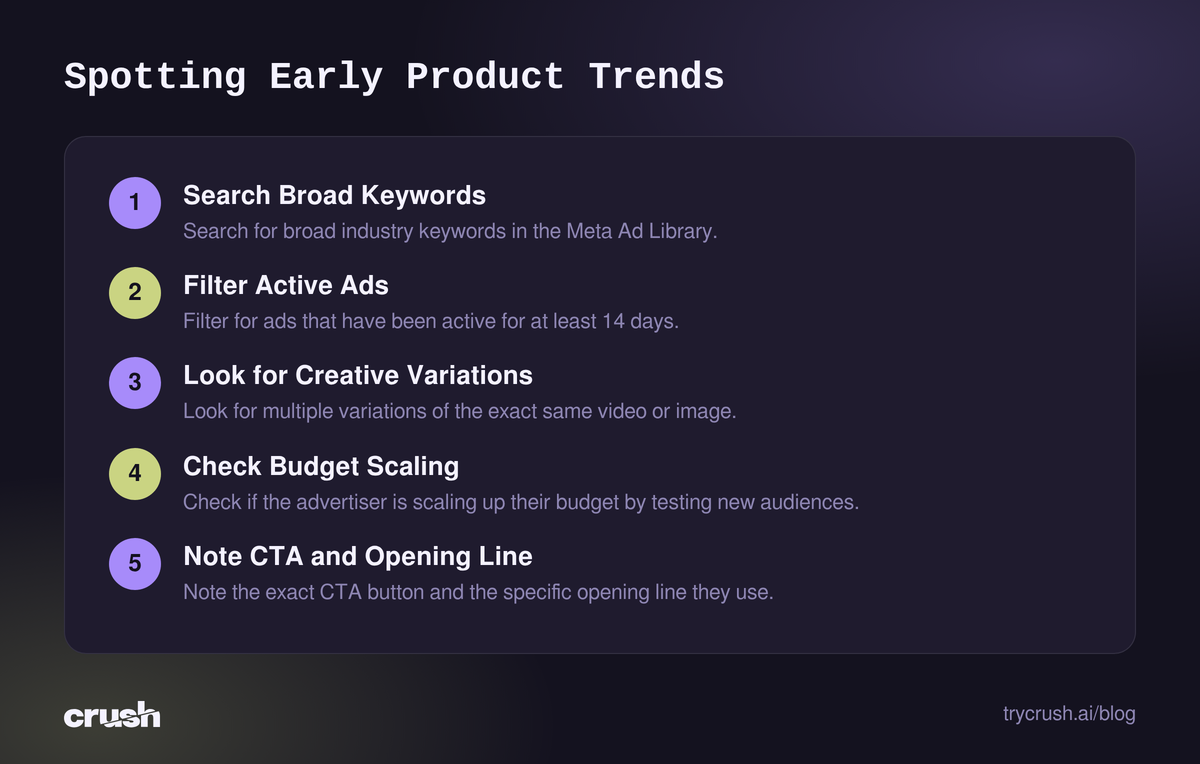
Here is how you spot a product trend early:
- Search for broad industry keywords in the Meta Ad Library.
- Filter for ads that have been active for at least 14 days.
- Look for multiple variations of the exact same video or image.
- Check if the advertiser is scaling up their budget by testing new audiences.
- Note the exact CTA button and the specific opening line they use.
If you want to automate this research, you can use our free public ad library. It lives at trycrush.ai/ad-library. We keep the history of these ads, including the ones that were taken down. This gives you a massive advantage when tracking a new product trend.
Why Is Duplicate Count a Major Product Trend Signal?
A high duplicate count means the advertiser found a winning creative and is aggressively scaling it across different audiences to maximize the product trend. This is the strongest signal that an item is highly profitable.
Reading the Relaunch Data
Look back at the Udemy example from our data table. They relaunched their ad 180 times. You only duplicate an ad 180 times if the product trend is printing cash.
Every time you relaunch or duplicate an ad, you are forcing the algorithm to find a new pocket of buyers. Advertisers do this when they want to spend more daily budget without resetting the learning phase on their original ad set.
Using Winning Ads as References
When you see a competitor with a high duplicate count, you have found a verified product trend. Your next step is to make your own version of that creative.
Our Crush platform can generate ad-creative iterations from a winning reference ad. You take the ad that has been running for 90 days, feed it into the system, and build your own angles based on a proven, profitable format.
How Do You Validate a Product Trend With Your Own Budget?
You validate a product trend by running a structured media buying test that strictly kills losing ads and scales the winners mathematically. You cannot just guess with your budget.
The Campaign Testing Structure
Testing a new product trend requires absolute discipline. You must isolate your variables to know what is actually driving the sale.
Here is the standard media buying checklist for testing a product trend:
- Launch one campaign dedicated solely to testing new product creatives.
- Use three to five ad sets, each targeting a broad audience.
- Place three different ad creatives inside each ad set.
- Set a strict daily budget you are completely willing to lose while gathering data.
- Turn off any ad that spends past your target cost per acquisition without a sale.
Say your target CPA is $50. If the ad spends $75 with zero purchases, kill it immediately. Do not hold out hope for a late conversion.
Automating the Media Buying Process
Media buying is tedious if you do it manually. Staring at Ads Manager all day leads to emotional decisions. You might fall in love with a product trend and refuse to turn off a losing campaign.
Crush fully automatically runs Facebook ads. Our AI creates campaigns, scales winners, and kills losers without human emotion. If you want to see how the automation handles budget scaling, paid plans start with a trial. You can check current pricing at trycrush.ai/pricing.
What Are the Biggest Mistakes When Chasing a Product Trend?
The biggest mistake advertisers make is confusing a viral organic moment with a sustainable product trend that can actually support paid traffic. Viral videos do not always translate into profitable cost per acquisition metrics.
Ignoring Profit Margins at Scale
Just because a product trend is popular does not mean you can afford to sell it. High search volume means absolutely nothing if the math does not work on the media buying side.
If your product costs you $20 to source and ship, and your average CPA on Meta is $30, you will lose money on a $40 retail price. Always calculate your strict break-even point before launching any ads.
Overcomplicating the Creative Hook
The opening lines from our top-performing examples are incredibly basic. Zapier asks a simple question about leveling up your company. Udemy states exactly what you get in one sentence. Idealancy literally says "Interested in our products?".
Do not try to be overly clever when selling a product trend. State what the product is, explain the direct benefit, and ask for the sale. The algorithm is smart enough to find the buyers if your core message is clear.
Why Does Meta Campaign Architecture Matter for a Product Trend?
Meta campaign architecture matters because how you structure your ad sets dictates whether the algorithm can find your ideal buyers efficiently. Testing a product trend requires a completely different setup than scaling a proven winner.
Campaign Budget Optimization Strategies
When validating a fresh product trend, many buyers use Ad Set Budget Optimization. This forces the system to spend equally on every creative so you get fair data.
Once a product trend shows a strong return on ad spend, buyers shift to Campaign Budget Optimization. This allows Meta to push the daily budget toward the most profitable ad set automatically. Managing this transition manually is difficult, which is exactly why automated scaling systems exist.
Managing Creative Fatigue
Even the strongest product trend will eventually experience creative fatigue. The audience gets tired of seeing the exact same video over and over.
This is why tracking relaunch counts is crucial. Advertisers duplicate successful campaigns to reset delivery. They refresh the first three seconds of the video while keeping the core product trend messaging identical. You must iterate constantly to keep your costs down.
How we got this data
The numbers in this article come from Crush’s ad library: 1,924,005 unique Facebook ads tracked via the Meta Ad Library, 448,227 of them active at the time of writing. Ad examples reference real advertisers and their public ads. Data queried on 2026-09-08. Third-party product facts are attributed inline to their sources.
Frequently Asked Questions
Common questions about this topic
1What is a product trend?
2How do you find a product trend on Meta?
3Why do advertisers relaunch the same ad?
4What is a good test budget for a new product?
5Does search volume guarantee a profitable product?
Written by

Albertas Pocius
Co-founder, CMOAlbertas is the Co-Founder and CMO of TryCrush.ai, bringing elite-level performance marketing expertise to the platform. With over $50M+ in combined Facebook and TikTok ad spend, Albertas has launched and scaled dozens of projects from zero, driven by a deep obsession with data and experimentation. He has trained 20+ media buyers, consulted 100+ companies, and is widely recognized as one of Europe’s early TikTok pioneers, likely the first to scale campaigns beyond $100K per day. Today, he also teaches advertising strategy at two colleges, shaping the next generation of media buyers.
Stop Guessing.
Start Crushing.
AI Ad Manager trained by world-class media buyers to generate your creatives and optimize your ads 24/7.
Learn more
Continue Reading

How to Build an AI Creative Agency in 2026 (With Data)
An AI creative agency replaces manual design and media buying with autonomous software. Discover the exact ad data and automated workflows driving the most profitable agencies in 2026.

5 Proven Examples of Audience Analysis From Winning Ads
We analyze five long-running Facebook ads to show exactly what successful audience analysis looks like in the real world of media buying.
Fix a Disabled Ad Account on Facebook (2026 Protocol)
A step-by-step guide to appealing a Meta restriction, analyzing long-running compliant ads, and protecting your Business Manager infrastructure.