Key Takeaways
- 1Longevity and relaunch counts are the only accurate metrics to prove an ad is a profitable winner.
- 2The average proven ad runs for 85 days, with elite creatives running for over 400 days without fatigue.
- 3Nearly half (48%) of all successful advertising creatives rely on the 'Learn More' CTA to reduce click friction.
- 4B2B ads scale by translating basic product features into direct financial outcomes for the buyer.
- 5High duplicate counts indicate a media buyer has found a control creative and is actively scaling it across new audiences.
Most ad examples focus on aesthetics. We use proprietary longevity data to break down three real Facebook ads that ran for over 400 days and explain exactly why they convert.
The best Facebook advertising examples are not necessarily the ones with the flashiest graphics or the biggest production budgets.
They are the ads that run for hundreds of days because they consistently acquire customers at a profitable CPA.
Most marketing blogs curate ad examples based on what looks nice. However, experienced media buyers know that aesthetic opinions do not pay the bills. The only metric that conclusively proves an ad works is ad longevity.
If a brand spends money on the exact same creative for over a year, that ad is a proven winner. Below, we break down three real Facebook ad examples that survived the Meta algorithm and drove results for over 400 days.
Proven Facebook Advertising Examples: What Makes Them Different?
These examples rely on hard data, not subjective design opinions. To find them, we pulled data from Crush, our AI Facebook-ads platform. Our software automatically creates campaigns, scales winners, and kills underperforming ads.
As part of our platform, we track competitors' Facebook ads via the Meta Ad Library and keep a permanent history. This includes ads that were eventually taken down by the advertiser.
Crush's ad library tracks 1,650,858 unique Facebook ads, with 526,097 currently active.
Because we track this massive dataset, we can see exactly how many days an ad has been running. We can also see duplicate counts, which tells us how many times an advertiser relaunched the exact same creative into new ad sets or campaigns.
A high longevity score combined with multiple relaunches is the strongest signal of a winning ad in 2026. It means the media buyer found a control creative and squeezed every drop of ROI out of it.
Meta Ad Longevity: The True Test of Facebook Ad Success
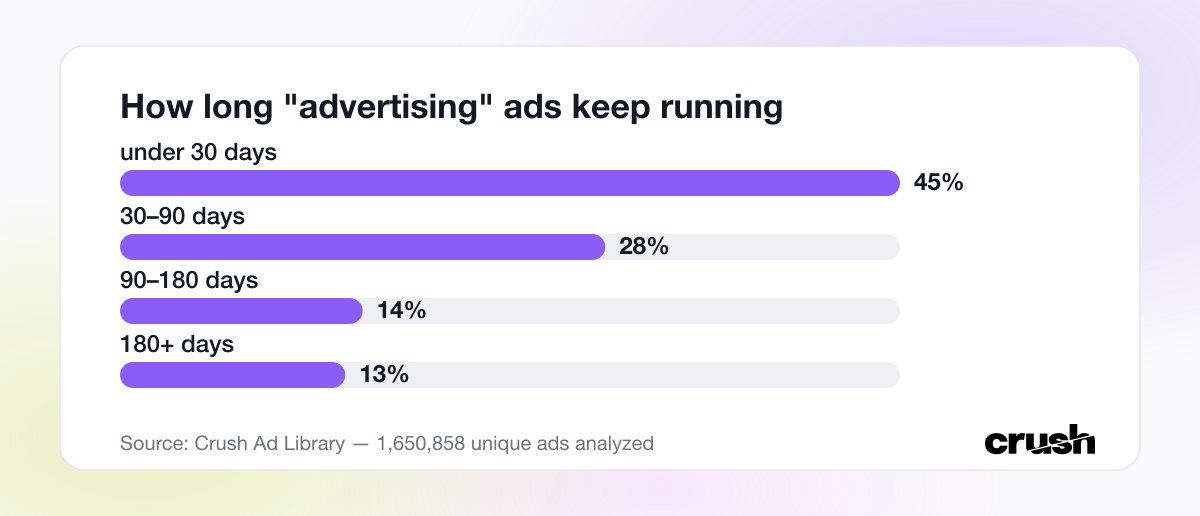
In 2026, the Meta algorithm cycles through creatives faster than ever. Ad fatigue is a real problem, and most ads die within their first two weeks of testing.
When we filtered our database for the keyword "advertising," we found that 2,095 tracked ads match that term, with 359 active right now. The survival rate for these ads is surprisingly top-heavy.
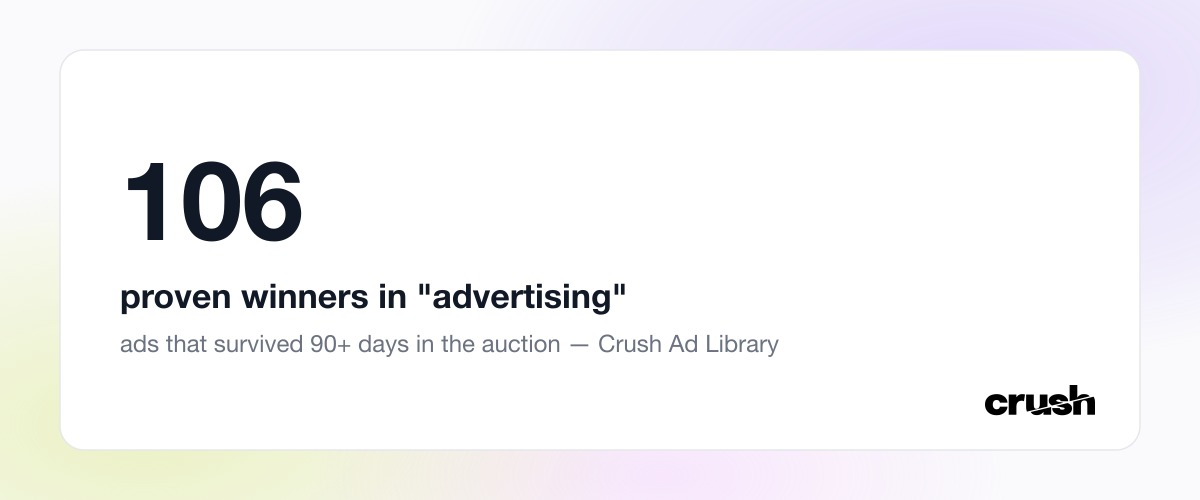
Among top "advertising" ads, the average run time is 85 days. However, 106 of the top 400 ran for 90+ days. Hitting the 90-day mark is the threshold for a proven winner. For campaigns designed to run even longer and stay top-of-mind, reviewing reminder advertising examples reveals how top brands successfully keep assets active for over 500 days.
3 Winning Facebook Ad Examples (Backed by 2026 Data)
The following Facebook ad examples have shattered the 90-day baseline. These are workhorse creatives that drive reliable conversions.
We will break down what the advertiser did, why the hook and offer work, and what actionable elements you should copy for your own campaigns.
1. Wraps Ink (Ran for 1,013 Days)
Wraps Ink ran a masterclass in local B2B lead generation. This ad ran for an incredible 1,013 days and was relaunched once.
- The Opening Line: "Transform your fleet vehicles into moving billboards with a STAND OUT vehicle design and wrap from Wraps Ink."
- Why it works: This hook does not sell the physical product (a vinyl wrap). It sells the financial outcome (a moving billboard). By framing the service as an advertising asset, it changes the buyer's psychology from "spending money" to "investing in marketing."
- The CTA: Learn more. For high-ticket B2B purchases, forcing a "Buy Now" button creates too much friction. "Learn more" invites the user to view a portfolio without commitment.
- What to copy: Translate your product's feature into a direct revenue driver for your target audience. Use capitalization sparingly on key emotional drivers like "STAND OUT" to break up the text block.
2. Stikee Grafix Advertising (Ran for 793 Days)
Stikee Grafix Advertising proves that you do not need complex funnels to drive massive volume. This ad ran for 793 days and was relaunched once.
- The Opening Line: "Enjoy every outdoor activity, from political campaigns to personal and business use. Here at Stikee Grafix Advertising, we offer easy installation yet Heavy Dut..."
- Why it works: The copy immediately calls out the specific use cases (political campaigns, business use) to qualify the audience. It then counters the biggest objection in the physical signage space: durability versus ease of use. They promise "easy installation yet Heavy Duty."
- The CTA: Message page. This is a brilliant use of conversational commerce.
- What to copy: If you sell custom physical products or are sourcing the best products to dropship in 2026, skip the complex landing page. In fact, analyzing ad longevity is one of the most reliable ways to spot a winning product trend in 2026 before the market catches on. Push users straight into Messenger or WhatsApp. When users click "Message page," they enter your inbox, allowing your sales team to close the deal with high-touch customer service.
3. Weitz & Luxenberg P.C. (Ran for 585 Days)
Mass tort and legal lead generation are some of the most expensive auctions on Facebook. Say your target CPA is $500 for a qualified legal lead, you need an ad that filters out unqualified clicks instantly. This ad ran for 585 days and was relaunched once.
- The Opening Line: "Have You Experienced Vision Loss After Taking Wegovy or Ozempic? If you or a loved one has suffered vision loss or been diagnosed with NAION (Non-Arteritic Ante..."
- Why it works: The first sentence is a direct, binary question. If the user answers no, they scroll past, saving the advertiser money on accidental clicks. If they answer yes, they are highly qualified. Mentioning the specific medical diagnosis (NAION) builds immediate authority.
- The CTA: Learn more. Legal services require immense trust. The "Learn more" button sets the expectation of reading a case study or a medical breakdown before asking for personal contact information.
- What to copy: For high-intent lead generation, use a disqualifying question as your hook. Do not try to appeal to everyone. Speak exclusively to the exact persona that fits your ideal client profile.
Ad CTA Optimization: The Best Calls to Action for 2026
Choosing the right Call to Action (CTA) button changes the user's expectation of the post-click experience. If you ask for too much commitment upfront, your click-through rate plummets. If you ask for too little, you get junk traffic.
We analyzed the most common CTA buttons on all "advertising" ads in our proprietary database. The data points to a clear preference for low-friction discovery.
For additional historical context beyond these benchmarks, explore our proven call to action examples compiled from over five years of advertising data.
| CTA Button | Usage Rate on Top Ads | Best Used For |
|---|---|---|
| Learn More | 48% | High-ticket, B2B, Lead Gen |
| Sign Up | 10% | Workshops, SaaS, Newsletters |
| Apply Now | 8% | Jobs, Financing, Exclusive Offers |
Nearly half of all proven, long-running ads use "Learn more." It is the safest baseline for any new campaign you launch in 2026.
Only switch to "Sign up" or "Apply now" when the user has extremely high intent or is already familiar with your brand through retargeting. If you're building campaigns for software companies, studying high-performing SaaS examples and ad frameworks can provide even more specialized insights into choosing the right CTA.
Creative Strategy: How To Reverse-Engineer These Ads
You cannot just screenshot these examples and expect them to work. You need to extract the underlying media buying framework. Building a winning creative strategy in 2026 requires systematic iteration and competitive intelligence.
Follow these structural steps to map proven concepts to your product:
- Isolate the primary hook: Look at the first three seconds of the video or the first sentence of the primary text. What is the core emotion or logic being triggered? When dissecting video ads, understanding how to pause a video on Instagram or Meta formats will help you effectively capture split-second visual hooks.
- Identify the audience filter: Note how the ad excludes bad leads. Do they call out an industry? Do they mention a specific pain point?
- Analyze the offer framing: Are they selling a feature, or are they selling an outcome (like the "moving billboards" example)?
- Match the CTA to the friction level: Ensure your button matches the complexity of your landing page.
Common Mistakes When Analyzing Facebook Ads
When marketers search for Facebook advertising examples, they frequently pull from swipe files that lack performance context. Avoid these costly errors when building your next creative sprint:
- Copying brand new ads: Just because a massive brand launched an ad yesterday does not mean it is profitable. Never copy an ad that has run for less than 30 days.
- Ignoring the post-click experience: A winning ad is only half the equation. If an ad has run for 500 days, it means the landing page is converting those clicks efficiently.
- Focusing on design over messaging: Ugly ads often outperform highly polished studio creatives. The clarity of the offer always beats the production value of the asset. For example, if you explore magazine adverts examples, you will notice how effective editorial copy drives engagement much better than simple striking visuals alone. Furthermore, treating community surfaces like your Facebook group description as ad copy rather than an afterthought proves that strong messaging always drives results.
- Forgetting duplicate counts: A single ad running for a long time might just be stuck in a low-budget retargeting campaign. High duplicate counts prove the advertiser is actively scaling it.
How To Find More Winning Facebook Ad Examples Instantly
Stop relying on subjective swipe files. The only way to win in Meta ads today is to base your creative strategy on verified, long-running data.
Frequently Asked Questions
Common questions about this topic
1How long should I let a Facebook ad run before killing it?
2Why do some ads run for over 1,000 days without fatiguing?
3What is the most effective call to action for Facebook ads?
4How can I tell if a competitor's Facebook ad is actually profitable?
5Should I copy the design or the copy of winning Facebook ads?
About this article
This article was written with AI assistance. Ad examples and ad data come from the Crush ad library.
Written by

Ignas Obulaitis
Head of ITIgnas Obulaitis is the head of IT for TryCrush.ai, leading the platform’s engineering and AI innovation. With a strong background in product-driven development, Ignas has built and scaled complex systems across fintech, SaaS, and AI-focused companies. An ex-IBM engineer and former Head of Development at Fluensure, Ignas combines deep technical expertise with a sharp product mindset to turn ambitious ideas into scalable, production-ready technology.
Stop Guessing.
Start Crushing.
AI Ad Manager trained by world-class media buyers to generate your creatives and optimize your ads 24/7.
Learn more
Related articles
Proven Online Ad Examples Based on Meta Ad Longevity Data
Stop guessing what works. We analyzed millions of active campaigns to bring you the best online ad examples based on pure longevity and profitability data.
Data-Backed Ways to Spot a Winning Product Trend in 2026
A real product trend is not defined by search volume, but by how long advertisers are willing to spend money promoting it.
Best Products to Dropship in 2026: Proven by Meta Ad Longevity Data
Most dropshipping guides rely on static wholesale catalogs. We rely on active ad spend data to show you exactly which products are surviving profitably on cold traffic.
Instagram Ads Examples: Top Creatives & Data-Backed Formulas
We analyzed millions of creatives to find the best Instagram ads examples. Discover the exact hooks, copy, and call to action buttons that keep campaigns profitable for hundreds of days.