Key Takeaways
- 1Winning Instagram ads share a common baseline: the average run time for top creatives is 197 days.
- 2A 90-day run time is the ultimate threshold that proves an ad is hitting its target acquisition cost.
- 3The 'Learn More' button dominates the platform, used by 35% of top advertisers to reduce user friction.
- 4B2B and lead generation ads scale best when they state exact services and geographical areas in the first sentence.
- 5You can reverse engineer high-performing ads by tracking their duplicate counts and total active days.
We analyzed millions of creatives to find the best Instagram ads examples. Discover the exact hooks, copy, and call to action buttons that keep campaigns profitable for hundreds of days.
What Metric Defines the Best Instagram Ads Examples?
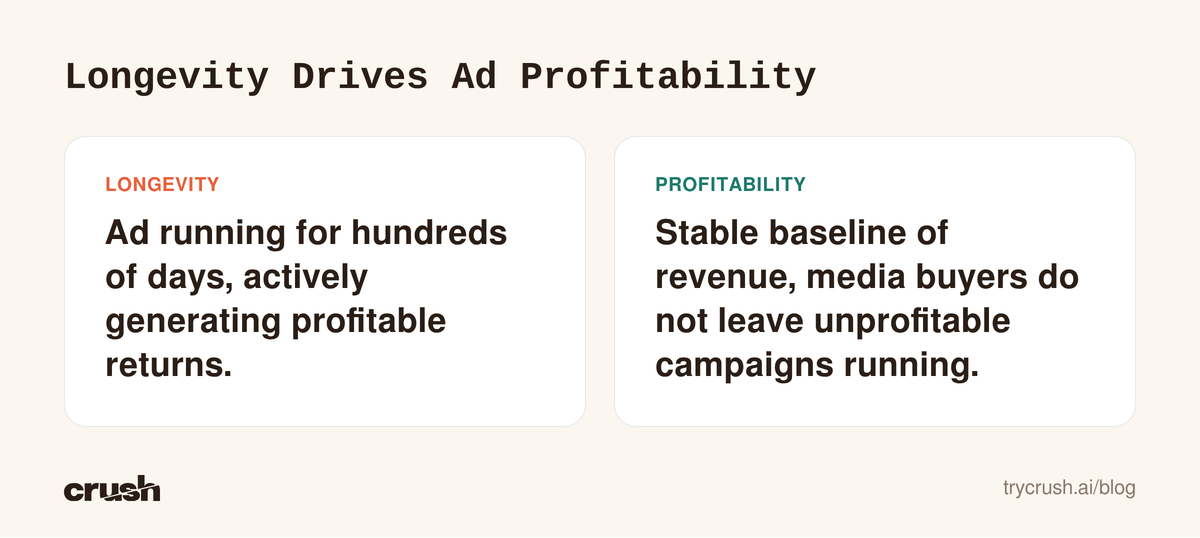
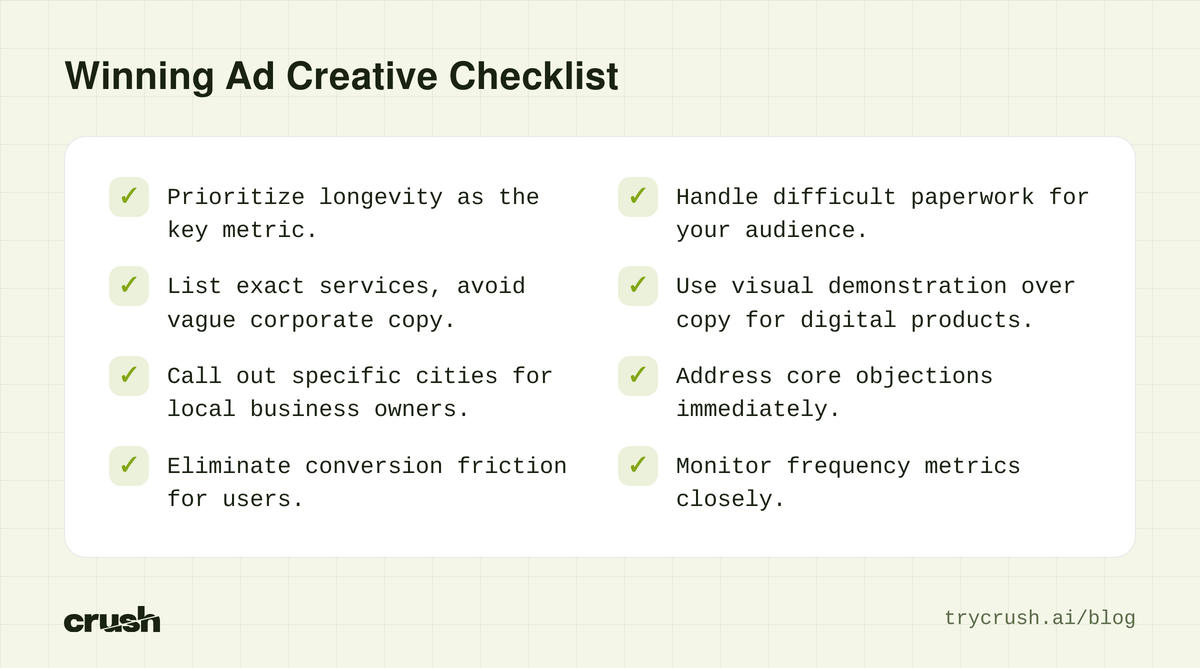
The best Instagram ads examples share one undeniable metric: longevity. An ad that runs for hundreds of days is actively generating profitable returns. By analyzing these proven winners, media buyers can reverse engineer successful hooks and formats to lower their own acquisition costs.
Media buyers often debate the most reliable metric for creative success. Return on ad spend is the ultimate goal, but competitor performance data is strictly private. We must rely on proxy metrics to evaluate their success from the outside.
Longevity measures how many days an ad has been active. An ad running continuously for months is generating a stable baseline of revenue. Media buyers simply do not leave unprofitable campaigns running for a year. By observing these long-running creatives, you can map out concrete marketing goal examples tailored specifically for profitable advertising.
Instagram Ads Data: What Makes a Campaign Successful?
The first step to building better creatives is analyzing historical performance. At Crush (our AI Facebook ads platform), we track competitors' Facebook ads via the Meta Ad Library and keep history, including ads that were taken down.
Our ad library contains millions of Facebook ads across niches. Specifically, our library tracks 1,874,565 unique Facebook ads, with 442,874 currently active right now.
When filtering for specific placements and tags, we found 1,570 tracked ads that explicitly match the keyword "instagram" in their targeting data. Currently, 127 of those are active right now. We track their longevity to find the outliers.
Among top "instagram" ads, average run time is 197 days, and 167 of the top 400 ran 90+ days.
A 90-day run time is the proven winner threshold. If an advertiser spends money on the same creative for three months, it is consistently hitting their target cost per acquisition. Here is a breakdown of our proprietary data findings.
| Metric | Data Point | Media Buying Insight |
|---|---|---|
| Total Tracked Ads | 1,874,565 | Provides a massive sample size for creative analysis. |
| Average Top Ad Run Time | 197 Days | Winning creatives scale efficiently for over six months. |
| Top CTA Button | Learn More (35%) | Low friction buttons consistently convert better on mobile. |
B2B Instagram Ads Example: KlickPiloten (2,244 Days)
Business-to-business lead generation is notoriously expensive on social platforms. Yet, the German agency KlickPiloten launched an ad that ran for a staggering 2,244 days. It was relaunched 0 times, proving the original ad set was stable enough to maintain delivery without forced duplication.
They used the "Contact Us" call to action button. The opening line was highly specific: “Die Digital-Marketing KlickPiloten Beratung & Agentur aus #Stuttgart, #Hamburg und #Berln: SEO, SEA, Social und Amazon Kampagnen für B2B & B2C.”
Geographic Hook Breakdown for Local Targeting
Calling out specific cities in the first line immediately stops the scroll for local business owners. It pairs broad digital marketing services with strict geographic relevance. Localized ad copy historically yields higher click-through rates than generic national targeting.
Media Buying Lesson: List Services Immediately
List your exact services immediately. Do not hide your value proposition behind vague corporate copy. In 2026, corporate buyers want to know exactly what you do before they click. The copy explicitly states SEO, SEA, Social, and Amazon campaigns to pre-qualify every single impression.
App Install Ads Example: wilov (2,189 Days)
Consumer apps need low friction to scale profitably. The French auto insurance company wilov ran a highly successful ad for 2,189 days. Just like the previous example, it was relaunched 0 times.
Their chosen button was "Learn More". The opening copy read: “wilov, la 1ère assurance auto à l’usage pour arrêter de payer plein pot. Nous résilions votre ancienne assurance pour vous. Sans engagement.”
Core Offer Breakdown: Solving Pain Points
The copy translates to offering pay-as-you-go auto insurance so users stop paying full price. The ultimate conversion trigger is their promise to handle the difficult paperwork. They state explicitly that they will cancel the user's old insurance for them.
Eliminating Conversion Friction in Ad Copy
The phrase "Sans engagement" translates to "no commitment". By taking on the administrative burden of canceling the competitor's policy, wilov removes the biggest psychological hurdle in switching insurance providers. This is a textbook example of a high-converting structural offer.
Digital Product Ads Example: Genera Studios (1,887 Days)
Digital products require heavy proof and clear demonstrations to overcome user skepticism. Genera Studios has a creative currently running for 1,887 days, relaunched 0 times. They rely heavily on the "Learn More" button to drive traffic.
Visual Demonstration Over Copy
When selling software, plugins, or audio tools, the visual asset must do the heavy lifting. A long run time indicates they found a specific audience pocket that responds to direct product workflow demonstrations rather than lifestyle marketing.
Managing Audience Fatigue
Running an ad for 1,887 days requires a massive total addressable market or highly restricted budget pacing. Say your hypothetical target cost per acquisition is fifty dollars. You must monitor frequency metrics closely to ensure your target audience does not go blind to the visual asset.
Higher Education Ads Example: ALEC University (1,396 Days)
Higher education marketing is highly competitive, especially for online degrees. ALEC at the University of Tennessee has an ad currently running for 1,396 days with 0 relaunches.
Their chosen call to action is "Learn More". The opening line addresses adult learner objections immediately: “Our highly flexible programs will allow you to obtain a degree through traditional coursework or entirely online.”
Addressing the Core Objection
The primary objection for continuing education is time management. The copy immediately highlights highly flexible programs and the choice between traditional and online coursework. It speaks directly to working professionals who cannot commute to a campus.
Structuring Lead Generation Copy
They do not sell the degree itself. They sell the flexibility of the schedule. The low-pressure button works perfectly here because a degree is a massive time investment. You cannot push a high-pressure button on a multi-year financial commitment.
Home Services & Solar Ads Example: LGCY Power (1,334 Days)
Home services and solar offers usually burn through creatives quickly. Yet, LGCY Power successfully ran an ad for 1,334 days with 0 relaunches. They drove traffic using the standard "Learn More" button.
The opening line relies entirely on third-party validation: “LGCY Power has been recognized by @bestcompanyUSA's 2022 Companies to Watch! We're experiencing unprecedented growth and have been consistently recognized as on”.
Leveraging Third-Party Authority
Solar installation is a trust-based sale. By opening the ad text with an award recognition, LGCY Power borrows credibility from established rating entities. This immediately lowers the guard of a skeptical homeowner who is tired of aggressive sales tactics.
The Power of Business Momentum
Stating they are experiencing unprecedented growth taps into the psychological bandwagon effect. Buyers want to work with stable companies, especially for a long-term home installation project. Highlighting growth signals safety to the consumer.
Top Call to Action (CTA) Buttons for Instagram Ads
Your choice of button heavily influences your outbound click-through rate. Based on our dataset of tracked ads matching the Instagram placement, three distinct call to action buttons dominate the platform.
Here is the exact distribution among the top performers:
- Learn More (35%): The most popular option by a wide margin. It implies low commitment and high educational value for the prospect.
- Shop Now (19%): The standard choice for direct response e-commerce brands pushing physical products.
- WhatsApp Message (17%): A rapidly growing option for international markets and high-touch sales operations requiring direct human contact.
Aligning the Button With the Sales Funnel
You must match the button to the user's immediate intent. Say you are selling a hypothetical two thousand dollar consulting service. Pushing a direct shopping button creates far too much pressure. A softer educational button transitions the user smoothly to a landing page where your long-form copy can do the actual selling.
How Do You Identify a Winning Ad Creative?
Media buyers rely on two core metrics to evaluate competitor creatives from the outside. The first is longevity. The second is the duplicate count metric, which reveals how the media buyer is managing their ad account structure.
Understanding Longevity Data
Our ad library contains longevity data to show exactly how many days an ad has been running. Advertisers kill losing ads within a few days to protect their daily budgets. If a creative survives the initial learning phase and runs for months, it is highly profitable.
Understanding Duplicate Counts
Duplicate counts track how many times an advertiser re-launched the same creative. A high duplicate count is a strong winning ad signal. It means the media buyer is actively testing the proven visual asset against new audiences or placing it into new scaling campaigns.
How to Test Your Own Instagram Ads Examples
Finding your own long-term winning ad requires a rigorous, emotionless testing process. You cannot rely on guessing what the algorithm wants. You need a structured methodology to build variations and cut losers rapidly.
- Find a proven baseline: Find a competitor ad in your niche with at least 90 days of run time.
- Generate iterations: Change exactly one variable at a time, such as the primary text hook, the visual asset, or the headline.
- Launch with strict rules: Set a hard automated kill switch if the cost per acquisition exceeds your target metric by twenty percent.
- Scale the winners: Increase the daily budget on ads that meet your key performance indicators incrementally over several days.
Building an Automated Creative Testing Workflow
Executing a high-volume testing strategy manually requires hours of daily account management. Media buyers in 2026 are moving toward automation to handle the tedious aspects of campaign management. In fact, many modern marketers are exploring how to build an AI creative agency to replace manual design and media buying with autonomous software.
Analyzing Competitor Creative Automatically
You can browse thousands of proven creatives in our free public ad library. Look for ads in your specific industry with high run times or high duplicate counts to establish your creative baseline.
Automating Your Campaign Management
Once you find a winning reference ad, our product Crush can generate ad-creative iterations automatically. Our system fully automatically runs Facebook ads from start to finish. It creates campaigns, scales the winners, and kills the losers without human intervention.
This automated approach removes emotional bias from your media buying process and actively protects your budget from sudden algorithm shifts. For brands looking to scale their ad spend safely, our paid plans start with a trial.
How we got this data
The numbers in this article come from Crush’s ad library: 1,874,565 unique Facebook ads tracked via the Meta Ad Library, 442,874 of them active at the time of writing. Ad examples reference real advertisers and their public ads. Data queried on 2026-08-31. Third-party product facts are attributed inline to their sources.
Frequently Asked Questions
Common questions about this topic
1What is the most popular call to action for Instagram ads?
2How long do successful Instagram ads run?
3What is a duplicate count in media buying?
4Why do advertisers use the WhatsApp message button?
About this article
This article was written with AI assistance. Ad examples and ad data come from the Crush ad library.
Written by
Rokas Steponavičius
Founder, CEORokas is the Founder and CEO of TryCrush.ai, an ex-IBM professional turned entrepreneur focused on building AI-driven growth platforms. With a strong background in ecommerce, performance marketing, media buying, and artificial intelligence, Rokas specializes in creating scalable, data-led systems that drive measurable revenue. His mission is to help modern businesses leverage AI to optimize acquisition, conversions, and long-term profitability.
Stop Guessing.
Start Crushing.
AI Ad Manager trained by world-class media buyers to generate your creatives and optimize your ads 24/7.
Learn more
Related articles
Magazine Adverts Examples: 3 Proven Winners For 2026
Magazine adverts examples show marketers how to blend editorial copy with striking visuals. We analyze three digital ads that borrow print tactics to achieve incredible longevity.
3 Proven Facebook Advertising Examples (Backed By 2026 Longevity Data)
Most ad examples focus on aesthetics. We use proprietary longevity data to break down three real Facebook ads that ran for over 400 days and explain exactly why they convert.
Proven Online Ad Examples Based on Meta Ad Longevity Data
Stop guessing what works. We analyzed millions of active campaigns to bring you the best online ad examples based on pure longevity and profitability data.

7 Ways AI is Secretly Optimizing Your Competitors' Ads
Your competitors are using AI to automate their ads while you tweak manually. Learn the 7 ways AI algorithms optimize targeting, creative testing, and bidding 24/7 to steal your customers before you even bid.