
Key Takeaways
- 1Autonomous AI software now handles both creative generation and budget scaling without human intervention.
- 2Among top agency ads in the Crush database, the average run time is 160 days, proving longevity beats rapid concept switching.
- 3A 90 day run time indicates a proven winner that AI platforms can use as a reference to generate profitable iterations.
- 4Low friction calls to action dominate the data, with the learn more button appearing on 41 percent of successful agency campaigns.
An AI creative agency replaces manual design and media buying with autonomous software. Discover the exact ad data and automated workflows driving the most profitable agencies in 2026.

AI Creative Agency Operations: What’s Different in 2026?
An AI creative agency replaces manual design and media buying with autonomous software. Instead of paying human teams to guess which creatives work, these modern operators use AI platforms to generate ad iterations, scale winners, and kill losers automatically. In 2026, the entire focus has shifted to data-driven asset production.
Traditional advertising relies on heavy human involvement, while modern operators build scalable systems around software. At Crush, our own AI Facebook-ads platform, we see this transition firsthand every day.
Our system fully automatically runs Facebook ads. It creates campaigns, scales winners, and kills losers without human intervention. This entirely removes the emotional bias that ruins most media buying budgets.
Manual media buyers often pause campaigns too early or let losing ads run too long out of hope. An automated system executes decisions based entirely on hard math.
Overcoming Manual Ad Testing Bottlenecks
Testing creative variations manually requires immense labor. Graphic designers must build new files, and media buyers must build new ad sets.
A true AI creative agency bypasses this bottleneck. By utilizing autonomous campaign creation, the software can test hundreds of variations without increasing headcount.
Winning Agency Ads: Real Performance Data
You cannot build a successful creative AI agency without tracking exactly what your competitors are doing. We track competitors' Facebook ads via the Meta Ad Library.
Crucially, our system keeps the complete history of these campaigns. This historical data includes ads that were taken down.
You can view this data yourself. Our free public ad library lives at https://trycrush.ai/ad-library. The volume of data inside this database reveals clear patterns in the current advertising market.
Crush's ad library tracks 1,918,196 unique Facebook ads. Right now, 443,321 of those are currently active on the platform.
If you filter this data specifically for the agency niche, the numbers are substantial. Exactly 5,322 tracked ads match the word "agency". Out of those, 799 are active right now.
The 90-Day Proven Winner Threshold
Most ads fail within the first few weeks of testing. When an ad runs for months, the market has validated its messaging and its ability to convert profitably. In fact, analyzing how long advertisers spend on specific creatives is one of the most reliable ways to spot a winning product trend.
We call this longevity metric the proven winner threshold.
Among top "agency" ads, the average run time is 160 days, and 193 of the top 400 ran for 90 or more days.
This longevity metric is the ultimate signal of profitability. An advertiser will simply not spend money on a failing ad for half a year.
Top Call-to-Action Buttons for Agency Ads
A successful AI creative agency does not guess which call to action to use. The data clearly shows what drives conversions in the agency space.
Here are the most common CTA buttons on "agency" ads based on our tracking data:
- Learn more accounts for 41 percent of the top ads.
- Whatsapp message accounts for 13 percent of the top ads.
- Apply now accounts for 10 percent of the top ads.
The data heavily favors low-friction requests. Asking a prospect to learn more works much better than asking them to commit immediately. This principle of reducing friction is also evident when analyzing successful web banner ad examples across multiple industries.
Ad Longevity: Why Some Agency Ads Run for Years
Our ad library contains millions of Facebook ads across niches. It tracks vital longevity data, showing exactly how many days an ad has been running.
It also tracks duplicate counts. This metric shows how many times an advertiser relaunched the same exact creative. A high duplicate count is a very strong winning ad signal.
Let us examine four highly successful campaigns from our database. These examples prove that targeted direct response copy often outlasts flashy design elements.
- Canada Benefit Group ran an ad for 1544 days and relaunched it 1 time.
- Prime Genetics ran an ad for 1017 days and relaunched it 1 time.
- Automateclients ran an ad for 762 days and relaunched it 1 time.
- Top Music Marketing Agency ran an ad for 738 days and relaunched it 1 time.
Example One: Canada Benefit Group
This campaign is a masterclass in direct audience calling. Running for 1544 days is an extreme outlier in modern media buying, proving its immense profitability.
They rely on the "learn more" CTA. Their exact opening line reads: "Have you heard of the Disability Tax Credit? It was designed to assist Canadians of all ages and income levels. This tax credit program is life-changing with re".
They call out the exact geographic and demographic target in the first sentence. There is zero ambiguity about who this specific ad is for.
Example Two: Prime Genetics
Running for 1017 days, this ad relies heavily on specific financial numbers to stop the user from scrolling. They also use the highly effective "learn more" CTA.
The opening line reads: "⚡ Surrogates Needed In TX! ⚡ Surrogates make up to $70,000 by carrying a baby for couples who want a child, but can't carry one on their own. Generous compensat".
State-specific targeting combined with a bold income claim captures attention immediately. The text is highly practical and speaks directly to a specific audience.
Example Three: Automateclients
Automateclients built a highly resilient campaign that ran for 762 days. They relaunched this creative 1 time during its lifecycle.
Like the majority of successful operators in this space, they opted for the "learn more" CTA. Consistency in these core mechanics separates the winners from the losers.
Example Four: Top Music Marketing Agency
Top Music Marketing Agency maintained their core ad for 738 days. They relaunched it 1 time to maintain momentum.
They also utilized the "learn more" CTA. Seeing this button dominate the top percentile of ads confirms that minimizing initial friction is mandatory for agency scaling.

Building an AI Creative Agency Workflow
You do not need a massive internal team to replicate these exact results. A modern AI creative studio or agency relies almost entirely on software to handle the heavy lifting.
The workflow fundamentally changes when you introduce autonomous tools into your daily operations. Let us compare the historical approach to the current automated model.
| Process Step | Traditional Agency Model | AI Platform Workflow |
|---|---|---|
| Concept Generation | Brainstorming sessions and manual mood boards. | Data extraction from proven 90-day winners. |
| Asset Production | Graphic designers building files from scratch. | AI generating ad-creative iterations from reference ads. |
| Campaign Management | Media buyers manually pausing and scaling ads. | Software scaling winners and killing losers automatically. |
Leveraging Historical Competitor Ad Data
A traditional setup relies on current active ads for inspiration. This creates a massive blind spot regarding what has historically failed.
Because our platform keeps history, including ads that were taken down, you avoid repeating your competitors' mistakes. You only focus on the mechanics of their long-term winners.
Generating Ad Iterations from Proven Winners
Once you find a campaign that has run for over 90 days, you have your validated baseline. Crush can generate ad-creative iterations directly from a winning reference ad.
This means you never start from a blank slate. You feed the platform a verified winner, and the AI produces distinct, highly optimized variations of that exact concept.
You test these iterations against your target metrics in real time. Say your target CPA is $50. You launch the AI-generated variations and let the software track the results.
Autonomous Media Spend: Managing Budgets with AI
Creating the visual assets is only half the battle. A true AI creative agency uses AI to manage the actual media spend without human hesitation.
Crush fully automatically runs Facebook ads based on strict rules and hard data. If a creative iteration exceeds your $50 CPA target, the system kills it immediately.
If the iteration acquires customers for $35, the system scales the budget. You remove all manual adjustments from the campaign scaling process.
Eliminating Manual Budget Adjustments
Manual budget adjustments are notoriously slow. A human media buyer might check an account twice a day. The market moves much faster than that.
Software monitors the spend continuously. By relying on autonomous media buying, your budget is always allocated to the highest performing iteration at any given moment.
Transitioning Your Agency Model to AI
In 2026, the competitive advantage firmly belongs to agencies that can iterate faster than their competitors. You simply cannot out-design a data-driven system.
You must leverage existing historical data to inform your decisions. By analyzing duplicate counts and run times, you eliminate massive guesswork, allowing you to build a reliable creative strategy.
To successfully transition into a fully autonomous model, you need to follow these core pillars:
- Find reference ads using historical competitor data.
- Generate iterations autonomously rather than starting from scratch.
- Scale automatically based entirely on hard metrics and performance data.
Every manual step you eliminate directly increases your operational margin and speeds up your testing cycle.
If you are ready to transition your media buying entirely to an autonomous system, we offer a straightforward way forward. Our paid plans start with a trial, and you can view the complete details at https://trycrush.ai/pricing.
How We Got This Data
The numbers in this article come from Crush’s ad library: 1,918,196 unique Facebook ads tracked via the Meta Ad Library, 443,321 of them active at the time of writing. Ad examples reference real advertisers and their public ads. Data queried on 2026-09-07. Third-party product facts are attributed inline to their sources.
Frequently Asked Questions
Common questions about this topic
1What defines an AI creative agency in 2026?
2How does competitor ad history improve campaign performance?
3What does a high duplicate count indicate on a Facebook ad?
4Why is the 90 day run time considered a proven winner threshold?
5What is the most effective call to action for agency advertisements?
About this article
This article was written with AI assistance. Ad examples and ad data come from the Crush ad library.
Written by

Rokas Steponavičius
Founder, CEORokas is the Founder and CEO of TryCrush.ai, an ex-IBM professional turned entrepreneur focused on building AI-driven growth platforms. With a strong background in ecommerce, performance marketing, media buying, and artificial intelligence, Rokas specializes in creating scalable, data-led systems that drive measurable revenue. His mission is to help modern businesses leverage AI to optimize acquisition, conversions, and long-term profitability.
Stop Guessing.
Start Crushing.
AI Ad Manager trained by world-class media buyers to generate your creatives and optimize your ads 24/7.
Learn more
Related articles
How to Search the Facebook Ad Library Like a Pro in 2026
Master the Facebook ad library with proprietary data from 1.7 million campaigns. Learn how to track ad longevity, spot hidden winners, and fully automate your creative testing.
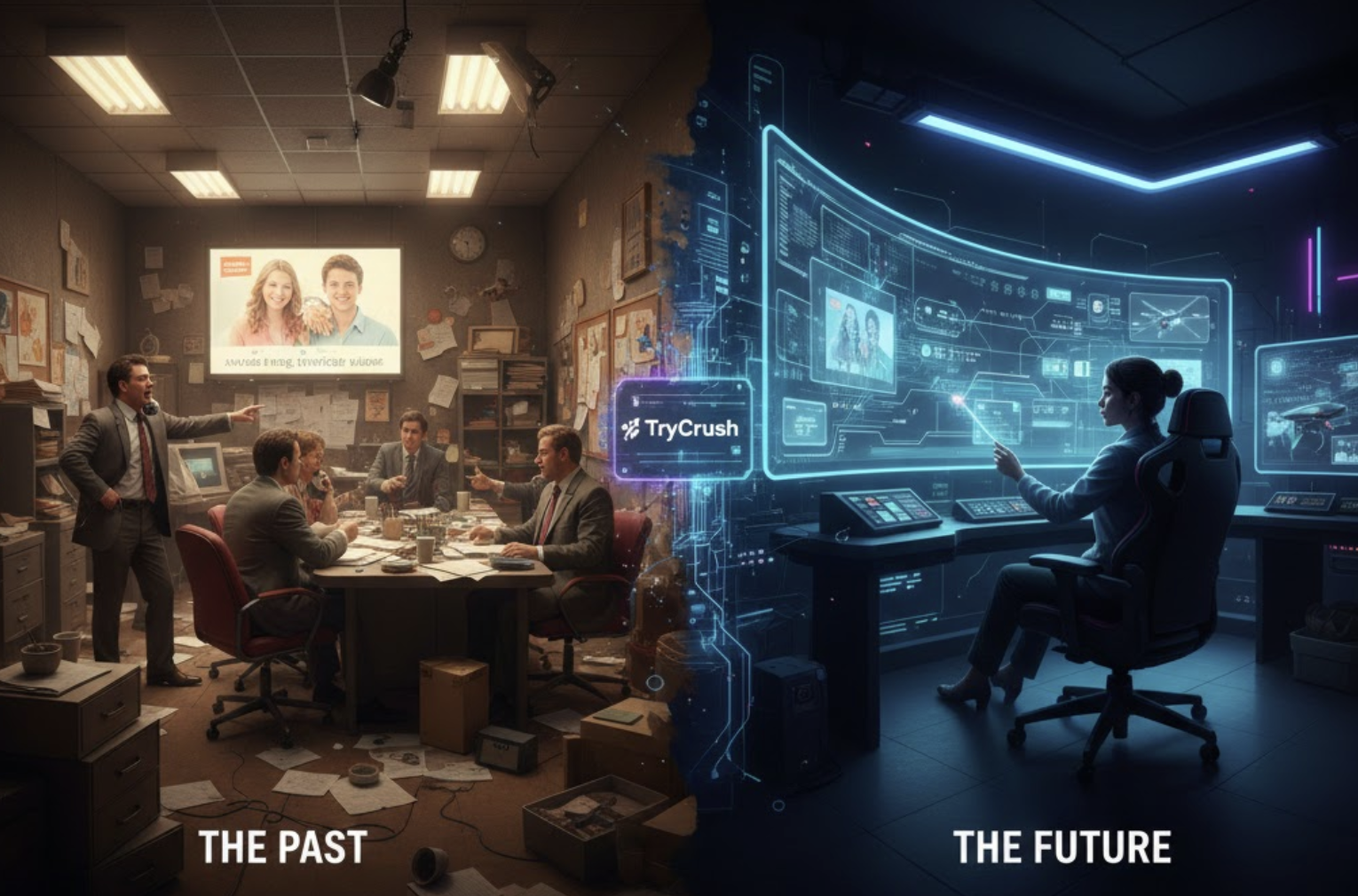
What is Media Buying in 2026? The AI Revolution
The digital revolution changed advertising forever, but AI is completely rewriting the rules. Learn what media buying is today, why manual bidding is dead, and how modern marketers use creative strategy and AI algorithms to scale profitably.
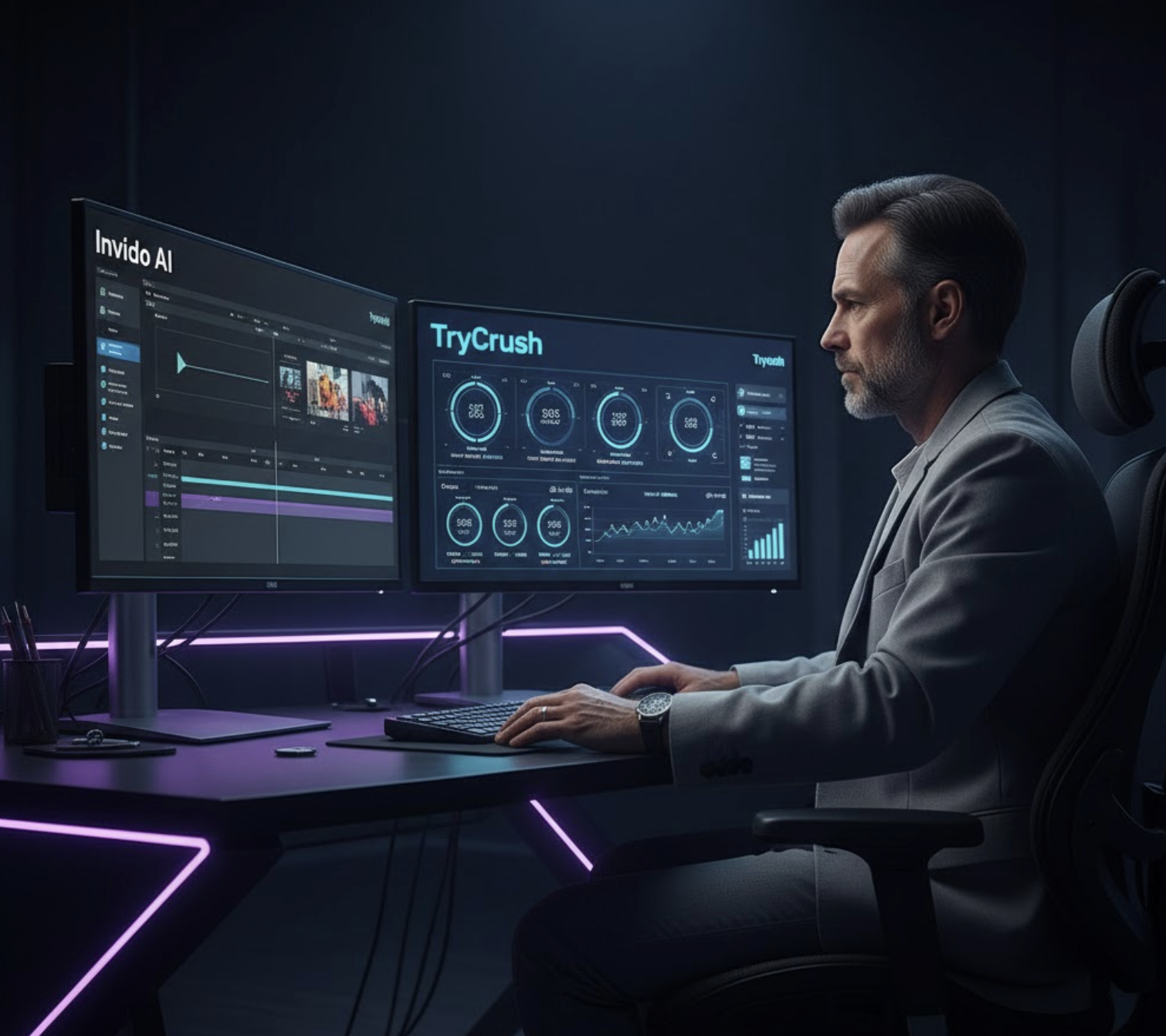
Invideo AI vs TryCrush: Why Media Buyers Are Switching
While Invideo AI excels at organic content creation, performance advertisers need tools built for revenue. Explore the Invideo AI vs TryCrush comparison to see why media buyers are migrating to autonomous, data-driven ad scaling.
AI Creative Studio: Ad Data and Formats for 2026
Discover how media buyers use AI creative studios to generate, test, and scale Facebook ads based on data from millions of active campaigns.