Key Takeaways
- 1Top performing ecommerce Facebook ads have an average run time of 146 days.
- 2The learn more CTA is used by 25 percent of top ecommerce ads, beating shop now at 9 percent.
- 3The 90 day mark is the proven winner threshold, with 144 of the top 400 ads passing this milestone.
- 4Zero relaunch counts indicate an original campaign structure that was profitable from day one.
- 5Successful media buyers let automation scale winners and kill losers instantly.
We analyzed millions of Facebook ads to find the best web banner ad examples. Here is exactly what top advertisers do to drive profitable conversions.
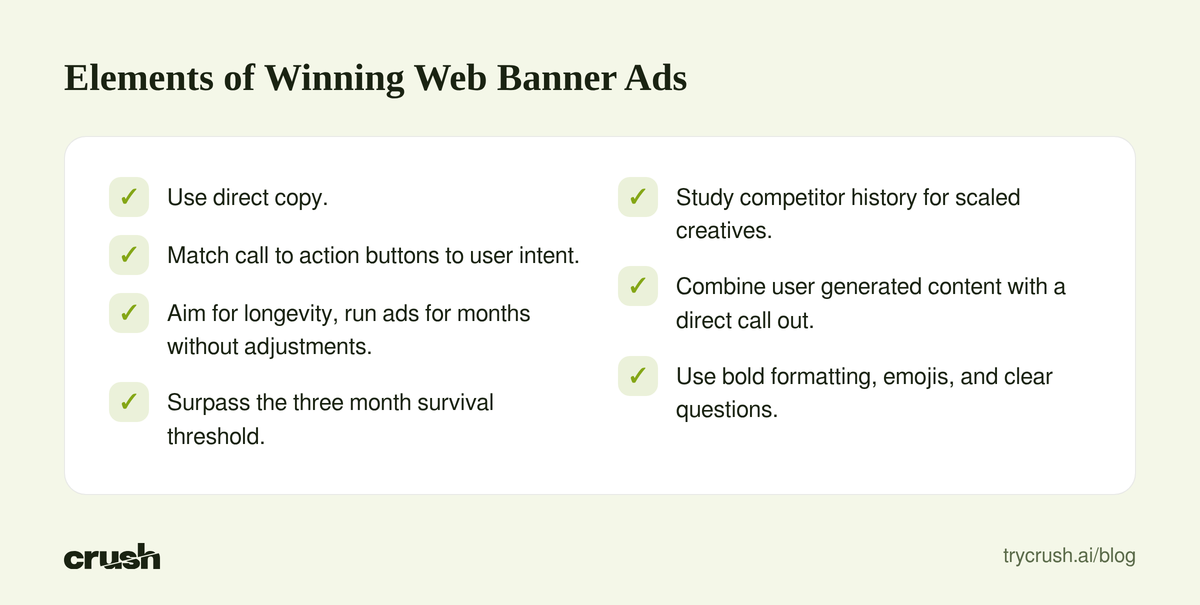
The most effective web banner ad examples use direct copy, match their call to action buttons to user intent, and run for months without needing adjustments. Successful display campaigns rely on testing clear offers, tracking competitor history, and scaling the creatives that sustain profitable customer acquisition over time.
What makes web banner ads actually convert in 2026?
The data shows that longevity and the right call to action drive long term performance. At Crush, our platform tracks competitor history via the Meta Ad Library so media buyers can see exactly what works. Learning how to search the Facebook ad library is essential for uncovering these hidden trends.
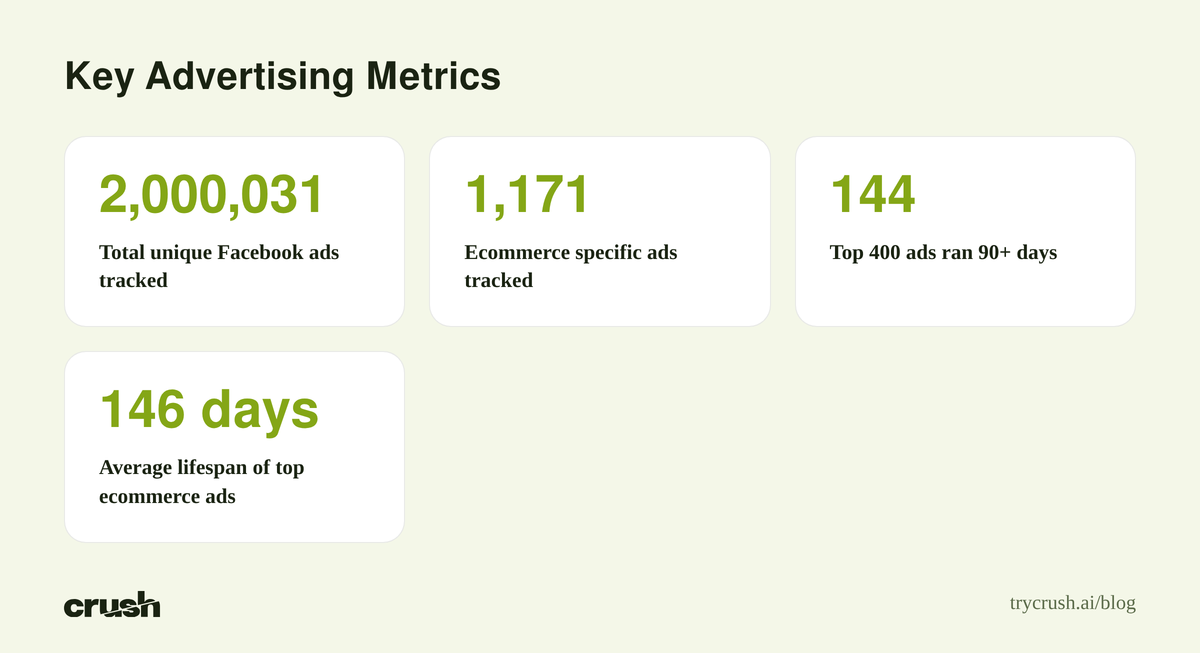
Our database currently tracks 2,000,031 unique Facebook ads. Out of that massive dataset, 466,683 are currently active across the platform. When we narrow the focus, 1,171 tracked ads match the exact term "ecommerce" in our system. Right now, 531 of those specific ecommerce campaigns are active.
Among top ecommerce ads, the average run time is 146 days, proving that buyers do not need to constantly rotate creatives.
We analyze this data to find the baseline for winning campaigns. Stop guessing what works and start looking at the historical spend.
| Metric Focus | Proprietary Data Point | Market Signal |
|---|---|---|
| Total Ads Tracked | 2,000,031 unique Facebook ads | Massive dataset for pattern matching |
| Ecommerce Specific Ads | 1,171 tracked (531 active right now) | High intent niche testing |
| Top 400 Benchmark | 144 ran 90+ days | The proven winner survival threshold |
| Average Lifespan | 146 days | Winning creatives resist audience fatigue |
How do you identify winning web banner ad examples?
You identify winners by looking for creatives that surpass the three month survival threshold. An ad that runs for two days is a failed test, but an ad that runs for a quarter is generating revenue and maximizing your conversion rate.
The critical 90 day threshold
We looked closely at the best performing creatives in our system. The data is clear: 144 of the top 400 ran 90+ days, establishing the definitive proven winner threshold.
Media buyers do not leave ads running for three months if they are losing money. When you see an ad cross that 90 day mark, you know the hook and offer are working.
Tracking real competitor history
Finding these winners manually is nearly impossible. The Meta Ad Library removes campaigns once they stop running. This means you lose access to historical data just when it becomes valuable.
Our system solves this. Crush keeps history, including ads that were taken down. This allows you to study the exact creatives your competitors scaled during their peak seasons.
How does button choice impact your conversion rate?
Your button choice dictates the psychological friction the user feels before clicking. We analyzed the most common CTA buttons on ecommerce ads to see what top advertisers actually use, pulling insights from millions of proven call to action examples.
Analyzing the call to action data
The results go against traditional media buying advice. The "learn more" CTA dominates at 25 percent. The "whatsapp message" button follows closely at 19 percent. Surprisingly, the "shop now" button trails at just 9 percent.
The data shows that 25 percent of top ecommerce ads use the learn more button, outperforming the traditional shop now CTA.
When you ask a user to shop, you demand a financial commitment. When you ask them to learn more, you offer free information. This micro commitment is crucial for cold traffic.
How to match your CTA to your offer
You must align your button with your specific sales funnel. Using the wrong button will kill your click through rate immediately.
- Choose "learn more" for complex products requiring education before a purchase.
- Select "whatsapp message" when your sales team can close high value leads directly via chat.
- Stick to "shop now" for low priced impulse buys where the product value is instantly obvious.
5 proven web banner ad examples you can copy right now
We pulled five high performing creatives from our free library at trycrush.ai/ad-library to show you exactly how top brands write copy. These ads achieved massive run times without being relaunched, reflecting strategies found in the best proven Facebook advertising examples.
1. Justine's Jewels Mtl focuses entirely on the product
This jewelry advertiser proves that simple and direct copy works best. This ad is running 1692 days and was relaunched 0x. It uses the "shop now" CTA.
The opening line reads: “Beautiful pink stone earrings in rose sterling Italian silver”.
This works because it wastes zero time. The advertiser tells the prospect exactly what the product is. They state the materials and the color directly, filtering out anyone who is not interested.
2. Chikigo leverages user generated social proof
This apparel brand ad ran 1506 days and was relaunched 0x. In a highly unusual move, they used the "book travel" CTA.
The opening line says: “Spotted @__auliafitri__ in our polo knit - earthy blue 💙🤍 Grab yours now at our ecommerce store! 😃”.
This creative works by combining user generated content appeal with a direct call out. Tagging a specific handle builds immediate social proof. The unusual CTA button might have been a technical error, but the longevity proves the overall setup remained profitable.
3. It Expert Service's asks a direct, aggressive question
This B2B service ad ran 1292 days and was relaunched 0x. They selected the "message page" CTA to generate leads directly in Messenger.
Their opening line is highly aggressive: “𝘼𝙙𝙫𝙚𝙧𝙩𝙞𝙨𝙚 𝙮𝙤𝙪𝙧 𝘽𝙪𝙨𝙞𝙣𝙚𝙨𝙨 𝙖𝙣𝙙 𝙞𝙣𝙘𝙧𝙚𝙖𝙨𝙚 𝙩𝙝𝙚 𝙨𝙖𝙡𝙚𝙨 👉DO YOU KNOW THE SECRET TO SUCCESSFUL ONLINE BUSINESSES? ✔️YES, Facebook”.
B2B web banner ad examples often fail by being too corporate. This advertiser uses bold formatting, emojis, and a clear question to stop the scroll instantly. The "message page" button allows the business owner to start a conversation without leaving the app.
4. Crystal Brown targets a severe pain point
This ad ran 1217 days and was relaunched 0x. It uses the "learn more" CTA to lower initial friction.
The opening line goes straight for a major pain point in Spanish: “♂️La imp🔞tencia ya no es un problema!♂️”.
Direct response marketing requires calling out the problem immediately. This advertiser uses emojis to bypass potential ad filters while making the subject matter obvious. The "learn more" button is perfect here because the prospect requires privacy and information before buying.
5. Apex Wilderness Tackle states the obvious
This outdoor goods ad is currently running 1212 days and was relaunched 0x. They use the traditional "shop now" CTA.
The opening line is: “Apex Wilderness Tackle is an E-Commerce store that supplies outdoor recreation Goods & Equipment.”.
Many media buyers would call this copy boring, but the data says otherwise. When a user sees this ad, they instantly know who the company is and what they sell. There is zero ambiguity.
Why is the duplicate count metric so important?
Duplicate counts reveal exactly how many times an advertiser relaunched the same creative. Our ads library contains millions of Facebook ads across niches, and we track this specific metric as a strong winning ad signal.
Interestingly, all five of our top examples today have zero relaunches. This means the original campaign structure was so well optimized they never needed to pause it and duplicate it into a new ad set.
How can you build systems to test your creatives?
You must build automated rules that cut losing ads early and increase budgets on profitable campaigns. Manual media buying is dead in 2026. The algorithm moves too fast for humans to keep up. If you want to know what is media buying today, the answer lies in leveraging AI automation.
Let automation handle the heavy lifting
Media buyers often build a few variants and hope for the best. Crush changes this by fully automatically running Facebook ads for your business.
Our software creates campaigns, scales winners, and kills losers based on hard data. You can also generate ad creative iterations from a winning reference ad automatically.
Say your target CPA is $50 and your average order value is $100. You need software that recognizes when an ad hits a $45 CPA and scales the budget instantly. You can view our paid plans at trycrush.ai/pricing to see how this works in practice.
Follow a strict launch process
When you find web banner ad examples you want to model, you need a disciplined testing framework. Never launch creatives blindly.
- Identify the hook: Find the opening hook from a winning ad and rewrite it for your specific product offering.
- Match the CTA: Align your call to action button to your funnel friction level.
- Go broad: Launch the new creative in a broad targeting ad set to let the algorithm find your buyers.
- Monitor CPA: Track the cost per acquisition strictly for the first seven days.
- Cut losers: Kill the ad immediately if the metrics do not hit your break even point.
Successful media buying requires strict discipline. You find what works in the Meta Ad Library, you model the core concepts, and you let the data tell you if you succeeded.
How we got this data
The numbers in this article come from Crush’s ad library: 2,000,031 unique Facebook ads tracked via the Meta Ad Library, 466,683 of them active at the time of writing. Ad examples reference real advertisers and their public ads. Data queried on 2026-09-13. Third-party product facts are attributed inline to their sources.
Frequently Asked Questions
Common questions about this topic
1What is the average run time for a successful ecommerce ad?
2Which call to action button works best for banner ads?
3Why do advertisers use the learn more button for physical products?
4How can I see competitor ads that have been taken down?
5What does a zero relaunch count mean?
Written by

Rokas Steponavičius
Founder, CEORokas is the Founder and CEO of TryCrush.ai, an ex-IBM professional turned entrepreneur focused on building AI-driven growth platforms. With a strong background in ecommerce, performance marketing, media buying, and artificial intelligence, Rokas specializes in creating scalable, data-led systems that drive measurable revenue. His mission is to help modern businesses leverage AI to optimize acquisition, conversions, and long-term profitability.
Stop Guessing.
Start Crushing.
AI Ad Manager trained by world-class media buyers to generate your creatives and optimize your ads 24/7.
Learn more
Continue Reading
Proven Online Ad Examples Based on Meta Ad Longevity Data
Stop guessing what works. We analyzed millions of active campaigns to bring you the best online ad examples based on pure longevity and profitability data.
How to Add Branding to Meta Ads That Actually Convert
Most advertisers ruin their return on ad spend by overcomplicating their visual identity. Here is how to integrate branding into your creatives to drive direct response.
Scaling Dropshipping Shopify Stores: 2026 Ad Data
Most guides just show you pretty storefronts. We analyze the actual Facebook ad data that successful Shopify dropshipping stores use to scale profitability in 2026.