Key Takeaways
- 1Effective reminder ads can run for hundreds of days without requiring creative changes.
- 2Relaunching a proven ad resets algorithm delivery while leveraging historical data.
- 3The 'Learn more' button dominates reminder campaigns by appearing on 43 percent of top ads.
- 4Capping ad frequency ensures your warm audience does not experience brand fatigue.
Explore real reminder advertising examples backed by proprietary 2026 data. Learn how top brands keep winning ads running for hundreds of days to maximize return on ad spend.
What Are Reminder Advertising Examples?
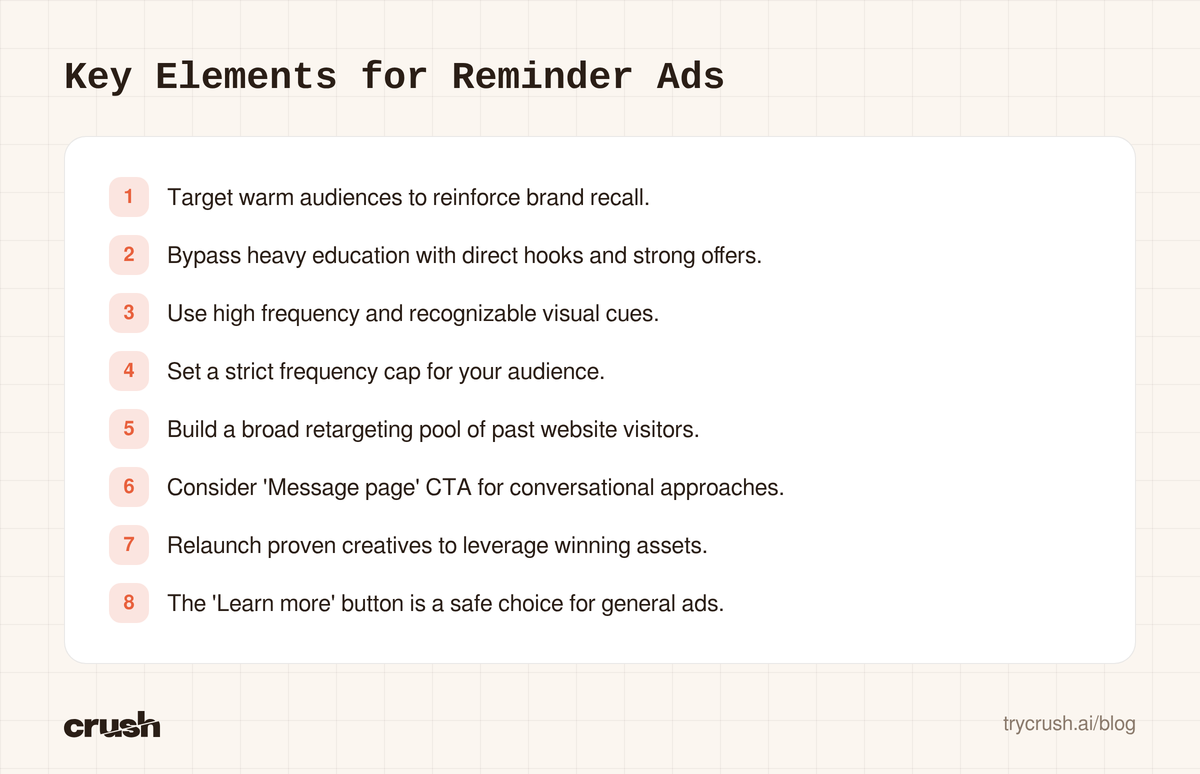
A reminder advertisement targets warm audiences to reinforce brand recall and trigger delayed conversions. Effective reminder advertising examples bypass heavy education in favor of direct hooks, strong offers, and familiar branding.
They rely on high frequency and recognizable visual cues to nudge prospects who already know your business into finally making a purchase.
Why Tracking Ad Longevity Matters in 2026
Tracking ad longevity reveals exactly which campaigns generate real profit. Most media buyers obsess over click-through rates and early metrics while completely ignoring the long-term survival of a creative.
We built our product Crush, an AI Facebook ads platform, to expose these exact market truths. Our database tracks competitors' campaigns, and learning how to search the Facebook ad library effectively helps uncover ads that were taken down alongside active winners.
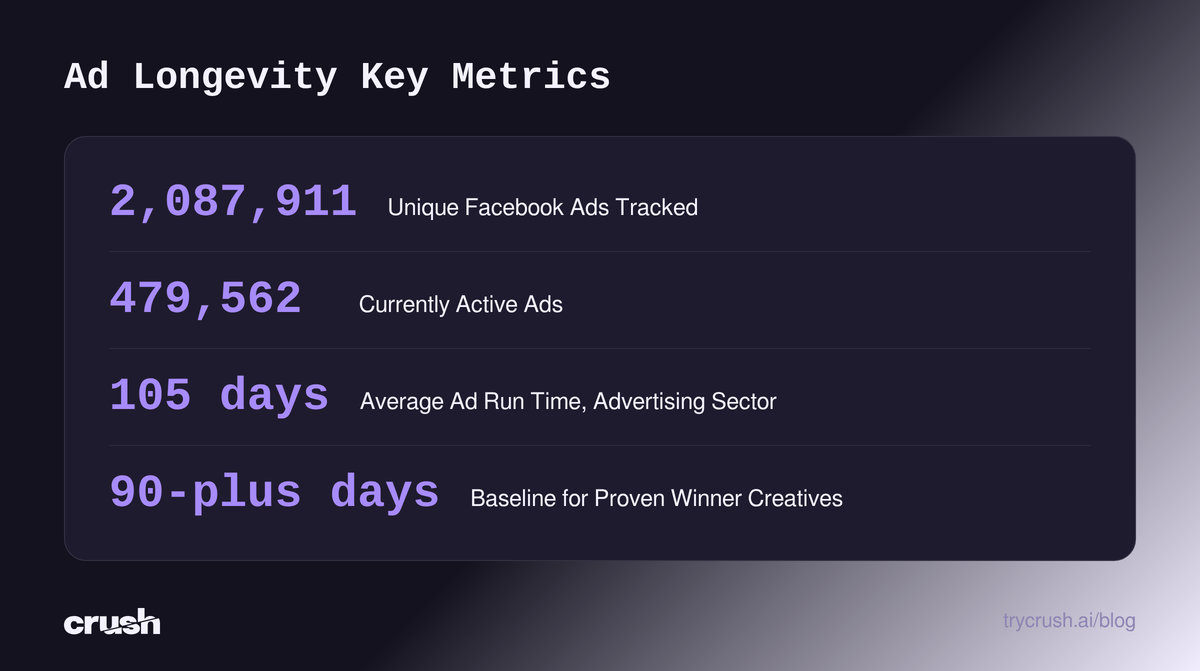
Right now, Crush tracks 2,087,911 unique Facebook ads, with 479,562 currently active. This scale of data proves that nobody keeps a losing ad live for hundreds of days.
When you see a campaign running for over a year, you are looking at a money printer. You can browse these proven winners in our free public library at trycrush.ai/ad-library.
The Baseline for Proven Campaigns
We isolated the data for the advertising sector specifically. Our system shows that 2,938 tracked ads match "advertising", and 320 are active right now. The average run time for these campaigns is 105 days. However, the top-tier creatives push much further into profitability.
Among top advertising creatives, 129 of the top 400 ran for 90-plus days, defining the baseline threshold for a proven winner.
Once a creative crosses that 90-day threshold, it transitions from a test into a stable revenue driver. This is where reminder campaigns thrive. They sit in the background, hoovering up warm leads at a highly controlled cost per acquisition.
5 Real Examples of Reminder Advertising
To understand what actually works in 2026, we pulled five specific reminder advertising examples from our proprietary database. These are not hypothetical concepts. These are live campaigns driving actual revenue.
Example 1: Wraps Ink (Ran 1013 Days)
B2B services require long sales cycles. Fleet managers do not buy on impulse, which means they need constant nudging over time.
This ad from Wraps Ink ran for exactly 1013 days and relaunched 1 time. The opening line reads: "Transform your fleet vehicles into moving billboards with a STAND OUT vehicle design and wrap from Wraps Ink."
It uses a "Learn more" call to action. This ad survived for over two and a half years because it stayed in front of local business owners until they were finally ready to pull the trigger on a vehicle wrap.
Example 2: Wildstone (Running 911 Days)
Wildstone provides another masterclass in passive brand recall. This creative has been running for 911 days and relaunched 1 time. It also utilizes the "Learn more" call to action.
Reminder campaigns do not always need complex iteration if the core offer remains identical. You simply set a strict frequency cap, build a broad retargeting pool of past website visitors, and let the Meta algorithm do the heavy lifting in the background.
Example 3: Stikee Grafix Advertising (Ran 793 Days)
Local businesses often struggle with lead friction. Stikee Grafix Advertising solved this by changing their interaction model entirely. This creative ran for 793 days and relaunched 1 time.
The opening line reads: "Enjoy every outdoor activity, from political campaigns to personal and business use. Here at Stikee Grafix Advertising, we offer easy installation yet Heavy Dut".
Instead of sending users to a slow-loading website, they used the "Message page" call to action. When a warm prospect sees this ad, they just tap the button and open a conversation in Messenger. This conversational approach drops the barrier to entry to zero.
Example 4: Cloud Media (Running 748 Days)
This campaign proves that high-friction events still benefit from straightforward repetition. The ad has been running for 748 days and features a "Sign up" call to action.
It opens with an attention-grabbing, emoji-heavy line: "🔥𝐆𝐨𝐨𝐠𝐥𝐞 𝐀𝐝𝐬 & 𝐘𝐨𝐮𝐓𝐮𝐛𝐞 (+) 𝐅𝐚𝐜𝐞𝐛𝐨𝐨𝐤 & 𝐈𝐧𝐬𝐭𝐚𝐠𝐫𝐚𝐦 (+) 𝐓𝐢𝐤𝐓𝐨𝐤 𝐇𝐚𝐧𝐝𝐬-𝐨𝐧 𝐀𝐝𝐯𝐞𝐫𝐭𝐢𝐬𝐢𝐧𝐠 𝐖𝐨𝐫𝐤𝐬𝐡𝐨𝐩🔥 Elev".
The most important data point here is the relaunch count. Cloud Media relaunched this exact creative 7 times. Event-based marketing operates on cycles. You fill the seats, pause the ad, run the event, and then relaunch the exact same winning creative for the next cohort, eliminating the need to constantly test new variations.
Example 5: Ads Page test (Running 593 Days)
Aggressive media buying requires knowing when to pause and when to push. This ad has been running for 593 days and uses the "Learn more" call to action.
The standout metric is that it has relaunched 10 times. Ten relaunches across nearly two years shows a relentless optimization strategy. When a creative shows fatigue, the buyer pauses it, waits for the audience pool to refresh, and then relaunches. This resets algorithmic delivery while leveraging a proven visual asset.
Dissecting the Anatomy of a Reminder Ad
Looking across thousands of long-running campaigns reveals distinct patterns. Successful reminder ads share specific structural choices that separate them from cold prospecting ads.
The Call to Action Breakdown
The button you choose dictates user intent. Our data isolates exactly which call to action examples dominate the advertising niche.
| Call to Action | Percentage of Top Ads | Best Use Case |
|---|---|---|
| Learn More | 43% | General B2B and high-ticket retargeting |
| Sign Up | 11% | Webinars, workshops, and recurring events |
| Apply Now | 8% | Exclusive programs and financing offers |
The "Learn more" button is overwhelmingly the safest choice for general reminder ads. However, if you are running an event like Cloud Media, "Sign up" filters out casual clickers and captures high-intent prospects.
The Power of the Relaunch
Media buyers often abandon a creative the moment its return on ad spend dips. The data tells a different story. Relaunching an ad multiple times is the strongest signal of a winning campaign.
If an ad fatigues in a specific retargeting pool, simply pausing it allows new users to enter that audience segment. Once the pool is refreshed, you can reactivate the exact same ad. This saves thousands of dollars in creative production costs.
How to Build Your Own Reminder Ad Strategy in 2026
Executing a successful retargeting layer requires strict audience control. Conducting thorough audience analysis ensures you accurately isolate your warm traffic from your cold prospecting campaigns.
- Segment your web traffic: Build custom audiences for users who visited your site in the last 30, 90, and 180 days.
- Exclude recent purchasers: Do not waste budget showing reminder ads to someone who bought yesterday, unless you are pushing a specific upsell.
- Cap your frequency: Set strict limits to ensure your audience only sees the ad two or three times a week.
- Strip out the education: Remove long-form copy. Your audience already knows what you do, so just give them the offer.
- Monitor audience refresh rates: Keep an eye on how many new users enter your retargeting pool daily to avoid creative fatigue.
Budget and Bidding Tactics
Your reminder audience is inherently smaller than your cold audience. Therefore, your budget allocation must reflect that reality. Say your target CPA is $50; you do not want to spend $40 of that on a user who is already highly likely to convert organically.
By isolating your reminder audience, you can bid aggressively for impression share while keeping your daily budget relatively low. Most media buyers allocate roughly 10 to 20 percent of their total daily spend to these bottom-of-funnel reminder campaigns.
Automating Your Media Buying Workflow
Manual management of retargeting layers drains your time. Constant monitoring of frequency caps and audience fatigue is exactly why top agencies rely on software.
Crush fully automatically runs Facebook ads. It creates campaigns, scales winners, and kills losers without human intervention. When a reminder creative starts to fatigue and your cost per acquisition rises, the system handles the pausing automatically.
If you need fresh angles, our platform can generate ad-creative iterations from a winning reference ad. Paid plans start with a trial, allowing you to test the automation logic on your own accounts. You can view the current tiers at trycrush.ai/pricing.
Critical Errors in Reminder Advertising
Even with a warm audience, media buyers still make fundamental mistakes that ruin their return on ad spend. Avoid these common pitfalls:
- Overcomplicating the hook: Warm audiences do not need a clever hook. They just need a compelling reason to click today.
- Changing creatives too fast: If a campaign is profitable, leave it alone. Our data proves ads can run successfully for hundreds of days.
- Ignoring cross-contamination: If your cold campaigns do not strictly exclude past website visitors, your reminder ads will end up bidding against yourself.
- Using the wrong call to action: Forcing a "sign up" button on a low-intent local service creates unnecessary friction for a warm lead.
Mastering reminder advertising comes down to trusting the data. Find the creatives that survive the 90-day threshold, duplicate their structure, and let repetition do the selling.
How we got this data
The numbers in this article come from Crush’s ad library: 2,087,911 unique Facebook ads tracked via the Meta Ad Library, 479,562 of them active at the time of writing. Ad examples reference real advertisers and their public ads. Data queried on 2026-09-19. Third-party product facts are attributed inline to their sources.
Frequently Asked Questions
Common questions about this topic
1What is a reminder advertisement?
2How often should you change reminder ad creatives?
3Which call to action button works best for reminder campaigns?
4Why do media buyers relaunch the same ad multiple times?
Written by

Ignas Obulaitis
Head of ITIgnas Obulaitis is the head of IT for TryCrush.ai, leading the platform’s engineering and AI innovation. With a strong background in product-driven development, Ignas has built and scaled complex systems across fintech, SaaS, and AI-focused companies. An ex-IBM engineer and former Head of Development at Fluensure, Ignas combines deep technical expertise with a sharp product mindset to turn ambitious ideas into scalable, production-ready technology.
Stop Guessing.
Start Crushing.
AI Ad Manager trained by world-class media buyers to generate your creatives and optimize your ads 24/7.
Learn more
Continue Reading
Advertising Weight Loss on Facebook: Data from 5,886 Ads
We analyzed over 5,000 active health campaigns to uncover what makes weight loss ads profitable and compliant on Facebook in 2026.
5 Direct Response Ad Examples Proven By Relaunch Data
We analyzed over two million active Facebook ads to find the exact direct response ad examples that advertisers spend money on for hundreds of days.
5 Proven Marketing Goal Examples Backed by Real Ad Data
Learn how to map a theoretical marketing goal to a profitable advertising campaign using longevity and duplicate data from top-performing Facebook ads.