
Key Takeaways
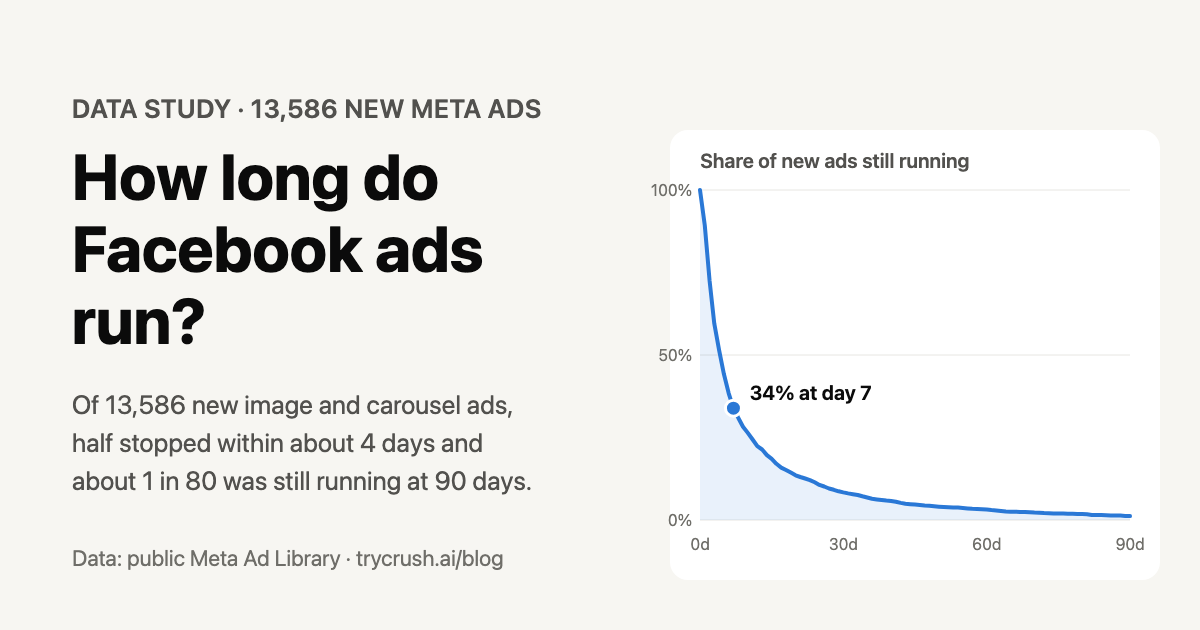
- 1Of the new image and carousel ads we followed, half stopped within about 4 days, about 1 in 12 was still running after 30 days and about 1 in 80 after 90 days. Other ways of counting give 1 in 16 to 1 in 9 at 30 days and 1 in 170 to 1 in 50 at 90. Video was not tracked before September 8, 2026.
- 2How long to run an ad: give each new ad at least a week before judging it; a week is the shortest A/B test Meta recommends. Cut it early only on a stop rule set before launch; after the week, turn it off if its cost per result is above target and keep it running while it stays on target.
- 3Store ads (Shop now style buttons or links to product pages) last a little longer: a median of about 6 days, with about 12% (9% to 14% across the alternative ways we counted) still running at 30 days.
- 4The Ad Library's active listings over-represent long runners: 37% of the live ads we tracked in late September 2026 had run 90+ days, while only about 1 in 80 new ads in our launch data got that far.
- 5Single images end fastest. Among store ads, carousels and catalog ads were about 1.7 times as likely as single images to still be running at 30 days. On two September launch days, video did as well as single images or better, but two launch days are too few to call it.
- 6Ads that open a chat or an Instagram profile end fastest, and ads on a single platform end sooner than ads shown on both. Our reading, which the data cannot prove, is that many are boosted posts with a set duration.
- 7Live fashion store ads were the youngest (median 55 days) and home and garden ads the oldest (116 days), a snapshot that also reflects when brands launch.
What 13,586 new and 96,614 live Meta ads show about how long ads last, by format, button and niche, and how long to run yours.
Most new Facebook ads do not run for long. Of 13,586 new image and carousel ads we followed from their first days, half stopped within about four days, about 1 in 12 was still running after 30 days and about 1 in 80 lasted 90 days (estimates; see the ranges below).
The few that last can run for months, and they take up much of the Ad Library's active listings: 37% of the 96,614 live ads we tracked in late September 2026 had run for 90 days or more. Part of the reason is that a long runner stays listed as active the whole time.
How long should you run a Facebook ad? Give each new ad at least a week before you judge it; a week is the shortest A/B test Meta recommends (A/B testing best practices). The exception is a stop rule you set before launch, such as turning an ad off once it spends two to three times your target cost per purchase with no add-to-cart.
After that week, turn it off if its cost per result is above your target, and keep it while it stays on target. If a winner later stays above target for about a week, launch a fresh creative next to it and turn the old one off once it loses money or the new one beats it. Meta says keeping a fatigued ad on meanwhile may maximize results (About creative fatigue recommendations).
| Measure | Result |
|---|---|
| Median lifespan of a new image or carousel ad | 4.1 days (3.8 to 6 across our checks) |
| New image and carousel ads still running after 7 days | 34% (30% to 43% across our checks) |
| New image and carousel ads still running after 30 days | 8.3% (6% to 11% across our checks) |
| New image and carousel ads still running after 90 days | 1.2% (0.6% to 1.9% across our checks) |
| New image and carousel store ads still running after 30 days | 11.7% (9% to 14% across our checks) |
| Live ads we tracked in late September 2026 that had run 90 days or more | 37% |
| Ads analyzed | 153,928 unique ads after filters, from about 69,000 Pages, including the 13,586 new ads we followed and 96,614 live ads |
How we measured how long Facebook ads run
Crush, which makes Meta ads for online stores, ran this study. Our data comes from the public Meta Ad Library, which lists every ad currently active across Meta's apps (About the Meta Ad Library). Ended ads that reached the UK or EU stay listed as inactive for a year, and ads about social issues, elections or politics for seven years; we collected only ads listed as active, searching all countries.
Our software has collected about 2.8 million Meta ads from the public Ad Library since January 2026 (2.2 million unique creatives), found through the keywords and competitor Pages our users track. A tracked search is rescanned about every two days.
AI tools pulled the data and wrote both the analysis code and this article, which runs under the byline of Rokas Steponavičius, our founder and CEO. Automated reviews then rechecked the numbers, the method and the text against the data.
View 1: new ads, followed from their first days
We took every image and carousel ad in our database whose Ad Library start date was February 10, March 12, April 13, May 13, June 12 or July 8, 2026. We chose one weekday between the 8th and 13th of each month, not at random, before computing any survival figures. We did not store video ads before September 8, 2026, so video gets its own check in Finding 3.
We kept ads first seen within 3 days of launch (median 1.8 days). Age counts from the launch date, but each ad joins the estimate only on the day we first found it (delayed entry). After the filters below, that left 13,586 ads from 6,942 Pages. The 5,522 store ads have a Shop now, Order now, Buy now or Get offer button to a website, or link to a product, collection, Shopify store or marketplace page.
An ad counts as stopped when a scan of its search, run to the last page, no longer lists it as active. We date the end halfway between the last scan that saw it and the first that did not. For 78% of ended ads, those two scans were at most 3 days apart.
For some ads we never saw an end: 26 were still running at our last scan, and we lost track of 1,832 (13%). Each lost ad's search either stopped being scanned, for example because no user tracked it anymore, or came back empty or incomplete, which our software does not count as a stop.
The Kaplan-Meier estimator, the standard method for survival data with incomplete follow-up, counts these ads as running until we last saw them. It assumes that losing track of an ad has nothing to do with when it would have stopped. It also assumes that ads found a few days after launch last like those found at once. Our checks suggest they end a little sooner.
View 2: everything running now
We also took every unique ad flagged active when we last saw it, with that sighting between September 12 and 26, 2026: 112,811 ads, or 96,614 from 40,129 Pages after the filters. We counted the days from each ad's start date to that last sighting, a minimum, since most were still running. Each creative counts once (see Filters); a recount of every live ad on September 27, copies included, gives about 34% instead of 37% at 90 days or more.
Finding 1: most new Facebook ads stop within a week
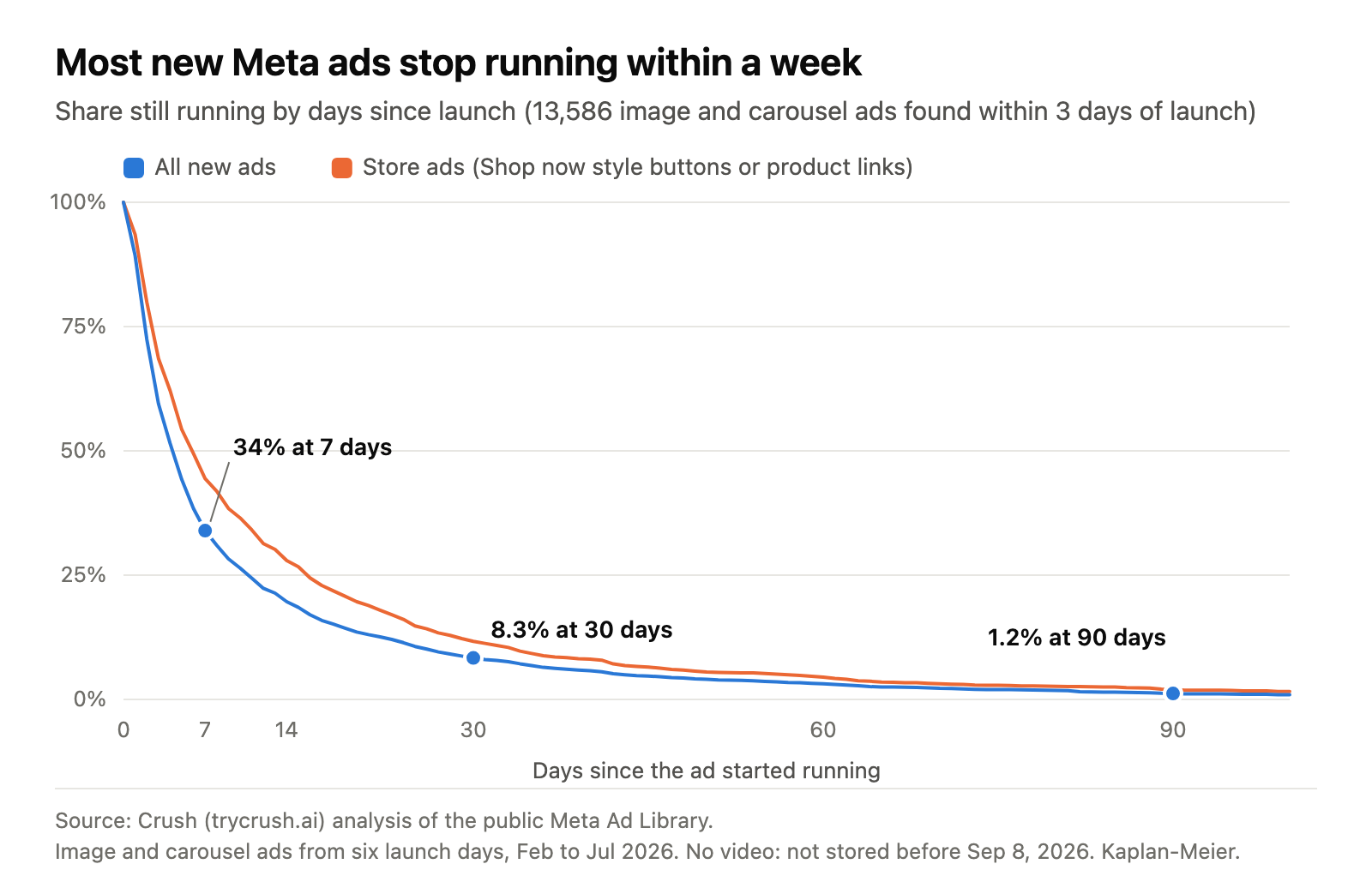
The median lifespan was 4.1 days, and about two in three ads had stopped within the first week. Store ads lasted a little longer (median 5.9 days).
| Days since launch | All new ads still running | Store ads still running |
|---|---|---|
| 3 | 59.5% | 68.6% |
| 7 | 33.9% | 44.4% |
| 14 | 19.7% | 27.9% |
| 30 | 8.3% | 11.7% |
| 60 | 3.1% | 4.5% |
| 90 | 1.2% | 2.0% |
These are estimates. Dating every end as late as possible gives a median of 6 days, 10.7% at 30 days and 1.9% at 90 days. Across all our checks, the 30-day share runs from about 6% to 11% and the 90-day share from 0.6% to 1.9%; by launch day, 30-day survival ranged from about 5% to 13%.
One check needs no end-date estimate: a direct count of recent launches. It found a fifth to two fifths fewer ads still running than our curve predicts for ads already running when found (about half as many store ads at 30 days). So our 30-day figures, store ads included, may run high.
Meta measures the learning phase per ad set: an ad set usually leaves it after about 50 results in the week after its last significant edit (About the learning phase). Most of our ads were off within 7 days, but we cannot see their ad sets, budgets or results, so we cannot say whether they were cut before learning finished.
Finding 2: the Ad Library shows you the survivors
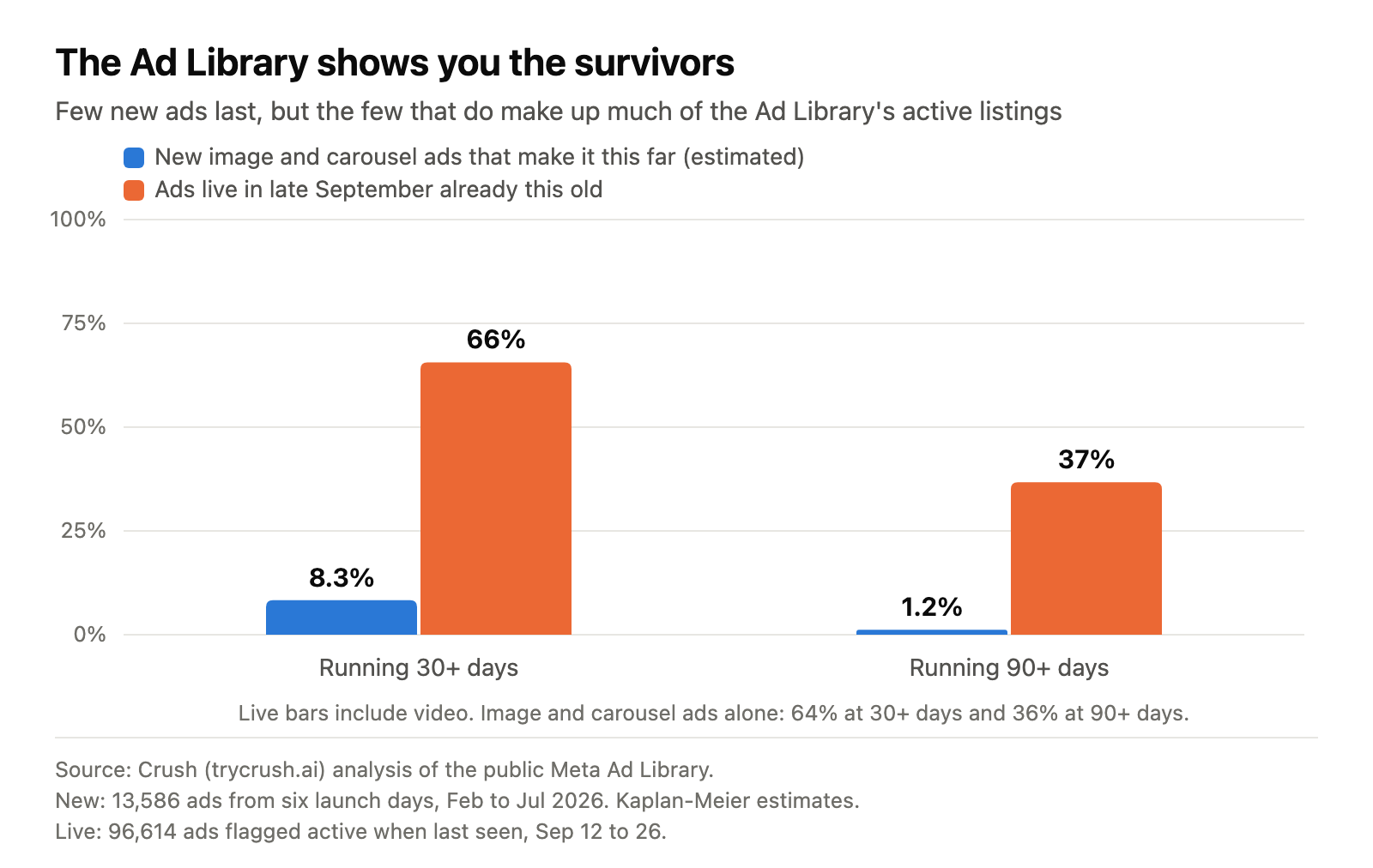
Only about 1 in 80 new ads (an estimated 1.2%) reaches 90 days, yet 37% of the live ads we tracked had run that long (36% among image and carousel ads alone). A test switched off after four days is listed as active for four days, while an ad that runs for a year is listed as active all year. So the Ad Library's active listings over-represent long runners, a form of survivorship bias.
| Days the live ad had run | Share of live ads |
|---|---|
| Under 7 days | 9.3% |
| 7 to 29 days | 25.1% |
| 30 to 89 days | 28.9% |
| 90 to 179 days | 21.2% |
| 180 to 364 days | 9.4% |
| 365 days or more | 6.1% |
The median live ad had been running for 57 days. Counting only ads seen in the last two days of our data gives the same 37%.
Survivorship bias explains the direction of the gap, but not its full size. If ads launched at a steady pace and lasted as our launch curve says, fewer than half of live ads would be at least a month old. That holds even if every ad still running after 113 days kept going for two more years. In fact, 66% were (64% of image and carousel ads).
Some long runners were probably paused and restarted under their first start date, or kept running as a copy of the ad we tracked, which our end rule counts as a stop. The two views also come from different searches and months, so our launch data may miss some long runners.
When you browse a competitor's active ads, you mostly see what they kept, not what they tried.
Finding 3: single images end fastest, while carousels and catalog ads last longer
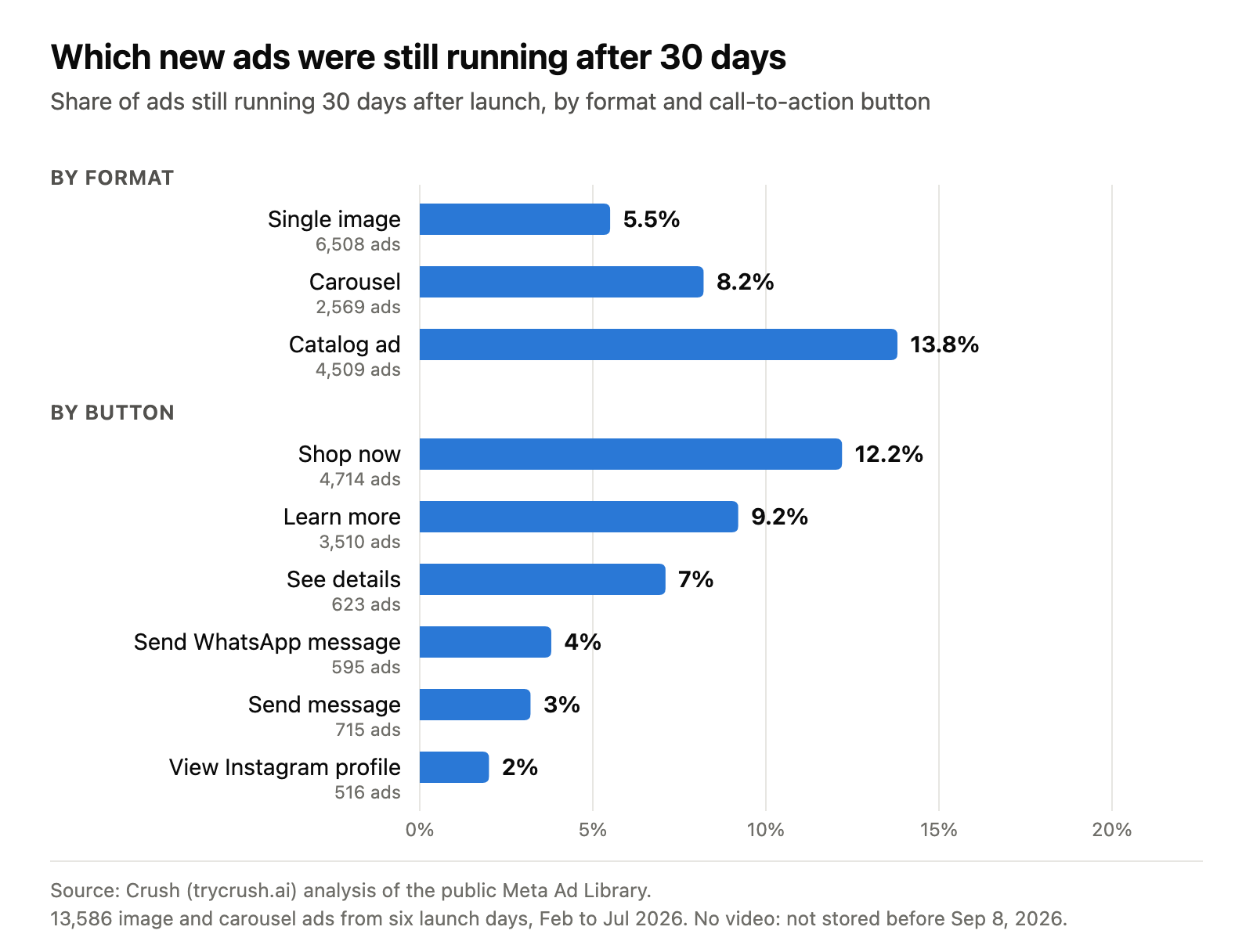
Catalog ads are Advantage+ catalog ads, which show each person products from your catalog (About Meta Advantage+ catalog ads).
| Format | All new ads: median | All new ads: at 30 days | Store ads: median | Store ads: at 30 days |
|---|---|---|---|---|
| Single image | 3.1 days | 5.5% | 4.1 days | 8.1% |
| Carousel | 4.2 days | 8.2% | 6.9 days | 14.2% |
| Catalog ad | 6.9 days | 13.8% | 7.3 days | 13.8% |
Single images ended soonest: about 1 in 18 lasted a month. Across all ads, catalog ads lasted longest, but among store ads, catalog ads and carousels were level at 30 days (about 14%), both about 1.7 times the rate of single images (8%).
Two September launch days give a first look at video, counted directly at our latest scan:
| Format | Launched September 9, counted about 16 to 17 days later | Launched September 16, counted about 9 to 10 days later |
|---|---|---|
| Video | 19% (274 ads) | 27% (590 ads) |
| Carousel or catalog ad | 18% (551 ads) | 31% (293 ads) |
| Single image | 13% (630 ads) | 26% (550 ads) |
Video beat single images on one launch day and matched them on the other; two days are too few to call it.
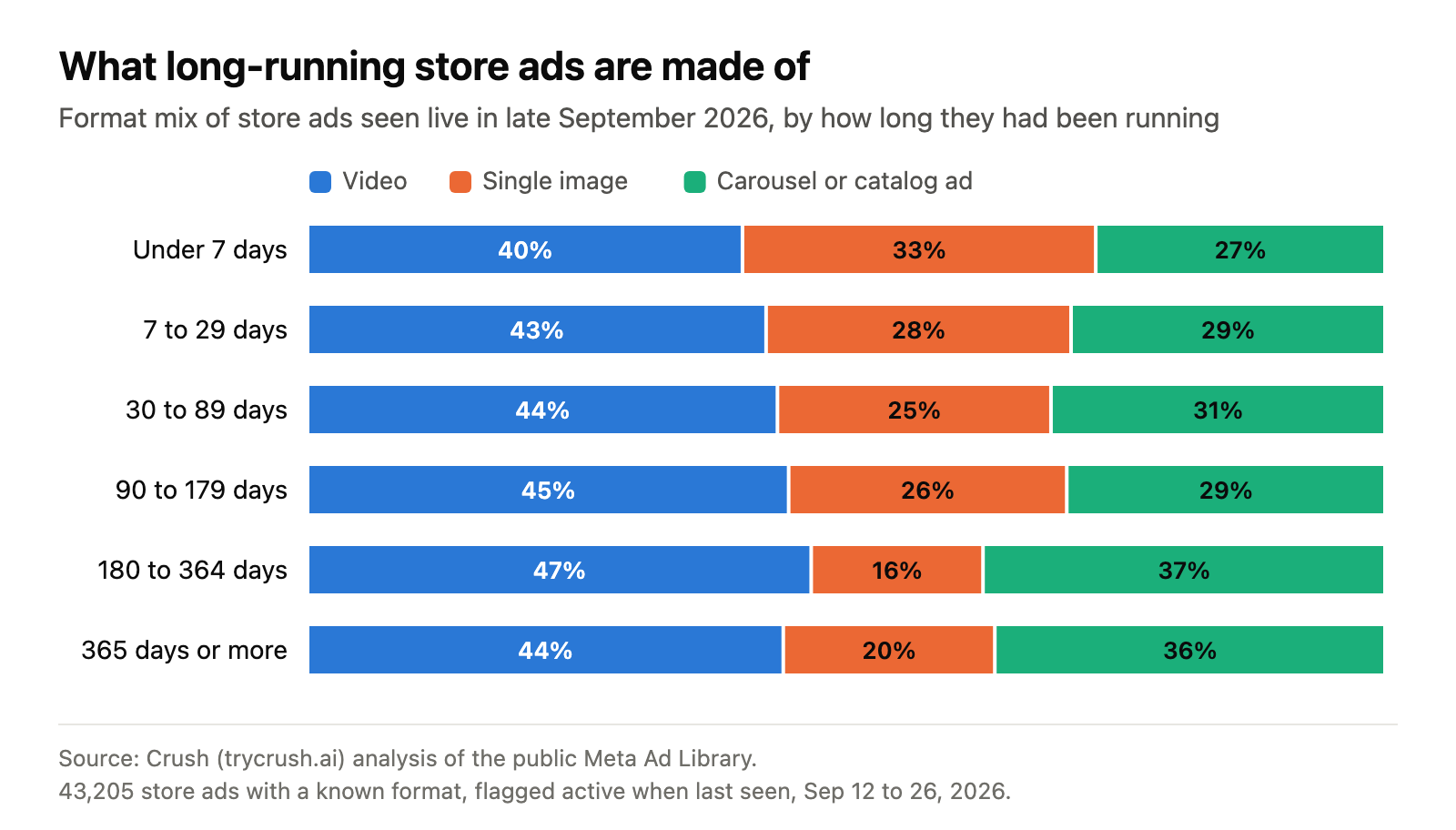
Among live store ads, single images made up a third of ads under a week old but only 16% to 20% of ads running six months or more. Video led at every age, at 40% to 47%.
Finding 4: Shop now ads outlast chat buttons and single-platform ads
New ads with a Shop now button had a median lifespan of 6.0 days, and 12.2% were still running after 30 days. Learn more ads reached 9.2%.
Ads that open a conversation or a profile ended fastest: only about 2% to 4% of Send WhatsApp message, Send message and View Instagram profile ads lasted a month. Ads shown only on Facebook or only on Instagram had medians of 3.4 and 3.6 days, and about 3% lasted a month. Ads shown on both lasted longer: a median of 4.3 days with Audience Network and 4.8 days without, and about 9% lasted a month.
Our reading, which the data cannot prove, is that many of these are boosted posts, where you pick a duration or an end date up front (Boost a post from your Facebook Page). If so, they reached their set end date.
Finding 5: live fashion ads were the youngest, home and garden ads the oldest
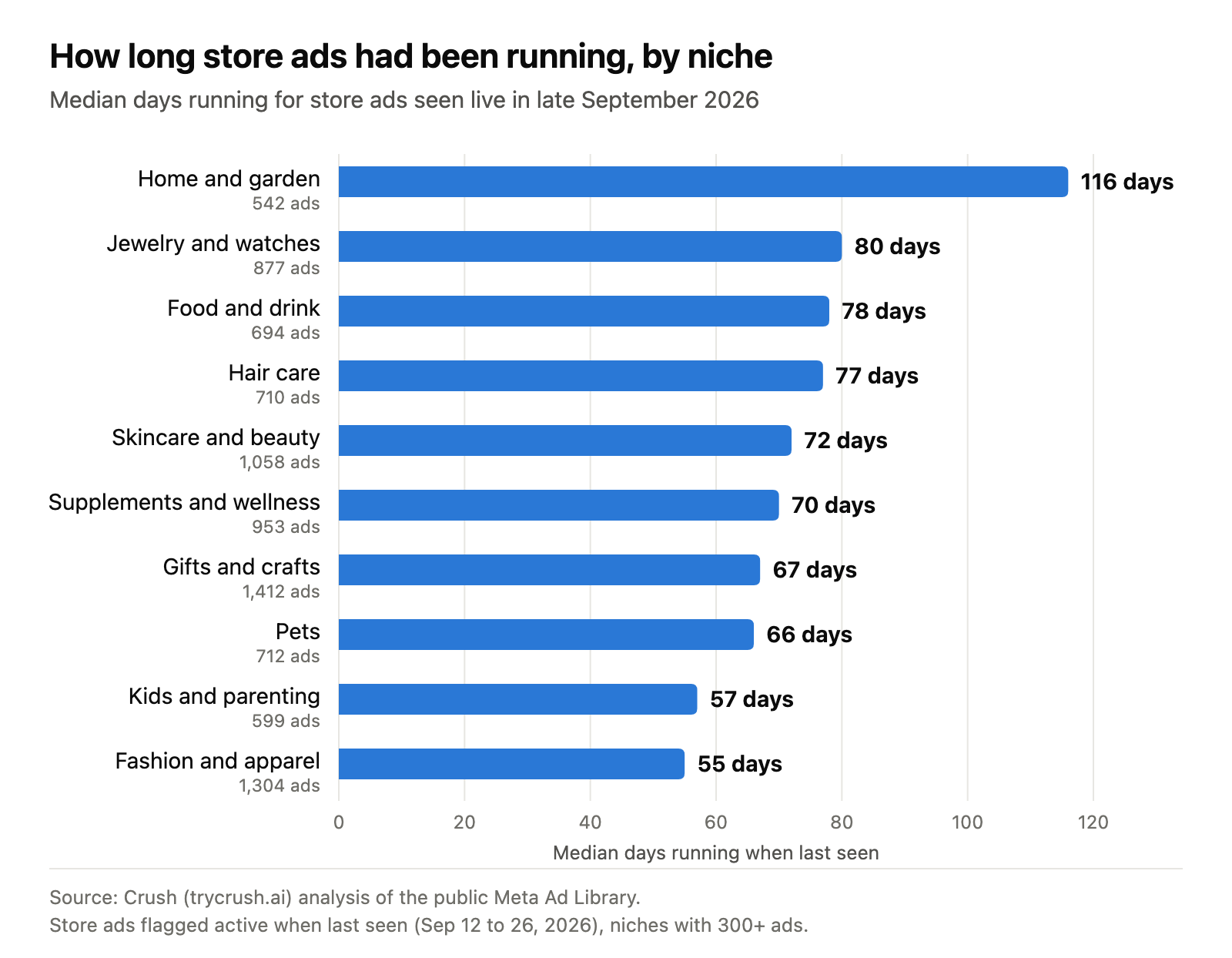
Among live store ads in late September, the median home and garden ad had been running for 116 days, fashion and apparel for 55 and kids and parenting for 57.
Our guess: fashion runs on seasons and drops, while a mattress sells all year. But this snapshot also reflects how many ads were just launched, and many fashion brands launch fall collections in September; our launch data has too few ads per niche to check. Niches come from the search terms that found each ad.
How long should a Facebook ad run? What the data means for your store
Give each new ad at least a week, then keep only the ones on target.
1. Plan for volume, because most ads will not last
About 1 in 12 new ads is still running after a month (about 12% of store ads). That is a survival rate, not a win rate. Expect roughly two or three of every 25 to 35 new ads (18 to 26 store ads) to still be running 30 days later, perhaps fewer. Many tests can be new versions of ads that already work (see tip 3).
Test them in small weekly batches in one separate test ad set, away from ads that already work, because adding an ad is a significant edit that sends its ad set back into learning (Significant edits and learning phase).
Set the test ad set up so it can reach about 50 results a week: give it enough budget, or optimize for a more frequent event such as add to cart, as Meta suggests (About learning limited). If it still cannot, test fewer ads at a time so each gets enough spend, rather than cutting each after a day or two.
2. Decide how you will judge an ad before you launch it
Write down your stop rule, such as the spend limit above, and your target cost per result before launch. Deciding in advance keeps one bad day from ending a test. While an ad set is learning, avoid significant edits such as new targeting or a new optimization event (Significant edits and learning phase).
3. Keep winners running and build on them
In ad sets with one creative, Meta flags "Creative fatigue" when people have seen an ad many times and its cost per result reaches twice that of your past ads (About creative fatigue recommendations). Rising frequency is an early warning. The fix is often a new version of an ad that already works.
4. Check how long competitors' ads have run
An ad that has run for 90 days is a rare survivor, which makes run time a useful free filter when you study competitors. In Meta's Ad Library, each active ad shows a "Started running on" date. It appears not to reset when an ad is paused and restarted, so treat the time since then as the longest the ad could have run.
5. Add an always-on catalog ad if you sell many products
Catalog ads and carousels lasted longest among store ads. With a product catalog and a working pixel, a catalog ad can keep running next to your tests. Catalog ads can run under the Sales objective, which our overview of the types of Facebook campaigns explains.
Methodology details
Filters
- Unique creatives only. When the same image or video ran in several ads, we counted the first ad once.
- A strict junk filter removed adult, miracle-cure, weight-loss drug and scam ads, ads in stylized Unicode lettering, Pages named after a person (this catches fake doctor personas), personal Marketplace listings, web novels, recruiting and non-commercial ads such as politics, religion and charity. It dropped 7.6% of live ads and 10.9% of launch-day ads, including some real small businesses named after their owner.
- At most 25 ads per advertiser Page (picked at random), so a few large catalog advertisers cannot dominate.
Checks we ran
- Ads we found late. All 55,226 launch-day ads, including those found later, give 33% at day 7 but only about 6% at day 30 and 0.6% at day 90. Of ads still running on day 7, 53% of those found 3 to 7 days after launch reached day 14, against 58% of the main group, and 2.1% against 3.5% reached day 90. The long tail is the least certain part of the study.
- Ads we lost track of. Counting the 238 whose search later came back empty or incomplete as stopped gives 8.0% at 30 days and 1.1% at 90. Counting all 1,832 as stopped a day after we last saw them gives a median of 3.9 days, 6.1% at 30 days and 0.7% at 90.
- Copies. The Ad Library shows identical ads as one grouped result, and we store one per group. For about 1 in 11 ended ads, a same-Page copy was still running afterward. Counting those as running gives 10.7% at 30 days and 1.9% at 90 (by chance, the same as late dating), or more if the copies missing from our data were counted.
- Long gaps. Treating an end found more than 7 days after the last sighting as unknown gives 9.6% at 30 days and 1.8% at 90.
- Without the junk filter the 30-day share is 7.7% (median 3.8 days), without the per-Page cap 8.0%, and without July 8, the launch day whose ads we first saw latest, 8.4% (1.3% at 90 days).
- A direct count on recent launches, with no end-date estimate. Of image and carousel ads found in their first 3 days, 28% of September 16 launches were still running at our latest scan, about 9 to 10 days later. So were 15% of September 9 launches after about 16 to 17 days, and 6% of August 26 launches (7% of store ads) after about 30 days. For these ads, already running when found, our curve predicts 35%, 20% and 10% (13% for store ads).
Limitations
- Running time is not profit. Advertisers turn ads off for budget, stock, season or test plans, and some long runners are forgotten.
- We lost track of 13% of launch ads. If most had stopped, the true figures are lower (see the checks above).
- The start date is the first start. As far as we can tell, a paused and restarted ad keeps its original start date, so the pause counts toward its age.
- Our sample is not random. The ads come from searches our users track, which skews toward e-commerce brands and their markets. We have no spend or per-ad country data.
- "Stopped" means no longer listed as active. A short pause during our scan could look like an end, and so could a scan that resumed after an interruption or skipped the ad, though an ad we see again goes back to active. We have not compared our end dates with the inactive UK and EU listings.
- Dates are approximate. Meta gives start dates as calendar days, and we count from the start of that day in Pacific time, so each lifespan may be overstated by up to a day.
- Video is only covered since September 8, 2026.
- We spot catalog ads by Meta's product template text, which stopped appearing in ads that started after mid-August 2026, so catalog figures cover ads launched before then.
- The junk filter works best in English.
- Data runs through September 26, 2026 (the live-copies recount, September 27).
How to cite this study
You are welcome to use these numbers and charts with a link to this page. Please cite it as:
Crush (trycrush.ai), "How Long Do Facebook Ads Run? We Followed 13,586 New Ads," September 2026, https://trycrush.ai/blog/how-long-do-facebook-ads-run
The aggregate tables behind every chart and table are available as a JSON file.
Get more shots on goal
Finding an ad worth keeping takes a steady stream of new ones to test. Crush makes Meta ad creatives and copy for your store. Plans start with a paid trial; see the pricing page.
Frequently Asked Questions
Common questions about this topic
1How long do Facebook ads usually run?
2How long should I run a Facebook ad before turning it off?
3Why do so many ads in the Facebook Ad Library seem to run for months?
4Which Facebook ad format runs the longest?
5Is a long-running Facebook ad always profitable?
6How long does a Facebook ad run if I do not stop it?
About this article
This article was written with AI assistance and researched against the sources listed below. It was reviewed by our automated editorial checks before publishing.
Sources
- About the Meta Ad Library (Meta Business Help Center) (facebook.com)
- Best practices for A/B tests for Meta ads (Meta Business Help Center) (facebook.com)
- About budgets (Meta Business Help Center) (facebook.com)
- About the learning phase (Meta Business Help Center) (facebook.com)
- Significant edits and learning phase (Meta Business Help Center) (facebook.com)
- About learning limited (Meta Business Help Center) (facebook.com)
- About creative fatigue recommendations in Meta Ads Manager (Meta Business Help Center) (facebook.com)
- About Meta Advantage+ catalog ads (Meta Business Help Center) (facebook.com)
- Boost a post from your Facebook Page (Meta Business Help Center) (facebook.com)
- Kaplan-Meier estimator (Wikipedia) (en.wikipedia.org)
- Survivorship bias (Wikipedia) (en.wikipedia.org)
- Meta Ad Library (facebook.com)
Written by

Rokas Steponavičius
Founder, CEORokas is the Founder and CEO of TryCrush.ai, an ex-IBM professional turned entrepreneur focused on building AI-driven growth platforms. With a strong background in ecommerce, performance marketing, media buying, and artificial intelligence, Rokas specializes in creating scalable, data-led systems that drive measurable revenue. His mission is to help modern businesses leverage AI to optimize acquisition, conversions, and long-term profitability.
Stop Guessing.
Start Crushing.
AI Ad Manager trained by world-class media buyers to generate your creatives and optimize your ads 24/7.
Learn more
Related articles
Reminder Advertising Examples: 3 Ads That Ran Over 500 Days
Explore real reminder advertising examples backed by proprietary 2026 data. Learn how top brands keep winning ads running for hundreds of days to maximize return on ad spend.

The "Creative Fatigue" Lie: You Don't Need More Ads, You Need Better Iterations
Think you need fresh creative every week? Discover why "Creative Fatigue" is a myth and learn the step-by-step process to iterate existing ads into high-converting winners without filming new footage.

Why You Need 100 Ad Variations (Not 3)
Most advertisers fail because they test too few creatives. Discover why generating 100 ad variations is the mathematical secret to beating creative fatigue, finding winning ads, and scaling your campaigns effortlessly with AI bulk generators.
Proven Online Ad Examples Based on Meta Ad Longevity Data
Stop guessing what works. We analyzed millions of active campaigns to bring you the best online ad examples based on pure longevity and profitability data.