Key Takeaways
- 1Winning online ads rely on longevity metrics, with the best performers running consistently for over 90 days.
- 2The learn more call to action is the most effective choice for online ads, used by 38% of top performers.
- 3High relaunch counts indicate that a media buyer is aggressively scaling a highly profitable creative concept.
- 4Successful ad copy removes purchase friction by stating shipping terms or financial incentives in the first sentence.
- 5You must avoid copying unproven ads that have not survived multiple billing cycles in live ad accounts.
Stop guessing what works. We analyzed millions of active campaigns to bring you the best online ad examples based on pure longevity and profitability data.
Online ad examples with the highest ROI are not just creative concepts. They are proven setups that survive the brutal testing ground of live ad accounts.
We track millions of active campaigns to find the true outliers. The best online ads combine a direct hook, a specific offer, and a measurable call to action.
What makes a winning online ad?
A winning online ad simply buys revenue profitably for an extended period of time. You cannot gauge success by looking at pretty designs. Instead, you must look at how long an advertiser is willing to spend money on that exact creative.
Our platform, Crush, tracks competitors' Facebook ads and keeps their history. When you search the Facebook Ad Library with historical data, it includes ads that were taken down. By looking at run times and duplicate counts, we separate the proven winners from the temporary tests.
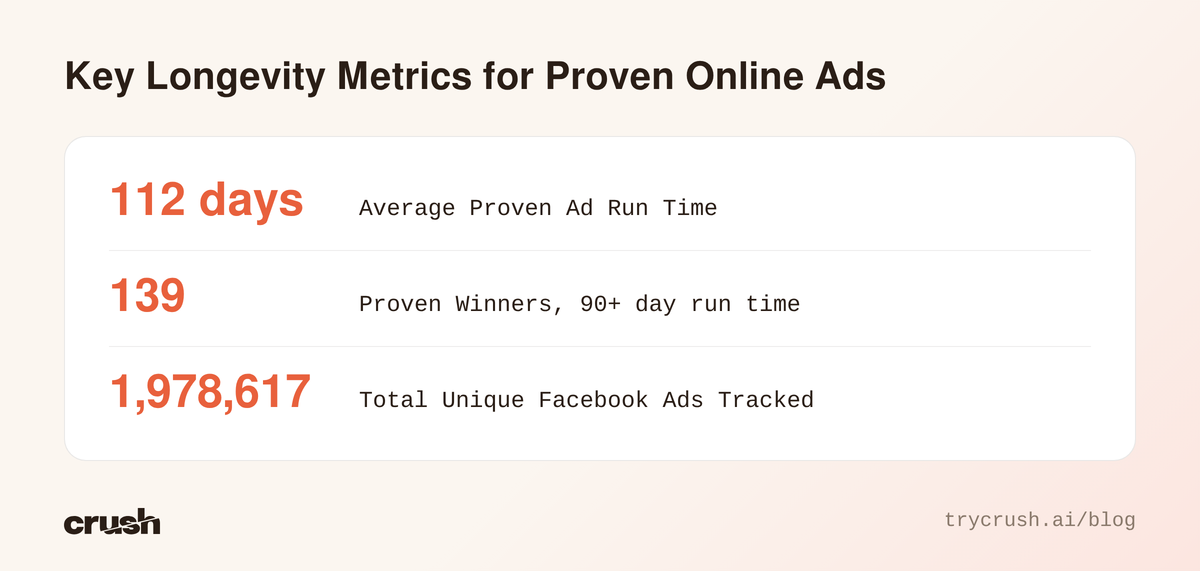
Among top "online" ads, average run time is 112 days; 139 of the top 400 ran 90+ days (the "proven winner" threshold).
Crush's ad library tracks 1,978,617 unique Facebook ads (464,737 currently active). Exactly 17,722 tracked ads match "online" (4,126 active right now). We pulled the top performers from this dataset to show you exactly what works right now in 2026.
Proven online ad examples you should copy
The best way to build your own ads is to reverse engineer creatives that are already spending heavily. We pulled five distinct examples across B2B, local services, ecommerce, and digital platforms.
Faire (B2B Wholesale)
Faire uses extreme clarity to capture B2B intent. Their ad has been running 313 days and has been relaunched 59 times. A high relaunch count is a massive signal that the creative is driving core business metrics.
The opening line reads: "Faire is an online wholesale marketplace connecting independent retailers and brands around the world. Eligible retailers can enjoy 60-day payment terms & free"
- Why this works: The copy immediately qualifies the audience. If you are not an independent retailer or brand, you will keep scrolling. If you are, the offer of 60-day payment terms removes a massive point of friction. The CTA used here is "shop now", driving immediate intent.
- What you should copy: Put your core value proposition in the very first sentence. Offer financial terms that lower the barrier to entry for B2B buyers.
Academy for Mathematics & English (Local Service)
Local ads need hyper-specific targeting in the copy. This specific ad from Academy for Mathematics & English - Hamilton ran for 1,524 days and was relaunched 5 times. It uses the CTA "sign up".
The opening line is bold: "❤️ Hamilton Parents --> Wow - this is insane! We are giving you a 👉$300 SUMMER Tutoring Savings Coupon 👈! Watch grades soar! Use for IN CENTRE or ONLINE tutor"
- Why this works: It calls out the exact target demographic immediately. It offers a high perceived value upfront with the $300 coupon. It also handles objections by stating the service works for both physical and digital formats.
- What you should copy: Use city or neighborhood names in your first line. Give a specific dollar amount for your discount rather than a percentage.
CLN (Ecommerce Retail)
Ecommerce ads need to highlight product benefits while overcoming shipping objections. This ad from CLN ran an astonishing 1,352 days and was relaunched 6 times. The CTA is "learn more".
The opening line states: "Essentials that combine lifestyle and versatility! Free shipping above 995. Cash on delivery."
- Why this works: It gets straight to the transactional details. Free shipping thresholds and cash on delivery options are major trust signals for retail buyers. It removes purchase anxiety immediately in the primary text.
- What you should copy: Do not hide your shipping policies. Put your free shipping thresholds directly in your ad copy to pre-qualify clicks and boost conversion rates.
ChemCert Training Group (Accreditation)
Training and certification ads thrive on regulatory compliance and flexibility. This ad from ChemCert Training Group - RTO 90855 ran 1,212 days and was relaunched 6 times. The CTA used is "learn more".
The opening line reads: "High quality training and Industry Accreditation in VIC for people working with AgVet Chemicals. Face to Face and Online Courses available. Courses include: - A"
- Why this works: The ad names the specific accreditation and the location. It offers multiple learning formats, catering to different preferences. The copy is dry but highly relevant to its very niche audience.
- What you should copy: State exactly who the course is for in the first sentence. Clarity always beats cleverness when selling professional accreditations.
La Télé Du Développement Personnel (Digital Subscriptions)
Digital content requires strong hook retention. This ad ran 854 days and was relaunched 4 times. It uses the CTA "sign up".
- Why this works: Running an ad for over two years in the personal development space is incredibly difficult due to audience fatigue. This advertiser achieves longevity by targeting a broad pain point and offering a clear subscription path.
- What you should copy: Match your CTA to the friction level of your offer. If you are selling a subscription, use a logical signup action rather than forcing an immediate retail purchase.
What do the longest running online ads share?
The data shows clear patterns among ads that survive the 90-day mark. Winning ads are not fundamentally complex. They share a distinct set of structural similarities that you can apply to any niche.
We analyzed the most common CTA buttons on "online" ads: learn more (38%), shop now (16%), and sign up (9%). These numbers indicate that low-commitment CTAs often outperform high-commitment ones at the top of the funnel.
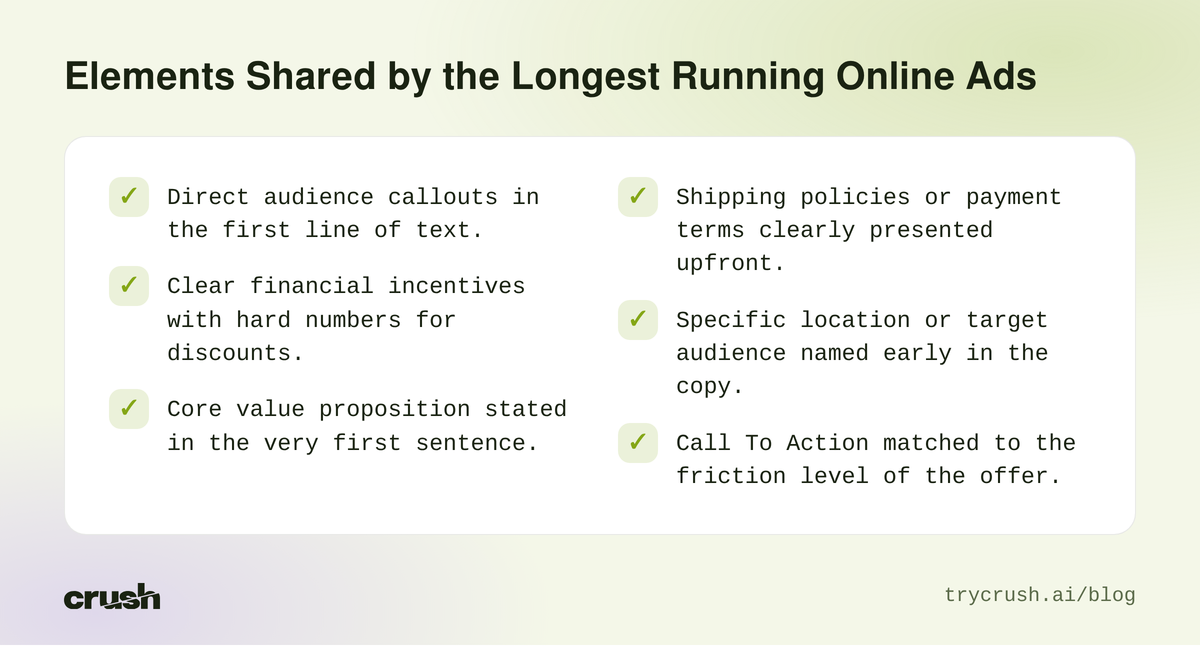
Here are the core elements almost every proven ad shares:
- Direct audience callouts: They name the target customer directly in the first three seconds of video or the first line of text.
- Clear financial incentives: They use hard numbers for discounts rather than vague promises of savings.
- Friction removal: They state shipping terms, payment terms, or delivery methods upfront to answer objections before the click.
- Low-commitment pathways: They lean heavily on informational clicks to get users off the feed and onto a high-converting landing page.
The danger of copying untested ad creatives
Many media buyers make the mistake of copying ads they see on their own social feeds. Seeing an ad once does not mean it is profitable. It only means the advertiser is spending money today.
You must apply a strict filter before using an ad as a reference. If you copy a creative that has only been running for five days, you might be copying a failed experiment.
We use the 90-day mark as our baseline for a proven winner. Any ad that survives three billing cycles is almost certainly driving a positive return on ad spend. Out of our dataset, 139 of the top 400 online ads crossed this specific longevity threshold.
When you base your creative iterations on proven setups, your baseline conversion rate improves immediately. You bypass the initial testing phase that drains most ad budgets.
Decoding the most effective call to action buttons
The CTA you choose dictates the mindset of the user landing on your site. Our dataset of proven call to action examples reveals a massive preference for low-friction buttons in successful campaigns.
As mentioned, the most common buttons are learn more, shop now, and sign up. These percentages are not accidental. They reflect the realities of modern media buying.
When to use the learn more button
This CTA dominates with 38% usage because it asks for the least amount of commitment. Users are scrolling to be entertained or informed. Asking them to buy immediately creates friction.
It works exceptionally well for high-ticket items, complex B2B software, and specialized services. It bridges the gap between passive scrolling and active reading.
When to use the shop now button
This CTA captures 16% of the winning ads. It is strictly for transactional intent. If your product is visual and highly commoditized, you want to filter out window shoppers.
Faire uses this button effectively. Even though they are B2B, they operate a wholesale marketplace. They want users who are ready to build a cart and checkout.
When to use the sign up button
This CTA sits at 9%. It is the perfect middle ground for lead generation and account creation. The Academy for Mathematics & English uses this to drive lead forms.
You should use this button when the next step requires an email address but does not require an immediate credit card transaction.
How relaunch counts reveal scaling strategies
Longevity is only half the equation. The number of times an advertiser relaunches an ad tells you how they are managing their budget.
A relaunch occurs when a media buyer duplicates an ad into a new ad set or campaign. They do this to force the algorithm to find new pockets of customers, or to test the exact same creative against a new lookalike audience.
When you see a high relaunch count, you know you have found an ad that is highly scalable. It is not just profitable in a small niche.
Here is a breakdown of the specific longevity and relaunch metrics from our top examples:
| Advertiser Name | Run Time (Days) | Relaunch Count | CTA Used |
|---|---|---|---|
| Academy for Mathematics & English | 1524 | 5 | sign up |
| CLN | 1352 | 6 | learn more |
| ChemCert Training Group | 1212 | 6 | learn more |
| La Télé Du Développement Personnel | 854 | 4 | sign up |
| Faire | 313 | 59 | shop now |
How to spot your own winning ad examples
You need a systematic way to find ads that are actually working for your competitors. The native ad platforms provide basic libraries, but they lack longevity metrics. You need to know how long an ad has been active.
Our product tracks these specific metrics automatically. Our ads library contains millions of Facebook ads across niches, with longevity data and duplicate counts. You can browse our free directory at https://trycrush.ai/ad-library to see exactly how many days an ad has survived in the wild.
Follow this process to reverse engineer your competitors and build a data-driven creative strategy:
- Search for your direct competitors in a specialized tracking tool.
- Filter the results by active run time, isolating ads that have run for 90 days or more.
- Analyze the duplicate counts to see which creatives they are aggressively scaling.
- Break down the winning copy into a template you can adapt for your own product.
- Generate new creative iterations from that proven reference ad.
Automating the creative testing process
Once you find winning online ad examples, you still have to build and test your own versions. Manual testing is slow and prone to human error. Automation removes the friction from campaign management.
Crush fully automatically runs Facebook ads. The system creates campaigns, scales winners, and kills losers without manual intervention. It can even generate ad-creative iterations from a winning reference ad.
If you are ready to stop guessing and start running proven concepts, you can start with a trial. Check trycrush.ai/pricing for current access levels.
How we got this data
The numbers in this article come from Crush’s ad library: 1,978,617 unique Facebook ads tracked via the Meta Ad Library, 464,737 of them active at the time of writing. Ad examples reference real advertisers and their public ads. Data queried on 2026-09-12. Third-party product facts are attributed inline to their sources.
Frequently Asked Questions
Common questions about this topic
1What defines a winning online ad?
2How often should you refresh ad creatives?
3Why do so many online ads use the learn more button?
4What is the best way to test new ad concepts?
5How much budget do you need to test a new ad?
Written by

Ignas Obulaitis
Head of ITIgnas Obulaitis is the head of IT for TryCrush.ai, leading the platform’s engineering and AI innovation. With a strong background in product-driven development, Ignas has built and scaled complex systems across fintech, SaaS, and AI-focused companies. An ex-IBM engineer and former Head of Development at Fluensure, Ignas combines deep technical expertise with a sharp product mindset to turn ambitious ideas into scalable, production-ready technology.
Stop Guessing.
Start Crushing.
AI Ad Manager trained by world-class media buyers to generate your creatives and optimize your ads 24/7.
Learn more
Continue Reading
How to Add Branding to Meta Ads That Actually Convert
Most advertisers ruin their return on ad spend by overcomplicating their visual identity. Here is how to integrate branding into your creatives to drive direct response.
Scaling Dropshipping Shopify Stores: 2026 Ad Data
Most guides just show you pretty storefronts. We analyze the actual Facebook ad data that successful Shopify dropshipping stores use to scale profitability in 2026.
Clothing Ads in 2026: Data and Benchmarks for Profitable Campaigns
Discover what drives profitable clothing ads in 2026 through proprietary ad library data. We break down benchmarks, top calls to action, and the exact frameworks needed to scale.