
Key Takeaways
- 1Top clothing ads run for an average of 68 days, proving that durable creative is the key to scaling.
- 2The Shop Now button dominates apparel advertising, appearing on 71% of all successful clothing ads.
- 3Relaunching the same winning creative multiple times is a common strategy used by top brands to reset performance.
- 4AI automation eliminates the need for manual campaign management by automatically scaling winners and killing losers.
Discover what drives profitable clothing ads in 2026 through proprietary ad library data. We break down benchmarks, top calls to action, and the exact frameworks needed to scale.
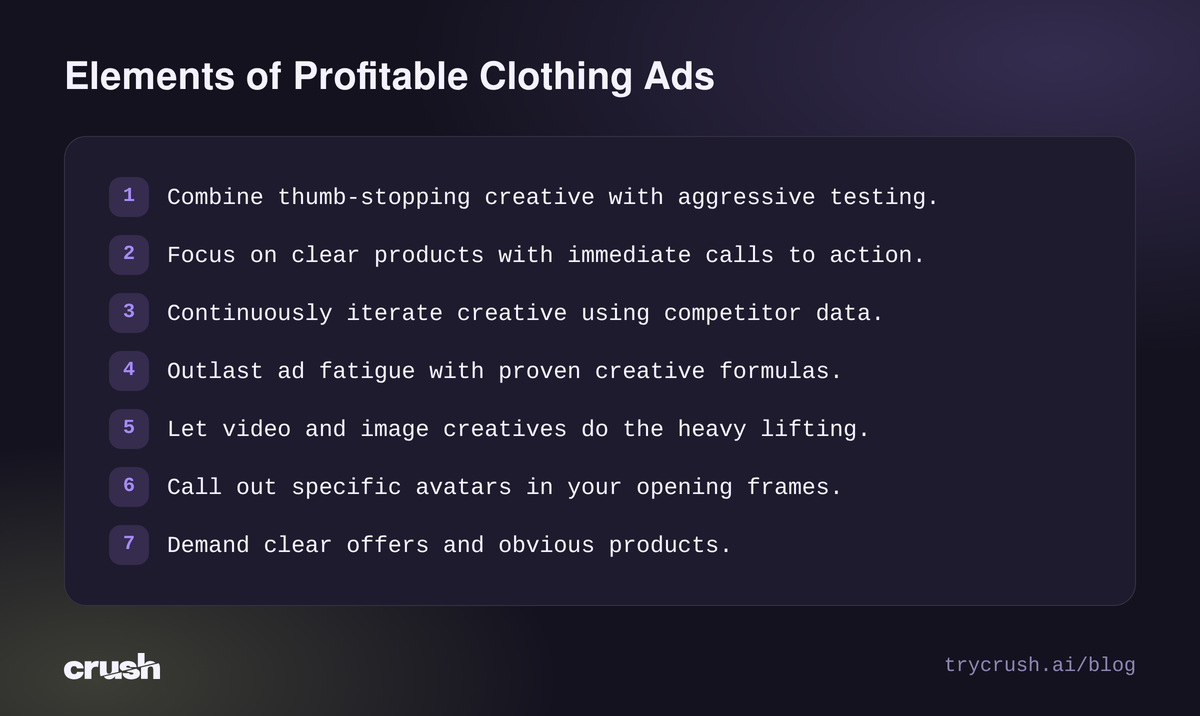
Effective clothing ads combine thumb-stopping creative with aggressive testing to find winning formats that scale. In 2026, the most profitable clothing brands ads rely on clear product focus, immediate calls to action, and continuous creative iteration based on competitor data to maintain low acquisition costs over long periods.
What makes clothing ads profitable in 2026?
Profitability requires outlasting ad fatigue through proven creative formulas rather than guessing. The most successful media buyers understand that ad creative is the new targeting. You cannot rely on traditional audience analysis and settings to find your buyers anymore.
Instead, your video and image creatives must do the heavy lifting. By calling out specific avatars in your opening frames, you naturally filter out bad clicks. This approach stabilizes your cost per acquisition over time.
Scaling requires an unyielding focus on direct response principles. Lifestyle imagery is great for organic social media, but paid campaigns demand clear offers and obvious products. If a user cannot tell what you are selling in the first two seconds, they will keep scrolling.
How long do winning clothing ads actually run?
Winning creatives stay active for months, not days. Most beginner advertisers panic when performance dips for a single afternoon, leading them to turn off ads prematurely. Real data tells a completely different story about ad longevity.
At our product Crush, an AI Facebook-ads platform, our ad library tracks 1,934,049 unique Facebook ads across all industries, with 445,490 currently active. This massive dataset allows us to see exactly how long real brands keep their checkbooks open for specific creatives.
When we narrow that down, 4,484 tracked ads match "clothing" in our system, and 1,216 are active right now. The endurance of these creatives is the ultimate indicator of success. Nobody spends money on a losing ad for three months.
Among top clothing ads, average run time is 68 days, proving that proven winners do not fatigue quickly.
The 90-day threshold for scaling
We found that 91 of the top 400 clothing ads ran 90 or more days. We consider this the proven winner threshold. When an ad crosses the three-month mark, it means the creative has successfully navigated algorithm changes, weekend slumps, and audience saturation.
Achieving this kind of longevity requires broad targeting. If you restrict your audience size, your frequency metrics will spike rapidly. The ad will fatigue before it ever reaches the 90-day mark.
Relaunching winners is a core strategy
Advertisers frequently duplicate and relaunch their best ads. Our data includes duplicate counts, revealing how many times an advertiser re-launched the same creative. This is a massive signal of a winning ad.
A brand might pause a winner due to inventory shortages. Once the stock is replenished, they relaunch the exact same creative. Other times, media buyers relaunch a winner to reset the learning phase if performance randomly degrades.
Which call to action dominates clothing brands ads?
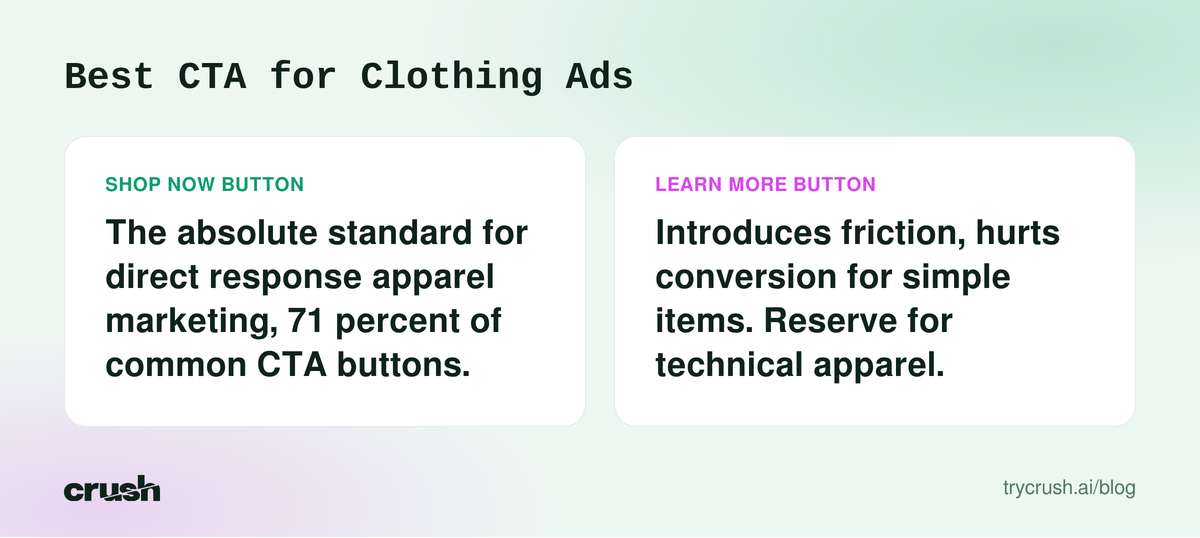
The "Shop now" button is the absolute standard for direct response apparel marketing. In the highly competitive fashion space, you cannot afford ambiguity. You want users clicking with the explicit intent to browse a catalog and make a purchase.
Our proprietary data confirms this dominance. We analyzed the most common CTA buttons on clothing ads across our database. The results leave zero room for debate on what works best for driving revenue.
Most common CTA buttons on clothing ads: shop now (71%), learn more (10%), subscribe (7%).
The problem with soft asks
Using a "learn more" button for a simple t-shirt or dress introduces friction. The user assumes they are going to an article or a complex landing page. This mismatch in expectations hurts your conversion rate.
Reserve "learn more" for highly technical apparel, like specialized outdoor gear or patented athletic wear. For standard everyday clothing ads, command the sale directly. Stick to the 71% majority and use "shop now" to prime the buyer.
What do top performing clothing ads have in common?
The best performers rely on direct offers, frequent relaunches, and clear opening hooks. We pulled five specific Facebook advertising examples from our library that demonstrate incredible longevity. These are not flashes in the pan; they are foundational business drivers.
| Brand | Run Time | Relaunches | Primary CTA |
|---|---|---|---|
| Legend London | 589 days | 4 | Shop now |
| Screamouse Clothing | 458 days | 2 | Shop now |
| Sutsu | 453 days | 3 | Shop now |
| Amazon.ae | 350 days | 2 | Shop now |
Dissecting the copy of proven winners
Look at Legend London. Their ad has been running for 589 days and was relaunched 4 times. Their opening line is completely literal. It reads: "Shop our huge collection of stylish clothing for both Men and Women. Including jeans, cargos, chinos, t-shirts, hoodies & jackets." They leave nothing to the imagination.
Sutsu takes a slightly different approach but maintains clarity. Running for 453 days and relaunched 3 times, their opening line hooks the exact demographic instantly. It states: "Discover eco-conscious clothing from Sutsu. Inspired by nature, designed for adventure. Shop now." The value proposition is front and center.
Even massive retailers follow this formula. Amazon.ae ran a clothing ad for 350 days, relaunched twice, with a blunt opening line: "Shop Top Rated Women's Clothing". The social proof of "top rated" combined with a direct instruction drives consistent clicks.
The role of localization in apparel ads
Sometimes blending local flavor with a strong visual identity works wonders. SCREAMOUS CLOTHING ran an ad for 458 days with 2 relaunches. Their opening line mixed English and Indonesian to connect with their market deeply.
The copy read: "Stay true to your vibe, tetap ekspresikan dirimu dengan gaya yang unik dan autentik! ✨ Dengan koleksi eksklusif dari Screamous, setiap detail menunjukkan karakt". They paired exclusivity with local dialect to build a community feel.
How should you structure your clothing campaign?
Structure dictates your ability to scale winners without breaking the algorithm's learning phase. The days of hyper-segmented ad sets are long gone. You must consolidate your spend to give the platform enough data to optimize efficiently.
We recommend a simplified account structure. Keep your prospecting and retargeting distinct, but do not slice your prospecting audiences into dozens of tiny interests. Broad targeting consistently outperforms narrow interests over a 90-day window.
Effective creative testing frameworks
You cannot find a 68-day winner without testing dozens of losers first. Creative testing needs to be isolated from your scaling campaigns. If you mix unproven ads with your winners, you risk destabilizing your entire account.
- Create a dedicated testing campaign using Campaign Budget Optimization.
- Test 3 to 5 new creatives per week against your baseline control ad.
- Use dynamic creative optimization to test different hooks and headlines automatically.
- Pause any test that spends 3x your target cost per acquisition without a purchase.
Scaling your proven winners
Once a creative proves it can generate sales at a profitable margin, it needs budget. Do not make large budget jumps on active ad sets. Increasing spend by more than 20 percent at a time can force the ad set back into the learning phase.
Instead, use cost caps for aggressive scaling. Say your target CPA is $50. You can set a cost cap at $50 and give the campaign a massive daily budget. The platform will only spend the money if it can acquire customers at or below that threshold.
Why competitor tracking dictates ad success
Tracking competitors reveals exactly what the market responds to before you spend a dime. If three different competitors are all running split-screen video formats for their fall collections, you can safely assume that format is converting.
Crush automatically tracks competitors' Facebook ads via the Facebook ad library and keeps history, including ads that were taken down. This historical data is crucial. Meta's native library deletes ads once they stop running, erasing valuable research material.
By retaining this data, our platform allows you to see what failed alongside what succeeded. You can access our free public ad library to start researching exactly how long specific brands are running their campaigns. Knowing the duplicate counts gives you a massive tactical advantage.
What are the biggest mistakes in clothing advertising?
Most brands fail by turning off ads too early or testing too few variables. Media buying requires patience and objective data analysis. Emotional decision making will ruin your return on ad spend faster than anything else.
Advertisers also struggle with product-market fit. An ad cannot fix a bad product or a terrible website experience. If your click-through rate is high but your conversion rate is abysmal, the ad is doing its job, but your landing page is failing.
- Changing budgets multiple times within a 48-hour window.
- Using soft calls to action like "learn more" instead of "shop now".
- Failing to show the actual product clearly in the first three seconds of a video.
- Relying on a single winning creative for more than six months without testing backups.
- Ignoring competitor history and repeating the exact same creative mistakes they already made.
How can AI automate your clothing brand scaling?
Artificial intelligence completely removes the manual burden of campaign management. Managing bids, duplicating ad sets, and killing underperforming creatives used to require a full-time media buyer staring at dashboards all day.
Crush fully automatically runs Facebook ads by executing these precise tasks. It creates campaigns based on proven structures, scales winners aggressively when metrics align, and ruthlessly kills losers before they drain your budget.
Generating creative variations instantly
When you finally find that winning ad that runs for 90 days, you will eventually need a fresh version of it. Recreating the magic manually is difficult and expensive. AI bridges this gap by analyzing the components of your success.
Our platform can generate ad-creative iterations from a winning reference ad. It takes the core hooks, visual pacing, and copy frameworks that are already converting and produces fresh variations to combat ad fatigue.
Transitioning to automated media buying
The media buying landscape in 2026 demands speed and precision. Manual adjustments simply cannot compete with algorithms that evaluate millions of data points in real time. Letting AI handle the execution allows you to focus purely on offer creation and business strategy.
If you are ready to stop guessing and start leveraging data to build campaigns that last, review our pricing to find a plan that fits your current ad spend. Paid plans start with a trial, giving you immediate access to historical ad data and automated scaling tools.
How we got this data
The numbers in this article come from Crush’s ad library: 1,934,049 unique Facebook ads tracked via the Meta Ad Library, 445,490 of them active at the time of writing. Ad examples reference real advertisers and their public ads. Data queried on 2026-09-09. Third-party product facts are attributed inline to their sources.
Frequently Asked Questions
Common questions about this topic
1How long should I test a new clothing ad?
2What is the best call to action for clothing brands?
3Why do advertisers relaunch the same ad?
4Can AI create variations of my winning ads?
Written by

Ignas Obulaitis
Head of ITIgnas Obulaitis is the head of IT for TryCrush.ai, leading the platform’s engineering and AI innovation. With a strong background in product-driven development, Ignas has built and scaled complex systems across fintech, SaaS, and AI-focused companies. An ex-IBM engineer and former Head of Development at Fluensure, Ignas combines deep technical expertise with a sharp product mindset to turn ambitious ideas into scalable, production-ready technology.
Stop Guessing.
Start Crushing.
AI Ad Manager trained by world-class media buyers to generate your creatives and optimize your ads 24/7.
Learn more
Continue Reading
Data-Backed Ways to Spot a Winning Product Trend in 2026
A real product trend is not defined by search volume, but by how long advertisers are willing to spend money promoting it.

How to Build an AI Creative Agency in 2026 (With Data)
An AI creative agency replaces manual design and media buying with autonomous software. Discover the exact ad data and automated workflows driving the most profitable agencies in 2026.

5 Proven Examples of Audience Analysis From Winning Ads
We analyze five long-running Facebook ads to show exactly what successful audience analysis looks like in the real world of media buying.