
Key Takeaways
- 1Audience analysis in media buying relies on behavioral data and ad longevity rather than just static demographic surveys.
- 2Crush's tracking of 1,891,131 Facebook ads shows the average top 'analysis' ad runs for 89 days, proving longevity is the ultimate metric of success.
- 3Over 34% of top analysis-related ads use a 'Learn more' CTA, indicating a preference for low-friction conversions.
- 4Winning creatives like Railey Realty have run for 2380 days because they perfectly match market intent with an immediate value proposition.
Stop guessing what your customers want. Learn how modern media buyers use real Facebook ad longevity data to build highly converting audience profiles.
What is audience analysis in 2026?
Audience analysis is the process of evaluating a target market's demographics, interests, and behaviors to craft messaging that drives action. Instead of relying on static surveys, modern media buyers perform audience analysis by tracking competitor ad spend, analyzing which creatives run the longest, and validating assumptions with real campaign data.
Most academic definitions will tell you this is about understanding who your customer is. However, that is only half the battle.
If you want to run profitable Facebook ads in 2026, you need to know what actually makes your audience convert. You do not ask people what they want. You run creatives and let the algorithm tell you what they click.
This approach transforms a theoretical marketing exercise into a financial strategy validated by actual ad spend.
Why traditional demographic analysis of audience fails
A basic audience analysis demographic profile might tell you your buyer is a 35-year-old female living in Texas. While somewhat helpful, this data is virtually useless for direct response marketing.
Two people can share the exact same demographic profile but possess entirely different buying triggers. One might buy a product for status, while the other might buy it for convenience.
If you are wondering what audience analysis is in the context of paid media, it is the pursuit of behavioral signals. Relying solely on a demographic analysis of audience limits your ability to scale campaigns because you are targeting general traits instead of specific problems.
To succeed, you need to layer psychographics and actual purchase behaviors over your basic audience analysis demographics.
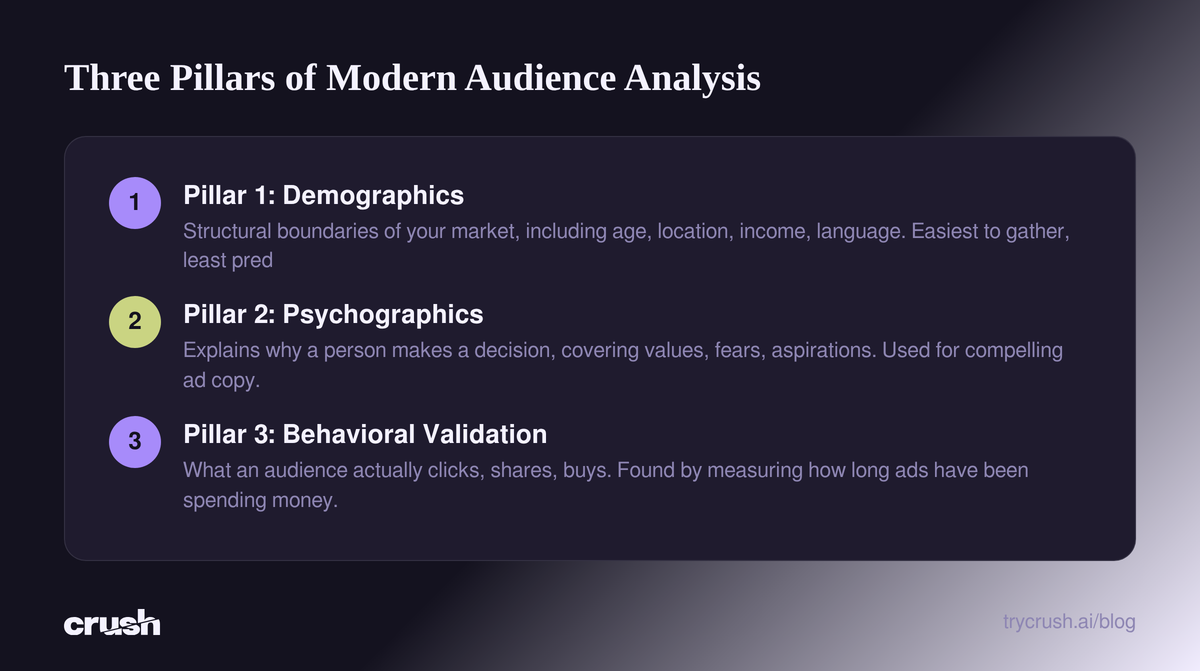
The three pillars of a modern audience analysis
A complete profile requires three layers of data to be actionable for media buying.
Pillar 1: Demographics
Demographics provide the structural boundaries of your market. This includes age, location, income level, and language. This is the easiest data to gather but the least predictive of actual buying behavior.
Pillar 2: Psychographics
Psychographics explain why a person makes a decision. This layer covers their values, fears, aspirations, and daily frustrations. Media buyers use psychographics to write ad copy that hooks the reader in the first three seconds.
Pillar 3: Behavioral validation
This is where the magic happens. Behavioral validation means looking at what an audience actually clicks, shares, and buys. You find this data by looking at active ad campaigns in your niche and measuring how long those ads have been spending money.
How to validate an audience analysis demographic with ad data
You can spend weeks building a hypothetical customer persona. The fastest way to validate it is by looking at what is already working in the market.
At Crush, our platform tracks competitor Facebook ads via the Meta Ad Library and keeps a historical record of longevity and duplicate counts. We do this because the length of time an ad runs is the ultimate proof of audience resonance.
An advertiser will not spend money on a losing ad for 90 days. If an ad runs for a long time, it means the audience analysis behind that ad was correct.
Let us look at the hard data from our AI Facebook ads platform to see how this works in practice.
The data behind winning audience analysis campaigns
Our product Crush tracks millions of Facebook ads across various niches. We provide longevity data to show exactly how many days an ad has been active.
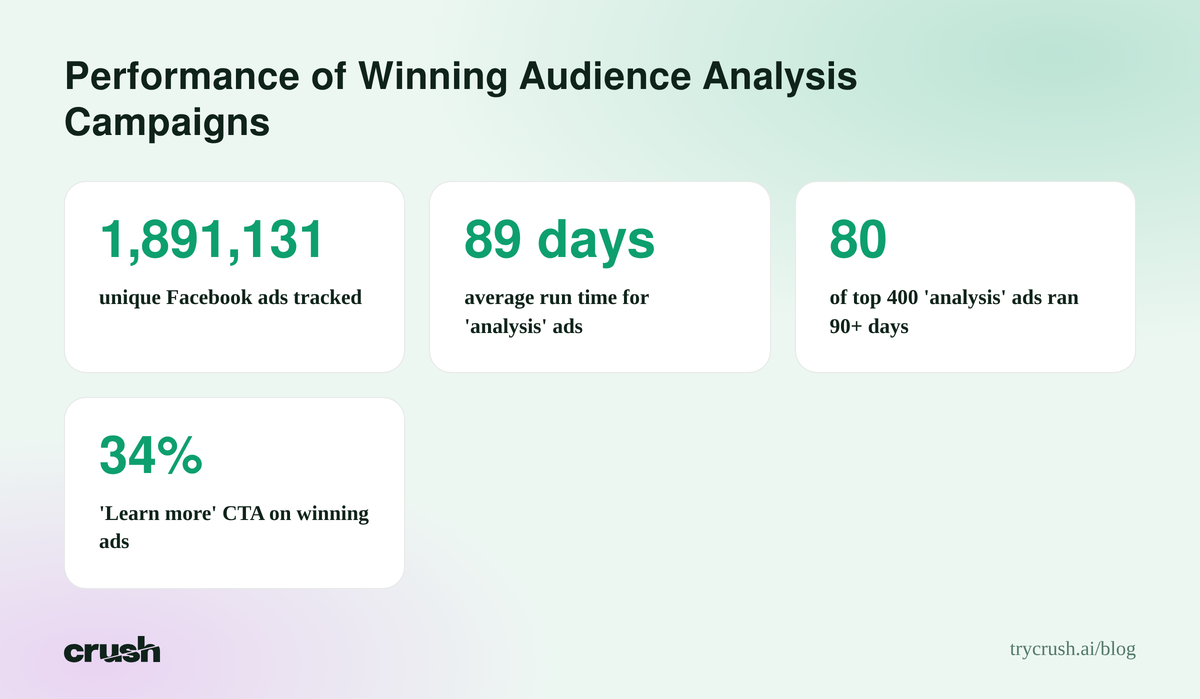
- Crush's ad library tracks 1,891,131 unique Facebook ads (with 440,469 currently active).
- Within that dataset, exactly 1,712 tracked ads match the keyword "analysis" (462 active right now).
- Among top "analysis" ads, the average run time is 89 days.
- Crucially, 80 of the top 400 analysis ads ran for 90 days or more. We consider 90 days the proven winner threshold.
Among top "analysis" ads, average run time is 89 days, and 80 of the top 400 ran for over 90 days, passing the proven winner threshold.
When we look at the specific calls to action used to convert this audience, clear patterns emerge.
The most common CTA buttons on these "analysis" ads are:
- Learn more (34%)
- WhatsApp message (12%)
- Message page (11%)
Understanding what audience analysis methods work best requires looking at these exact conversion mechanisms. Over a third of advertisers find that a low-friction "learn more" approach works best for complex analysis offers.
A sample audience analysis using real estate data
Real estate is a brutal market for media buyers. The audiences are highly localized and incredibly skeptical. Let us build a sample audience analysis by reverse-engineering some of the longest-running real estate ads in our database. If you want to see how these strategies apply across other industries, explore these proven examples of audience analysis from successful campaigns.
These advertisers clearly nailed their audience profiling because their ads have run for years without being turned off.
| Advertiser Name | Days Running | CTA Button | Opening Hook |
|---|---|---|---|
| Railey Realty Deep Creek Lake | 2380 days | Learn more | Considering selling? Get your home's value now... |
| Cheryle Sanderson Realtor | 1673 days | Learn more | Based in the Woodlands, Texas, Cherylé Sanderson has a highly skilled group... |
| Morgan Hopkins Coldwell Banker | 1544 days | Learn more | Let's talk real estate. Does the latest buzz about the competitive market have you second guessing... |
| Ryan Paul Century 21 Ace Realty | 968 days | Message page | Thinking of buying or selling a home? SELLERS The first step... |
Deconstructing the messaging
Look closely at the Railey Realty Deep Creek Lake ad. It has been running for 2380 days with zero relaunches. The opening line is direct: "Considering selling? Get your home's value now, which could be higher than you think. Garrett County's #1 Real Estate Company!".
This directly addresses the core psychographic of a potential home seller. They are curious about their net worth. By offering a home valuation, the advertiser captures intent perfectly.
Morgan Hopkins takes a different approach for a buyer audience. Her ad has run for 1544 days. The opening line reads: "Let's talk real estate. Does the latest buzz about the competitive market have you second guessing your role as a potential buyer? Do you find yourself curious".
This targets the specific fear and hesitation present in a tough housing market. The audience analysis here identified that buyers are intimidated. The ad copy validates that fear and positions the agent as a trusted guide.
International audience targeting
Audience behaviors shift dramatically across different cultures and markets. Consider the financial investment niche in Vietnam.
The advertiser Đầu Tư Thông Minh ran an ad for 1199 days with zero relaunches using a "message page" CTA. The opening line was: "TẶNG TOÀN BỘ EBOOK ĐẦU TƯ CHỨNG KHOÁN TÂM HUYẾT CỦA CHÚNG TÔI. Chi phí tải xuống: Hoàn toàn Miễn Phí. Đầu tư cho bản thân chính là chìa khóa dẫn đến th".
This translates to offering a completely free stock investment ebook via direct message. The audience analysis revealed that this specific demographic responds best to immediate, free, high-value educational assets delivered through a conversational channel rather than a traditional landing page.
Common mistakes in audience analysis
Media buyers waste thousands of dollars every day because they misinterpret their audience data. Here are the most common traps:
- Ignoring ad longevity: Just because a competitor launched a new ad today does not mean it works. You must filter your research by ads that have survived the initial testing phase.
- Targeting too broadly: Broad targeting works on Meta, but your creative must still speak to a specific persona. The algorithm uses your ad copy as the actual targeting mechanism.
- Overlooking the CTA: Forcing a high-friction CTA (like "Buy Now") on a cold audience that requires a "Learn More" approach will tank your conversion rates.
- Ignoring duplicate creatives: When an advertiser relaunches the exact same creative multiple times, it is a massive signal that they have found a winning message.
What a fully automated audience analysis looks like
Manual research takes hours of scraping ad libraries and guessing which metrics matter. In 2026, the standard operating procedure is a fully automated audience analysis.
Crush automatically runs Facebook ads. It creates campaigns, scales the winners, and ruthlessly kills the losers based on real-time performance data.
Because our ads library contains millions of Facebook ads across all major niches, you do not have to guess what works. You can search your specific industry, filter by active ads, and immediately see the duplicate counts. A high duplicate count means an advertiser is pouring budget into a proven concept.
Once you identify a winning angle from your audience research, Crush can generate ad-creative iterations from a winning reference ad. This allows you to launch campaigns tailored to your specific audience analysis demographics in minutes instead of days.
Building your audience strategy today
Stop writing generic copy based on outdated marketing textbooks. An effective audience analysis requires looking at where the money is actively flowing to build a data-driven creative strategy.
Start by identifying your core demographic traits. Then, list the top three emotional drivers that push your buyer to take action. Finally, validate those assumptions by looking at active ad campaigns in your space.
If you want to see exactly what your competitors are running to convert your shared audience, you can browse our free public ad library which lives at trycrush.ai/ad-library.
When you are ready to automate your campaign creation and let AI scale your best audience angles, you can review our paid plans. Paid plans start with a trial, and you can view the details at trycrush.ai/pricing.
The most successful media buyers do not guess. They analyze the data, build precise messaging, and let the ad longevity metrics prove them right.
How we got this data
The numbers in this article come from Crush’s ad library: 1,891,131 unique Facebook ads tracked via the Meta Ad Library, 440,469 of them active at the time of writing. Ad examples reference real advertisers and their public ads. Data queried on 2026-09-03. Third-party product facts are attributed inline to their sources.
Frequently Asked Questions
Common questions about this topic
1What is an audience analysis in marketing?
2Why is demographic analysis of an audience not enough?
3How do you find a sample audience analysis for Facebook ads?
4What is the best CTA for an analytical audience?
About this article
This article was written with AI assistance. Ad examples and ad data come from the Crush ad library.
Written by

Ignas Obulaitis
Head of ITIgnas Obulaitis is the head of IT for TryCrush.ai, leading the platform’s engineering and AI innovation. With a strong background in product-driven development, Ignas has built and scaled complex systems across fintech, SaaS, and AI-focused companies. An ex-IBM engineer and former Head of Development at Fluensure, Ignas combines deep technical expertise with a sharp product mindset to turn ambitious ideas into scalable, production-ready technology.
Stop Guessing.
Start Crushing.
AI Ad Manager trained by world-class media buyers to generate your creatives and optimize your ads 24/7.
Learn more
Related articles

5 Proven Examples of Audience Analysis From Winning Ads
We analyze five long-running Facebook ads to show exactly what successful audience analysis looks like in the real world of media buying.
Meta Advantage+ Audience: Setup and Targeting Guide
Set up Advantage+ Audience in Ads Manager, understand which settings restrict delivery, and choose an approach that fits your store's products and conversion data.
4 Proven Marketing Goal Examples Backed by Real Ad Data
Learn how to map a theoretical marketing goal to a profitable advertising campaign using longevity and duplicate data from top-performing Facebook ads.

The "Probation" Zone: What to Do With Ads That Are "Almost" Profitable
Stop killing ads that are "almost" profitable. Discover the "Probation Zone" strategy to identify hidden winners using secondary metrics like Unique Link CTR and Initiate Checkouts. Learn when to grant a stay of execution and when to pull the plug.