
Key Takeaways
- 1A profitable marketing goal must be tied directly to a hard metric like Cost Per Lead or Cost Per Trial.
- 2Top performing marketing ads average 92 days of run time, establishing the benchmark for a winning creative.
- 3The most common CTA button for marketing campaigns is 'learn more' at 51%, followed by 'sign up' at 12%.
- 4High duplicate counts on a single creative signal that an advertiser is aggressively scaling a winning goal.
- 5To achieve high-quality B2B leads, your opening ad copy must explicitly call out your target audience to filter out bad clicks.
Learn how to map a theoretical marketing goal to a profitable advertising campaign using longevity and duplicate data from top-performing Facebook ads.
A practical marketing goal example is a measurable objective tied directly to business revenue, such as reducing Cost Per Acquisition by 15% or driving 500 new software trials this quarter. In paid media, these goals dictate every creative decision you make, from the opening hook to the exact call to action you select.
What separates a theoretical marketing goal from a profitable one?
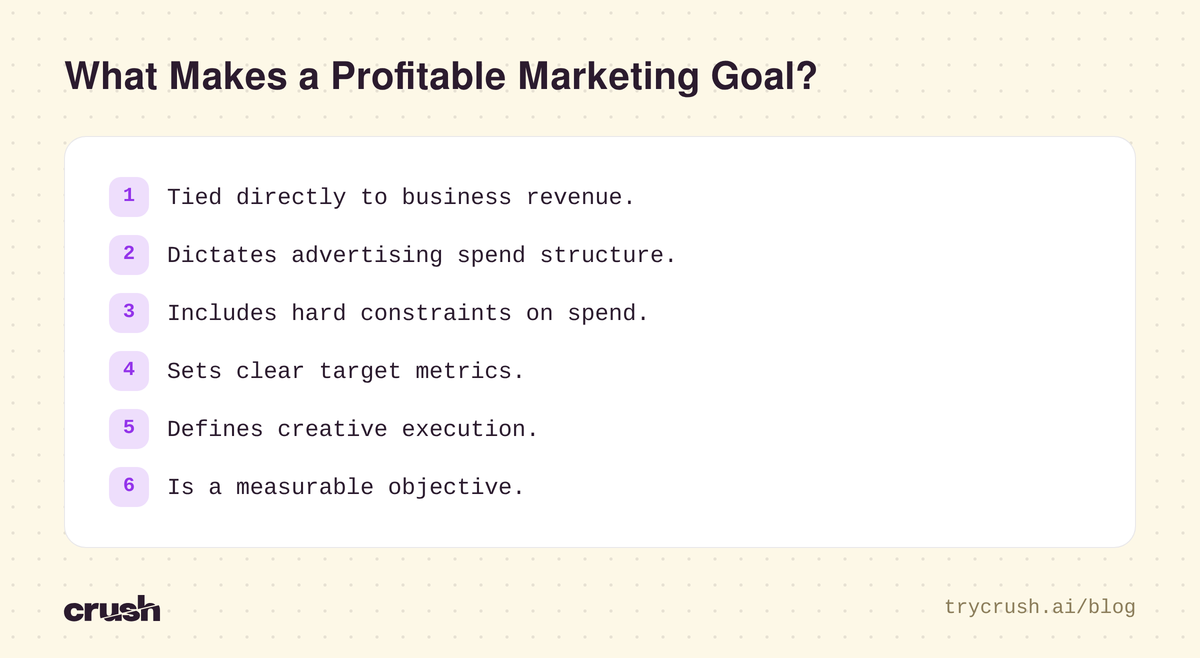
A profitable marketing goal directly dictates how you structure your advertising spend in 2026. Generic lists found on most blogs tell you to aim for broad brand awareness.
Experienced media buyers know that a real marketing goal example requires hard constraints on spend, target metrics, and creative execution.
The reality of goal setting in ad accounts
We track exactly how advertisers translate goals into creative execution using Crush, our AI Facebook-ads platform. Our product Crush monitors the Meta Ad Library to keep history on millions of creatives, including ads that were taken down. Learning how to search the Facebook ad library provides incredible insight into these specific advertiser trends.
Right now, our database tracks exactly 2,030,834 unique Facebook ads, with 475,597 currently active.
The volume of marketing-specific objectives
When we filter our proprietary data for campaigns explicitly matching the keyword "marketing", the numbers reveal massive investment. There are 14,695 tracked ads matching "marketing" in the system, and 867 of them are active right now.
These advertisers are not running ads just to be seen. They are running them to achieve specific, numeric business outcomes.
How do you map a marketing goal to an ad creative?
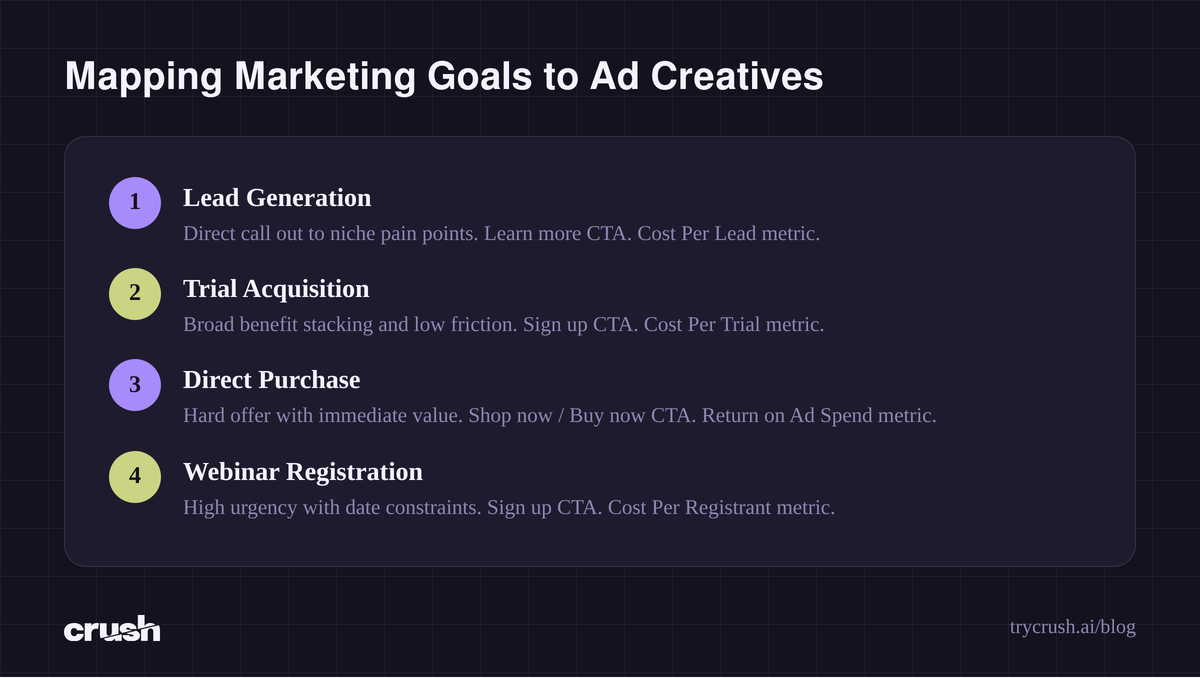
You map a marketing goal to a creative by aligning your call to action with the specific stage of the customer journey. A top-of-funnel lead generation goal requires a drastically different setup than a direct purchase goal.
The correlation between goals and CTAs
The button you choose tells the algorithm what your primary objective is. Our data reveals a stark preference for specific actions among top-performing campaigns.
Looking at proven call to action examples, the most common CTA buttons on "marketing" ads are "learn more" at 51%, "sign up" at 12%, and "whatsapp message" at 7%.
The framework for ad execution
Let us look at how different goals translate into ad structures. This structural alignment ensures you do not waste budget optimizing for the wrong conversion event in the auction.
| Marketing Goal | Creative Strategy | Most Common CTA | Target Metric |
|---|---|---|---|
| Lead Generation | Direct call-out to niche pain points | Learn more | Cost Per Lead |
| Trial Acquisition | Broad benefit stacking and low friction | Sign up | Cost Per Trial |
| Direct Purchase | Hard offer with immediate value | Shop now / Buy now | Return on Ad Spend |
| Webinar Registration | High urgency with date constraints | Sign up | Cost Per Registrant |
Marketing goal example 1: Driving high-intent B2B leads
Driving qualified B2B leads requires an ad that repels bad fits while capturing the exact target buyer. Swyft Sites provides a masterclass in executing this specific Cost Per Lead objective.
The Swyft Sites creative breakdown
This advertiser ran a single ad for 1,652 days with only 3 relaunches. The CTA they selected was "learn more".
This longevity is practically unheard of in modern media buying. It proves the ad consistently hit their target Cost Per Lead for over four years.
Why the hook works
The opening line reads: “Attn: Coaches who finally want to check the website off the list. We get it. Struggling to build a website by yourself can be time consuming, frustrating, and o”.
What you should copy
Use the direct audience call-out framework. It acts as an immediate filter for the algorithm. If you are not a coach, you scroll past, saving the advertiser money on wasted clicks. This is how you execute a strict lead quality goal.
Marketing goal example 2: Scaling direct response product trials
Scaling product trials means casting a wide net while maintaining a strict cost threshold. Udemy provides a perfect example of a marketing goal focused on sheer volume.
The Udemy execution strategy
Udemy ran a high-velocity campaign that lasted 189 days. What makes this fascinating is the duplicate count. They relaunched this exact creative 182 times.
When you see an advertiser relaunching a creative that often, they have found a massive winner.
Deconstructing the offer
Their CTA was "buy now", and the opening line was: “Learn thousands of in-demand skills in one subscription. From data, AI, and coding to productivity, marketing and creative skills, learn at your own pace. Subsc”.
The takeaway for volume goals
When your goal is volume, stack the benefits immediately in the primary text. They list data, AI, coding, and productivity in one sentence. Say your target CPA is $20 for a trial. You need broad appeal to keep your CPMs low enough to make that math work at scale.
Marketing goal example 3: Capturing event and workshop signups
Filling a workshop requires building immediate authority and visual disruption. Cloud Media shows exactly how to structure an ad for this objective in crowded feeds.
The Cloud Media workshop ad
This ad ran for 739 days and was relaunched 7 times using the "sign up" CTA. Running an event ad for two years means it is likely an evergreen webinar or a highly profitable recurring automated workshop funnel.
Visual disruption in the hook
The opening line grabs attention through heavy formatting and emojis: “🔥𝐆𝐨𝐨𝐠𝐥𝐞 𝐀𝐝𝐬 & 𝐘𝐨𝐮𝐓𝐮𝐛𝐞 (+) 𝐅𝐚𝐜𝐞𝐛𝐨𝐨𝐤 & 𝐈𝐧𝐬𝐭𝐚𝐠𝐫𝐚𝐦 (+) 𝐓𝐢𝐤𝐓𝐨𝐤 𝐇𝐚𝐧𝐝𝐬-𝐨𝐧 𝐀𝐝𝐯𝐞𝐫𝐭𝐢𝐬𝐢𝐧𝐠 𝐖𝐨𝐫𝐤𝐬𝐡𝐨𝐩🔥 Elev”.
Adapting this for your accounts
If your objective includes lowering your Cost Per Registrant, test disruptive typography in the first line. It stops the scroll effectively, buying you the three seconds you need to pitch the value of your event.
Marketing goal example 4: Qualifying niche e-commerce partners
When your service capacity is limited, your goal shifts from maximum volume to maximum qualification. JRNY Digital illustrates how to filter out low-tier prospects.
The JRNY Digital qualification strategy
This campaign ran for 744 days with 4 relaunches. Interestingly, they used the "shop now" CTA for a B2B service. This is unconventional but clearly tested well against their baseline metrics to survive that long.
The pain-point hook
The opening line reads: “Attention DTC brand owners: are you having trouble scaling your ads (without killing ROAS)? 👀 We're looking to partner with serious DTC brand owners that want ”.
Filtering out the noise
By explicitly calling out "scaling without killing ROAS" and demanding "serious DTC brand owners", they actively discourage beginners from clicking.
Understanding the strict differences between ROI vs ROAS is crucial here. If your objective is improving lead quality, your creative must be willing to turn people away.
Marketing goal example 5: Building software product awareness
Sometimes the objective is pure market penetration and brand awareness for a software tool. Zapier provides a strong baseline for this broader approach, closely mirroring many successful SaaS examples across the B2B tech space.
The Zapier longevity play
Zapier ran a specific ad for 861 days with 3 relaunches, utilizing the "learn more" CTA. Software companies with massive total addressable markets can afford to run broad awareness plays for years.
Why endurance matters
An 861-day run time indicates the ad serves as a foundational pillar in their top-of-funnel strategy. It consistently introduces the brand to new cohorts of users at a stable, predictable cost.
Measuring awareness goals
Unlike strict direct response, an awareness goal might be measured by brand lift or blended Customer Acquisition Cost across the entire ad account. Long-running ads provide the algorithmic stability needed to measure these macro trends.
What are the common mistakes when defining a marketing goal?
Many media buyers fail because their stated goals do not match their ad account realities. A theoretical goal means nothing if the math breaks in the auction.
Confusing metrics with goals
A low Cost Per Click is a metric, not a goal. Your goal should be tied to revenue or qualified pipeline. Optimizing purely for cheap clicks usually results in terrible traffic quality.
Setting unrealistic CPA targets
Say your product costs $100 and your gross margin is $50. If you set a target CPA of $5, you will likely fail. The auction requires a realistic budget to find buyers.
The list of frequent errors
- Running awareness creatives but judging them on direct response metrics.
- Changing the account goal too frequently, resetting the algorithm's learning phase.
- Using the wrong CTA button for the intended customer action.
- Failing to track offline conversions back to the specific campaign.
How do you validate your campaign objectives before launch?
Before spending a single dollar, you need to stress-test your objective against your budget and creative assets. This validation process prevents wasted ad spend.
Budget to CPA ratio
The platform algorithm needs data to optimize. You generally need a daily budget that is at least three to five times your target Cost Per Acquisition to exit the learning phase quickly.
Creative alignment
Your creative must sell the next step, not the whole company. If your goal is a lead magnet download, the creative should only sell the value of that specific PDF.
The validation checklist
- Is the business outcome clearly defined with a hard number?
- Does the chosen CTA match the friction level of the offer?
- Is the daily budget sufficient to generate 50 conversions a week?
- Do we have a system to track the exact revenue generated from this ad?
What do the best marketing goal examples have in common?
The most successful marketing goals translate into creatives that survive the algorithm's initial learning phase and run for months. Average ads die in days. Winning ads become foundational business assets.
The proven winner threshold
Among the top marketing ads in our database, the average run time is exactly 92 days. This is the baseline benchmark you should measure your own campaigns against.
Among top marketing ads, 130 of the top 400 ran for 90+ days, establishing the true proven winner threshold for media buyers.
The importance of longevity
If your ad cannot last 90 days, your marketing goal is likely misaligned with your creative execution, or your target CPA is too aggressive for the current auction climate.
Adapting to the data
The best media buyers do not guess. They look at what is already surviving in the auction. You can browse more of these long-lasting creatives in our free library at https://trycrush.ai/ad-library.
How can you reverse engineer competitor marketing goals?
By leveraging a comprehensive ad library guide, you can figure out exactly what your competitors are trying to achieve by analyzing their active and inactive ad creatives.
Their button choices, hooks, and duplicate counts reveal their entire paid strategy.
Tracking the invisible metrics
Meta shows you active ads, but they hide the true performance signals. You need to know how many days an ad has been running and how many times the advertiser relaunched the same creative. A high duplicate count is a massive signal that the ad is a winning creative.
Automating the media buying process
Once you identify these winning angles, you need to execute them flawlessly. Crush fully automatically runs Facebook ads by creating campaigns, scaling the winners, and killing the losers without manual intervention.
Scaling your own goals
We also generate ad-creative iterations directly from a winning reference ad. This allows you to launch variations of proven concepts instantly.
You can test our automation on your own ad account. View our current plans at https://trycrush.ai/pricing to get started today.
How we got this data
The numbers in this article come from Crush’s ad library: 2,030,834 unique Facebook ads tracked via the Meta Ad Library, 475,597 of them active at the time of writing. Ad examples reference real advertisers and their public ads. Data queried on 2026-09-15. Third-party product facts are attributed inline to their sources.
Frequently Asked Questions
Common questions about this topic
1What is a good example of a marketing goal?
2How long should a winning ad run to prove a marketing goal was met?
3Which CTA button works best for marketing objectives?
4Why do advertisers relaunch the same ad creative multiple times?
5How do you align ad copy with a lead quality goal?
Written by

Ignas Obulaitis
Head of ITIgnas Obulaitis is the head of IT for TryCrush.ai, leading the platform’s engineering and AI innovation. With a strong background in product-driven development, Ignas has built and scaled complex systems across fintech, SaaS, and AI-focused companies. An ex-IBM engineer and former Head of Development at Fluensure, Ignas combines deep technical expertise with a sharp product mindset to turn ambitious ideas into scalable, production-ready technology.
Stop Guessing.
Start Crushing.
AI Ad Manager trained by world-class media buyers to generate your creatives and optimize your ads 24/7.
Learn more
Continue Reading
B2B E-Commerce Platform Ads: Meta Data and Strategy for 2026
Most guides just list software features. We analyze proprietary ad data to show you exactly how top B2B e-commerce platforms acquire customers.
5 Web Banner Ad Examples That Converted (2026 Data)
We analyzed millions of Facebook ads to find the best web banner ad examples. Here is exactly what top advertisers do to drive profitable conversions.
Proven Online Ad Examples Based on Meta Ad Longevity Data
Stop guessing what works. We analyzed millions of active campaigns to bring you the best online ad examples based on pure longevity and profitability data.