ROI vs ROAS: Metric Differences and Top Software in 2026
•12 min read
ROI vs ROAS: Metric Differences and Top Software in 2026 (Crush blog cover)
Key Takeaways
1ROAS strictly measures gross ad revenue against ad spend, ignoring all other business expenses.
2ROI measures your true net profit by factoring in product costs, shipping, and agency fees.
3Crush's database shows 1,401 Facebook ads actively pitching ROAS metrics, with top performers running an average of 211 days.
4Tools like True ROAS and Gorilla ROI help track backend attribution, while Crush handles frontend ad automation and creative scaling.
5Scaling campaigns based purely on ROAS with low margin products is a guaranteed way to generate negative ROI.
ROAS measures gross ad revenue, while ROI measures total net business profit. Discover the key differences and compare the top tools for tracking true margins.
Return on ad spend (ROAS) measures gross revenue generated for every dollar spent on a specific advertising campaign. Return on investment (ROI) measures the total net profit of your entire business after all expenses. ROAS tells you if your ads work, while ROI tells you if your business is actually making money.
What is the exact difference between ROI vs ROAS?
Return on investment evaluates the financial efficiency of a specific venture after all business costs are subtracted. It represents true profitability. Return on ad spend evaluates the gross revenue generated strictly from ad campaigns compared to the amount spent on those specific ads.
The primary difference in the ROI vs ROAS debate is scope. ROAS is isolated to your marketing department's daily performance. ROI dictates whether your entire company remains solvent.
When you pull up a Facebook Ads Manager dashboard in 2026, the primary column you see is ROAS. This metric gives media buyers instant feedback on whether a new creative is catching attention and driving clicks that convert to top line sales.
However, the dashboard does not know your product margins. It does not factor in your warehouse rent, your Shopify subscription, or the cost of the goods you are selling. That is why media buyers must eventually reconcile their campaign ROAS against the total business ROI to ensure they are actually generating net profit.
Why ROAS lies to you (and ROI tells the truth)
Every experienced media buyer has scaled a campaign that looked wildly profitable in the ad account, only to realize the business lost money that month. This happens because ROAS is inherently flawed as a standalone business metric.
Ad platforms are designed to take full credit for conversions. If a customer clicks an email link, leaves your site, and then clicks a retargeting ad on Instagram two days later, Meta will claim that revenue. This artificially inflates your reported ROAS.
Say your product sells for $100, but it costs you $60 to manufacture and ship. Your absolute maximum profit per unit is $40. Say your ad spend to acquire that customer is $50. Your ROAS will display as 2.0 (calculated as $100 in revenue divided by $50 in ad spend). A 2.0 ROAS might seem like a good ROAS benchmark to an amateur media buyer. But your ROI is negative because you just lost $10 on that transaction.
This is why you must calculate true ROI. High ROAS on low margin products leads directly to bankruptcy.
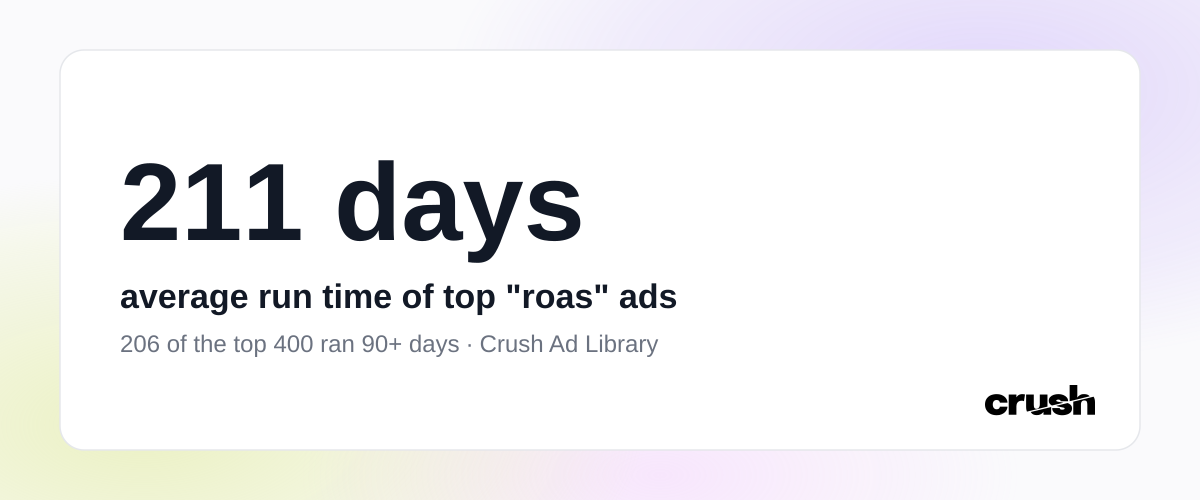
Longevity of top "roas" ads: the strongest profitability signal.
What Facebook ad data reveals about ROAS
To see how advertisers leverage ROAS messaging to attract clients, we pulled data from Crush, our platform. We track competitor ads across niches to find winning creatives via our free public ad library. Knowing how to search the Facebook ad library is essential for uncovering these market trends.
Crush's ad library tracks 1,741,554 unique Facebook ads (445,620 currently active). We found that B2B advertisers and marketing agencies frequently use ROAS as a primary hook.
Specifically, 1,401 tracked ads match "roas" (108 active right now). These ads have serious longevity in the ecosystem.
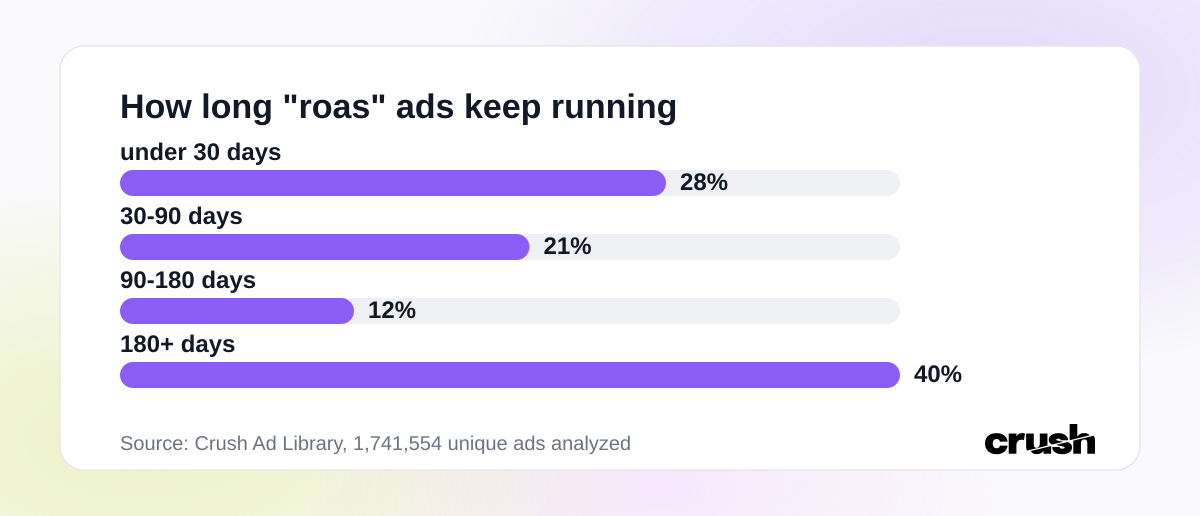
Among top "roas" ads, average run time is 211 days; 206 of the top 400 ran 90+ days (the "proven winner" threshold).
We also analyzed the call to action preferences. The most common CTA buttons on "roas" ads: shop now (37%), learn more (32%), message page (9%).
Here are five verbatim examples of long running campaigns mentioning ROAS in our database:
ROAS.ro: running 1351 days, relaunched 0x, opening line: “Vrei sa vinzi Parfumuri Orientale Arabesti? Intra acum pe https://www.roas.ro/ si deschide un cont de revanzator, pentru a beneficia de preturi de distribuitor ”.
Coffee Pods PH: ran 1224 days, relaunched 0x, CTA "shop now", opening line: “Is it time to refill on k-cups? Free shipping available. www.CoffeePods.ph”.
Measuring the gap between ad platform metrics and actual bank deposits requires specialized software. We researched the top analytics tools to see how they handle tracking.
Below is a breakdown of feature sets across popular solutions. Note that while some focus on backend profit data, our product Crush focuses entirely on frontend creative intelligence.
Feature Focus
Gorilla ROI
True ROAS
Crush (our product)
Primary Function
E-commerce order data sync
Cross-platform attribution
AI Facebook ad automation
Best Target Audience
Amazon and Shopify sellers
Multi-channel advertisers
Media buyers scaling creatives
Key Strength
Connecting massive inventory feeds
Customer journey tracking
Competitor ad library history
Deep dive into the top ROAS and ROI software
You need to know what real users say before you install a tracking pixel or sync your store data. Here is the verified research on the market leaders regarding ROAS vs ROI software platforms.
Gorilla ROI
According to the Gorilla ROI Pricing page, the software offers multiple pricing tiers geared toward e-commerce data syncing.
Gorilla ROI offers a Basic plan for $99 per month when billed monthly, or $74 per month when billed annually. The Gorilla ROI Basic plan has a usage limit of up to 1,000 orders per month and 3 total connections.
The Gorilla ROI Pro plan costs $199 per month when billed monthly, or $149 per month when billed annually. For the Gorilla ROI Pro plan, usage is limited to up to 5,000 orders per month and 5 total connections, with extra orders costing 1 cent each.
Gorilla ROI's Mega plan is priced at $399 per month when billed monthly, or $299 per month when billed annually. The Gorilla ROI Mega plan allows up to 25,000 orders per month, with extra orders costing 0.8 cents each. All Basic, Pro, and Mega plans from Gorilla ROI include a free trial, and Gorilla ROI also offers custom plans with custom order limits.
ROI Hunter
According to G2 reviews, users praise ROI Hunter for its intuitive interface, which allows for effective product optimization and insightful analytics. ROI Hunter significantly streamlines operational time through the easy creation of new product filters. Customer service is often described as excellent, proactive, and shares the vision of media and business goals with users.
Additionally, according to SaaSworthy, ROI Hunter offers integration with popular marketing platforms for seamless data import and provides team collaboration features for efficient campaign management.
However, the software has specific limitations. According to Reddit, the tool is focused solely on e-commerce and SKU products, limiting its ability to launch advanced localized campaigns.
On G2, some users have reported occasional access issues preventing the entire team from using the platform. Furthermore, one user found the tool's layout to be 'plastered and a little confusing,' suggesting a need for modernization in usability, according to SpotSaaS reviews.
ROI Revolution (RevolutionSuite)
According to the ROI Revolution official website, RevolutionSuite is a robust, comprehensive, and fully customizable suite of digital marketing tools developed by ROI Revolution, an agency that has invested over 100,000 development hours into its creation.
The RevolutionSuite helps support holistic ecommerce strategies, leveraging intelligent cross-platform integrations and insights. RevolutionSuite provides capabilities for strategic research, enabling the discovery of new avenues for growth and efficiency for a brand. It includes tools for closely planning, tracking, and managing budgets and revenue goals based on historical and seasonal performance.
The platform offers proactive monitoring and alerts for potential new opportunities or problematic issues within an account. RevolutionSuite features automated bidding solutions tailored for Google, Microsoft, and Amazon, optimized towards Return on Ad Spend (ROAS) and Advertising Cost of Sale (ACoS) goals. It also supports automated campaign buildouts for Google and Microsoft advertising platforms, and it integrates call and lead tracking for simplified offline to online conversion analysis.
True ROAS
According to the True ROAS Home page, True ROAS is an advanced ad tracking and optimization platform designed to help businesses maximize their Return on Ad Spend. True ROAS seamlessly integrates with various ad platforms, including Google Ads, Facebook Ads, and others, to consolidate data in a single location.
According to their Shopify App Store listing, the tool provides real-time tracking of ad performance across multiple platforms, including Google Ads, Facebook Ads, and TikTok Ads. Key features of True ROAS include AI Ad Tracking and Attribution, Customer Journeys for each order, Creative Breakdown, and Profit Tracking.
The platform features customizable dashboards to provide valuable insights into ad spend efficiency. True ROAS offers advanced reporting features that include detailed reports, analytics, and visualizations such as charts and graphs.
However, despite being a data-driven marketing analytics platform that specializes in optimizing advertising spend and improving return on ad spend by integrating with platforms like Meta, Google, and TikTok, it lacks public feedback. According to G2 Reviews, there are 0 reviews for True ROAS products on G2, indicating a lack of public user feedback on this platform.
ROAS Reports and ROAS Suite
According to the ROAS Reports Pricing page, ROAS Reports is an advertising/marketing software tool currently in private beta. The pricing page states that once launched publicly, it will have straightforward pricing, likely including a starter tier, per-brand or per-platform pricing for teams, and enterprise pricing. The ROAS Reports website mentions that users can request beta access to know when pricing is finalized.
According to a ROAS Suite Review, ROAS Suite is an AI-powered SaaS platform for e-commerce brands and agencies, designed for speed and ease of use to generate image and video advertising assets without requiring prompt writing skills.
Be aware of the limitations of AI generation. According to the ROAS Suite Terms of Service, the service does not guarantee the accuracy, error-free nature, or suitability of generated content, and users are responsible for reviewing all content before publishing.
ROAS Labs and Roaspy
According to Trustpilot, customers of ROAS Labs consistently praise the staff for their helpfulness and responsiveness, with reviewers describing the service as a 'top-notch agency'. ROAS Labs users generally report a positive user experience, highlighting the ease of use and smooth operations of the platform.
According to Trustpilot, Roaspy helps online businesses identify profitable ads and provides a single dashboard to view true ROAS, net profit, and customer journeys, using advanced fingerprint technology for accurate tracking. Roaspy's software is described as super fast and easy to set up and use, even for non-technical users, and it provides nearly 24/7 support from real human beings.
Crush (our product)
While the tools listed above focus heavily on backend data tracking and attribution modeling, our platform Crush focuses entirely on frontend creative leverage and ad management execution.
Crush is an AI Facebook-ads platform that fully automatically runs Facebook ads. When evaluating Facebook Ads vs. AI Ads, our tool stands out by creating campaigns, scaling winners, and killing losers without requiring manual daily adjustments.
We track competitors' Facebook ads via the Meta Ad Library and keep history, including ads that were taken down. Our ads library contains millions of Facebook ads across niches, with longevity data (how many days an ad has been running) and duplicate counts (how many times an advertiser re-launched the same creative, a strong "winning ad" signal).
Our software can generate ad-creative iterations directly from a winning reference ad, allowing you to launch proven concepts rapidly. Paid plans start with a trial; see trycrush.ai/pricing for current pricing.
How to calculate ROI versus ROAS in practice
To understand the actual formulas, you just need two basic math equations. Neither requires advanced financial modeling.
To calculate ROAS, divide your ad campaign revenue by your ad campaign spend. Say your customer acquisition cost (CAC) target is $50, and you spend $1,000 on a specific TikTok video ad that generates $4,000 in tracked sales. The ROAS is exactly 4.0.
To calculate ROI, take your net profit, divide it by your total investment costs, and multiply by 100 to get a percentage. Your total investment must include the product manufacturing cost, shipping fees, agency retainers, software tools, and the ad spend itself.
Say your total combined costs for a month are $5,000, and your total gross revenue is $6,000. Your net profit is $1,000. Your ROI is 20 percent.
The most common mistakes media buyers make with ROAS
New media buyers make the same mistakes when evaluating campaign performance. They confuse top line revenue with bottom line survival.
Here is what you must avoid when scaling campaigns:
Chasing high ROAS on low-margin products: Scaling an ad purely for frontend metrics without calculating total business costs is a fast track to draining cash reserves.
Ignoring backend longevity: Focusing on initial clicks causes you to ignore the Lifetime Customer Value of your newly acquired buyers.
Trusting platform attribution blindly: Remember that platforms like Meta and Google are designed to over-report their own success.
Run-time distribution of top "roas" ads. Longevity is the profitability signal.
How we got this data
The numbers in this article come from Crush’s ad library: 1,741,554 unique Facebook ads tracked via the Meta Ad Library, 445,620 of them active at the time of writing. Ad examples reference real advertisers and their public ads. Data queried on 2026-08-07. Third-party product facts are attributed inline to their sources.
Frequently Asked Questions
Common questions about this topic
1What does a 3.0 ROAS mean?
A 3.0 ROAS means that for every dollar you spend on advertising, you generate three dollars in gross revenue. It does not mean you made three dollars in net profit, as you still have to deduct your product and operational costs.
2Can I have a high ROAS but a negative ROI?
Yes. If your cost of goods sold, shipping, and operational expenses are very high, your profit margins will be thin. A high ROAS will generate sales, but those sales will not cover your total business expenses, resulting in a negative ROI.
3Why is Facebook reporting a higher ROAS than Shopify?
Ad platforms use attribution models designed to claim credit for any customer touchpoint. If a user clicks an ad but buys a week later through an email link, Facebook claims the sale. Shopify only tracks the final checkout event.
4What is a good ROAS benchmark?
A good ROAS is entirely dependent on your profit margins. A brand with 90 percent gross margins might be highly profitable at a 1.5 ROAS. A dropshipper with 20 percent margins might go bankrupt at a 3.0 ROAS.
5How do I transition from ROAS tracking to ROI tracking?
Start by calculating your exact break-even cost per acquisition for each product. Once you know exactly how much you can spend to acquire a customer profitably, you can manage campaigns based on CPA targets rather than platform ROAS.
#roi vs roas#roas vs roi#return on ad spend#return on investment#ad tracking software#ecommerce profitability
Ignas Obulaitis is the head of IT for TryCrush.ai, leading the platform’s engineering and AI innovation. With a strong background in product-driven development, Ignas has built and scaled complex systems across fintech, SaaS, and AI-focused companies. An ex-IBM engineer and former Head of Development at Fluensure, Ignas combines deep technical expertise with a sharp product mindset to turn ambitious ideas into scalable, production-ready technology.
Stop Guessing. Start Crushing.
AI Ad Manager trained by world-class media buyers to generate your creatives and optimize your ads 24/7.