Key Takeaways
- 1Winning branded ads can run for over two years without relaunching when the visual identity aligns perfectly with direct response copy.
- 2Embedding messaging call to action buttons captures leads immediately and leverages the trust built by your visual assets.
- 3Exclude unqualified clicks directly in your opening text to protect your budget and train the Meta algorithm efficiently.
- 4Test new visual identity elements in isolated campaigns against a proven control ad before scaling your daily spend.
Most advertisers ruin their return on ad spend by overcomplicating their visual identity. Here is how to integrate branding into your creatives to drive direct response.
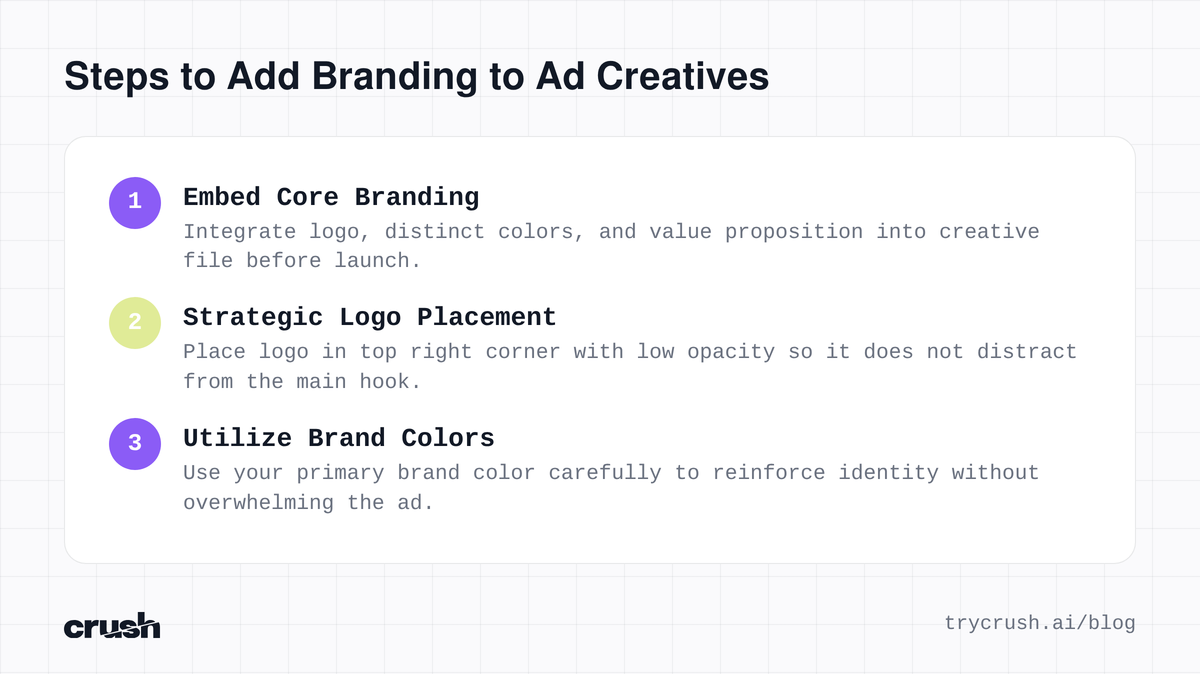
To add branding to your campaigns effectively, embed your logo, distinct colors, and core value proposition directly into the creative file before launching. Good branding in paid media is not just about visual appeal. It must drive direct response and measurable conversions within the Meta ecosystem.
Why do most advertisers fail when they add branding to campaigns?
The trap of purely visual design
Most advertisers focus entirely on visual design. They obsess over hex codes and font families. They forget that users scroll past static images in seconds.
To succeed in 2026, you need to combine visual identity with strong offers. You must look at what is actually running profitably right now.
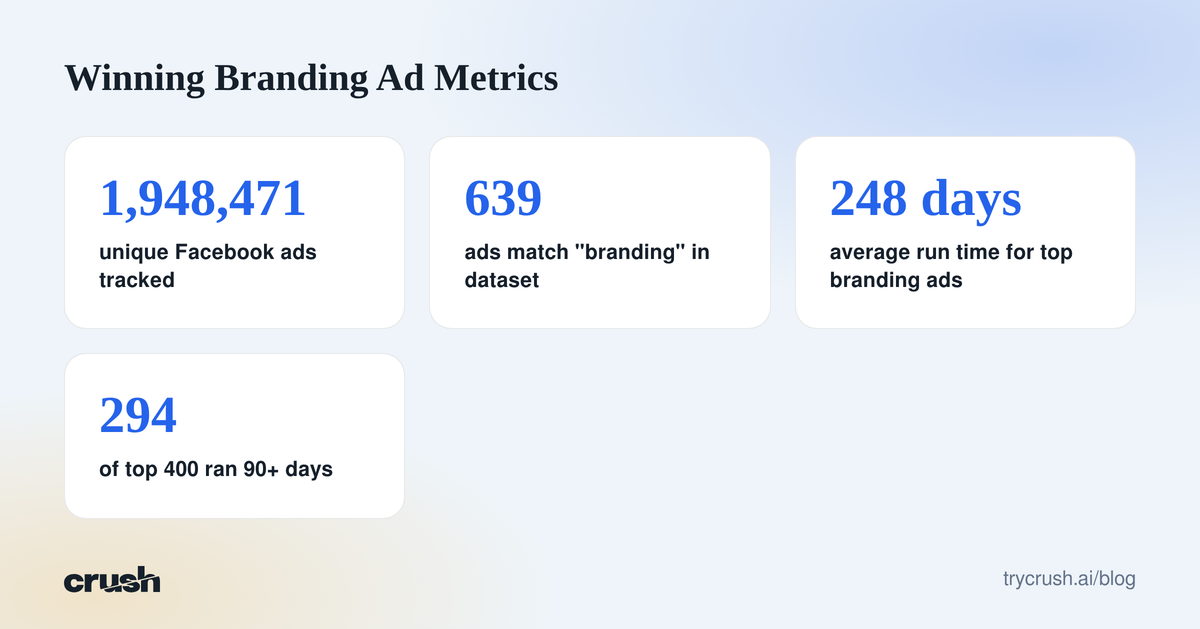
We know this because of the proprietary data at Crush, our platform for media buyers. Crush's ad library tracks 1,948,471 unique Facebook ads (445,654 currently active).
Our product Crush fully automatically runs Facebook ads by creating campaigns, scaling winners, and killing losers.
The necessity of direct response mechanics
When you build assets, you must force your creative strategy to serve performance. A beautiful image that fails to generate a click is a wasted budget.
We see media buyers make the same mistakes repeatedly. They treat Facebook like a billboard rather than a direct response channel.
Your visual elements must stop the scroll without looking like corporate spam. Your copy must speak directly to the exact problem the user faces.
Your offer has to justify the user leaving the platform or initiating a chat. Without these elements, your visual identity will not save a failing campaign.
What does the data say about winning branding ads?
Uncovering the proven winner threshold
We pulled the numbers to see how branded creatives actually perform. The results defy common marketing advice.
Within our dataset, exactly 639 tracked ads match "branding" (340 active right now). This tells us that highly specific branded messaging is a targeted approach, but it is incredibly resilient when it hits the right audience.
Among top "branding" ads, average run time is 248 days; 294 of the top 400 ran 90+ days (the "proven winner" threshold).
A run time of over 90 days indicates an ad is highly profitable. The algorithm has stabilized, the cost per acquisition is acceptable, and the advertiser is happily scaling spend.
Why longevity matters for visual identity
Ad fatigue kills most campaigns within a few weeks. However, ads with strong, integrated visual identity resist fatigue much better.
When a user sees a cohesive ad multiple times, they build familiarity. This lowers the resistance to click.
The data proves that you do not need to refresh your creative every seven days. If the foundation is solid, a good asset can run for months or even years.
Which call to action buttons perform best for branded ads?
The rise of messaging objectives
You might assume that a branded ad should drive traffic to a polished website homepage. The data shows a completely different reality.
The most common call to action examples on "branding" ads prioritize direct conversations over passive website visits.
Advertisers use messaging buttons to capture leads immediately. This prevents drop-off from slow website load times and leverages the trust established by the visual creative.
Implementing the correct button
Choosing the right button changes the user expectation instantly. Here is the exact breakdown from the top performing assets in our database.
| Call to Action Button | Usage Percentage | Primary Intent | Ideal Niche |
|---|---|---|---|
| Whatsapp message | 18 percent | Direct communication | B2B and High-ticket |
| Message page | 14 percent | In-app support | Local services |
| Learn more | 13 percent | Educational traffic | Complex software |
If you are struggling to get conversions on your website, switch your objective. Test a messaging button to see if direct engagement lowers your customer acquisition cost.
How long can a winning branded ad run?
Breaking down B2B brand longevity
A truly great ad can run for years. You do not need to constantly swap out your visual identity to appease the algorithm.
Let us look at a prime example from the promotional products space. An ad for Winning Imprints and Custom Trophies ran 2386 days and relaunched 0x.
The call to action was "call now" and the opening line was highly direct.
“We are a custom trophy and engraving business in addition to decoration of apparel and promotional items for your team, organization and business.”
There is no fluff in that copy. It states exactly what the brand does and calls out the exact target market.
Analyzing B2C product messaging
A similar rule applies to consumer products. A great example comes from stampyourballs.com. Their ad ran 1734 days and relaunched 0x with a "shop now" button.
The opening line was incredibly simple. “Stampyourballs.com is the brand new simple to use golf ball stamper, over 170 designs, lots of colour, and ideal for branding .....single stampers cost £6.99”
By stating the price directly, they pre-qualify the buyer. Every click they pay for is from a user who already knows the cost.
The power of a simple quote
Service businesses can achieve the same longevity. Another heavy hitter is Online Branding Solution.
Their top ad ran 1926 days and relaunched 0x using the "get quote" call to action.
These advertisers did not constantly redesign their assets. They found a format that worked, integrated their visual identity clearly, and let Meta do the heavy lifting.
What are the steps to add branding to your ad creatives?
Structuring the Meta Ads Manager setup
You need to layer your assets intelligently. If you put a massive logo in the center of the video, users will immediately recognize it as an ad and scroll past.
Instead, follow these specific mechanics to integrate your visual identity naturally.
- Place your logo strategically: Keep it in the top right corner with low opacity so it does not distract from the main hook.
- Utilize brand colors: Use your primary brand color exclusively as the background for text overlays.
- Hook them early: Feature your physical product or software interface prominently in the first three seconds of the video.
- Prioritize readability: Use your proprietary font only for headlines, keeping body text standard for maximum readability on mobile.
- Create a cohesive exit: End the video with a unified end card that displays your web address and core value proposition.
This structure guarantees that your identity is present without overwhelming the performance mechanics of the ad.
Integrating assets without causing ad blindness
Ad blindness occurs when users unconsciously ignore elements they perceive as advertisements. Traditional design rules often trigger this response.
When adding elements to your creative, prioritize native platform aesthetics. Your videos should look like they belong on a social feed.
Use user-generated content styles, but inject your hex codes into the captions or product framing. This bridges the gap between raw social media content and a polished corporate identity.
What mistakes should you avoid with branded creatives?
Common errors that drain ad spend
Advertisers often sabotage their own campaigns by overcomplicating their visual identity. The Meta platform rewards simplicity and clear messaging.
Avoid these common traps when launching your assets.
- Forcing a high-resolution corporate logo into the dead center of a user-generated content video.
- Changing core visual colors every single week, which prevents the algorithm from finding a stable audience.
- Using highly stylized, illegible corporate fonts in mobile video captions.
- Ignoring the ad copy and relying entirely on the visual image to do the selling.
- Testing too many design variables at once without establishing a proper baseline control ad.
How frequency impacts ad fatigue
When you add branding to a campaign, frequency becomes a critical metric to watch. Frequency measures how many times the average user sees your creative.
A generic direct response ad burns out quickly at a high frequency. Users get annoyed by repetitive hard sells.
However, well-designed branded creatives can tolerate a higher frequency. If a user sees your branded video three times in a week, they build trust.
By the fourth impression, they are ready to click. Always monitor your frequency and watch for spikes in your cost per click.
How does ad copy impact long term brand performance?
Aligning text with visual assets
Copy is just as important as visual design. The opening line sets the tone, qualifies the click, and reinforces your identity.
Look at Legal Bisnis Indonesia. They have an ad running 1607 days and relaunched 0x using a "whatsapp message" call to action.
Or consider Rô Macul. Their ad ran 1618 days and relaunched 0x using the "learn more" button.
They do not use clickbait. They use clear, descriptive text that aligns perfectly with their visual assets. When the visual identity and the written message match perfectly, user trust increases.
Allocating budget for new visual identity tests
You should not risk your main campaign budget on untested visual assets. Always isolate new tests to protect your proven winners.
Say your target CPA is $50. You should allocate a small percentage of your daily spend to a dedicated testing campaign.
If your new branded asset outperforms the control ad for seven consecutive days, promote it. Move the winning ad ID into your main scaling campaign to preserve the social proof.
Why should you track competitors when updating your brand guidelines?
Building a competitive moat
Your visual identity does not exist in a vacuum. It competes for attention against every other business in the mobile feed.
If every competitor uses blue backgrounds, testing a red background will lower your cost per impression simply by standing out.
You can analyze this competitive landscape using our free public ad library.
Crush tracks competitors' Facebook ads via the Meta Ad Library and keeps history, including ads that were taken down.
Using historical data to win
Our ads library contains millions of Facebook ads across niches, with specific longevity data.
This includes duplicate counts, which indicate how many times an advertiser re-launched the same creative. A high duplicate count is a strong signal of a winning ad.
By reviewing what your competitors run for 90 days or more, you can learn how to search the Facebook ad library effectively to reverse-engineer their visual strategy. Do not guess what works when the data is readily available.
How does AI help you scale winning brand assets?
Automating the testing process
Once you find an ad that works for a long time, you need to produce variations of it. Creative fatigue will eventually set in, even for the best campaigns.
Crush can generate ad-creative iterations from a winning reference ad automatically.
This ensures your visual identity remains consistent while introducing fresh elements to reset the platform algorithm.
It takes the emotion out of media buying. If an asset is losing money, the system kills it automatically.
Generating profitable iterations
When a creative prints cash, the system scales the budget. This is the fastest way to grow an ad account in 2026.
You can test this yourself. We offer paid plans that start with a trial, and you can view the exact details on our pricing page.
Focus your human energy on strategy and big-picture identity. Let the software handle the daily media buying execution and iteration.
How we got this data
The numbers in this article come from Crush’s ad library: 1,948,471 unique Facebook ads tracked via the Meta Ad Library, 445,654 of them active at the time of writing. Ad examples reference real advertisers and their public ads. Data queried on 2026-09-11. Third-party product facts are attributed inline to their sources.
Frequently Asked Questions
Common questions about this topic
1How do you add branding to Meta ads without lowering conversion rates?
2What is the optimal ad frequency for a heavily branded campaign?
3Should you use custom fonts in Facebook video captions?
4How does a messaging call to action improve branded campaign performance?
Written by
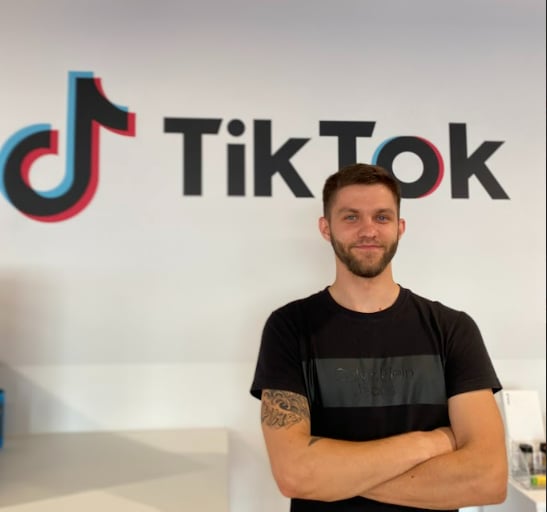
Albertas Pocius
Co-founder, CMOAlbertas is the Co-Founder and CMO of TryCrush.ai, bringing elite-level performance marketing expertise to the platform. With over $50M+ in combined Facebook and TikTok ad spend, Albertas has launched and scaled dozens of projects from zero, driven by a deep obsession with data and experimentation. He has trained 20+ media buyers, consulted 100+ companies, and is widely recognized as one of Europe’s early TikTok pioneers, likely the first to scale campaigns beyond $100K per day. Today, he also teaches advertising strategy at two colleges, shaping the next generation of media buyers.
Stop Guessing.
Start Crushing.
AI Ad Manager trained by world-class media buyers to generate your creatives and optimize your ads 24/7.
Learn more
Continue Reading
Scaling Dropshipping Shopify Stores: 2026 Ad Data
Most guides just show you pretty storefronts. We analyze the actual Facebook ad data that successful Shopify dropshipping stores use to scale profitability in 2026.
Clothing Ads in 2026: Data and Benchmarks for Profitable Campaigns
Discover what drives profitable clothing ads in 2026 through proprietary ad library data. We break down benchmarks, top calls to action, and the exact frameworks needed to scale.
Data-Backed Ways to Spot a Winning Product Trend in 2026
A real product trend is not defined by search volume, but by how long advertisers are willing to spend money promoting it.