Key Takeaways
- 1Winning fragrance ads are highly direct, with 71 percent using the "shop now" call to action.
- 2A proven fragrance ad runs for an average of 118 days before burning out.
- 3User-generated content focused on compliments often outperforms high-budget, abstract visual campaigns.
- 4Automating your media buying allows you to scale winning creatives horizontally while ruthlessly cutting losers.
- 5Lower the barrier to entry for cold traffic by advertising low-cost discovery sets instead of full-size bottles.
Forget high-budget aesthetic commercials. Success in fragrance advertising requires direct-response mechanics, rigorous testing, and data-backed media buying strategies.
Fragrance advertising is the strategic promotion of perfumes and colognes. In 2026, it has shifted from massive television budgets featuring celebrities to targeted, direct-response campaigns on platforms like Meta. Success now requires rigorous creative testing, clear calls to action, and data-driven scaling rather than purely aesthetic brand awareness.
Fragrance Advertising Data vs. Celebrity Endorsements
If you look at mainstream fashion magazines, fragrance advertising looks like high art. You see celebrities sprawled on velvet couches or running through forests. That works for global luxury houses with bottomless budgets, but it fails miserably for direct-to-consumer brands.
Performance marketing demands a completely different approach. You cannot deposit likes or aesthetic appreciation into your bank account. You need actual purchases.
The Shift to Measurable Performance Marketing
Direct response advertising forces brands to measure every dollar. If an ad does not convert, it gets turned off. At Crush, our AI Facebook-ads platform, we see this reality in the data every day. Reviewing proven direct response ad examples is one of the most effective ways to understand how top brands structure their messaging for immediate conversions.
Media buyers are optimizing for cost per acquisition (CPA), not just brand sentiment. The product does not even need an abstract narrative to sell. Instead, a successful ad requires:
- A compelling offer that drives urgency
- A frictionless checkout process
Winning Fragrance Ad Metrics for 2026
We can eliminate the guesswork by looking at actual ad performance. Our platform Crush tracks competitor campaigns via the Meta Ad Library and keeps historical data, including ads that were previously taken down.
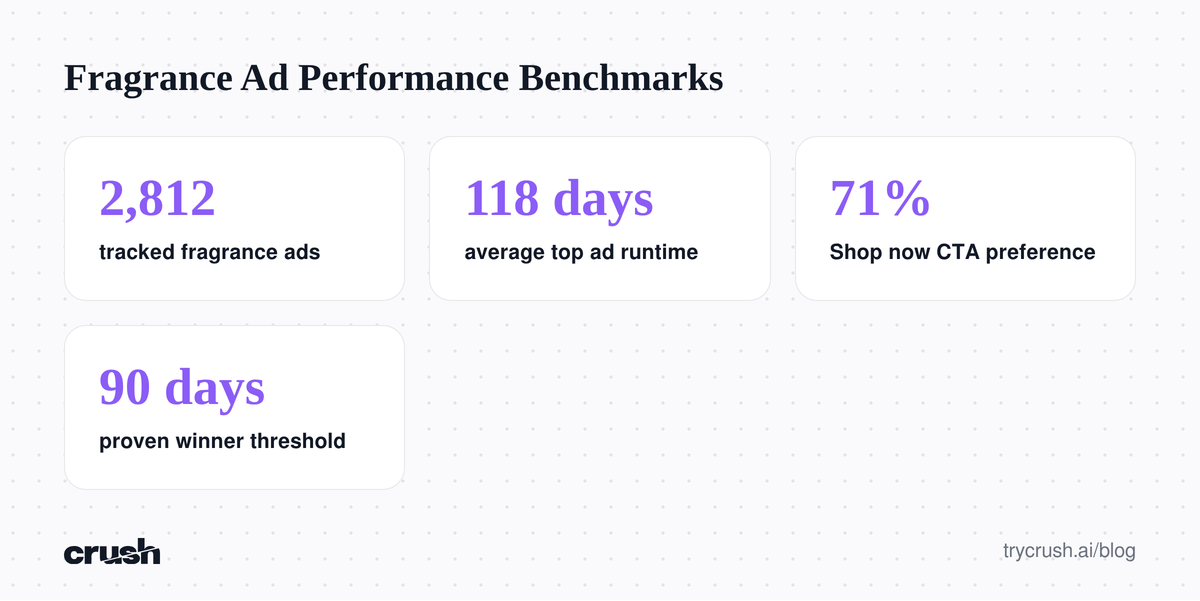
Out of the 1,855,786 unique Facebook ads we currently track across niches (giving us deep insights into different types of ads and what converts, and acting as a proven method to find the best products to dropship based on ad longevity), exactly 2,812 tracked ads match "fragrance" (with 693 active right now).
Similar to our findings on the data behind profitable coffee advertisements and our extensive analysis of profitable clothing ads in 2026, this robust dataset reveals exactly what works in the current market.
The 90-Day Proven Winner Threshold for Ads
Most ads fail quickly. The ones that survive are your proven winners. Among top fragrance ads in our database, the average run time is 118 days.
Furthermore, 149 of the top 400 campaigns ran for 90 days or more. We consider 90 days the absolute threshold for a proven winner. If an advertiser leaves a campaign on for three months, it is consistently generating profitable returns.
Among top "fragrance" ads, average run time is 118 days; 149 of the top 400 ran 90+ days.
Top Call to Action Preferences for Fragrance
You might think a luxury item requires a soft sell. The data proves otherwise. The most common CTA buttons on fragrance ads are highly direct.
"Shop now" leads entirely at 71%. This is followed by "Learn more" at 12% and "Order now" at 5%. Stop asking users to discover your scent and simply tell them to buy it.
Structuring Winning Fragrance Campaigns
Longevity and relaunch frequency are the two strongest signals of a winning ad. When a media buyer duplicates and relaunches the exact same creative multiple times, they have found a highly profitable formula. We see this exact behavior mirrored in many of the top direct response ad examples proven by relaunch data across various niches.
Let us examine a few specific examples directly from our free public ad library at trycrush.ai/ad-library.
High-Frequency Scaling Strategies
Nykaa provides a perfect example of aggressive scaling. They had a single ad run for 153 days, which they relaunched 174 times. Their primary CTA was "Shop now".
The opening line was entirely focused on the transaction: "It’s time for a beauty haul with unbeatable deals! Stock up on makeup, skincare, perfumes and more with Nykaa. Your ultimate shopping experience awaits ✨". There is no abstract storytelling here, just a clear, high-converting offer.
Long-Term Marathon Winners
Other brands find a profitable pocket of audiences and leave the ad running for years. The Psychic Tree ran a campaign for 1,209 days and relaunched it 7 times using the "Learn more" CTA.
Their hook was remarkably simple: "We have updated our collection with some great new goodies! Take a look on our website for more info 🤩".
Soft Surroundings has an ad running 1,163 days (relaunched 2 times) with a "Shop now" CTA. Their opening line focuses on outcome: "Our signature soft fabrics match comfort with style! Shop dresses, tops & more that will have everyone asking - 'Where did you get that?' ".
Wholesale and B2B Fragrance Advertising
Similar to the mechanics that drive successful B2B e-commerce platform ads, wholesale fragrance suppliers use strategic messaging targeted at business owners. Aroma Gallery - Premium Fragrance Oil Direct Supplier has an ad running 928 days (relaunched 1 time). Their CTA is "Message page".
The copy speaks directly to business owners: "Unlock the potential for your business with our 1-liter Premium Oil-Based wonders! 🌟💼 Curious to know more? Just drop us a message 📩 #AromaGallery #ScentedEn".
Meanwhile, Fragrance Express uk focuses on home scents, running an ad for 854 days (relaunched 1 time) with a "Shop now" CTA. Their opening line introduces a specific product: "🌟 Introducing the Magic of Catalytic Fragrance Lamps! 🌟 Are you ready to transform your home into a fragrant oasis? Look no further! At Fragrance Express UK..."
Summary of Top Performers
| Brand Name | Days Active | Relaunch Count | Primary CTA |
|---|---|---|---|
| Nykaa | 153 | 174 | Shop now |
| The Psychic Tree | 1209 | 7 | Learn more |
| Soft Surroundings | 1163 | 2 | Shop now |
| Aroma Gallery | 928 | 1 | Message page |
| Fragrance Express uk | 854 | 1 | Shop now |
Translating Scent into Visual Fragrance Advertising
Selling an invisible product online is the core challenge of fragrance advertising. You cannot transmit smells through a smartphone screen.
You must evoke the scent through:
- Visual cues that accurately match the mood
- Precise copywriting focusing on emotional and social outcomes
- Clear use cases for everyday life scenarios
The best media buyers focus on the outcome of wearing the fragrance rather than the chemical composition.
Focus on the Identity, Not Just the Notes
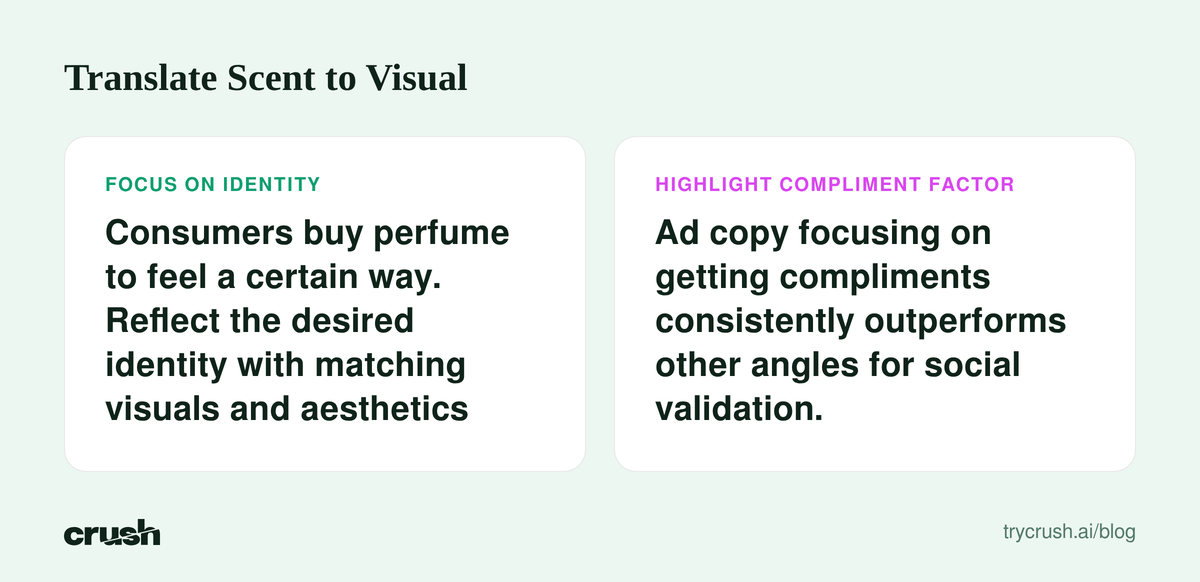
Consumers buy perfume to feel a certain way. They want to feel confident, attractive, or professional. Your ad creative must reflect that desired identity.
If your perfume has heavy wood and leather notes, use dark, rich visuals. If it is a light citrus summer scent, use bright, airy aesthetics. Match the visual weight to the olfactory weight. Knowing how to add branding to Meta ads effectively ensures your visual identity enhances conversions rather than distracting from the sale.
Highlight the Compliment Factor
One of the strongest copywriting angles for fragrance is social validation. People want to be told they smell good.
Ad copy that focuses on getting compliments consistently outperforms copy that merely lists the top, heart, and base notes. Use user-generated content (UGC) that specifically mentions how many people asked what they were wearing.
Biggest Mistakes in Perfume and Fragrance Advertising
Media buyers often waste thousands of dollars learning the same expensive lessons. The transition from physical retail to digital direct-response requires dropping several outdated habits. These are the core errors that drain ad accounts fast.
Over-Investing in Production Value
Shooting a cinematic commercial will not save a bad offer. In our experience, authentic user-generated content and simple static images often outperform high-budget videos.
Consumers respond to authenticity on social platforms. A simple video of a customer unboxing your perfume and giving an honest review will usually yield a lower cost per acquisition than a highly polished commercial.
Ignoring the Data Signals
Many brand founders fall in love with a specific creative and refuse to turn it off, even when the return on ad spend (ROAS) is negative. Ultimately, the market decides what works.
If an ad does not hit your target metrics within a standard testing window, kill it. Automation makes this easier. Our product Crush fully automatically runs Facebook ads. It creates campaigns, scales winners, and kills losers without manual intervention.
Failing to Iterate on Proven Winners
When you find an ad that works for 90 days, your job is not done. Ad fatigue is a real phenomenon. You must generate variations of your winning creative to extend its lifespan and maintain a positive ROI.
Change the hook, swap the background music, or test a different thumbnail. Crush can even generate ad-creative iterations from a winning reference ad, ensuring you always have fresh assets ready to deploy.
Building a Creative Testing Framework for 2026
A structured testing methodology is the only way to find your next 100-day winner. You cannot throw random ideas at the wall and hope one sticks.
You need a systematic approach to isolate variables and find exactly what drives the lowest cost per purchase.
The Modular Testing Approach
Break your ad creatives down into distinct modules. For video, this means the visual hook (the first 3 seconds), the core message, and the call to action. Test one variable at a time:
- Keep the core message identical but test five different three-second visual hooks.
- Once you find the winning hook, test three different calls to action against it.
- Take the ultimate winning combination and test it against different demographic segments.
Budget Allocation for Testing
Your testing budget should be separate from your scaling budget. A common framework is the 70-20-10 rule.
Allocate 70 percent of your budget to proven, scaling ads. Dedicate 20 percent to iterating on your current winners. Reserve the final 10 percent for entirely new, out-of-the-box concepts. This ensures stability while constantly feeding new creatives into your advertising pipeline.
Scaling a Profitable Fragrance Campaign
Scaling is where most media buyers break their accounts. Increasing the budget too quickly resets the learning phase and ruins performance. You must scale strategically to maintain profitability while increasing volume.
Vertical Versus Horizontal Scaling
Vertical scaling involves increasing the daily budget on an ad set that is performing well. Do this slowly. A typical recommendation is increasing the budget by 10 to 20 percent every few days.
Horizontal scaling involves taking a winning ad and showing it to new audiences. If your perfume ad converts well with a broad audience, duplicate it and test it specifically against users interested in luxury fashion.
Leveraging Automated Media Buying
Manual scaling requires constant monitoring. Media buyers in 2026 rely on AI platforms to handle the heavy lifting. Systems that automatically scale spend when conversion rates peak prevent human error.
If you want to see how automation can transform your media buying workflow, you can check out our current plans at trycrush.ai/pricing.
Audience Targeting Impact on Fragrance Sales
Even the perfect creative will fail if shown to the wrong people. While broad targeting has become highly effective thanks to Meta algorithm improvements, guiding the system with strong audience signals still matters for consistent campaign success.
Frequently Asked Questions
Common questions about this topic
1What is the best call to action for fragrance ads?
2How long should you test a fragrance ad?
3Should fragrance ads focus on the bottle or the lifestyle?
4How do you sell perfume without the customer smelling it?
5Are video ads better than image ads for perfumes?
About this article
This article was written with AI assistance. Ad examples and ad data come from the Crush ad library.
Written by
Albertas Pocius
Co-founder, CMOAlbertas is the Co-Founder and CMO of TryCrush.ai, bringing elite-level performance marketing expertise to the platform. With over $50M+ in combined Facebook and TikTok ad spend, Albertas has launched and scaled dozens of projects from zero, driven by a deep obsession with data and experimentation. He has trained 20+ media buyers, consulted 100+ companies, and is widely recognized as one of Europe’s early TikTok pioneers, likely the first to scale campaigns beyond $100K per day. Today, he also teaches advertising strategy at two colleges, shaping the next generation of media buyers.
Stop Guessing.
Start Crushing.
AI Ad Manager trained by world-class media buyers to generate your creatives and optimize your ads 24/7.
Learn more
Related articles

The "Media Buyer" is Dead. Long Live the Operator
Manual media buying is obsolete. Meta's AI algorithms now outperform human technicians. Learn how to escape the "Technician's Trap" and become a strategic Operator who leverages automation for massive scale.
Facebook Ads vs. AI Ads: The 2026 Showdown
Manual media buying is dead. We pit traditional Facebook Ads against the new wave of AI Ads in a 5-round battle covering setup time, optimization, and scalability. Discover why autonomous agents are the future of advertising.
How to Add Branding to Meta Ads That Actually Convert
Most advertisers ruin their return on ad spend by overcomplicating their visual identity. Here is how to integrate branding into your creatives to drive direct response.

The Ultimate Facebook Advertising Strategy for 2026
Hacks don't build businesses, systems do. Discover the ultimate Facebook advertising strategy for 2026, featuring the "Super CBO" method, 3-2-2 testing, and CAPI integration to scale profit in any market condition.