Key Takeaways
- 1Top performing online ads run an average of 102 days before experiencing terminal creative fatigue.
- 2The 'learn more' CTA button dominates online advertising, appearing on 38% of top performing ads.
- 3Scaling a winning ad is best done by duplicating the creative, not just aggressively raising the budget.
- 4Analyzing competitor ad longevity is the safest way to validate new creative angles before spending your own money.
Stop guessing which ad formats work. We analyzed over 1.8 million Facebook ads to find exactly which types of ads generate profitable returns in 2026.
Different types of ads fall into two main categories online: paid social and paid search. While aviation mechanics search this exact term looking for Airworthiness Directives, digital marketers need to know which advertising formats actually convert.
The most profitable types of ads combine proven visual formats with direct response copywriting.
What are the different types of ads in digital marketing?
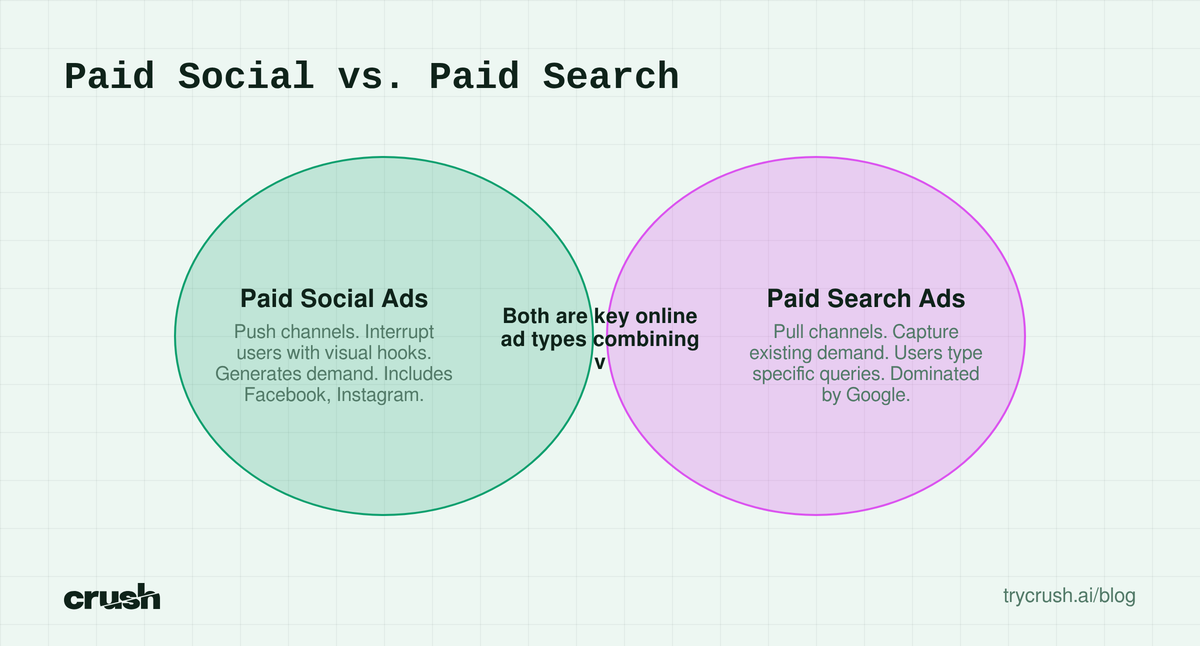
Media buyers categorize digital advertising into a few core pillars. Each serves a distinct purpose in the customer journey.
You do not need to master all of them immediately, but you must understand how they interact to build a profitable campaign.
Paid social advertising
Paid social includes platforms like Facebook, Instagram, TikTok, and LinkedIn. These are push channels.
You interrupt a user who is browsing a feed with a visual hook. Analyzing data from Facebook posts for engagement shows that the primary goal here is to generate demand that did not previously exist.
Paid search advertising
Paid search is dominated by Google. This is a pull channel where users type specific queries indicating high intent.
You pay to appear at the top of the search results, meaning this format actively captures existing demand.
Native and display advertising
Display ads are the banner graphics you see across various websites, while native ads are disguised to look like editorial content on publication sites.
These formats are typically used for broader brand awareness or aggressive retargeting campaigns.
Why does ad longevity reveal the best types of ads?
Most marketers focus on vanity metrics like click-through rates or cost per click. Professional media buyers look at ad longevity.
If an advertiser spends money on the same creative for months, that ad is profitable. Nobody funds a losing campaign for an entire year.
At Crush, our platform tracks exactly how long specific creatives remain active. Crush's ad library tracks 1,862,326 unique Facebook ads (443,750 currently active). We analyze this massive dataset to see what separates the winners from the losers.
When we filter this data for specific digital verticals, the numbers tell a clear story. Out of our dataset, exactly 16,840 tracked ads match "online" (4,068 active right now). This gives us a massive sample size to determine what makes different types of internet ads succeed.
Among top online ads, the average run time is 102 days, with 131 of the top 400 running past the 90-day proven winner threshold.
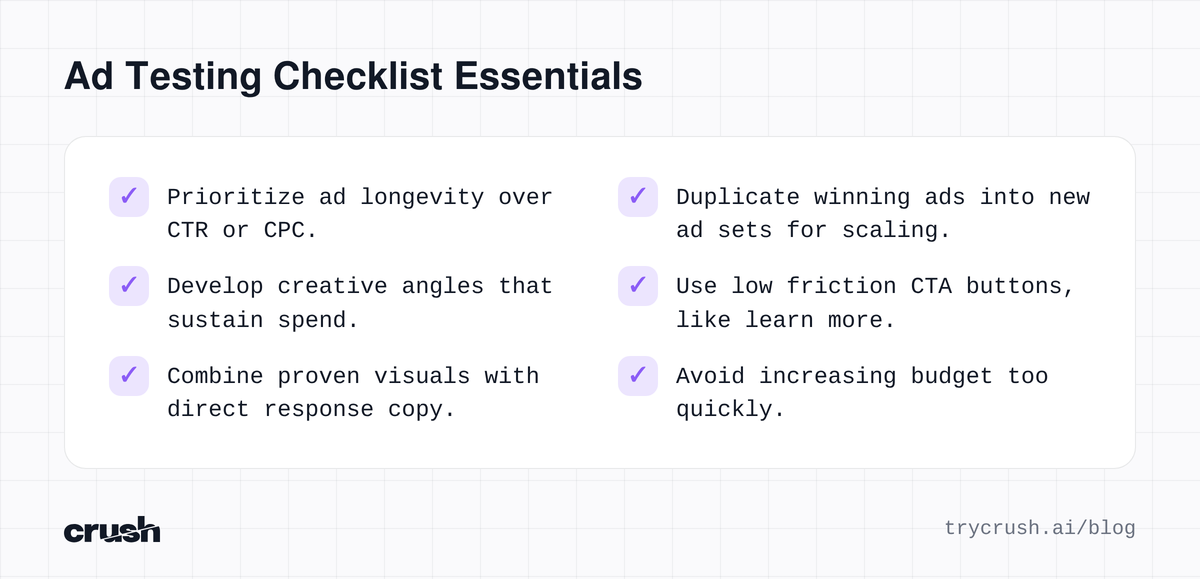
If your ad cannot survive past 90 days without fatigue, your creative strategy is too shallow. You need versatile angles that can sustain ad spend over the long term.
Which specific ad examples prove the 90-day rule?
Looking at raw data is helpful, but analyzing the actual creative copy is where you learn how to build different ads that convert. Let us look at a few extreme outliers from our library that have run for years.
Local services and tutoring
Local businesses often burn through creative quickly because their audience pool is small. However, the right offer can run indefinitely. Consider the Academy for Mathematics & English in Hamilton.
This ad has been running 1522 days and was relaunched 5 times. The CTA is "sign up". The opening line reads: "❤️ Hamilton Parents --> Wow - this is insane! We are giving you a 👉$300 SUMMER Tutoring Savings Coupon 👈! Watch grades soar! Use for IN CENTRE or ONLINE tutor".
This copy works because it immediately qualifies the audience by city and demographic. It then drops a massive, concrete financial incentive. There is zero ambiguity.
Vocational training and certification
B2B and certification ads require a different tone. The ChemCert Training Group (RTO 90855) has an ad that ran 1212 days and was relaunched 6 times with a "learn more" CTA.
Their opening line: "High quality training and Industry Accreditation in VIC for people working with AgVet Chemicals. Face to Face and Online Courses available. Courses include: - A".
This is dry, highly specific, and entirely functional. It works because it speaks directly to a mandatory compliance need in a specific region.
Education and online academies
Liberty University Online Academy K-12 has a flagship creative that has been running 714 days and was relaunched 4 times with a "learn more" CTA.
Long-term educational commitments require trust. This type of ad relies on institutional authority rather than aggressive discounts.
How does campaign scaling work for different ads?
When you find a winning ad, you do not just blindly increase the daily budget. Increasing budget too fast resets the learning phase and ruins performance.
Instead, experienced media buyers duplicate the winning creative into new ad sets. This duplicate count is the ultimate signal of a highly profitable ad.
Take Faire as an example. This ad has been running 298 days with a "shop now" CTA. Crucially, the advertiser relaunched it 59 times.
Their opening copy reads: "Faire is an online wholesale marketplace connecting independent retailers and brands around the world. Eligible retailers can enjoy 60-day payment terms & free". By duplicating this exact copy and creative 59 times, Faire can safely scale their spend without breaking the algorithm.
Another heavy scaler is Local Proxies. Their ad has been running 673 days and was relaunched 6 times with a "shop now" CTA.
The opening line reads: "🔒 Local Proxies offers top-quality residential proxies with unlimited authorization IPs and bandwidth, ensuring unrestricted browsing and ultimate privacy prot". Technical products scale well when the value proposition is front-loaded in the very first sentence.
Which call to action buttons perform best across different types of online ads?
Facebook offers dozens of call to action (CTA) button options. Most advertisers guess which one to use. Our dataset removes the guesswork entirely by providing proven call to action examples based on real performance.
Looking at the top performing ads in our system, the distribution is heavily skewed toward low-friction commitments. The most common CTA buttons on "online" ads are:
- Learn more (38%)
- Shop now (15%)
- Sign up (7%)
"Learn more" dominates because it feels safe to the user. It implies they are just gathering information, not immediately opening their wallet. Even e-commerce brands often see cheaper cost-per-click metrics using "learn more" before converting the user later on the landing page.
How do you find profitable types of advertising methods?
The fastest way to fail at media buying in 2026 is to start with a blank canvas. Your competitors have already spent millions of dollars figuring out what works. You need to leverage their paid data.
Our product Crush tracks competitors' Facebook ads via the Meta Ad Library and keeps historical records. This includes ads that were eventually taken down.
By looking at historical data, you can see exactly which ad variants were aggressively scaled and which were quickly killed.
You can verify this yourself right now. We maintain a free public ad library where you can search your exact niche. Look at the duplicate counts and longevity metrics. Find the ads running longer than 102 days and model your next campaign after their successful structure.
What are the most common mistakes when testing different ads?
Even with great data, execution matters. We see advertisers burn through thousands of dollars making the same structural errors week after week.
- Testing too many variables at once: If you change the headline, the video, and the CTA button in a single test, you will never know which element caused the performance drop.
- Ignoring ad fatigue: Just because an ad hits the 90-day mark does not mean it will run forever. You need new creatives warming up in the background.
- Using the wrong CTA: Forcing a "shop now" button on a cold audience for a high-ticket service kills click-through rates. Stick to "learn more" for complex offers.
- Scaling budget too fast: Doubling your daily budget overnight will crash your return on ad spend. Use the duplication method instead.
How should you structure your ad testing checklist in 2026?
Systematic testing is the only way to find winners consistently. Follow this strict order of operations when launching different types of online ads.
- Identify three competitor winners: Find ads in your niche that have been running for at least 90 days.
- Extract the core angles: Determine if they are using fear, greed, convenience, or status to drive the initial click.
- Generate your variations: Create three distinct visual creatives using the proven angles. Keep the primary text identical across all three.
- Launch in a testing campaign: Use broad targeting and let the platform's algorithm find the buyers.
- Kill the losers quickly: Turn off any ad that does not hit your target cost per acquisition within 72 hours.
Comparing the best types of internet ads
To summarize the data we have covered, here is how the top performing formats stack up against each other based on our proprietary tracking.
| Advertiser Example | Primary CTA Button | Days Active | Relaunch Count |
|---|---|---|---|
| Academy for Mathematics & English | Sign Up | 1522 Days | 5x |
| ChemCert Training Group | Learn More | 1212 Days | 6x |
| Liberty University Online Academy | Learn More | 714 Days | 4x |
| Local Proxies | Shop Now | 673 Days | 6x |
| Faire Wholesale | Shop Now | 298 Days | 59x |
Can AI automate these different types of internet ads?
Managing ad lifespans, duplicating winning ad sets, and killing losing creatives requires constant attention. If you are managing significant ad spend, manual optimization quickly becomes a bottleneck.
Crush is an AI Facebook ads platform built specifically to solve this. It fully automates your ad management by creating campaigns, scaling the winners, and killing the losers. It can even generate ad-creative iterations directly from a winning reference ad.
Media buying is fundamentally a game of math and iteration. The tools you use should handle the math so you can focus entirely on your offers. Our paid plans start with a trial so you can see the automation firsthand. You can view our current tiers at trycrush.ai/pricing.
Stop guessing which ad formats work. Use longevity data, respect the 90-day threshold, and lean heavily on low-friction CTAs to profit from ads AI and systematically scale your accounts this year.
How we got this data
The numbers in this article come from Crush’s ad library: 1,862,326 unique Facebook ads tracked via the Meta Ad Library, 443,750 of them active at the time of writing. Ad examples reference real advertisers and their public ads. Data queried on 2026-08-28. Third-party product facts are attributed inline to their sources.
Frequently Asked Questions
Common questions about this topic
1What are the main different types of online ads?
2How long do the most successful different ads run?
3Why do some different types of internet ads show high duplicate counts?
4Which call to action button works best for different ads?
About this article
This article was written with AI assistance. Ad examples and ad data come from the Crush ad library.
Written by

Rokas Steponavičius
Founder, CEORokas is the Founder and CEO of TryCrush.ai, an ex-IBM professional turned entrepreneur focused on building AI-driven growth platforms. With a strong background in ecommerce, performance marketing, media buying, and artificial intelligence, Rokas specializes in creating scalable, data-led systems that drive measurable revenue. His mission is to help modern businesses leverage AI to optimize acquisition, conversions, and long-term profitability.
Stop Guessing.
Start Crushing.
AI Ad Manager trained by world-class media buyers to generate your creatives and optimize your ads 24/7.
Learn more
Related articles
Proven Online Ad Examples Based on Meta Ad Longevity Data
Stop guessing what works. We analyzed millions of active campaigns to bring you the best online ad examples based on pure longevity and profitability data.
Facebook Link Ads vs. Collection Ads: Which Converts Better?
Deciding between the direct traffic of Link Ads or the immersive experience of Collection Ads? We break down the data on bounce rates, ROAS, and use cases to help you pick the winner for your brand.
AI Creative Studio: Ad Data and Formats for 2026
Discover how media buyers use AI creative studios to generate, test, and scale Facebook ads based on data from millions of active campaigns.
Advertising Types of Media: A 2026 Media Buyer's Guide to Winning
A deep dive into the different types of media for advertising, featuring proprietary data on ad longevity, top calls to action, and proven copywriting frameworks.