
Key Takeaways
- 1Implement the 3-2-2 Dynamic Creative method to rapidly identify winning ad variations
- 2Use the "Super CBO" strategy to stack winning ad sets for stable, algorithmic scaling
- 3Apply the "Kill Switch Protocol" to automatically pause underperforming ads and protect ROAS
- 4Shift from interest-based targeting to broad audiences to enable better AI optimization
- 5Integrate CAPI (Conversions API) to bypass signal loss and improve data resilience
Hacks don't build businesses, systems do. Discover the ultimate Facebook advertising strategy for 2026, featuring the "Super CBO" method, 3-2-2 testing, and CAPI integration to scale profit in any market condition.
If you search for "Facebook Ads Strategy," you will find a lot of noise.
"Use this secret audience!"
"Hack the algorithm with this bidding trick!"
"Only run ads at 3:00 AM on Tuesdays!"
Ignore all of it. Hacks don't build businesses. Systems build businesses.
In 2026, the best Facebook advertising strategy is not about outsmarting the AI. It is about enabling the AI.
This is the definitive guide to building a scalable, resilient ad account that prints profit in any market condition.
Phase 1: The Foundation (Data & Structure)
Before you spend a dollar, you need a solid foundation.
1. Signal Resilience
You cannot rely on the Pixel alone. You must implement CAPI (Conversions API). This sends data directly from your server to Facebook, bypassing ad blockers and browser restrictions.
Additionally, keeping your account compliant and active is non-negotiable. If you ever trigger Meta's automated bans, you'll need a reliable process to fix a disabled ad account on Facebook quickly.
2. Account Simplification
Stop creating 50 different campaigns. Modern strategy demands Account Consolidation.
You only need two or three campaigns maximum:
Campaign A: Testing (ABO or CBO)
Campaign B: Scaling (CBO)
Campaign C: Retargeting (Optional - only if broad misses it)
The days of "One Ad Set per Interest" are over. Group your audiences and give the algorithm room to breathe. If you are unsure how to simplify, read our guide on how to structure your Facebook ad account for predictable growth.
Phase 2: The Testing Engine (3-2-2)
You cannot scale without a winner, and you cannot find a winner without a system.
We use the Dynamic Creative (DCT) testing method. This is the core of our Dynamic Creative Ads Masterclass approach.
The Optimal DCT Setup
Create a dedicated "Testing" campaign. Inside, create an Ad Set targeting BROAD (no interests or lookalikes).
Inside that Ad Set, turn on Dynamic Creative and upload the following elements:
3 Images or Videos (Your Visual Hooks)
2 Primary Texts (Your Marketing Angles)
2 Headlines (To drive action)
Let the campaign run untouched for 48 hours. The algorithm will tell you which combination works best. Take the winner's Post ID and move it to Phase 3.
Phase 3: The Scaling Logic (The "Super CBO" Method)
Scaling is where most advertisers panic. They see a winning ad, double the budget, and watch their Cost Per Acquisition (CPA) skyrocket. This happens because "Vertical Scaling" (increasing budget on one ad set) resets the learning phase if done too aggressively.
The 2026 solution is the "Super CBO" Strategy. This method resolves the debate of ABO vs. CBO by leveraging the strengths of campaign budget optimization.
Step 1: The Post ID Transfer
When you find a winning ad in your Testing Campaign (Phase 2), grab the "Post ID" of that specific ad. Do not duplicate the ad creative itself; duplicate the existing post. This ensures all the likes, comments, and shares (Social Proof) remain intact.
Step 2: The Campaign Structure
Create a brand new, separate campaign specifically for Scaling.
Objective: Sales
Budget Type: CBO (Advantage+ Campaign Budget)
Daily Budget: $200 - $1,000+ (Adjust based on your risk tolerance)
Step 3: Stacking Your Ad Sets
Inside this Scaling CBO, you will create broadly targeted Ad Sets for your winners.
Ad Set 1: Broad (Open). Contains Winner #1 (Post ID).
Ad Set 2: Broad (Open). Contains Winner #2 (Post ID).
Ad Set 3: Broad (Open). Contains Winner #3 (Post ID).
You can safely stack up to 5-10 winning ad sets in a single CBO campaign.
Step 4: The Algorithm as Your Portfolio Manager
The CBO algorithm wakes up every morning at midnight. It looks at your portfolio of winning ads and asks: "Where is the cheapest conversion right now?"
On Monday, Ad Set 1 might secure 60% of the budget. By Tuesday, if Ad Set 1 fatigues, the algorithm automatically shifts the budget to Ad Set 2. This dynamic distribution provides unparalleled account stability. Your daily spend remains constant, but the allocation changes dynamically to protect your Return on Ad Spend (ROAS).
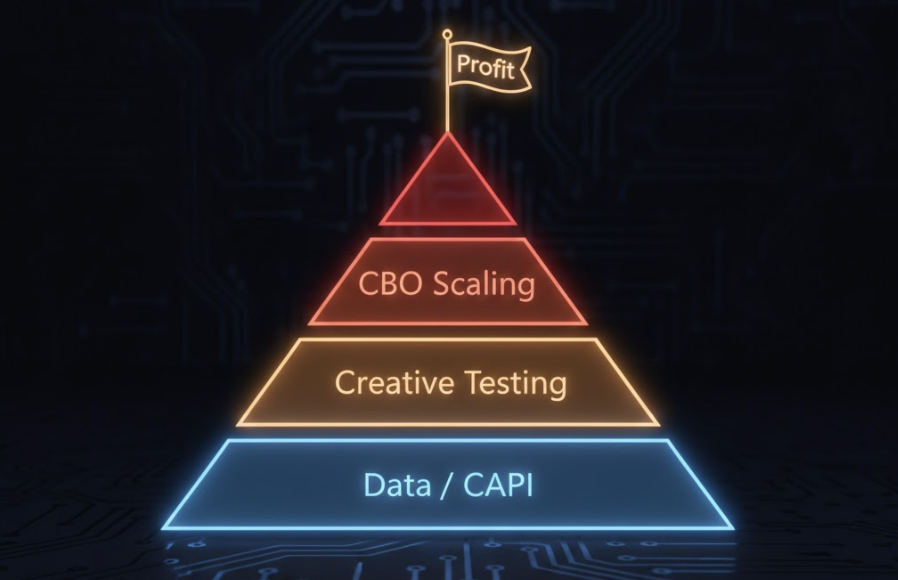
Phase 4: Maintenance (The "Kill Switch" Protocol)
Scaling is the easy part. Protecting your margins is hard. You need a strict set of binary rules to limit your downside.
We call this the "Kill Switch Protocol." By relying on data rather than gut feeling, you remove emotion from the decision-making process.
Rule 1: The "Early Kill" (Testing Phase)
When testing new creatives in Phase 2, waiting for a ROAS metric is often too slow. Instead, monitor your Cost Per Click (CPC) and Cost Per Mille (CPM).
If your CPC is greater than $5.00 (and your account average is $1.50), kill it. The market hates the ad.
If Ad Spend exceeds 1x Target CPA (e.g., $50) with ZERO sales, kill it immediately. No mercy.
Rule 2: The "Bleed Out" (Scaling Phase)
Sometimes a winning ad slowly dies. It doesn't crash overnight; it just steadily degrades.
The 3-Day Rule: If a previously winning Ad Set drops below your Break-Even ROAS for three consecutive days, pause it.
The "Zombie" Check: If an ad generates sales but the CPA is consistently 10% higher than your target, it is a "Zombie." It eats budget but doesn't scale the business. Kill Zombies to free up budget for new testing.
Rule 3: The "Moonshot" (For Surfing)
If an Ad Set hits a ROAS of 4.0+ (or double your target) by 12:00 PM, increase the Campaign Budget by 20% immediately. Ride the wave of cheap traffic while it lasts, then scale it back down at midnight.
Phase 5: The Feedback Loop (Creative Strategy)
The biggest mistake media buyers make is separating "Data" from "Creative." Your ad account tells you what happened. You need to investigate why it happened.
High Thumb Stop Rate (Hooks), Low Conversion Rate: Your ad is "Clickbait." You promised something in the intro that the product didn't deliver.
Action: Fix the landing page or make the ad promise more honest.Low Thumb Stop Rate, High Conversion Rate: Your ad is "Boring but Effective." Only a few people watch it, but those who do end up buying.
Action: Keep the body of the video, but test 5 new, aggressive hooks to get more people in the door.
The "Full Funnel" Myth
You will often hear gurus talk about complex "Top of Funnel," "Middle of Funnel," and "Bottom of Funnel" campaigns. In 2026, the marketing funnel is completely collapsed.
A high-quality video ad takes a user from "I've never heard of you" (Top) to "I want to buy" (Bottom) in 30 seconds.
Don't overcomplicate your account structure with "Video View" campaigns feeding "Traffic" campaigns that eventually feed "Conversion" campaigns. Just run Sales campaigns and let the creative do the funneling.
Conclusion: Stop Hacking, Start Building
The ultimate Facebook ads strategy is not a hidden toggle or secret setting. It requires a relentless focus on three core pillars:
Creative: Making demonstrably better ads than your competitors.
Offer: Selling a product or service people actually want.
Simplicity: Consolidating your account to get out of the algorithm's way.
Want to execute this strategy without the manual work? Crush automates the Testing, Scaling, and Kill Switch protocols for you.
Frequently Asked Questions
Common questions about this topic
1What is the best Facebook Ads strategy for 2026?
2What is the 3-2-2 testing method for Facebook Ads?
3How do I scale Facebook Ads without increasing CPA?
4When should I kill a Facebook ad?
Written by

Rokas Steponavičius
Founder, CEORokas is the Founder and CEO of TryCrush.ai, an ex-IBM professional turned entrepreneur focused on building AI-driven growth platforms. With a strong background in ecommerce, performance marketing, media buying, and artificial intelligence, Rokas specializes in creating scalable, data-led systems that drive measurable revenue. His mission is to help modern businesses leverage AI to optimize acquisition, conversions, and long-term profitability.
Stop Guessing.
Start Crushing.
AI Ad Manager trained by world-class media buyers to generate your creatives and optimize your ads 24/7.
Learn more
Related articles
The 48-Hour Rule: A Data-Driven Framework for Validating Facebook Ad Creatives
Most marketers test Facebook ads incorrectly, either killing them too fast or too slow. The 48-Hour Rule provides a data-driven framework to identify winning creatives, ensuring you only scale profitable assets while minimizing wasted spend.

7 Ways AI is Secretly Optimizing Your Competitors' Ads
Your competitors are using AI to automate their ads while you tweak manually. Learn the 7 ways AI algorithms optimize targeting, creative testing, and bidding 24/7 to steal your customers before you even bid.

Dynamic Creative Ads Masterclass: The AI Advantage
Static ads are dead. Discover how the "3-2-2" Dynamic Creative framework leverages Facebook's AI to automate testing, improve targeting, and eliminate manual guesswork.

Why Your Creative Testing is Burning 60% of Your Budget (And How to Fix It)
Most advertisers use the "Spaghetti Method," letting Facebook's algorithm starve potential winners. Discover why CBO fails at testing and how the Scientific ABO Protocol forces fair spend to uncover your actual top-performing ads.