Key Takeaways
- 1Invideo AI excels for organic creators, not performance media buyers.
- 2Generic AI stock footage triggers ad blindness and lowers conversion rates.
- 3TryCrush integrates with ad accounts to generate data-driven creatives.
- 4Automated kill switches stop ad spend waste by cutting losing creatives.
- 5Autonomous scaling generates horizontal variations of winning ad angles.
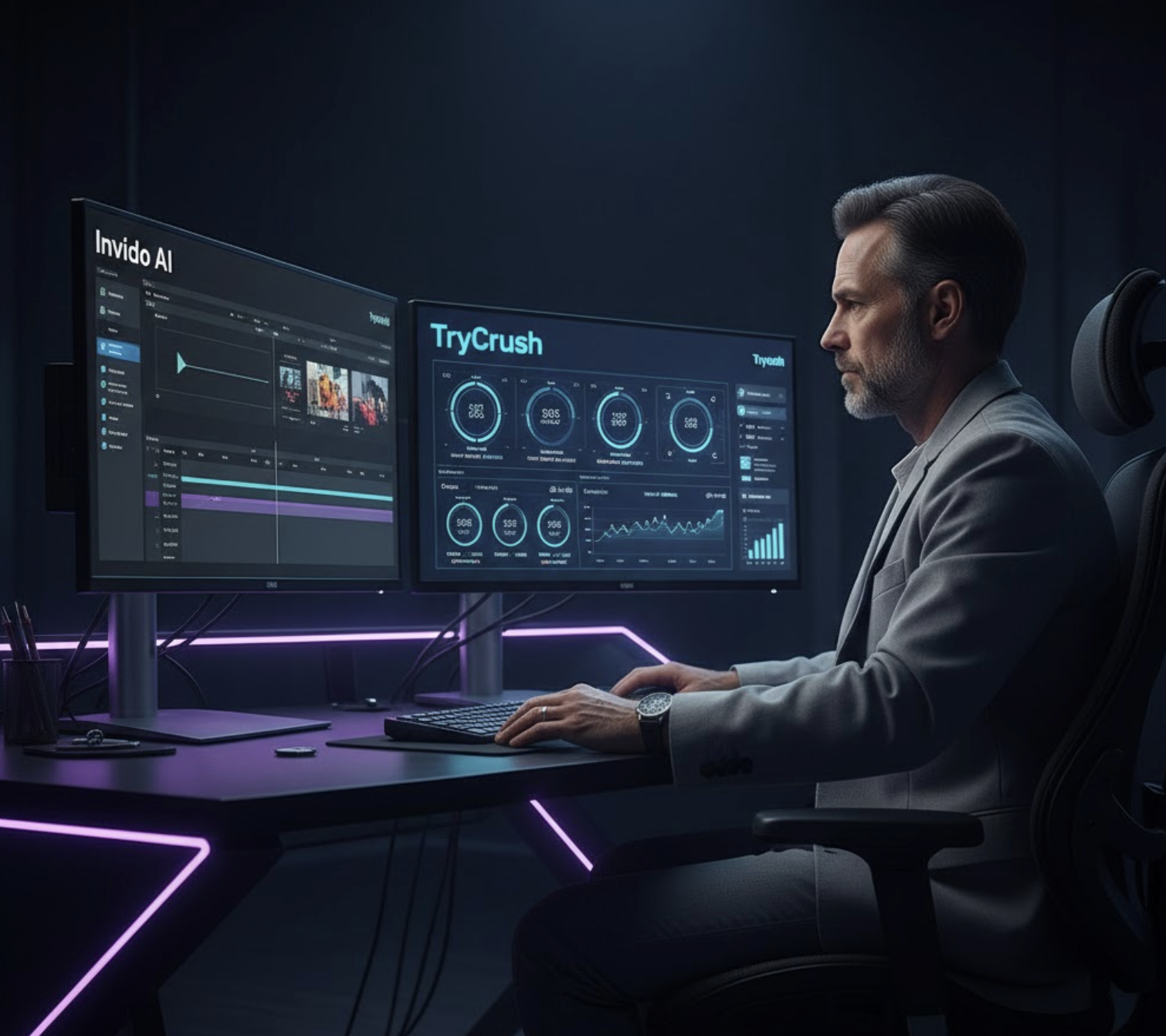
While Invideo AI excels at organic content creation, performance advertisers need tools built for revenue. Explore the Invideo AI vs TryCrush comparison to see why media buyers are migrating to autonomous, data-driven ad scaling.
The landscape of video creation has completely transformed over the last few years. What used to take a team of videographers, editors, and copywriters weeks to produce can now be generated in minutes using artificial intelligence.
This shift has given rise to numerous platforms, but as the technology matures, a critical distinction is emerging between tools made for content creators and tools made for performance advertisers.
This distinction is at the heart of the Invideo AI vs TryCrush conversation. Both platforms use AI to generate video, but they serve two entirely different masters: engagement versus revenue.
If you are an agency owner or e-commerce founder, understanding why top advertisers and media buyers are migrating from generalist video tools to specialized growth engines is essential for maintaining your competitive edge in 2026.
The Era of Prompt-to-Video AI Tools
Invideo AI has established itself as one of the most popular text-to-video platforms on the market. Its premise is simple and highly effective for its target audience.
You simply type a prompt (e.g., "Make a YouTube Short about the top 5 travel destinations in Europe"), and the AI writes the script, sources the stock footage, adds the voiceover, and compiles the video.
What Invideo AI Excels At
For a specific set of use cases, Invideo AI is a fantastic tool:
YouTube Automation: If you run "faceless" YouTube channels relying on volume, Invideo AI can churn out daily content rapidly.
Educational Content: It is great for creating simple explainer videos or summarizing blog posts into video format.
Organic Social Media: It provides a quick way to maintain a presence on TikTok or Instagram Reels without needing original footage.
However, the very features that make Invideo AI great for organic content are what make it a liability for paid advertising.
The Organic vs. Paid Advertising Gap
Organic content and paid advertising operate on completely different psychological and mathematical principles.
Organic content needs to be mildly entertaining to keep someone watching. In contrast, paid advertising needs to be a highly engineered psychological hook that interrupts a user's pattern, introduces a problem, agitates that problem, and forces them to click a link to spend money.
When you evaluate Invideo AI vs TryCrush through the lens of performance marketing, the limitations of generalist tools become glaringly obvious.
Lack of Conversion Data: Invideo AI does not know what your current Cost Per Acquisition (CPA) is. It doesn't know what hook rate you need to achieve profitability. It generates videos based on general aesthetics, not historical conversion data from your ad account.
The Stock Footage Problem: Invideo AI relies heavily on stock footage. In the world of direct-response advertising, highly polished stock footage often triggers immediate "ad blindness." Users scroll past it instantly because it lacks the native, user-generated feel required to convert cold traffic.
No Testing Infrastructure: If you generate 5 videos in Invideo AI, you still have to manually download them, upload them to Facebook Ads Manager, write the primary text, structure the campaign, and monitor the spend. The platform provides no help in the actual execution of creative testing and media buying.
TryCrush: The Media Buyer's Operating System
This is where TryCrush fundamentally diverges from tools like Invideo AI. TryCrush is not just a video editor with AI bolted on; it is an autonomous media buying system that happens to generate elite creatives.
We built TryCrush for businesses that spend money to make money. Our singular focus is lowering your Customer Acquisition Cost (CAC) and increasing your Return on Ad Spend (ROAS).
If you have explored other AI Ad Managers, like the ones we evaluated in our Madgicx Review 2026, you know how crucial automated campaign management is. TryCrush takes this philosophy further by natively binding performance data to the actual creative generation process.
The Architecture of Profitable Scaling
When professional media buyers compare Invideo AI vs TryCrush, they realize that TryCrush replaces not just their video editor, but a significant portion of their manual ad management workflow.
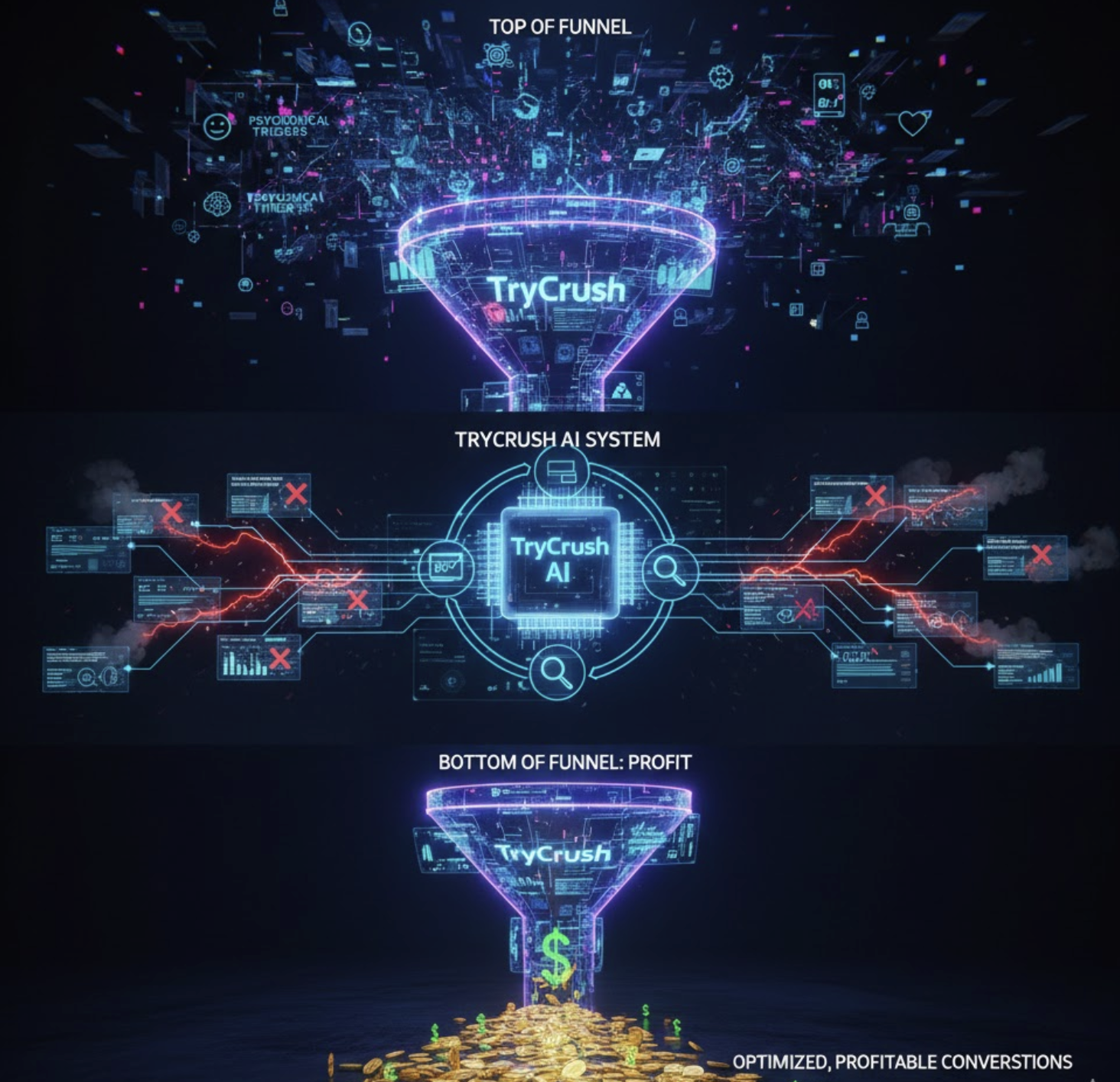
Data-Driven Ideation: TryCrush connects directly to your ad platforms. Instead of generating a generic video, it analyzes your past performance to identify which specific visual hooks, copy angles, and pacing have resulted in the lowest CPA. It then generates new creatives engineered around those winning data points.
Automated Deployment and Testing: TryCrush handles the heavy lifting of campaign creation. It deploys the generated creatives into structured A/B tests, isolating variables to figure out exactly why an ad is working.
The Ruthless Kill Switch: The fastest way to ruin your ROAS is letting bad ads run for too long. TryCrush monitors the micro-metrics of your ad spend in real-time. If a creative doesn't hit your target KPIs within a specified budget threshold, TryCrush kills it automatically to stop wasting budget. No emotion, no wasted spend.
Autonomous Scaling: When a winning creative is identified, TryCrush doesn't just let it run until it fatigues. It automatically generates new iterations based on that winning angle, horizontally scaling your success while protecting your margins.
Why the Switch is Inevitable
The advertising industry is moving away from the "spray and pray" methodology. You can no longer afford to generate 20 random videos, throw them at the Facebook algorithm, and hope one of them sticks.
Using a generalist tool like Invideo AI for paid ads is like bringing a butter knife to a gunfight. It might technically cut something, but it is not the right tool for the job.
Top media buyers are switching to TryCrush because they realize that creative generation without data integration is a liability. They want a closed-loop system that takes responsibility for the entire funnel, from the first pixel of the video to the final click of the checkout button.
Invideo AI vs TryCrush: The Final Word
If you are a YouTuber trying to create daily summary videos without showing your face, Invideo AI is a fantastic tool that will save you hours of editing.
But if you are spending $500, $1,000, or $10,000 a day on Meta or TikTok ads, you are playing a completely different game. Your survival depends on mathematical precision, rigorous testing, and ruthless budget protection.
In the Invideo AI vs TryCrush debate for performance marketers, there is only one platform built for revenue. TryCrush eliminates the guesswork, automates tedious media buying tasks, and builds a sustainable engine for predictable growth. Stop making videos, and start building profitable advertising systems.
Frequently Asked Questions
Common questions about this topic
1What is the main difference between Invideo AI and TryCrush?
2Is Invideo AI good for paid Facebook and TikTok ads?
3How does TryCrush scale profitable ad campaigns?
Written by

Rokas Steponavičius
Founder, CEORokas is the Founder and CEO of TryCrush.ai, an ex-IBM professional turned entrepreneur focused on building AI-driven growth platforms. With a strong background in ecommerce, performance marketing, media buying, and artificial intelligence, Rokas specializes in creating scalable, data-led systems that drive measurable revenue. His mission is to help modern businesses leverage AI to optimize acquisition, conversions, and long-term profitability.
Stop Guessing.
Start Crushing.
AI Ad Manager trained by world-class media buyers to generate your creatives and optimize your ads 24/7.
Learn more
Related articles
Kling AI vs TryCrush: The Ultimate Showdown for Advertisers
While Kling AI creates stunning cinematic videos, TryCrush builds profitable ad campaigns. Discover the key differences between generative video models and performance-first AI systems, and learn which tool media buyers need to lower CAC and scale revenue.
Higgsfield AI vs TryCrush: Which Platform Delivers Better ROAS?
The arms race in generative AI is accelerating. Discover the core differences between Higgsfield AI and TryCrush, and learn why transitioning from organic content creation to profitable paid ad conversion requires a specialized performance engine.
What is Media Buying in 2026? The AI Revolution
The digital revolution changed advertising forever, but AI is completely rewriting the rules. Learn what media buying is today, why manual bidding is dead, and how modern marketers use creative strategy and AI algorithms to scale profitably.

How to Build an AI Creative Agency in 2026 (With Data)
An AI creative agency replaces manual design and media buying with autonomous software. Discover the exact ad data and automated workflows driving the most profitable agencies in 2026.