Key Takeaways
- 1Cinematic tools like Kling AI prioritize visual art over ad conversions.
- 2TryCrush automates ad creation and testing to predictably scale ROAS.
- 3Data-backed, psychological ad hooks consistently outperform polished videos.
- 4Automated kill switches protect budgets by pausing failing creatives early.
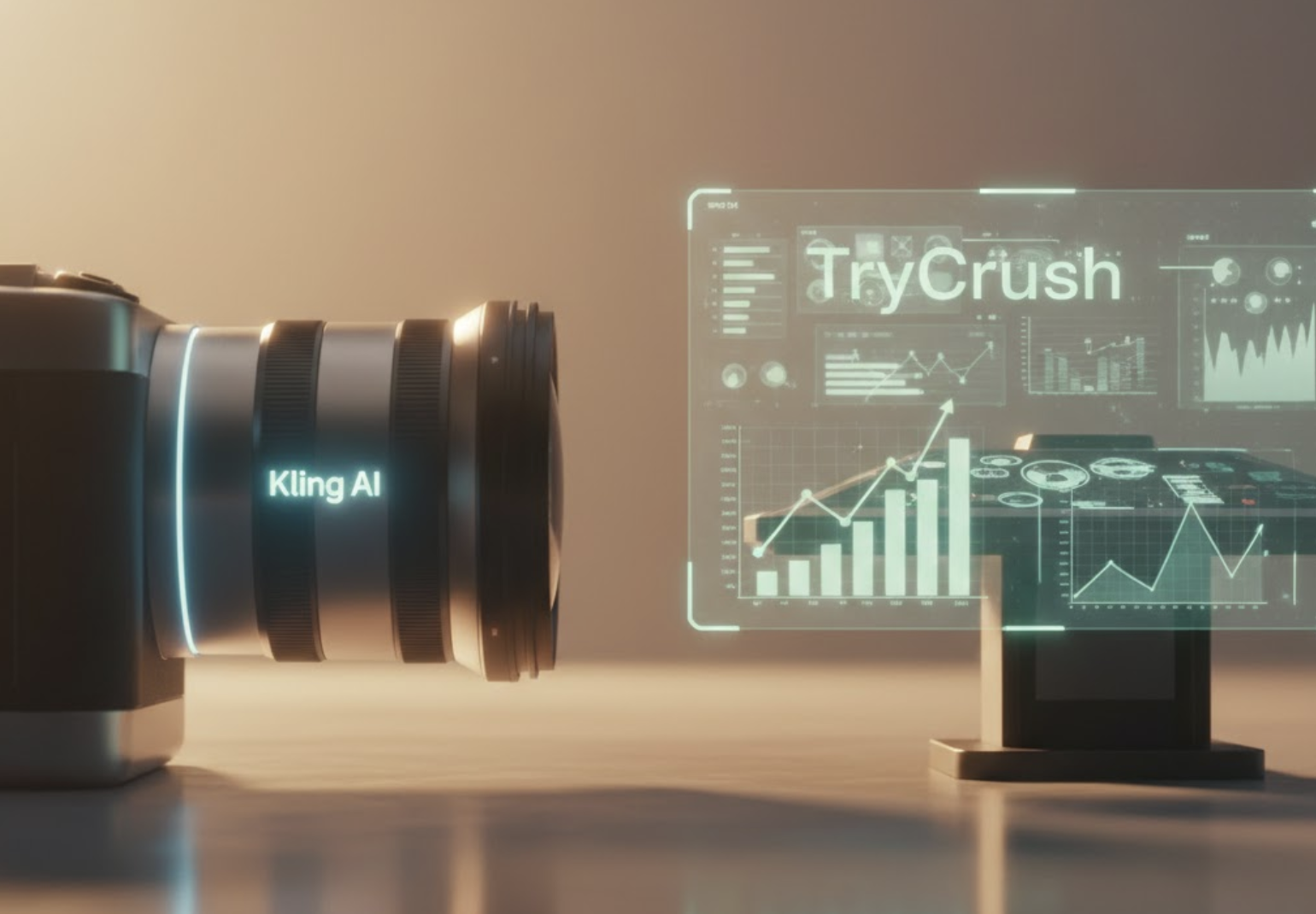
While Kling AI creates stunning cinematic videos, TryCrush builds profitable ad campaigns. Discover the key differences between generative video models and performance-first AI systems, and learn which tool media buyers need to lower CAC and scale revenue.
The landscape of AI video generation has exploded over the past two years. With new models emerging almost weekly, the capabilities for creating stunning, photorealistic video content have never been greater. However, as the dust settles, a clear dividing line has formed in the industry: tools built for cinematography versus tools built for performance advertising.
This divide is perfectly illustrated when we look at Kling AI vs TryCrush. Both represent the cutting edge of what artificial intelligence can accomplish in 2026, but they are fundamentally designed to solve completely different problems for completely different users.
If you are a media buyer, a performance marketer, or an e-commerce brand owner, understanding the distinction between these two platforms is crucial. Choosing the wrong tool can lead to beautiful videos that drain your budget, while the right tool can predictably scale your revenue.
The Rise of Kling AI: A Cinematic Marvel
Kling AI burst onto the scene as a direct competitor to generative video models like Sora and Runway. Its primary objective is simple yet incredibly difficult: generate highly realistic, physics-accurate video from text prompts.
In this regard, Kling AI is an undeniable marvel of engineering.
The Strengths of Kling AI
If your goal is pure visual fidelity, Kling AI offers several compelling advantages:
Photorealism: Kling AI can generate scenes with astonishing detail, accurate lighting, and realistic human movements.
Complex Prompt Adherence: It excels at understanding complex, multi-layered prompts, allowing creators to dictate precise camera angles, weather conditions, and character interactions.
Extended Video Lengths: Compared to earlier models, Kling AI can maintain temporal consistency over longer video clips, making it a favorite among AI filmmakers.
For a creative agency looking to generate B-roll footage, mock up a storyboard, or create a short sci-fi film, Kling AI is a powerful paintbrush. However, when it comes to the ruthless arena of performance marketing, a beautiful paintbrush is often not enough.
The Problem with "Beautiful" Ads
Here is a painful truth that every veteran media buyer knows: The best-looking ad rarely wins.
Time and time again, split tests reveal that highly polished, cinematic videos often lose to grittier, native-looking content or ads constructed with specific psychological hooks.
This is the core issue when using a tool like Kling AI for advertising. It can create a visually stunning sequence of a car driving through a neon-lit city, but it doesn't know why that video should convince a 35-year-old father to click a link and buy car insurance. It has no understanding of Customer Acquisition Cost (CAC), Return on Ad Spend (ROAS), or conversion rate optimization.
If you use Kling AI to make ads, you are still operating in the old paradigm: you make a video, you manually upload it to Facebook or TikTok, you cross your fingers, and you hope the algorithm likes it. Instead of guessing, modern media buyers optimize for Cost Per Acquisition to build sustainable growth.
Enter TryCrush: The Performance-First Engine
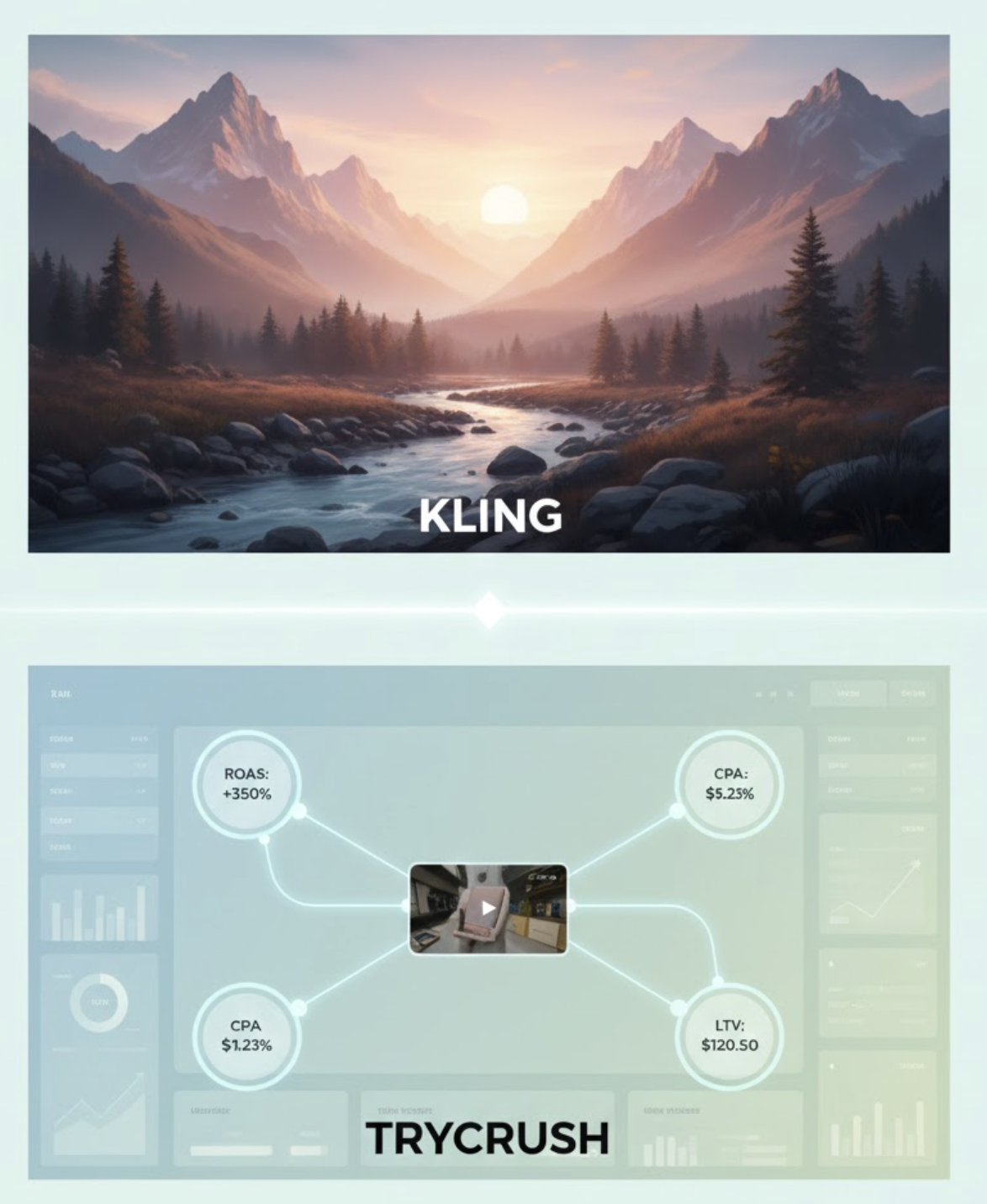
This is where the Kling AI vs TryCrush comparison fundamentally shifts. While Kling AI is a tool for video generation, TryCrush is a comprehensive operating system for profitable media buying.
We built TryCrush with a singular focus: to help businesses scale their advertising spend profitably. We realized that generating the creative asset is only the first, and arguably the easiest, step in the modern advertising funnel.
How TryCrush Differs from Generative Video Models
TryCrush doesn't just ask "what do you want the video to look like?" It asks "what is the psychological angle that will drive the lowest CPA?"
Data-Backed Creative Generation: Instead of relying on random prompts, TryCrush uses historical ad account data to generate creative variations that are mathematically likely to perform well. It understands hook rates, hold rates, and click-through rates, helping you decode winning concepts before your competitors do.
Autonomous Testing: TryCrush doesn't just hand you a video file. It directly integrates with your ad accounts to deploy the creatives, setting up structured A/B tests to identify the winning combination of visual, copy, and audience. This prevents the common mistake of burning budget on flawed creative testing.
Budget Protection: The most critical feature of TryCrush is its automated kill switch. It monitors early spend and instantly pauses creatives that are not meeting your target KPIs, leveraging a strict kill switch protocol to prevent you from burning cash on "beautiful" ads that don't convert.
The Media Buyer's Dilemma
Let's look at a practical scenario to illustrate the difference between these two platforms. Imagine you are launching a new skincare brand.
Scenario A: Using Kling AI
You spend three hours crafting the perfect prompts. You generate 10 gorgeous, photorealistic clips of water splashing on models' faces. You stitch them together, add music, and upload the ad. It looks like a million-dollar commercial. You spend $1,000 running it. It gets lots of likes, but your cost per purchase is $150, and your product only costs $40. You lose money. You have no idea why it failed, and you have to start over from scratch.
Scenario B: Using TryCrush
You input your product details and target audience into TryCrush. The system generates 15 different variations, testing 5 different psychological hooks (e.g., "The scientific approach," "The social proof angle," "The quick routine"). TryCrush deploys them with small micro-budgets.
Within $150 of spend, it kills 12 variations that are underperforming. It identifies that the "quick routine" hook is driving a $25 CPA. It immediately scales the budget on that winner and generates 5 new variations doubling down on that specific angle. You become profitable within 48 hours, fully capitalizing on the psychology of a unicorn ad.
Kling AI vs TryCrush: The Verdict
There is no question that Kling AI is a phenomenal technological achievement. If you are a filmmaker, an animator, or an agency looking to produce high-end conceptual visual art, it is one of the best tools on the market.
However, advertising is not art. Advertising is applied psychology combined with applied mathematics.
In the debate of Kling AI vs TryCrush, the winner depends entirely on your job title. If you are trying to win a film festival, use Kling AI. But if your goal is to acquire customers, lower your CAC, and scale your business to new heights without relying on guesswork, TryCrush is the superior system.
At TryCrush, we believe that the future of advertising belongs to closed-loop systems, platforms that not only generate the creative but manage the media buying, analyze the data, and continuously optimize for profit. Stop optimizing for pretty pixels, and start optimizing for actual revenue.
Frequently Asked Questions
Common questions about this topic
1What is the main difference between Kling AI and TryCrush?
2Is Kling AI effective for performance marketing ads?
3How does TryCrush protect ad campaign budgets?
Written by
Albertas Pocius
Co-founder, CMOAlbertas is the Co-Founder and CMO of TryCrush.ai, bringing elite-level performance marketing expertise to the platform. With over $50M+ in combined Facebook and TikTok ad spend, Albertas has launched and scaled dozens of projects from zero, driven by a deep obsession with data and experimentation. He has trained 20+ media buyers, consulted 100+ companies, and is widely recognized as one of Europe’s early TikTok pioneers, likely the first to scale campaigns beyond $100K per day. Today, he also teaches advertising strategy at two colleges, shaping the next generation of media buyers.
Stop Guessing.
Start Crushing.
AI Ad Manager trained by world-class media buyers to generate your creatives and optimize your ads 24/7.
Learn more
Related articles
Higgsfield AI vs TryCrush: Which Platform Delivers Better ROAS?
The arms race in generative AI is accelerating. Discover the core differences between Higgsfield AI and TryCrush, and learn why transitioning from organic content creation to profitable paid ad conversion requires a specialized performance engine.
Invideo AI vs TryCrush: Why Media Buyers Are Switching
While Invideo AI excels at organic content creation, performance advertisers need tools built for revenue. Explore the Invideo AI vs TryCrush comparison to see why media buyers are migrating to autonomous, data-driven ad scaling.
What is a Creative Strategist? The 2026 Data Guide
A creative strategist bridges the gap between media buying and ad design. Discover the exact frameworks they use to build and scale winning Facebook campaigns.

What is CAC? How AI Can Cut Your Acquisition Costs in Half
Customer Acquisition Cost (CAC) is the ultimate metric for business survival. Learn the true CAC meaning, the golden LTV:CAC ratio, and how AI-driven creative testing can systematically cut your acquisition costs in half.