What is a Creative Strategist? The 2026 Data Guide
•9 min read
What is a Creative Strategist? The 2026 Data Guide (Crush blog cover)
Key Takeaways
1A creative strategist connects media buying data with graphic design to build highly profitable ads.
2Among top marketing ads on Facebook, the average run time is 88 days.
3The most successful B2B marketing ads use the Learn More CTA to reduce initial user friction.
4True creative strategy relies on testing isolated variables rather than changing multiple ad elements at once.
5Top performing ads are often relaunched dozens of times to fight platform ad fatigue.
A creative strategist bridges the gap between media buying and ad design. Discover the exact frameworks they use to build and scale winning Facebook campaigns.
What is a Creative Strategist?
A creative strategist is the analytical bridge between media buying and ad design. They analyze performance metrics to understand exactly why a specific ad drives conversions.
Instead of relying on gut feelings, they use this data to dictate visual direction and copywriting for future campaigns.
The role evolved because platform algorithms now handle most audience targeting automatically. Today, the ad creative itself is your primary targeting tool.
A creative marketing strategist ensures every video, image, and headline is engineered to capture a specific buyer profile through deep audience analysis.
Why Creative Strategy is Replacing Traditional Media Buying
Traditional media buying focused heavily on manual audience targeting, bid caps, and campaign structures. In 2026, algorithmic targeting handles the distribution mechanics far better than a human can.
The platforms want broad audiences and massive data sets to optimize delivery. Monitoring this algorithmic delivery requires understanding the difference between impressions vs reach to measure true campaign scale.
Because the algorithm handles the delivery, the creative itself dictates who stops scrolling. If your video speaks directly to a specific pain point, the algorithm finds the users who suffer from it. This shift forces brands to output massive volumes of highly targeted ad variations.
A creative marketing strategist manages this massive pipeline systematically. They ensure the design team is not just guessing what might look good. They build rigid testing frameworks to isolate variables and scale profitable concepts without wasting ad spend.
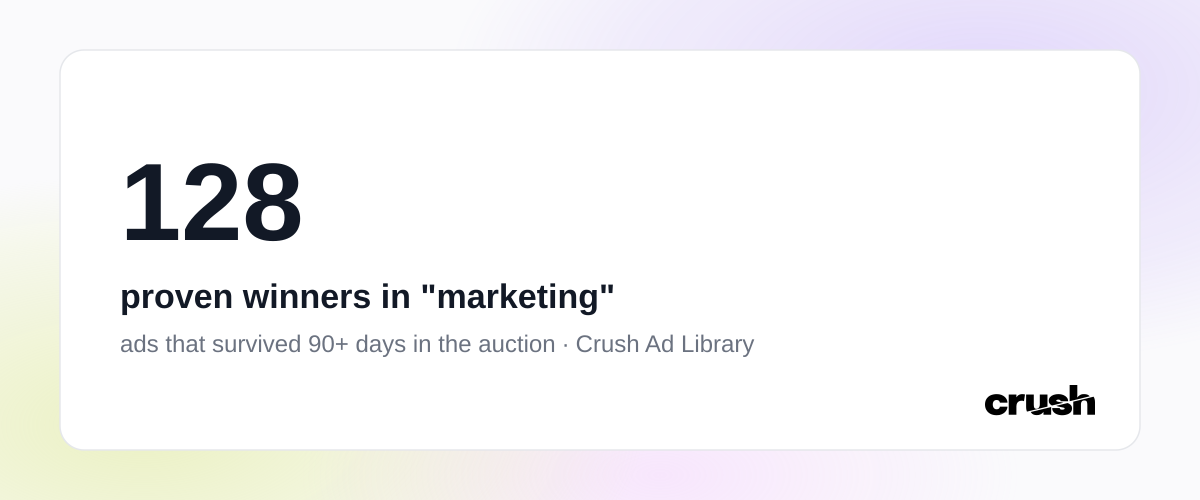
"Marketing" ads past the 90-day proven-winner threshold.
What Data Proves a Creative Strategy Actually Works?
Longevity is the ultimate metric for creative success. If an advertiser leaves an ad running for months, that ad is generating profitable returns. Nobody spends money on a losing campaign for a year.
We track this exact longevity signal using our own product Crush, an AI Facebook ads platform. Crush's ad library tracks 1,716,711 unique Facebook ads (456,459 currently active). This massive dataset reveals exactly what strategies survive in competitive markets.
Among top "marketing" ads, average run time is 88 days; 128 of the top 400 ran 90+ days (the "proven winner" threshold).
If your creative strategist cannot produce ads that run for at least 90 days, your testing framework is broken. You are likely burning through creatives too quickly or failing to iterate on your best advertising concepts.
What are the Traits of a 90-Day Winning Ad?
Hitting the 90-day mark requires a creative that commands attention while actively avoiding ad fatigue. Advertisers fight this fatigue by relaunching identical or slightly modified creatives to reset platform delivery. We track these duplicate counts as a strong indicator of a winning concept.
They demonstrate how top strategists use copy and hooks to secure long-term profitability.
1. Filtering Audiences with Direct Copy
JRNY Digital ran a campaign for 744 days and relaunched it 4 times. Their CTA was "shop now". They used highly specific copy to immediately disqualify bad leads.
Their opening line read: “Attention DTC brand owners: are you having trouble scaling your ads (without killing ROAS)? 👀 We're looking to partner with serious DTC brand owners that want ”.
This copy explicitly calls out the target buyer in the first three seconds. A creative strategist knows that paying for clicks from unqualified users destroys campaign profitability. This makes understanding audience intent an absolutely essential part of your strategy before writing a single word of copy.
2. Stacking Value for Subscriptions
Udemy has a proven winner running 186 days, which they relaunched 118 times. The "buy now" CTA drives immediate action on a massive value proposition.
The opening line states: “Learn thousands of in-demand skills in one subscription. From data, AI, and coding to productivity, marketing and creative skills, learn at your own pace. Subsc”.
Relaunching an ad 118 times shows immense confidence in the creative concept. The strategist here built a concept focused entirely on volume and accessibility.
3. Combining Empathy with Immediate Solutions
Swyft Sites ran a B2B ad for 1652 days and relaunched it 3 times. They chose a "learn more" CTA to lower the friction for a high-consideration service.
The opening line hooks the reader with empathy: “Attn: Coaches who finally want to check the website off the list. We get it. Struggling to build a website by yourself can be time consuming, frustrating, and o”.
This strategy addresses the emotional pain of the task before pitching the solution. It is a classic copywriting framework executed perfectly.
How Do Call-to-Action Buttons Impact Strategy?
The call-to-action (CTA) you choose fundamentally changes how users interact with your funnel. A great strategist tests these systematically to find the right balance of friction and intent. Asking for a purchase too early can kill a great video.
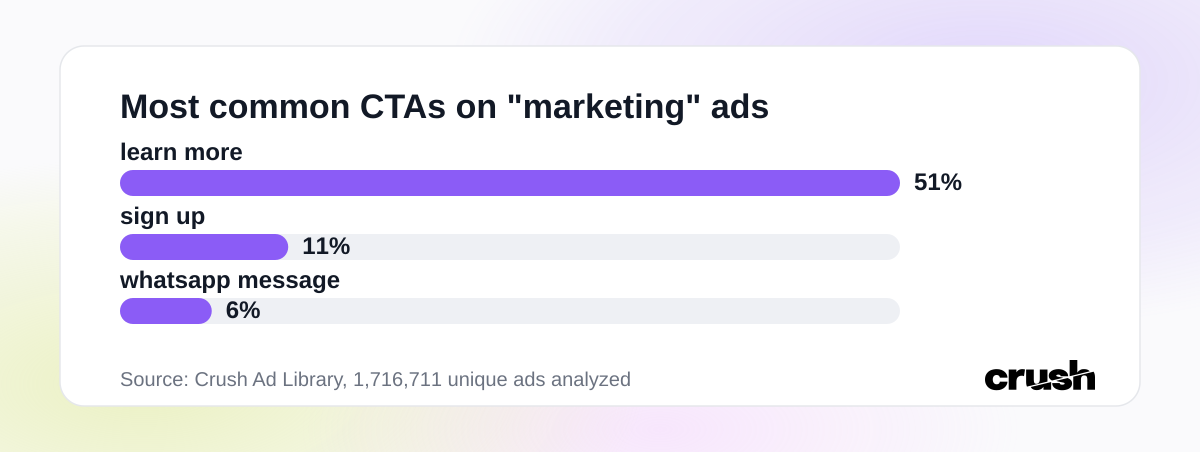
Our proprietary data shows clear platform preferences. Most common CTA buttons on "marketing" ads: learn more (51%), sign up (11%), whatsapp message (6%).
The dominance of "learn more" proves that marketing services require education before conversion. We built a table to visualize these common CTA distributions and their typical use cases.
CTA Button
Market Share
Primary Use Case
User Friction Level
Learn More
51%
B2B Services, High Ticket
Low
Sign Up
11%
SaaS, Lead Generation
Medium
Whatsapp Message
6%
Direct Consulting, Local Services
High
What Does a Creative Strategist Do Daily?
A strategist lives in the data but speaks the language of design. They do not just ask the team for more videos. They break down winning ads frame by frame to find actionable insights:
Audience Retention: If a video holds attention for three seconds but drops off immediately after, they rewrite the transition.
Funnel Bottlenecks: If the click-through rate is high but conversions are zero, they analyze the landing page alignment.
Consider Zapier. We track an ad of theirs running 844 days, relaunched 3 times, with a "learn more" CTA. A strategist studies this ad to understand its visual pacing, color contrast, and text overlays.
They then map out iterative tests based on those insights. They hand the designer a highly detailed creative brief that dictates exactly what to change and what to keep identical.
How Should You Structure a Creative Testing Framework?
Testing randomly wastes your budget and ruins account stability. You need a rigid methodology. Every test must be designed to answer a specific mathematical question.
Follow this exact sequence to isolate variables and find winning concepts. Never skip a step, or your data will be useless.
Test three entirely different visual concepts using the exact same proven copy. To test copy efficiently, try utilizing modular copy formulas (ad libs) to systematically swap variables.
Take the winning visual concept and test three different hooks in the first three seconds.
Take the winning hook and test three different text overlay variations.
Scale the final, highly optimized variation using automated campaign rules.
What Tools Does a Modern Creative Strategist Use?
Manual tracking through native platform libraries wastes countless hours. More importantly, it hides historical data on ads that get taken down. You cannot build a strategy on incomplete data.
Crush automatically tracks competitors' Facebook ads via the Meta Ad Library and keeps history. This means you can study ads that were taken down months ago to see what failed.
Beyond Facebook, top strategists analyze ad networks across the web. For example, utilizing the Google Ad Library for competitor research allows you to reverse engineer search and display campaigns to see what copy drives clicks on other channels.
Once you find a proven winner, scaling it requires massive iteration volume. To truly maximize scale, teams need to understand why generating 100 ad variations is critical to success.
This is where an AI creative studio replaces manual media buying and basic graphic design tweaks.
Crush fully automatically runs Facebook ads. It creates campaigns, scales winners, and kills losers based on your precise target metrics. This frees the strategist to focus entirely on concept generation.
Our platform can also generate ad-creative iterations from a winning reference ad. If you have an image that converts, the system can build dozens of high-quality variations instantly.
Brands looking to automate their creative testing pipeline can start immediately. Our paid plans start with a trial, and you can view the details on our pricing page.
What Are the Biggest Mistakes in Creative Strategy?
Many teams fail because they let subjectivity overrule hard data. If your creative director loves an ad but it loses money, it is a bad ad. The data is the only source of truth.
A great creative marketing strategist removes ego from the process. Avoid these common pitfalls when building out your own testing pipeline:
Changing the hook, the body copy, and the CTA all in a single test.
Ignoring ad longevity metrics and focusing only on day-one return on ad spend.
Failing to research competitor ads that have successfully run for more than 90 days.
Assuming B2B audiences only want polished corporate videos instead of native content.
CTA button distribution on tracked "marketing" ads.
How Do You Build Briefs Designers Actually Understand?
Vague instructions lead to useless ad variations. A brief must be incredibly specific about visual hierarchy. Do not use meaningless phrases like "make it pop" or "make it dynamic."
Instead, your creative briefs should include actionable details:
Placement: Tell the designer to place the primary value prop in the top third of the frame.
Brand Guidelines: Specify the exact hex codes for text backgrounds to ensure platform compliance and readability.
Visual Benchmarks: Provide reference links to real competitors.
For example, Cloud Media ran an ad for 697 days, relaunched 5 times, with a "sign up" CTA. Show this to your team.
Their opening line was heavily formatted: “🔥𝐆𝐨𝐨𝐠𝐥𝐞 𝐀𝐝𝐬 & 𝐘𝐨𝐮𝐓𝐮𝐛𝐞 (+) 𝐅𝐚𝐜𝐞𝐛𝐨𝐨𝐤 & 𝐈𝐧𝐬𝐭𝐚𝐠𝐫𝐚𝐦 (+) 𝐓𝐢𝐤𝐓𝐨𝐤 𝐇𝐚𝐧𝐝𝐬-𝐨𝐧 𝐀𝐝𝐯𝐞𝐫𝐭𝐢𝐬𝐢𝐧𝐠 𝐖𝐨𝐫𝐤𝐬𝐡𝐨𝐩🔥 Elev”. A strategist points to this as a benchmark for using emojis and bold text to disrupt the feed.
When Should You Kill an Underperforming Ad?
Ad platforms need data to optimize, but you cannot afford to bleed cash indefinitely and increase your cost per acquisition when scaling dropshipping Shopify stores. A creative strategist knows exactly when to cut a losing concept and pivot to a fresh iteration.
Frequently Asked Questions
Common questions about this topic
1What is the difference between a creative director and a creative strategist?
A creative director focuses on brand identity, visual aesthetics, and emotional resonance. A creative strategist focuses purely on conversion data, analyzing click-through rates, hook retention, and cost per acquisition to dictate the exact design requirements for profitability.
2Do creative strategists buy media?
Most creative strategists do not press the buttons to launch campaigns themselves. They work directly alongside media buyers to analyze campaign data, using those insights to build specific creative briefs for the design team.
3How long should a winning Facebook ad run?
Our data tracking 1.7 million ads shows that 90 days is the threshold for a proven winner. Top marketing ads average an 88-day run time. If an ad survives this long, it is consistently generating a positive return.
4What skills do you need to be a creative marketing strategist?
You need strong data analysis skills to read platform metrics, copywriting abilities to script video hooks, and a deep understanding of direct response marketing. You must also communicate effectively with both analytical media buyers and visual graphic designers.
#creative strategist#what is a creative strategist#creative marketing strategist#facebook ad strategy#ad creative testing#media buying data#performance marketing
Rokas is the Founder and CEO of TryCrush.ai, an ex-IBM professional turned entrepreneur focused on building AI-driven growth platforms. With a strong background in ecommerce, performance marketing, media buying, and artificial intelligence, Rokas specializes in creating scalable, data-led systems that drive measurable revenue. His mission is to help modern businesses leverage AI to optimize acquisition, conversions, and long-term profitability.
Stop Guessing. Start Crushing.
AI Ad Manager trained by world-class media buyers to generate your creatives and optimize your ads 24/7.