Key Takeaways
- 1Reach counts the unique users who see your ad, while impressions count the total number of times the ad is displayed.
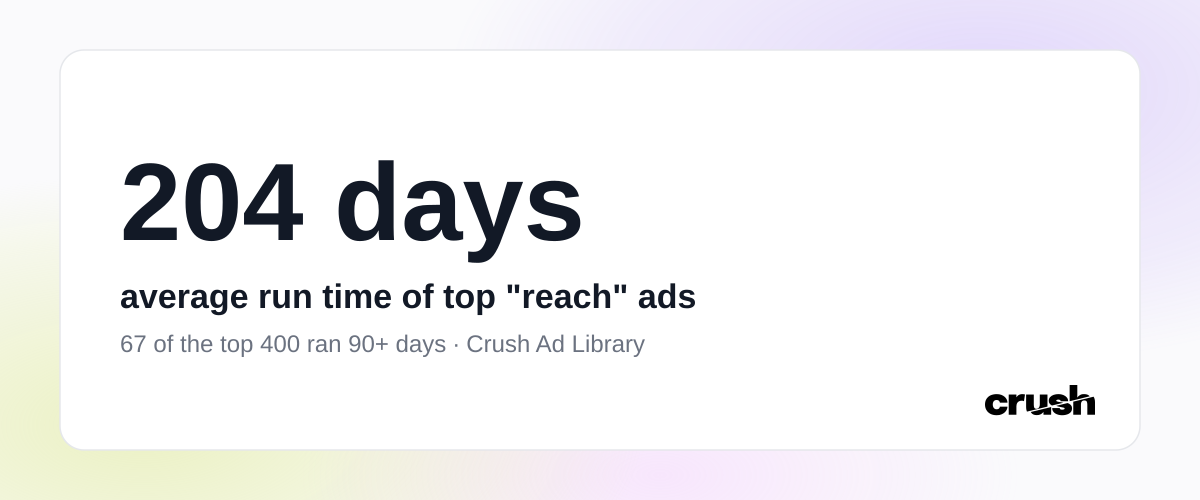
- 2Top-performing reach ads in our 1.7 million ad library have an average run time of 204 days.
- 3The most successful call-to-action for reach campaigns is 'Learn more', used by 42 percent of top ads.
- 4Impression.so is best for AI content repurposing, starting at $57 per month.
- 5REACH.ai excels at automated SMS booking and email marketing, while Crush is built exclusively for scaling winning Facebook ads.
We break down the difference between reach and impressions using hard data from 1.7 million Facebook ads, plus a review of the top tools bearing these names.
What is the core difference between impressions and reach?
In Facebook ads, reach is the number of unique people who see your ad. Impressions refer to the total number of times your ad is displayed on a screen. If one person sees your ad three times, you get one reach and three impressions.
Understanding this distinction controls your frequency and ad fatigue. Ad servers and marketing platforms track impressions to measure visibility and total delivery, not direct engagement like clicks, according to Cometly's digital marketing guide.
Served impressions vs viewable impressions
Not all impressions are equal. Advertising platforms accurately track ad impressions by embedding analytics code that counts each time an ad loads or enters a viewer's viewport, using tracking pixels, JavaScript tags, or server-side logging, as detailed by AdVenture Media.
Digital marketing tools distinguish between served impressions (where content is delivered) and viewable impressions. Viewable impressions use device data to exclude cases where the content was likely not seen due to ad-blocking software or minimized windows, according to BigCommerce.
An impression is considered 'viewable' by industry standards when at least 50 percent of the ad's pixels appear in the viewport for a minimum of one second for display ads, or two seconds for video ads.
What do the numbers say about reach ads in 2026?
Our platform Crush tracks real-world media buying data to see what actually works. Crush's ad library tracks 1,753,236 unique Facebook ads (443,774 currently active). This massive dataset reveals exactly how top advertisers build campaigns designed for maximum reach.
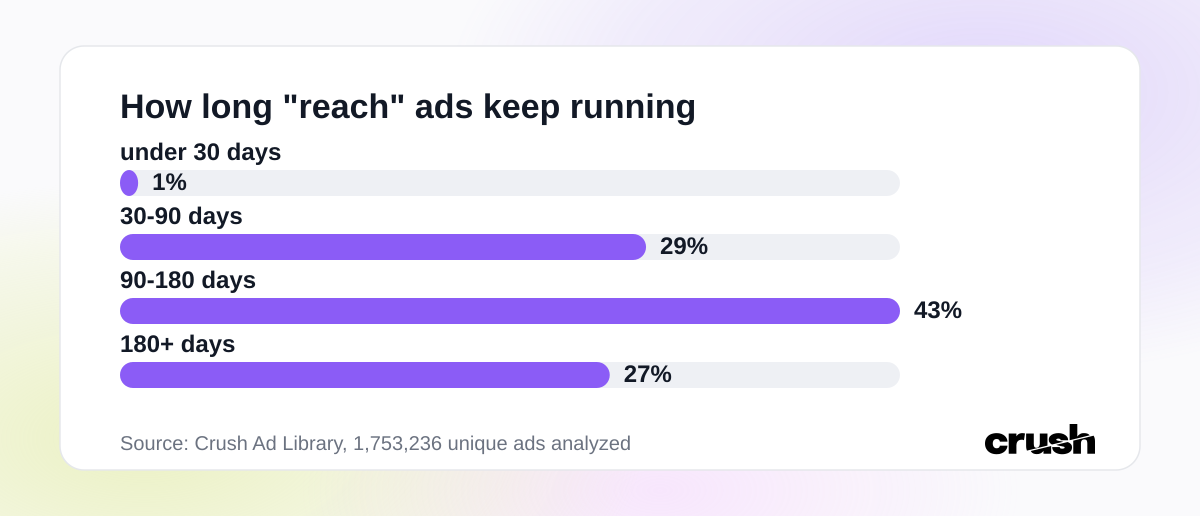
We found that 96 tracked ads explicitly match the campaign objective of "reach" (63 active right now). These are not short-lived tests. Among top "reach" ads, average run time is 204 days; 67 of the top 400 ran 90+ days (the "proven winner" threshold).
Examples of proven reach campaigns
When you optimize for unique eyeballs, creative longevity matters. Here are three verbatim examples from our database that demonstrate how long a winning reach ad can run without burning out.
- Example (Lake City Physical Therapy): ran 1819 days, relaunched 0x, CTA "learn more", opening line: "Female athletes face different injuries than men. Whether you're a runner, CrossFitter or bowler our team of women's health PTs will make you stronger, faster a".
- Example (Crunch Fitness): running 1370 days, relaunched 0x, CTA "sign up", opening line: "Our experienced personal trainers develop fun (yes, fun!) individualised fitness programs to help you reach your goals.".
- Example (Kelli Ide- Skaneateles Real Estate Sales & Staging): running 906 days, relaunched 0x, CTA "book travel", opening line: "Michael DeRosa Exchange is a boutique brokerage in the Finger Lakes region, specializing in luxury estates, historic properties and waterfront vacation homes. C".
The best call-to-action for reach
The goal of a reach campaign is to introduce a brand to as many new people as possible. Because the audience is cold, high-friction CTAs perform poorly. Based on our data of proven call to action examples, the most common CTA buttons on "reach" ads are:
- Learn more (42 percent of all reach ads)
- Apply now (10 percent)
- See details (9 percent)
Using "learn more" lowers the barrier to entry, allowing the algorithm to maximize unique impressions efficiently at a lower CPM (cost per mille).
Impression software vs Reach software (The platform showdown)
In digital marketing, "impressions" refers to a fundamental metric rather than a specific software tool named "Impressions" (Cometly). However, several marketing software companies have adopted these core metric names for their platforms.
We regularly see buyers comparing tools named Impression and Reach. As a media buyer, you need to know if these platforms actually help you acquire users. Below is a direct review of Impression.so, REACH.ai (and EmbedReach), and Crush, our platform.
What does Impression do well?
Impression.so focuses heavily on AI content creation and repurposing. According to Impression.so Pricing, their Pro plan includes unlimited AI repurposing, writing, and editing. They offer a 3-day free trial for their Pro and Agency plans.
Users note that Better Impression generates high traffic and a relevant target audience, according to G2 reviews. Better Impression is also lauded for providing great insights to its users.
On the pricing front, Impression.so offers a Pro plan for $57 per month. A Pro Lifetime plan is available for a one-time payment of $189, which is 36 percent off the regular price of $299. This lifetime plan includes a $50 AI token balance to start, with options to top up the balance in-app.
For larger teams, Impression.so provides an Agency plan priced at $399 per month. The Agency plan supports 50 brands and offers unlimited users. Alternatively, their Business plan includes 25 users, with an additional cost of $9 per user per month from the 26th user onward.
What does Reach do well?
The name "Reach" belongs to a few different marketing tools, most notably REACH.ai and EmbedReach. Reach is an embeddable marketing tools and services platform designed to help SaaS customers acquire and retain users, and convert leads, per the EmbedReach website.
The platform offers growth and retention features such as ads, email/SMS, and more, all of which are AI Native. Reach allows users to automate email and SMS campaigns for lead conversion, customer re-engagement, and retention, with advanced features like segmentation, scheduling, and A/B testing.
For paid media buyers, the 'Acquire' solution within Reach enables businesses to create, manage, and optimize paid digital advertising campaigns using AI-powered tools, according to Reach Marketing Documentation. Reach allows for the connection of Google and Meta ad accounts to create advertising campaigns.
Reach's automated ad engine optimizes targeting, budgets, and creative elements to maximize ROI, helping users reach the right audience at the right time. The platform includes revenue attribution tools that provide clear insights into marketing impact.
Another product, REACH.ai, offers automated appointment filling. Birdeye reviewers praise REACH.ai for automatically filling last-minute appointments, cancellations, and quiet times, generating over $1,000,000 in additional revenue for clients in a 30-day period.
Where does Reach fall short?
While the automation sounds great, real user experiences reveal significant friction. A user reported being charged for a full month by REACH.ai after quitting a 30-day free trial after only 15 days, and stated the software "did NOTHING" for their business (Birdeye).
Additionally, users of Hostinger Reach complain about the software's email editing functionality being "trash" and that it forces the use of AI to create HTML templates, often resulting in "garbage" content and random changes, according to Reddit r/Hostinger. Some users of REACH digital signage have also reported occasional minor bugs or delays when syncing updates across all screens (Capterra).
How does Crush fit into this?
Our product Crush (trycrush.ai) is a dedicated AI Facebook ads platform built strictly for media buyers. We do not do email marketing or digital signage. We focus 100 percent on scaling winning Facebook creatives.
Crush fully automatically runs Facebook ads. The system creates campaigns, scales winners, and kills losers without manual intervention. To feed the machine, Crush allows you to search the Facebook ad library to track competitors' ads and keeps history, including ads that were taken down.
You can access our free public ad library to see exactly which creatives are lasting 90+ days. When you find a winner, Crush can generate ad-creative iterations from that reference ad, ensuring you always have fresh assets to combat ad fatigue. Paid plans start with a trial, and you can check our current pricing for full details.
Platform feature comparison (Impression vs Reach vs Crush)
Here is how the three platforms stack up regarding core features, automation, and base pricing structures.
| Feature / Capability | Impression.so | REACH.ai | Crush (our product) |
|---|---|---|---|
| Core Focus | AI content repurposing | Email, SMS & Bookings | Facebook Ads Automation |
| Starting Price | $57 per month | $285 per month | Free trial available |
| Ad Account Integration | No | Yes (EmbedReach) | Yes (Meta exclusive) |
| Competitor Ad Tracking | No | No | Yes (1.7M+ ads) |
| Automated Scaling | No | Yes | Yes |
Who should pick which platform in 2026?
If you are a content creator looking to stretch your existing videos and text across multiple organic platforms, pick Impression.so. Their Pro Lifetime deal for $189 is highly cost-effective for solopreneurs who just need an AI rewriting tool.
If you run a local service business (like a salon or spa) and need to fill last-minute schedule gaps, pick REACH.ai. Despite the billing complaints, their automated SMS booking system is proven to recover lost revenue from cancellations.
If you are a performance marketer or media buyer spending real money on Meta, pick Crush. We built our platform because we were tired of manually pausing losers and duplicating winners. We give you the historical data to know what creatives actually work, and the automation to scale them.
How should media buyers optimize for reach vs impressions?
The foundational rule of media buying is that you pay for impressions, but you profit from reach. Demand-Side Platforms (DSPs), a type of ad tech software, enable advertisers to buy impressions and select audiences across numerous publisher sites, according to Amazon Ads.
Supply-Side Platforms (SSPs) are tools for publishers that automate the selling of digital ad impressions, including video, display, and mobile ads, allowing them to maximize revenue (Amazon Ads). You are bidding against these systems. To win, you must monitor your frequency metric (Impressions divided by Reach).
Checklist for managing ad fatigue
- Set a frequency cap: If your frequency goes above 3.0 on a cold audience, you are wasting impressions. Rotate your creatives immediately to revive fatigued campaigns.
- Monitor CTR drop-offs: When impressions rise but outbound clicks fall, your audience is blind to your ad.
- Broaden your targeting: If your reach plateaus early, your audience size is too small. Switch to Advantage+ broad targeting to unlock cheaper impressions.
- Launch iterations: Do not just launch completely different ads. Find a creative with a high reach, and iterate just the hook or the thumbnail.
Common mistakes when tracking these metrics
Tracking the wrong metric at the wrong stage of the funnel destroys ROAS. Here are the most frequent errors we see in ad accounts:
- Optimizing for impressions on bottom-of-funnel retargeting: Retargeting audiences are small; optimizing for impressions will hammer the same 100 people 50 times a day.
- Ignoring viewability standards: Not every served impression is actually seen by a human eye.
- Judging reach campaigns by direct conversions: Reach campaigns build the top of the funnel. If you measure them purely by immediate CPA, you will prematurely kill your best brand-building assets.
How we got this data
The numbers in this article come from Crush’s ad library: 1,753,236 unique Facebook ads tracked via the Meta Ad Library, 443,774 of them active at the time of writing. Ad examples reference real advertisers and their public ads. Data queried on 2026-08-09. Third-party product facts are attributed inline to their sources.
Frequently Asked Questions
Common questions about this topic
1Is it better to optimize for reach or impressions?
2How do you calculate ad frequency?
3What is a viewable impression?
4Why is my reach so much lower than my impressions?
About this article
This article was written with AI assistance. Ad examples and ad data come from the Crush ad library.
Written by

Rokas Steponavičius
Founder, CEORokas is the Founder and CEO of TryCrush.ai, an ex-IBM professional turned entrepreneur focused on building AI-driven growth platforms. With a strong background in ecommerce, performance marketing, media buying, and artificial intelligence, Rokas specializes in creating scalable, data-led systems that drive measurable revenue. His mission is to help modern businesses leverage AI to optimize acquisition, conversions, and long-term profitability.
Stop Guessing.
Start Crushing.
AI Ad Manager trained by world-class media buyers to generate your creatives and optimize your ads 24/7.
Learn more
Related articles
Higgsfield AI vs TryCrush: Which Platform Delivers Better ROAS?
The arms race in generative AI is accelerating. Discover the core differences between Higgsfield AI and TryCrush, and learn why transitioning from organic content creation to profitable paid ad conversion requires a specialized performance engine.
ROI vs ROAS: Metric Differences and Top Software in 2026
ROAS measures gross ad revenue, while ROI measures total net business profit. Discover the key differences and compare the top tools for tracking true margins.
Forward vs Next Story: Instagram Metrics & Tool Review (2026)
A deep dive into Instagram story metrics, plus a complete feature and pricing comparison of marketing tools Forward and The Next Stories.
Invideo AI vs TryCrush: Why Media Buyers Are Switching
While Invideo AI excels at organic content creation, performance advertisers need tools built for revenue. Explore the Invideo AI vs TryCrush comparison to see why media buyers are migrating to autonomous, data-driven ad scaling.