
Key Takeaways
- 1Winning food campaigns run for an average of 110 days, proving that ad longevity beats constant creative rotation.
- 2The most effective calls to action for food ads are 'shop now' at 33% and 'order now' at 10%.
- 3High duplicate counts are a massive signal of a winning ad, as media buyers relaunch successful creatives repeatedly.
- 4Local fast food campaigns must use hyper specific visual hooks and explicit pricing to remove checkout friction.
- 5Cost cap bidding protects profit margins for direct delivery orders by strict algorithmic spending limits.
Learn how the most profitable fast food campaigns actually operate in 2026 by analyzing ad longevity, duplicate counts, and specific call-to-action data.
Fast food advertisements are paid campaigns designed to drive immediate foot traffic or online orders. In 2026, successful ads for fast food rely on localized targeting, direct calls to action, and continuous creative testing to capture high-intent diners right when they are hungry and ready to buy.
What Makes Fast Food Advertisements Convert in 2026?
A successful advertisement for fast food in 2026 hinges on ad longevity and proven creative iteration rather than constant refreshing. The current meta on Facebook favors running strong creatives for extended periods.
At Crush, our AI Facebook-ads platform, we track what actually works right now. Our product automatically runs Facebook ads, creating campaigns, scaling winners, and killing losers so you do not have to guess. We track competitors' Facebook ads via the Meta Ad Library and keep history, including ads that were taken down.
Our ad library tracks 1,837,933 unique Facebook ads, with 443,544 currently active. From that massive dataset, 5,094 tracked ads match "food", and 1,453 are active right now.
This data reveals that consistent, long-running campaigns drastically outperform short burst promotions. Advertising fast food requires letting the algorithm find your ideal local customer over weeks, not days.
How Long Should You Run Ads For Fast Food?
You should run your winning fast food advertisements for months instead of days. Many media buyers kill campaigns too early out of fear of ad fatigue. Our proprietary longevity data proves this is a massive mistake.
Among top food ads, average run time is 110 days, and 130 of the top 400 ran 90+ days.
We consider 90 days the proven winner threshold. When you are advertising for fast food, local frequency matters. People might see your burger ad three times before they finally order on a Friday night. Pulling the ad after one week guarantees you miss those delayed conversions.
Case Study: Little Growling Cafe
Local eateries benefit massively from extreme ad longevity. Consider the Little Growling Cafe. Their ad has been running 1,845 days and was relaunched just one time. They use the CTA "get directions" to drive immediate local foot traffic.
Their opening line is simple and effective: “We have a little kitchen but a big heart, and a huge passion for delivering fresh, great quality food to you daily”
This approach to fast food advertising works because it builds a permanent local presence. The campaign acts as a digital billboard. Over 1,845 days, the Facebook algorithm perfectly mapped the exact local audience likely to click for directions during lunch hours.
Which Calls to Action Drive the Most Fast Food Advertising Clicks?
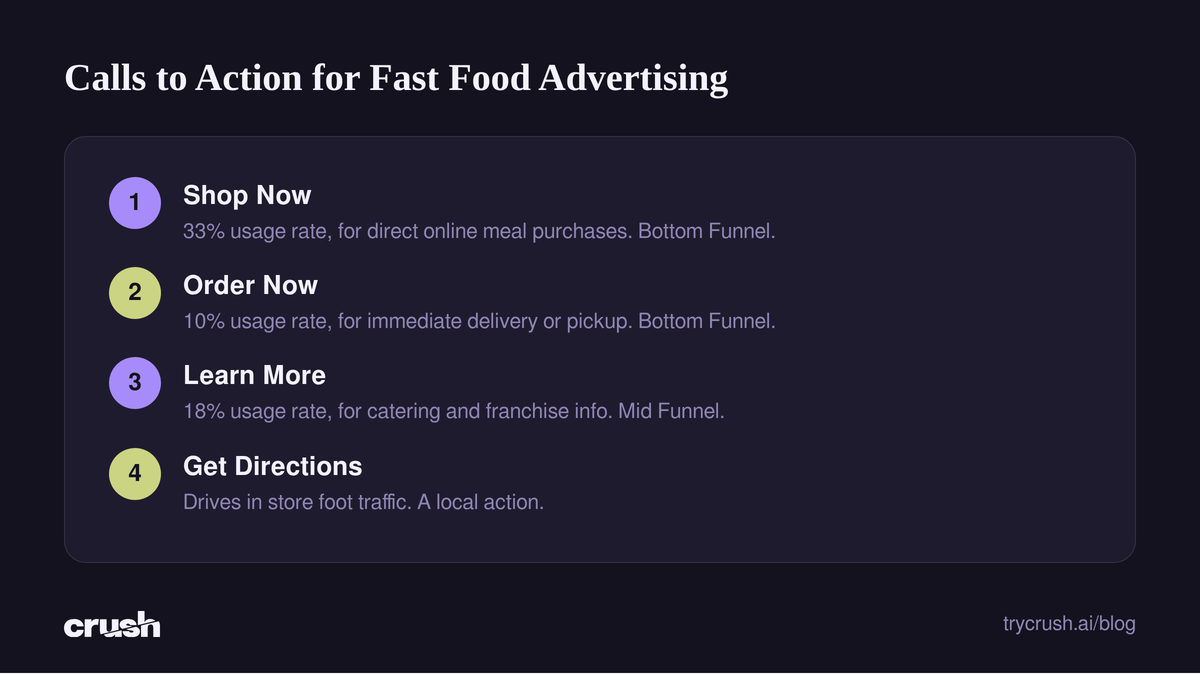
The most effective fast food ads use clear, immediate action verbs. We analyzed the calls to action across our database to see what drives real orders in 2026. The data shows a massive preference for direct purchase intent.
The most common CTA buttons on "food" ads are shop now (33%), learn more (18%), and order now (10%). This distribution highlights a critical rule in fast food campaigns: Do not ask users to browse if your goal is an immediate meal purchase.
Below is a breakdown of how these CTAs function in modern media buying.
| CTA Button | Usage Rate | Primary Campaign Goal | Funnel Stage |
|---|---|---|---|
| Shop Now | 33% | Direct online meal purchases | Bottom Funnel |
| Learn More | 18% | Catering and franchise info | Mid Funnel |
| Order Now | 10% | Immediate delivery or pickup | Bottom Funnel |
| Get Directions | N/A | In store foot traffic | Local Action |
The Power of Relaunching Ads
Our platform tracks duplicate counts, which tells you how many times an advertiser re-launched the same creative. A high duplicate count is a massive signal of a winning ad. Media buyers simply do not duplicate losing creatives.
Take the travel and food tour company GetYourGuide. One of their top ads has been running 95 days and was relaunched 229 times. They use the CTA "book travel" to capture intent.
Their opening line reads: “Book from 150,000+ things to do in your destination with skip-the-line tickets, food tours, water activities, and more.” This aggressive duplication strategy forces Facebook to spend budget across multiple ad sets while maintaining the exact same winning creative format.
How to Structure a High Converting Fast Food Advertisement
Structuring ads for fast food requires a hyper-specific visual hook and an immediate path to purchase. The goal is to trigger hunger and remove friction from the checkout process. You need a mix of product clarity and localized context.
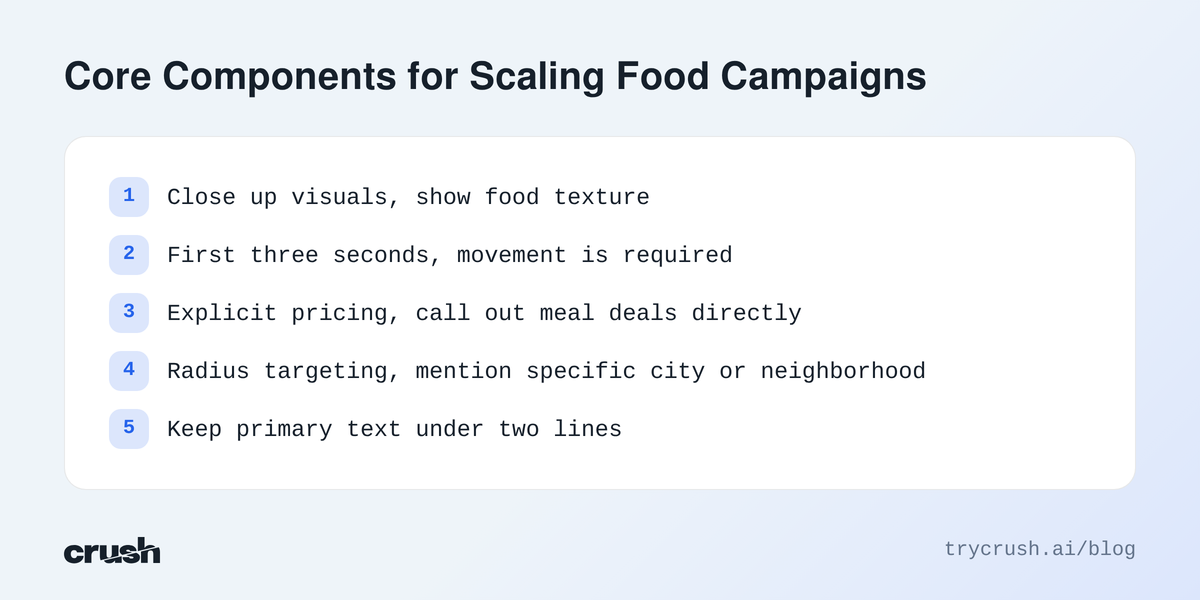
Media buyers in 2026 use a very specific checklist for these campaigns. Here are the core components required to scale food campaigns successfully.
- Close up visuals: Show the texture of the food. Burgers need visible cheese melt. Fries need visible salt.
- First three seconds: Movement is required. Pouring sauce or a bite being taken stops the scroll.
- Explicit pricing: Call out meal deals directly in the creative. Do not make users click to find the price.
- Radius targeting: Mention the specific city or neighborhood in the primary text to capture local attention.
If you are building an advertisement for fast food, your creative strategy must ensure the copy supports the visual. Keep the primary text under two lines. Let the video or image do the heavy lifting.
Our AI can generate ad-creative iterations from a winning reference ad, allowing you to test multiple text hooks against a single strong video automatically.
Bidding Strategies for Advertising Fast Food
The correct bidding strategy dictates whether your campaigns will be profitable or burn cash. In 2026, highest volume bidding works best for broad local awareness, while cost cap bidding protects your margins on direct delivery orders.
Say your target CPA is $15 for a family meal delivery. Using a cost cap ensures Facebook only delivers impressions when the algorithm predicts a conversion under that strict threshold. This is crucial for fast food advertising where profit margins are razor thin.
Dayparting and Budget Pacing
Dayparting involves scheduling your ads to run only during specific hours. For fast food, this usually means ramping up spend right before lunch and dinner. However, modern Facebook algorithms often perform better with continuous delivery.
Instead of hard scheduling, we recommend adjusting your budget dynamically. Facebook machine learning needs continuous data to optimize. Pausing campaigns every night disrupts the learning phase and resets your optimization. Leave the campaigns running and let the algorithm learn exactly when your users actually click and convert.
What Are the Biggest Mistakes in Advertising Food?
The most expensive mistake in fast food advertising is rotating creative too quickly. Advertisers get bored of their own ads long before the local audience does. This leads to killing profitable campaigns just as they exit the initial learning phase.
Another major error is failing to use local context. National generic ads perform poorly on a hyper local level. You must tailor the message. Here are the most common traps media buyers fall into today.
- Overcomplicating the offer: Forcing users to download an app before they can see the menu creates massive drop off.
- Weak visual contrast: Dark or poorly lit food photography looks unappetizing on mobile screens.
- Ignoring competitor history: Failing to research what local competitors have already tested costs thousands in wasted spend.
- Killing ads early: Turning off an ad after three days because the initial CPA is slightly high.
Ignoring Longevity Signals
Killing ads too early is a systemic issue across the industry. Remember that the average run time for top food ads is 110 days. If you turn off your campaigns after two weeks, you are actively fighting the algorithm.
This is where strict automation becomes mandatory. Our platform scales winners based on statistical significance, not human emotion. If an ad meets the KPIs, it scales. If it fails over a statistically valid window, the AI automatically kills it.
How to Steal Competitor Strategies for Fast Food Advertisements
You can reverse engineer your competitors by studying their ad history and takedown data. Meta provides basic transparency, but tracking actual longevity and duplicate counts requires a specialized ad library. You need to see not just what is active right now, but what ran for a year and generated real revenue.
You can explore these historical trends yourself in our free public ad library at https://trycrush.ai/ad-library. Looking at this data lets you skip the expensive testing phase and start with proven creative frameworks.
If you want our platform to handle the media buying completely, our paid plans start with a trial. You can view current details at https://trycrush.ai/pricing.
Analyzing International Food Campaigns
Great media buying strategies cross borders. By analyzing international food ads, you can find creative angles your local competitors have never seen. Our database holds incredible examples of extreme ad longevity from around the world.
Take the Thai meal prep service AM Healthy Food. Their ad ran 1504 days and was relaunched just once. They use the CTA "message page" to generate direct leads. Their opening line translates to a clear value proposition: “คอร์สอาหารควบคุมน้ำหนัก AM Healthy Food จัดส่งถึงบ้านหรือที่ทำงานคุณได้ทั่วประเทศแล้วค่า 😄 ✔️เราจัดอาหารโลว์คาร์บ ให้ทานแบบไม่ซ้ำเมนู ✔️เราจัดส่งให้คุณถึงที่บ้”
Similarly, international pet food brands show identical longevity patterns. The brand kito.pet has an ad running 1241 days, relaunched once, using the CTA "shop now". Their opening text focuses heavily on farm freshness: “Çiftliğimizden sevdiklerinize! Karkas Çiftliği bünyesindeki yemyeşil yaylalarda serbest dolaşan besi hayvanlarından üretilen Kito; hem besleyeci hem de oldukça ”
Another great example is Henne Pet Food Danmark. Their ad ran 921 days, was relaunched once, and used the CTA "watch more" to educate customers. These global examples prove that when you find a winning food ad, you leave it alone for years.
Testing Frameworks for Advertising Fast Food
Testing creative is the foundation of profitable advertising fast food. You cannot guess what your local market wants to eat. You have to buy the data. In 2026, the most efficient testing framework isolates variables one at a time.
Start by testing three distinct visual angles. Try one video showing the food preparation, one static image of the final meal, and one user generated style video of a customer eating. Keep the primary text and headline identical across all three variations. This ensures that any change in performance is strictly due to the visual asset.
Once you identify the winning visual, you iterate. We take the proven visual and test five different text hooks against it. This systematic approach guarantees you are always moving toward lower acquisition costs without guessing.
Local Reach vs Direct Conversions
Many local restaurant owners struggle with choosing the right campaign objective. Facebook offers awareness, traffic, and sales objectives. For fast food advertisements, you must align the objective with your actual business goal.
If you run a franchise and just need people to know you opened a new location, a local awareness campaign can work. Say your budget is $20 a day. Awareness objectives will buy you massive cheap impressions within a five mile radius. However, these impressions rarely translate to trackable online orders.
If you want actual delivery orders, you must use a sales objective optimized for conversions. Facebook will show your ads specifically to local users who have a history of clicking order now or shop now buttons. The cost per thousand impressions will be higher, but the return on ad spend will be measurable.
How we got this data
The numbers in this article come from Crush’s ad library: 1,837,933 unique Facebook ads tracked via the Meta Ad Library, 443,544 of them active at the time of writing. Ad examples reference real advertisers and their public ads. Data queried on 2026-08-22. Third-party product facts are attributed inline to their sources.
Frequently Asked Questions
Common questions about this topic
1What is the best call to action for fast food ads?
2How long should a fast food ad run?
3Should I use awareness or conversion objectives for a restaurant?
4How do you test new fast food creatives?
About this article
This article was written with AI assistance. Ad examples and ad data come from the Crush ad library.
Written by
Rokas Steponavičius
Founder, CEORokas is the Founder and CEO of TryCrush.ai, an ex-IBM professional turned entrepreneur focused on building AI-driven growth platforms. With a strong background in ecommerce, performance marketing, media buying, and artificial intelligence, Rokas specializes in creating scalable, data-led systems that drive measurable revenue. His mission is to help modern businesses leverage AI to optimize acquisition, conversions, and long-term profitability.
Stop Guessing.
Start Crushing.
AI Ad Manager trained by world-class media buyers to generate your creatives and optimize your ads 24/7.
Learn more
Related articles
How to Add Branding to Meta Ads That Actually Convert
Most advertisers ruin their return on ad spend by overcomplicating their visual identity. Here is how to integrate branding into your creatives to drive direct response.
The 2026 Guide to Profitable Advertisement Makeup Campaigns
Discover exactly how long winning makeup ads run, which calls to action drive sales, and the exact copy frameworks used by top cosmetics brands.
How to Hire a Facebook Ads Freelancer That Actually Delivers
Most freelancers promise the world but fail to deliver. Discover the battle-tested framework to find, vet, and hire a media buyer who understands strategy and creative. Includes job templates and interview scripts.
Different Types of Ads: 2026 Data on What Converts
Stop guessing which ad formats work. We analyzed over 1.8 million Facebook ads to find exactly which types of ads generate profitable returns in 2026.