

Key Takeaways
- 1AI broad targeting finds cheaper conversions than manual interest audiences
- 2Dynamic creative testing personalizes modular assets for higher CTRs
- 3Predictive bidding targets high-probability users in real-time to maximize ROAS
- 4Automated kill switches instantly pause underperforming ads to save budget
- 5AI ad creation combats fatigue by generating fresh ad variations instantly
Your competitors are using AI to automate their ads while you tweak manually. Learn the 7 ways AI algorithms optimize targeting, creative testing, and bidding 24/7 to steal your customers before you even bid.
There is a reason your CPA (Cost Per Acquisition) is rising.
It’s not just "inflation." It’s not just "bad luck." And it’s certainly not because Facebook is "dead."
It’s because you are bringing a knife to a gunfight.
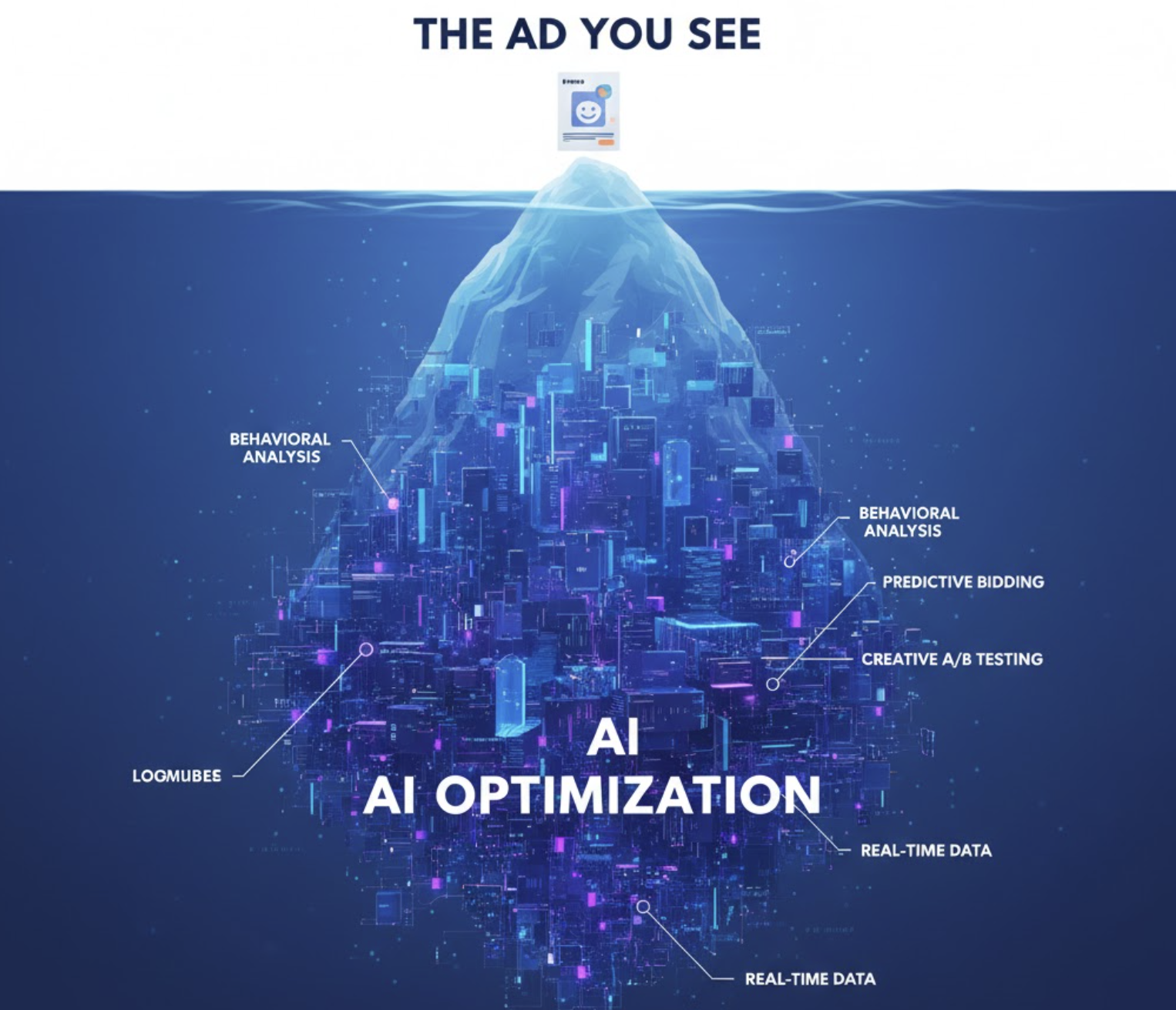
While you are sitting in front of your laptop, manually tweaking your ad sets, refreshing your dashboard, and agonizing over whether to turn off an ad or let it run for "one more day," your smartest competitors have handed the keys over to AI Facebook ad optimization algorithms.
These algorithms are working 24 hours a day, 7 days a week. They don't sleep. They don't eat. They don't take weekends off. They are making thousands of micro-decisions every single hour, decisions that are invisible to the naked eye but devastating to your bottom line.
They are stealing your best customers before you even have a chance to bid on them.
If you've ever wondered why your competitor seems to be scaling effortlessly while you are grinding for every sale, this is the answer. Here are the 7 ways AI is quietly eating your lunch, and exactly how it works.
1. The "Invisible" Audience Expansion
You think you know your customer. You have built a persona. You target:
Women, 25-34
Interest: Yoga
Location: New York
You feel smart because you narrowed it down.
Your competitor doesn't target interests. They use Broad Targeting. They trust the AI Meta ads algorithm to find the customers for them.
Here is what happens in the background: The AI analyzes millions of data signals that you can't see. It looks at scrolling speed, click history, video watch time, and even the brightness of the user's screen.
It notices that people who buy your competitor's yoga mat aren't always yoga enthusiasts. A huge chunk of them are actually "Gardeners" who suffer from back pain. The AI spotted a behavioral pattern, a specific type of scrolling hesitation on health-related content, that links these two groups.
While you are fighting tooth and nail for the expensive "Yoga" audience (where the CPMs are $30+), the AI is finding cheap conversions in the "Gardening" audience (where the CPMs are $10) because it spotted a correlation you missed.
The result? Your competitor gets the same customer for a third of the price.
2. Dynamic Creative Testing on Steroids
How many creative tests do you run a week? Three? Five? Maybe ten if you have a big team?
Your competitor's AI is testing 300 combinations an hour.
Using the Dynamic Creative framework, they are not uploading finished ads. They are uploading modular assets. They upload:
10 headlines
10 primary texts
10 images
10 videos
The machine then mixes and matches them dynamically in real-time. It serves "Headline A" with "Image B" to a teenager in California. It serves "Headline C" with "Image A" to a retiree in Florida.
It learns that the teenager responds to "social proof" (reviews), while the retiree responds to "safety" (guarantees). It creates a personalized ad for every single user, maximizing the click-through rate (CTR) for each segment.
You are showing the same generic ad to everyone. The AI is whispering exactly what each person wants to hear.
3. Predictive Bidding (The Sniper Approach)
Manual bidding is like throwing a grenade into a room and hoping you hit something. You set a bid cap or a cost cap based on your average performance.
AI bidding is a sniper shot.
An autonomous AI media buying agent doesn't just bid based on the past. It bids based on the future. It predicts the probability of a conversion for a specific user at a specific millisecond.
Let's look at two scenarios:
User X is online. The AI calculates: "User X has a 90% probability of buying this product right now because they just visited 3 competitor sites and added an item to cart." The AI bids aggressively, maybe $5 for that single impression, because it knows the return is guaranteed.
User Y comes online. User Y looks similar, but the AI calculates only a 10% probability of purchase because their credit card was declined yesterday. The AI bids $0.10 or doesn't bid at all.
You, with your manual bid, might win the impression for User Y and lose the impression for User X. You are paying for the "trash" traffic that the AI rejected.
4. The "Kill Switch" Protocol
You go to sleep at 11 PM. Your ads keep running.
At 2 AM, something happens. Maybe the news cycle changes. Maybe a competitor launches a flash sale. Maybe your site goes down for 10 minutes.
Your ads keep spending. You wake up at 7 AM to find you wasted $500 overnight on a dud that got zero sales.
Your competitor's AI ad campaign has a safety net. It utilizes a Kill Switch protocol.
The moment an ad's performance dips below a specific threshold (e.g., "Spend > $50 with 0 Purchases"), the AI pauses it. Instantly. Automatically.
It doesn't "hope" it gets better. It ruthlessly cuts the loss.
This efficiency compounds. Over a month, your competitor saves thousands of dollars in wasted spend. They take that saved money and reinvest it into their winning ads, accelerating their growth while you are bleeding cash.
5. Cross-Platform Intelligence
You are likely looking at Facebook in a silo. You check your Facebook ROAS. You check your Google ROAS.
AI looks at the entire ecosystem.
Advanced AI ads platforms integrate data from Google, TikTok, YouTube, and email marketing. They build a holistic view of the customer journey.
The AI knows that User Z watched 50% of your YouTube ad yesterday. It knows they are now "primed." When User Z logs into Facebook today, the AI serves them a "retargeting" ad, even if you didn't manually set up a retargeting audience.
It understands the multi-touch attribution path in a way that a siloed human buyer never could. It knows exactly when to push and when to pull back across different channels to maximize the overall blended ROAS.
6. Automated Scaling (Riding the Wave)
Scaling is the hardest part of media buying. It’s emotional.
When an ad starts to go viral, every second counts. You see the sales coming in. You think, "Is this real? Should I scale? What if I break it? Maybe I'll wait until tomorrow to double the budget."
By the time you decide to scale tomorrow, the viral moment might be over.
The AI sees the trend line immediately. It confirms the statistical significance within hours. And it scales aggressively.
It rides the wave all the way to the top, performing vertical scaling by increasing the budget by 20%, 30%, or 50% every few hours as long as the CPA holds steady. It squeezes every drop of revenue out of that trend.
And the moment the trend turns? The moment the CPA starts to creep up? It pulls back just as fast.
It maximizes the upside and minimizes the downside, capturing value that manual buyers miss because they are too slow or too scared.
7. Generative Refreshes (The Anti-Fatigue Shield)
Creative fatigue is the silent killer of ad accounts. Eventually, everyone has seen your ad. The frequency gets too high. Performance drops.
Usually, this means you have to scramble to get your designer to make new ads. It takes days.
Your competitor uses AI ad creation to automatically generate "remixed" versions of their winners.
The AI takes the winning image and changes the background color. It crops it differently. It overlays a new headline. It changes the aspect ratio from 1:1 to 9:16.
It generates 20 "fresh" versions of the winning ad instantly.
It keeps the ad fresh without lifting a finger, maintaining high ROAS for months instead of weeks. The audience thinks they are seeing new content, but it's really just the same winning concept in a new outfit.
The Arms Race: How to Fight Back
This sounds terrifying. And it should be.
This is not a fair fight. Competing against an autonomous AI media buying agent with manual tools is like trying to outrun a Ferrari on a bicycle. You might be a great cyclist, but the machine is just physically capable of things you are not.
The gap is widening every day. The algorithms are getting smarter. The competitors are getting faster.
So, what can you do?
You can ignore it. You can complain about it. You can hope it goes away.
Or you can equip yourself with the same weapons.
You can adopt AI marketing platform tools that give you these capabilities. You can accept that the media buyer is dead and start being an "AI Architect" who manages the machine.
The technology is available to everyone, not just the Fortune 500. But you have to make the decision to switch.
The choice is yours. But know this: The AI is already running. And it’s coming for your market share.
Frequently Asked Questions
Common questions about this topic
1How does AI optimize Facebook ads better than manual bidding?
2What is the difference between broad targeting and interest targeting?
3How does AI help with ad creative fatigue?
Written by

Rokas Steponavičius
Founder, CEORokas is the Founder and CEO of TryCrush.ai, an ex-IBM professional turned entrepreneur focused on building AI-driven growth platforms. With a strong background in ecommerce, performance marketing, media buying, and artificial intelligence, Rokas specializes in creating scalable, data-led systems that drive measurable revenue. His mission is to help modern businesses leverage AI to optimize acquisition, conversions, and long-term profitability.
Stop Guessing.
Start Crushing.
AI Ad Manager trained by world-class media buyers to generate your creatives and optimize your ads 24/7.
Learn more
Related articles

"My Ads Are Dead": How to Revive Fatigued Campaigns with AI
Ad fatigue kills more businesses than bad products. Discover how autonomous AI agents can bring dead campaigns back to life using the "CPR Protocol" instead of starting from scratch.
The Ultimate Facebook Advertising Strategy for 2026
Hacks don't build businesses, systems do. Discover the ultimate Facebook advertising strategy for 2026, featuring the "Super CBO" method, 3-2-2 testing, and CAPI integration to scale profit in any market condition.
Facebook Ads vs. AI Ads: The 2026 Showdown
Manual media buying is dead. We pit traditional Facebook Ads against the new wave of AI Ads in a 5-round battle covering setup time, optimization, and scalability. Discover why autonomous agents are the future of advertising.

The Silent Takeover: How AI Advertising is Replacing Agencies
The Mad Men era is over. Welcome to the Math Men era, where AI advertising is rapidly replacing traditional agencies. Discover how algorithms are driving higher ROAS, testing hundreds of creatives, and transforming the future of digital marketing.