
Active· since Jun 4, 2026
- 99
- days running
- 0
- relaunches
Ad copy
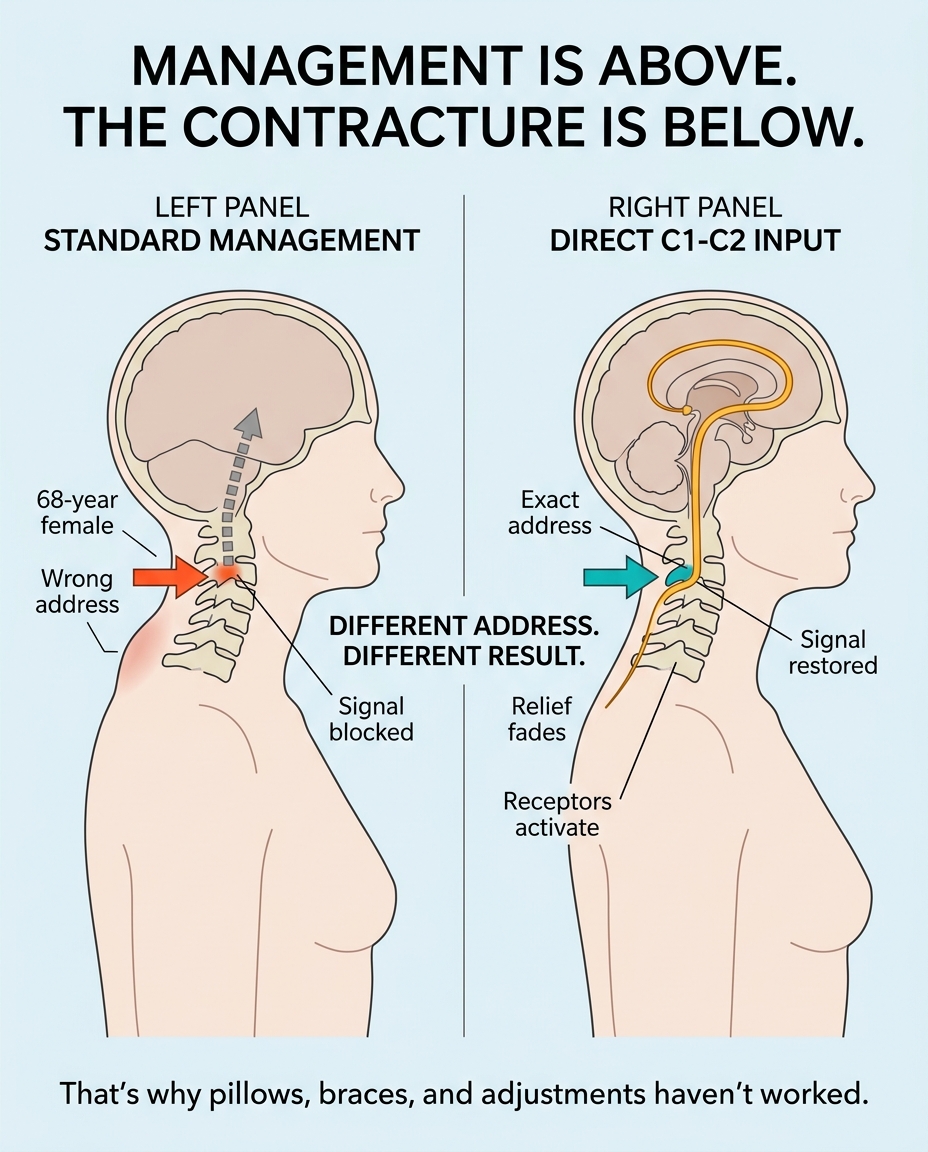
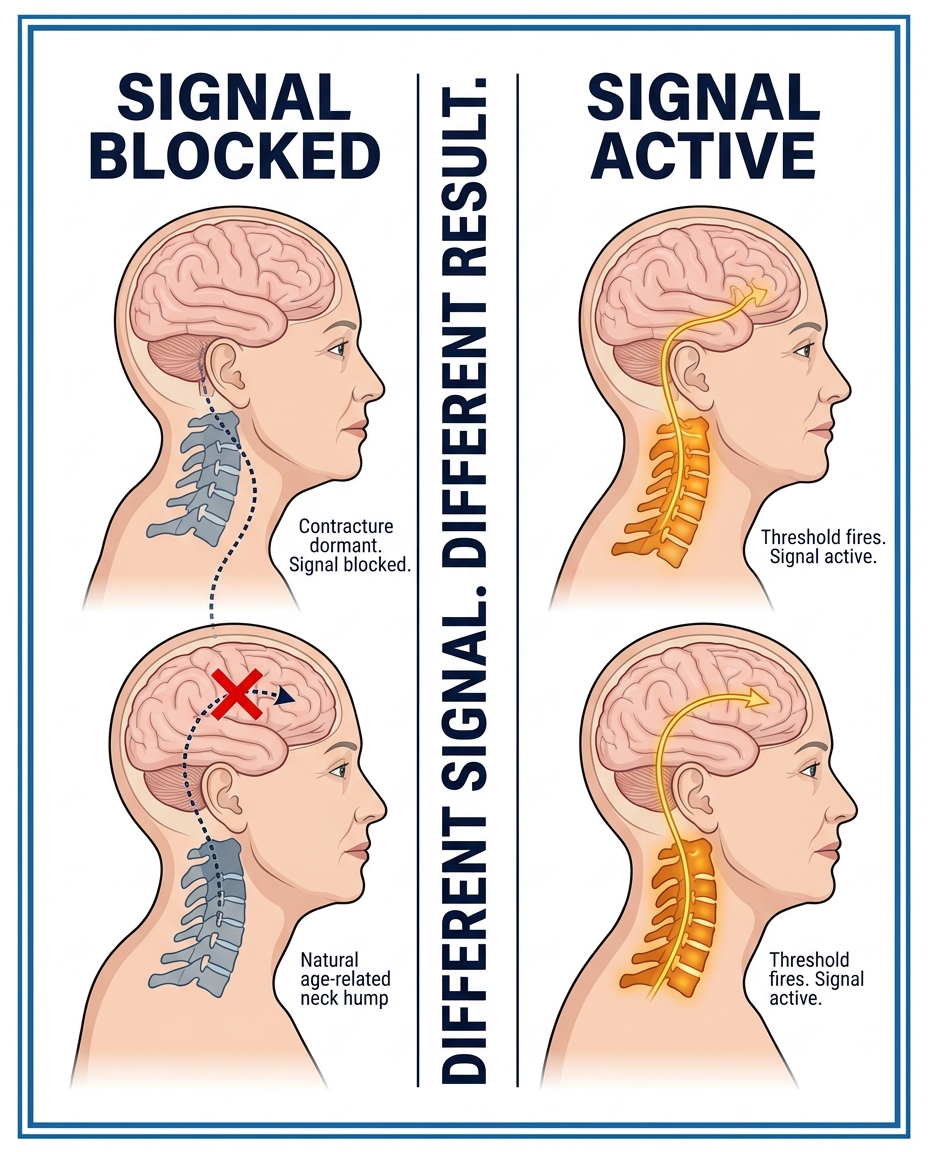
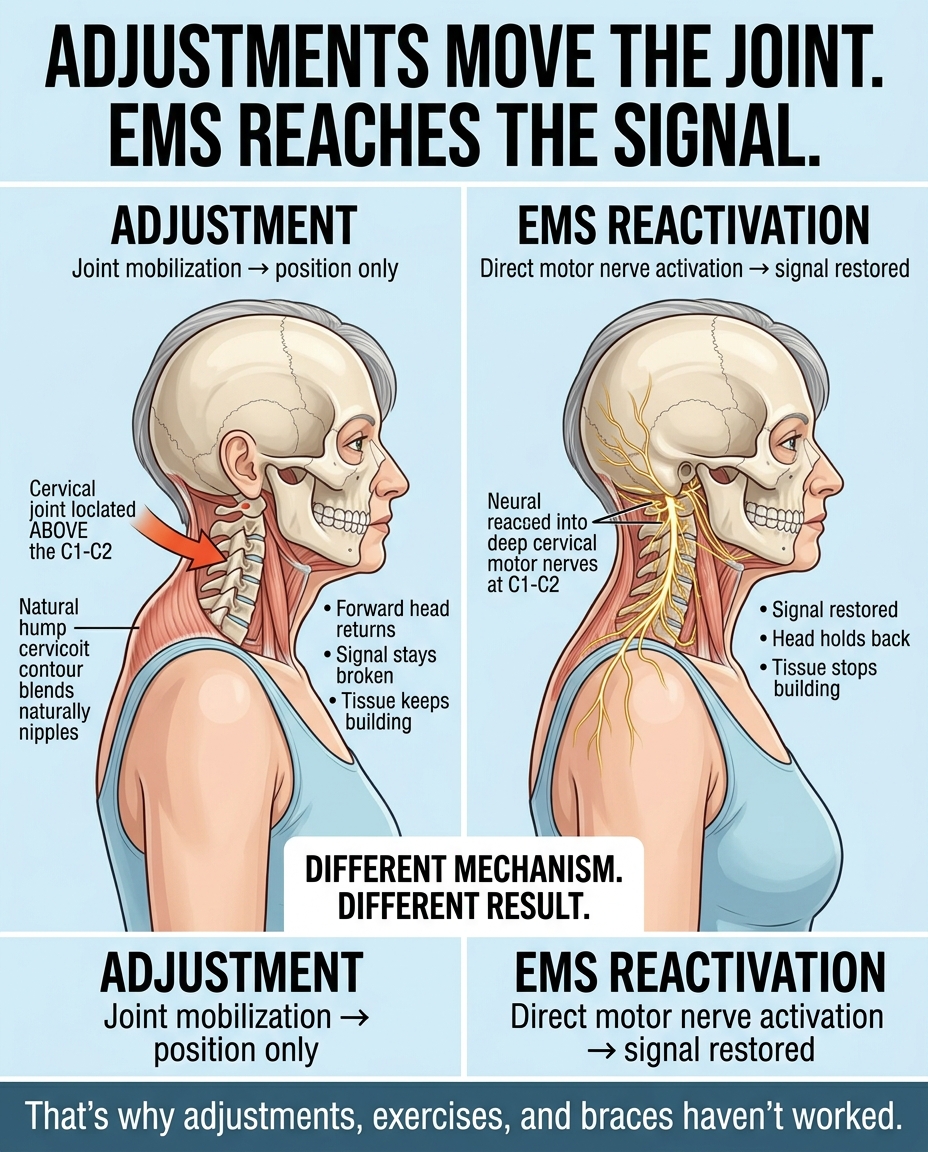
"My Neck Hump Has Been Growing for 3 Years. Five Practitioners. Zero Results." My neck hump has been growing for three years. Not a posture issue from a bad chair. Not a temporary thing from too much screen time. A slow, persistent, visible buildup at the base of my neck that shows up in every photo, gets worse every season, and has made every person in my life ask me the same question at least once: "Are you okay? That looks different." I'm 52 years old. I've been careful about my posture my entire adult life. And my neck looks like someone who has never thought about posture once. Let me tell you about the practitioners. Practitioner #1: My primary care. She looked at my measurements. Normal range. No structural issue. "Probably posture habits." Recommended a posture app and screen time reduction. Eight weeks later: still progressing. Worse, actually. Especially after long drives and sitting at my desk. Practitioner #2: A chiropractor. Full assessment. Mild forward head compensation. "That's probably it." Twice-weekly adjustments and a home exercise sheet. I did the adjustments. Did the exercises. Reduced screen time. Rearranged my entire desk setup. Progressed every month. Practitioner #3: A physical therapist. Full cervical evaluation: normal range of motion. Functional strength: adequate. She said, "It might be postural habit compensation." Gave me a resistance band protocol and a chin tuck program. I did those exercises religiously for three months. The progression didn't change. Not even a little. She added a second protocol. Then a third. Then said, "Some cases are just hard to treat." Some cases are just hard to treat. That's what $800 in specialist copays gets you. Practitioner #4: A cervical specialist. She assessed my deep cervical muscle activation. Said it was significantly reduced. "Consistent with neuromuscular inhibition." I said, "But I've been doing my exercises." She said, "That's why I call it inhibition. The muscles are switched off. The exercises are asking them to respond to a signal that isn't reaching them. You can do the exercises perfectly and the inhibited muscles never fire." Three years. Four practitioners. Posture habits, exercises, adjustments, three protocols. And it was the signal the whole time. She put me on a structured clinical reactivation program. 40 minutes, three times a week. "Intensive neuromuscular reactivation. Give it three months." I gave it three months. The progression slowed maybe 20%. The tissue buildup went from rapid to gradual. The morning tightness went from severe to moderate. 20% better after three months of three-weekly clinical sessions. She added manual therapy. Added taping. Told me to change how I slept, stop sitting after 6 PM without support, avoid all trigger positions. I did everything. Everything. I followed the protocol to the letter like my career depended on it — because it does. I'm a project manager. I lead meetings. I present to clients. And I do it all while calculating every neckline, every photo angle, every mirror I pass. Six months of maximum clinical therapy and I was still progressing. Still building. Still that maddening visible tissue at the base of my neck that wasn't supposed to be there. Practitioner #5: A second cervical specialist. She ran a full assessment. Deep cervical activation was still significantly below threshold. "Consistent with ongoing neuromuscular inhibition." She said, "Inhibition is notoriously difficult to treat with surface-level approaches. Direct reactivation works for some people. Some people need intensive intervention. Some people just learn to manage it." Learn to manage it. Manage a neck hump that makes colleagues notice. Manage a wardrobe that has quietly reorganized itself around one problem. Manage the calculation that runs automatically every morning before I've had my coffee. Manage the embarrassment of avoiding photos at every family gathering, every work event, every occasion that matters. I drove home and sat in my driveway for twenty minutes. Here's what nobody explained until I researched it myself: Neuromuscular inhibition is different from regular posture problems. With a posture habit, your muscles are working but working incorrectly — you can retrain them. With neuromuscular inhibition, the brain has shut the deep cervical muscles off entirely. The signal that was supposed to hold your head back isn't reaching them. So the head drifts forward. The body builds compensatory tissue at the base of the neck to absorb the constant forward load. The tissue up there has no resistance mechanism of its own. Your muscles were supposed to provide that resistance. Your deep cervical muscles are supposed to hold the load. Your surface muscles? They compensate for a while. Then they give out. So even small amounts of continued forward load cause massive tissue accumulation — month after month, year after year. And here's the critical part: exercises and adjustments address the position. But the signal — the brain-muscle connection — remains broken even when the position is temporarily corrected. Exercises ask the inhibited muscles to respond to a signal that isn't reaching them. Adjustments move the joint above the inhibited muscles. So you can do the exercises perfectly and do the adjustments faithfully and STILL have ongoing signal failure driving the progression. That's why I got 20%. They addressed the position but not the signal. And they didn't reach the inhibited motor nerves where the failure was actually occurring. For the next year, I tried every approach the cervical rehabilitation forums recommended: Cervical traction — used it daily. Decompressed the joint. Never reached the motor nerves. No signal change. Postural bracing — wore it consistently. Held the position. Gone the moment I took it off. McKenzie protocol — followed it precisely. Temporarily improved range of motion. Back to baseline within 48 hours. Dry needling — targeted the tight muscles. Helped surface tension. Never reached the inhibited deep fibers. Foam roller protocols — released the surface tissue. Gone in minutes. Cervical pillows — supported the position during sleep. My practitioner called it "passive assistance." Nothing changed. Every approach had the right idea. Every one failed because of targeting. Surface approaches went to the wrong layer. Manual therapy mobilized the wrong structure. Exercises asked the wrong muscles to respond. Nothing reached the inhibited deep cervical motor nerves directly enough to matter. Then a woman in my cervical health support group posted something that stopped my scrolling. "I found something that actually reaches the inhibited motor nerves. It's an EMS device. You use it for 15 minutes. You can feel it reaching the deep layer on the way through. It's the first thing that actually gets there." I'd read hundreds of device recommendations in that group. I'd ignored most of them. But "actually gets there" — that phrase got me. Because nothing had ever gotten there. She posted the specifications. I recognized every parameter from my rehabilitation history: Direct electrical muscle stimulation. Motor nerve pathway targeting. 8 unique programs for different stages of inhibition. 19 adjustable intensity levels. 15 minutes, whenever it suits you. Engineered specifically for the deep cervical musculature. All of it. In one device. Designed to bypass the broken brain-muscle signal entirely and force the inhibited motor nerves to activate directly. Not a brace that holds the position around the inhibition. Not an exercise that asks inhibited muscles to respond. Not an adjustment that mobilizes the joint above without reaching the signal below. A direct electrical pulse that reaches the inhibited tissue and forces activation. Obviously I was skeptical. I'd spent $4,000+ on approaches that failed. But the 90-day money-back guarantee meant the worst case was another $70 down the drain. I ordered it at 10 PM because I'd just calculated my outfit for the third time that morning and realized I hadn't worn an open neckline in fourteen months. Fourteen months. Because of tissue buildup driven by signal failure that five practitioners took three years to properly name. First session: I used it for 15 minutes before bed. The activation was immediate and physical. The electrical pulses have a sensation — targeted, reaching, penetrating the layer that nothing else had reached. I could feel it working at a depth that no surface approach had ever touched. And then — after I took it off — a different quality to how my neck was holding itself. Something had shifted. That was the difference. It reached the right layer. I went to bed that night — still skeptical, because I had been skeptical for three years — and noticed that the forward pull I always felt when I lay down was slightly quieter. Not gone. But quieter. I woke up at 5:30 AM and the morning tightness that used to take until noon to resolve had already mostly cleared. Day 3: The daytime forward pull dropped from constant to occasional. Not zero. But I noticed because I wasn't repositioning myself during a meeting and my colleague looked at me like something was different. Day 7: I got dressed without the calculation. For the first time in over a year. I reached for a blouse I hadn't considered in months. I put it on. I looked in the mirror. It looked right. My husband sent me a message from downstairs: "You look like yourself today." He didn't know what that message meant to me. Week 3: The morning tightness was gone. The one that used to last until noon — the constant forward pull that made my family notice before I'd even had my coffee. Gone. Week 5: I went to a family event. I was in the photos. At the front. Not at the edge. Not calculating my angle. My sister kept looking at me. After twenty minutes she said, "You seem different." I hadn't even been thinking about it. That's how gone the calculation was. Week 8: I stopped the bracing protocol. The one that never worked anyway. The one I'd been wearing out of desperation for two years. Stopped it. Nothing changed. Because the progression was never about position. It was about signal. And now the signal was being restored. Week 12: My practitioner assessed me again. The forward head position and tissue measurements had visibly improved. She asked what changed. I showed her the device. She looked at the specifications. Looked at me. Said, "This makes sense. These are the parameters that should be reaching the motor nerves. I don't know why nobody delivers them in a targeted home device." I said, "Someone finally did." I ordered two more from her parking lot. I will never be without this. My mother called me last week. We talked for 45 minutes. She didn't ask about my neck once. Because there was nothing to ask about. My husband says I'm different now. Not different in a way he can explain. Different because the constant self-monitoring, the positioning, the calculation that had been the background music of our life together is quieter now. My colleague at work pulled me aside and said, "Whatever you're doing, keep doing it. You carry yourself like a completely different person." I am a completely different person. I'm the person I was before the progression stole three years of my confidence. Sorry this is so long. But I spent three years being told I had a posture habit. Then muscle weakness. Then structural compensation. Then a "difficult case." Five practitioners. Three protocols. Seven approaches. $4,000+. And not one person told me my deep cervical motor nerves needed direct electrical activation — not just position management. Cevera is the first thing that reached the inhibited tissue and stayed there. Because it delivers a direct electrical signal to the motor nerves. And direct electrical activation is the only approach that makes sense when the failure is in the signal, not the position. Thank you for giving me my neckline back. For giving me quiet mornings. For giving me meetings without the calculation and photos without the positioning and mirrors I can pass without bracing myself. It still blows my mind. — Christine D. 👉 Try Cevera Risk-Free: https://trycevera.com/pages/adv2-womens-wellness-report 🛡️ 90-Day Money-Back Guarantee ⚡ 8 unique programs · 19 intensity levels · Direct cervical EMS 💡 15 minutes — direct motor nerve activation for deep cervical reactivation
Like this ad? Make it yours.
Crush rebuilds this exact creative around your product — your brand, your colors, your offer — in about a minute.