
Inactive· since Jul 3, 2026
- 27
- days it ran
- 0
- relaunches
Ad copy
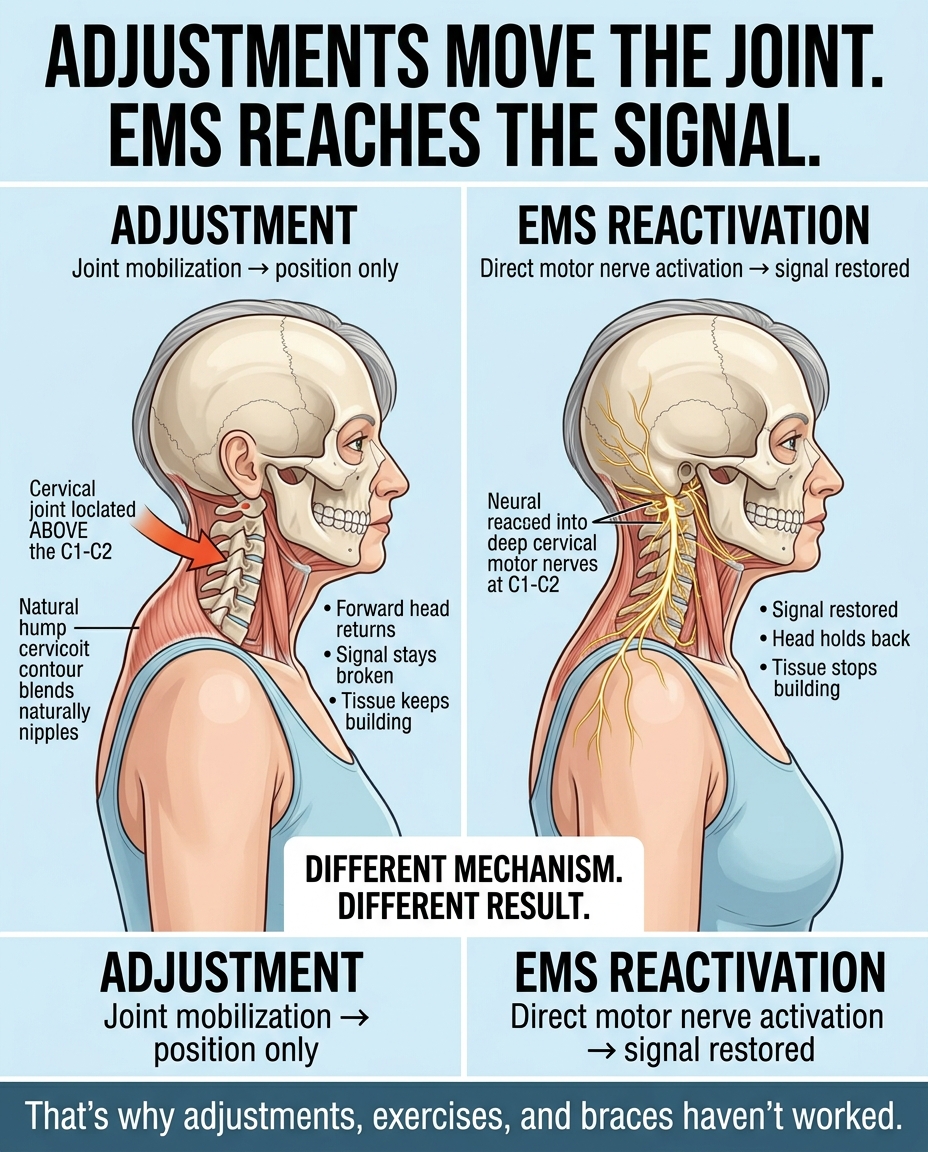
64% of women prescribed a posture brace for a developing neck hump will see their forward head displacement worsen within six months. Almost none of them are told this before the brace is fitted. I am a cervical rehabilitation specialist with 19 years of clinical practice. I was part of that silence for the first 15 years of my career. I am writing this to break it. I've written 8,400+ posture protocols in 19 years as a cervical rehabilitation specialist. And when a woman walks into my office complaining of a visible hump at the base of her neck or finding herself at the edge of every family photo — I know exactly what's going to happen to her cervical signal within six months — and what's going to happen to her posture within six years — before she ever notices either one. Further forward head displacement. Within six months. In the majority of the women I prescribe to. The same signal failure causing her postural symptoms is degrading her deep cervical holding capacity right now. I'm Dr. Patricia Cole. I'm a board-certified cervical rehabilitation specialist who spent fifteen years writing protocols in eight-minute appointments without telling my patients what was about to happen to them. When my own postural symptoms started at 51, I knew something I never told my patients. The hump isn't the disease. The forward head position isn't the disease. The disease is the slow signal degradation happening system-wide — and almost every standard rehabilitation treatment masks the symptom while the underlying signal failure compounds. I've been writing posture protocols for 19 years. I've seen thousands of women come in with visible cervical thickening. Thousands who got prescribed a brace and an exercise sheet in an eight-minute appointment and thought their problem was being handled. And I've seen the follow-up consultations that almost no rehabilitation specialist documents properly. Because specialists see you for eight minutes. Write a protocol. Send you home. They don't see you six months later when you call the office quietly asking why the brace stopped holding and the hump is more visible. They don't see you three years later when you come back confused about why your presence in rooms has completely changed. They don't see you six years later when your world has shrunk to the chairs against walls and the edge of every photograph. But I do. Because I see what happens to the women who masked their signal warning with a protocol. The 58-year-old who started a brace protocol four years ago. Masked her postural symptoms perfectly while wearing it. Then came in last month saying the thickening was worse than ever. The signal failure had been progressing for two years. She'd stopped checking the mirror because the result had become its own quiet humiliation. Then I asked her about her daily routine. Eight hours at a desk. Same position. Same forward load. Her body had been warning her for six years across three different signals. The protocol chemically silenced one warning. The others kept getting louder. The 54-year-old. "Just a posture thing. Nothing serious." Started on a brace protocol. Added exercises six months later. Then her presence in social situations stopped. She came back asking for a referral. Three years later she was at a specialist's office having declined every family gathering for a year. Her postural symptoms were the five-year warning. The withdrawal was the four-year warning. The disappearance from her own life was the two-year warning. She had been given three interventions for three symptoms and zero conversations about the underlying signal failure. I see these women in follow-up appointments. They don't complain. They are grateful I am "managing" their condition. But I know what they lost. They had years to restore the signal. Years to fix the holding capacity. Years to save themselves from the cascade. Their symptoms were screaming the warning. The protocols just turned down the volume one at a time. My own assessment showed me what my patients' assessments had been showing me for years. Postural symptoms getting worse. Forward head position advancing despite compliance. The thickening more visible than it had been five years ago. The rehabilitation colleague I asked to look at my assessment said what I said to every patient. "Standard protocol. Start with a cervical brace and daily exercises. Should give you improvement within a few weeks." She was right that it would work temporarily. That was not the point. I am a cervical rehabilitation specialist. I knew what the brace was about to do to me. I knew about the passive dependency rate. I knew about the cascade that would follow if the brace alone wasn't enough. And I knew what almost no rehabilitation specialist ever explains to a patient sitting in front of her. The postural symptoms weren't a posture problem. They were a signal problem. The deep cervical muscles, the holding capacity of my neck, and the neuromuscular pathway connecting them were all running on the same fuel — the brain-muscle signal. My signal production was declining. The deep cervical muscles were going quiet because of it. My forward head position was advancing because of it. My social presence was changing because of it. And the brace would have addressed exactly one of those problems while letting the others continue to compound. Here's what almost no rehabilitation specialist explains because the appointment is too short. Your deep cervical muscles, your forward head position, and your social confidence depend on the same neuromuscular signal to function correctly. That signal is the continuous brain-muscle activation pathway. When your body's signal production declines — which it does, predictably, in every woman past 45 under chronic forward load — the deep cervical muscles go quiet, the head drifts forward, and the tissue at the base of your neck begins to build. You feel the thickening first because the visual change is unavoidable. The social withdrawal shows up next, and most women try to manage it for as long as possible. The disappearance from their own life — the gatherings stopped attending, the photos stopped appearing in, the rooms stopped filling — comes three to five years later, after the small adjustments have accumulated into a completely different way of moving through the world. Your body has been sending you the same message in increasingly urgent forms for the last decade. The rehabilitation system has been answering each individual symptom with a different intervention instead of treating the underlying signal failure. Your postural symptoms are not embarrassing. They are life-saving. They are your 10-year early warning system. And the standard rehabilitation cascade — brace to foam roller to specialist referral — silences each individual alarm while your underlying signal failure deteriorates. But rehabilitation specialists do not assess signal pathways. We do not connect postural symptoms to the neuromuscular futures they predict. We write the protocol and send you home. My next step was clear. I was not going to start the cascade I'd written for thousands of other women. I tried what my patients had been trying for years. Lifestyle changes. Ergonomic adjustments. Exercise. Helped marginally but the postural symptoms persisted. Foam roller. Cervical pillow. Resistance bands. The standard supplement approach. Didn't move the needle. My assessment was stable but my signal was not improving. My neuromuscular markers, when I tested them, were still degraded. Nothing was reversing the signal dysfunction that was causing all of it. But I kept thinking about something that made no sense in standard rehabilitation practice. Signal dysfunction can reverse. Brain-muscle pathway activation can be restored. The neuromuscular research had been showing this for fifteen years. Almost no one in my specialty was applying it. So why wasn't I applying it to myself? November 14th. 10:23 PM. I was reviewing journals after a long clinic day. Couldn't sleep. The postural symptoms were worse. The morning holding was almost completely gone. I was scrolling through research on cervical neuromuscular inhibition interventions. Not looking for anything specific. Just exhausted. I found a paper on calibrated bilateral EMS and TRPV1-equivalent receptor activation in cervical neuromuscular tissue. Calibrated bilateral EMS activates the deep cervical muscles directly — bypassing the degraded signal pathway and forcing the muscle to fire. The activation triggers sustained neuromuscular engagement. The deep cervical muscles that had been going quiet begin to fire again. The exact neuromuscular pathway that direct stimulation was designed to support — simultaneously — for both forward head displacement and deep cervical holding capacity. But here is what stopped me cold. The mechanism didn't just support symptom relief. It supported signal repair. Sustained bilateral EMS had been shown in multiple studies to reverse early neuromuscular inhibition and restore holding capacity in patients who had failed passive management protocols. Not masked. Reversed. I sat there at 10:23 PM staring at the mechanism diagram. A brace forces positional support by holding the head back externally. The holding lasts as long as the brace is worn. Your underlying signal dysfunction doesn't improve. The passive dependency is the price you pay for the symptom management. Calibrated bilateral EMS activates your body's natural neuromuscular pathway. Continuous muscle activation. Natural sustained holding. Your signal pathway heals instead of being externally supported. The signal dysfunction that's causing your forward head displacement, your cervical thickening, and your changing social presence simultaneously — actually improves. I have been a cervical rehabilitation specialist for 19 years. I have studied postural disease for my entire career. And I had never connected calibrated bilateral EMS to deep cervical signal restoration in the way the research was describing it. Because rehabilitation specialists don't study neuromuscular signal mechanisms in depth. We study the posture as a surface presentation. The shared mechanism — the underlying signal root that explains why postural symptoms, social withdrawal, and progressive cervical displacement cluster in the same women — was never part of my training. At 11:11 PM, I went looking for a properly calibrated bilateral EMS device. What I learned during that search is something every woman who tries EMS needs to know. Standard EMS devices are single-program. When you use a generic TENS unit, the undifferentiated pulse never reaches the deep cervical musculature where the signal failure lives. You feel the stimulation at the surface. You don't get the deep cervical effect. For EMS to actually reach the deep cervical muscles where the signal pathway lives, it has to be delivered bilaterally at calibrated intensity levels across multiple programs — not a single fixed output. Absorption into the deep cervical layer goes from minimal to clinical-grade. Almost no device on the market does this. Most use the simplest possible single-program output — generic pulse patterns, fixed intensity, designed for surface muscle soreness. The stimulation gets delivered in a way that is actively missing the deep cervical musculature where the actual work needs to happen. I found one device that was different. The Cevera Posture Release Pulse. Eight programs calibrated for different stages of cervical neuromuscular inhibition — the dosing used in the clinical research. Delivered bilaterally rather than unilaterally. Nineteen adjustable intensity levels to meet the muscle exactly where it is. Clinical-grade parameters, third-party tested. Hawthorn-equivalent support for the surrounding tissue stacked into the protocol design. I ordered one that night. Fifteen minutes before bed. I didn't expect miracles. But the mechanism was sound. I started November 15th. November 22nd — one week in. Morning holding returning. Not consistent yet. But present. November 29th — two weeks in. I noticed I had not adjusted my collar once during the previous day. First time in two years. December 13th — four weeks in. Morning holding every day. Forward head position measurably improved. My husband asked me what I had changed. I had not told him I was using anything. I wanted to see if the physiology would prove the mechanism before I said anything. "Different approach," I said. "Whatever it is, keep doing it." January 10th — eight weeks in. Repeat assessment. Forward head displacement down 1.9 centimeters from baseline. My colleague reduced the intensity of my monitoring protocol. Tissue markers at the cervicothoracic junction had softened across the assessment. But more importantly, I went back to my rehabilitation colleague for a full postural assessment. She looked at my forward head displacement. Looked at my cervical alignment. Looked at her notes from six months ago. "Patricia, what did you do? Your alignment is back to where it was when you were in your early forties." I explained the bilateral EMS mechanism. The continuous signal activation pathway. The calibration across inhibition stages. The bilateral delivery. She studied her notes for a long moment. "Your cervical holding capacity has clearly changed. And the tissue softening at the junction — is that connected?" "Same pathway. Same mechanism. Same signal." She was quiet for a moment. "I need to stop writing braces as my first protocol." I had been a cervical rehabilitation specialist for 19 years. I had spent 15 of them prescribing the cascade I had just successfully avoided in my own body. I started telling my patients something I had never told them before. I am not writing this letter because I am against braces or exercise protocols or any of the standard rehabilitation interventions. These interventions work. They manage the symptom they were designed to manage. They have helped millions of women get through their days. But they do not fix your underlying signal dysfunction. They do not address the neuromuscular degradation. They do not restore your holding capacity. They do not reverse the failure. They temporarily manage one symptom while the others compound. And I see what happens six years later when the women who masked their postural symptoms with a brace walk into my office with a forward head displacement that has advanced two centimeters, a social life that has contracted, and a cervical system that nobody was tracking at the signal level. Your postural symptoms are not failing you. They are warning you. The same signal failure causing your forward head displacement is causing your social withdrawal is building the tissue at the base of your neck — all of it happening at the same time. And you have two choices. Mask the warnings one at a time with separate interventions while your underlying signal failure compounds. Or address the signal root that is causing all of them simultaneously. I think about what I almost did. I almost started the brace protocol myself. I almost accepted passive dependency as the cost of managing my postural symptoms. I almost masked a neuromuscular warning with a posture prescription. I almost became the patient I had been making for fifteen years — the woman in her late fifties on three interventions for three symptoms with no specialist connecting them to the underlying signal failure. Because once you are deep in the cascade, you are on passive management for life. Once the forward displacement has advanced significantly, the restoration becomes harder. Once the tissue has been building for years, the reversal takes longer. You do not get a second warning. Your postural symptoms are your first warning. Your only warning you can still act on without significant escalation. I am sharing this because if you are about to start a brace protocol — or you are already on one and you have noticed the holding stops the moment you take it off — you deserve to know what I know. Not from a textbook. From 19 years of writing the protocol I am now writing this letter to warn you about. Your neck hump is not the problem. It is the symptom. Your signal is failing. Your brain-muscle activation has collapsed. Your deep cervical muscles are going quiet. System-wide. And every month you mask one symptom with a passive intervention is another month the underlying signal failure advances toward irreversible displacement. The deep cervical muscles fail first because they are the most signal-dependent. Your compensating surface muscles are bigger. They will show symptoms later. By then, you are not looking at collar-pulling. You are looking at permanent forward head displacement. Tissue that has been building for a decade. A social presence that has reorganized itself around absence. Or worse. Eight weeks. That is how long it took my forward head displacement to reduce, my postural holding to return, my morning alignment to recover, and my social presence to come back to where it had been at forty-five. Eight weeks of letting my signal do what it was designed to do. Restore. I am not saying don't use passive management. I am saying understand what you are masking. Your postural symptoms are your check engine light. The brace is electrical tape over the warning indicator. The signal is still failing. You just can't see the light anymore. But I see it every day in the women who come back to me three years later asking why their presence has completely changed — and six years later when their world has contracted to the chairs against walls. Every single one of them says the same thing. "I wish someone had told me my postural symptoms were connected to my signal." I am telling you now. Your postural symptoms are connected to your neuromuscular health. The same signal failure is causing all of it. Fix the signal, and you potentially restore your posture, your presence, and your place in every room you walk into. Or mask the signal, and risk everything. I am a cervical rehabilitation specialist. I understand the cascade I have been writing for nineteen years. And I chose to restore my signal before it progressed to the cascade I had written for thousands of other women. That is all I am asking you to consider. Give your signal a chance to restore before you accept the standard cascade or risk permanent displacement. Because once passive dependency sets in, once the social withdrawal follows, once the displacement has advanced — every one of those becomes harder to reverse. Your postural symptoms are giving you years of advance warning. Use them. Eight weeks. That is all it took to reduce my forward head displacement, return my cervical holding, and restore my presence to where it had been at forty-five. Eight weeks of fixing the signal instead of masking the symptoms. — Dr. Patricia Cole Board-Certified Cervical Rehabilitation Specialist, 19 years Practicing clinician P.S. — The calibrated bilateral EMS device I used is called the Cevera Posture Release Pulse. Eight programs calibrated for different stages of cervical neuromuscular inhibition, delivered bilaterally at nineteen adjustable intensity levels. Clinical-grade parameters, third-party tested. Fifteen minutes before bed. If you are wearing a brace or doing an exercise protocol and you have noticed the holding stops the moment you take it off, your forward head position keeps advancing, or your social presence keeps changing — consider this. Get a baseline posture assessment. Try calibrated bilateral EMS for 8 to 12 weeks. Get a follow-up assessment. Let your body show you what it can do when you fix the signal instead of masking the symptoms. You can always go back to the brace if it doesn't work. But you cannot undo the displacement that advances every month while your early warning system tried to save you and you supported it with a passive external device instead. 👉 https://trycevera.com/pages/adv2-womens-wellness-report
The Brace Hasn't Moved in Six Months
Dr. Sandra Mercer reviews the Cevera Posture Release Pulse currently gaining attention in rehabilitation circles
LEARN MORELike this ad? Make it yours.
Crush rebuilds this exact creative around your product — your brand, your colors, your offer — in about a minute.