
Inactive· since Jun 2, 2026
- 27
- days it ran
- 3
- relaunches
Ad copy
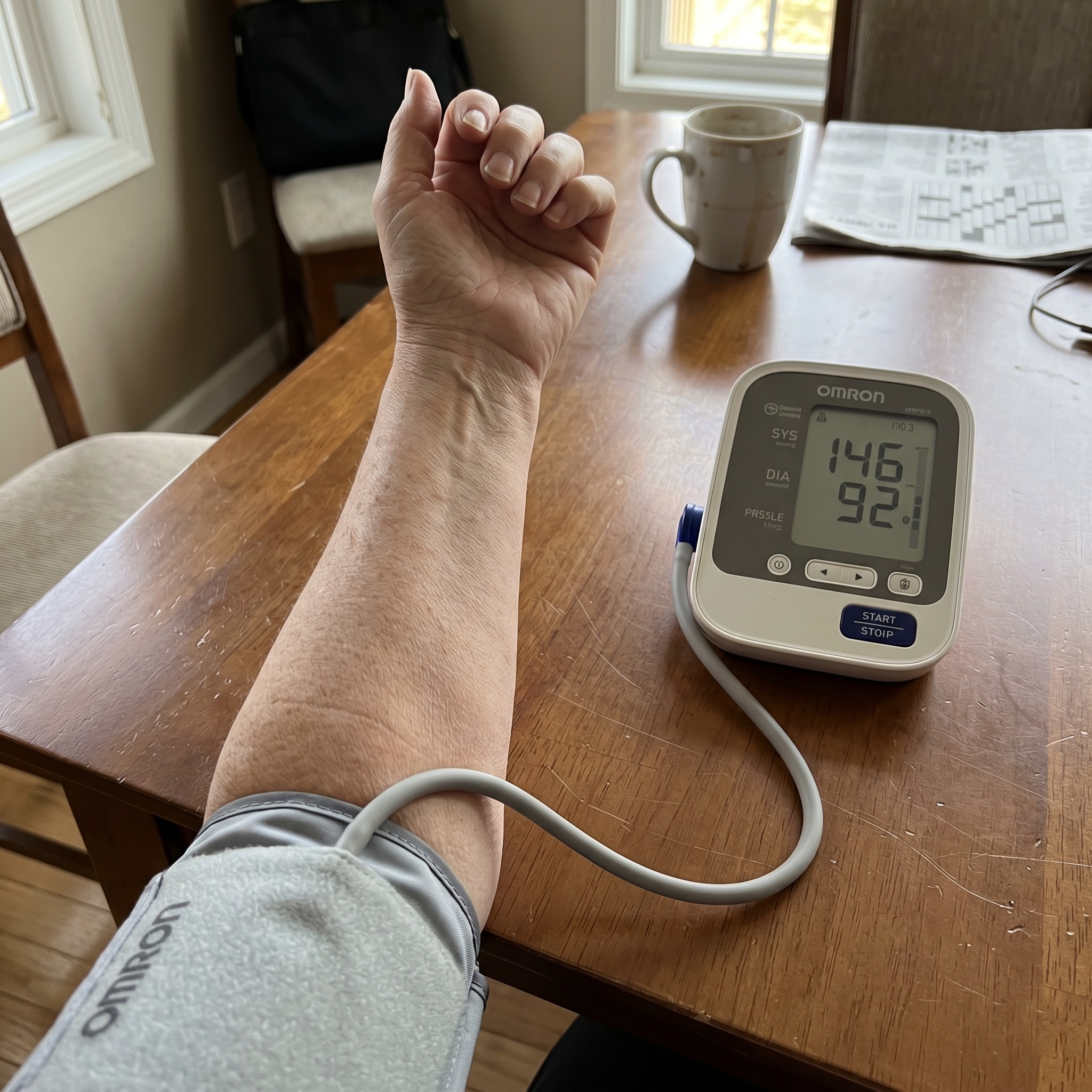
I was making my Christmas card list at the kitchen table in October when I realized I'd crossed off 4 names this year. Three from heart attacks. One from a stroke. All men. All my husband's age. All gone within the same calendar year. I sat there with my pen hovering over the list and I looked across the kitchen at Earl eating Cheerios in his pajamas and I felt something cold move through my chest. Earl had no idea I was watching him. He was reading the back of the cereal box like he does every morning. Same chair. Same bowl. Same blue plaid pajamas Holly bought him for Christmas in 2021. And I sat there and I thought, you're going to be next. I thought it just like that. You are going to be next and there is nothing I am doing to stop it. My name is Patricia. Most people call me Patty. I'm 62 years old. I worked for the United States Postal Service for 34 years, the last 18 of those out of the Erie, Pennsylvania main office on Peach Street, and I retired in May of 2023 with a pension and a bad back and a lot of free time I didn't quite know what to do with. Earl and I have been married for 38 years. We have one daughter, Holly, who lives in Pittsburgh and is a paralegal, and one son, Brendan, who lives 20 minutes from us and runs a small landscaping business he started after high school. Earl is 64. He drove a delivery truck for Pepsi for 30 years and his back is worse than mine. He retired in 2022. We live in the same 3 bedroom house off East 38th Street that we bought in 1991 for 68,000 dollars and that's worth God knows what now and we don't care because we're not selling it. This is where we live and this is where we'll die, and that's where the story really starts. Because in 2024, in the span of 11 months, I started crossing names off my Christmas card list at a pace I have never seen in my life. January, Dale Hochberg. Heart attack. 67. He was Earl's bowling buddy from the Tuesday night league at Eastland Bowl. They'd bowled together since 1998. Dale slumped over at the lane between frames and was gone before the ambulance got there. Earl was standing right next to him. April, Tom Wisniewski. Heart attack. 63. Tom was Earl's neighbor growing up. They'd reconnected at a high school reunion in 2009 and stayed in touch ever since. Tom went out to shovel his driveway after a late spring snow and his wife Linda found him face down in the snowbank at the end of the driveway. July, Greg Marchetti. Stroke. 65. Greg ran the body shop where Earl took his Silverado. He'd been complaining about headaches for a week and his wife kept telling him to go to the doctor and he kept telling her he was fine. He wasn't fine. September, Jim Bonifacio. Heart attack. 62. Jim was my cousin Linda's husband. He was the youngest of the 4. He went to bed on a Sunday night after dinner and didn't wake up Monday morning. By October, when I sat down to make my Christmas card list, all 4 of those names were already crossed off in the address book. And I realized something that made me put my pen down. Every single one of those men had been on blood pressure medication. Every. Single. One. Dale was on something I can't pronounce. Tom was on lisinopril. Greg was on something his wife called "the water pill plus another one." Jim was on amlodipine and his cardiologist had just bumped up his dose 6 months before he died. All of them were being "managed." All of them had numbers their doctors were tracking. All of them were doing what they were told. And all of them were dead before 68. I sat at that kitchen table for a long time. Earl finished his cereal and put the bowl in the sink without rinsing it the way he always does and went into the living room to watch the Today show. And I picked up my pen and I started writing the Christmas cards. But I couldn't focus. Because Earl is on the same blood pressure medicine Dale was on. Earl's last numbers, from his physical in August, were 152 over 94. His doctor had said, "Earl, we need to get you under 140 over 90. I'm going to add a second medication. Let's recheck in 90 days." Earl had nodded. Earl always nods. Earl trusts his doctor the same way he trusts his mechanic, which is to say completely and without question. We picked up the new prescription at the Rite Aid on Buffalo Road the next week. Earl takes 2 pills now. Morning and night. And in October, sitting at that kitchen table, watching him watch the Today show in the next room, I realized something. Those 4 men I'd just crossed off my Christmas card list had all been on 2 pills too. Some of them on 3. I want to back up here for a second because I'm not a person who panics. I worked in a federal job for 34 years. I've seen ice storms shut down half of Erie in February and I've kept the mail moving. I am not a person who jumps to conclusions. But I'm also not a person who ignores patterns. And the pattern in front of me was getting hard to ignore. I went into the bedroom and got my laptop and I sat back down at the kitchen table and I started reading. I read about blood pressure. I read about what high blood pressure actually does to your body over time. I read about the medications that are prescribed for it. I want to tell you what I learned, but I want to tell you slowly, because I think this is the part most women don't get told, and it took me weeks to really understand it. Here's what I figured out. Blood pressure medication does one thing. It lowers the number on the cuff. That's it. It doesn't fix the reason the number is high in the first place. It manages the symptom. The underlying issue, the thing that actually makes your blood pressure climb in the first place, is something happening at the level of your blood vessels themselves. The inner lining of your arteries, called the endothelium, is supposed to be smooth and flexible. When you're 25, it's like the inside of a brand new garden hose. When you're 62, after decades of stress and processed food and oxidative damage, that lining gets stiff and inflamed. Stiff arteries don't expand and contract the way they should. So your heart has to push harder. So the pressure goes up. So the doctor puts you on a pill that forces the number down. But the artery is still stiff. The lining is still damaged. The underlying terrain is still rotting underneath, and meanwhile the cuff says 132 over 84 and everyone says "great, you're doing great." This is why men on blood pressure medication still have heart attacks. This is why men on 2 pills, 3 pills, the whole regimen, still die at 63. The medication is managing the number. It's not managing the problem. I read this and I closed my laptop and I went and sat on the bed for a while. Because I realized that Earl's doctor, who I like, who is a perfectly nice man, had never once mentioned the lining of Earl's arteries. He'd mentioned numbers. He'd mentioned medication. He'd mentioned "managing the condition." Nobody had said anything about what was actually happening inside Earl's chest. I called my sister Marjorie that night. Marjorie lives in Buffalo. She's 5 years older than me, 67, and she's the smartest person I know. She used to teach high school chemistry. She reads research papers for fun. I told her about the Christmas card list. I told her about Earl's numbers. I told her about what I'd read. She was quiet for a long time. Then she said, "Patty, do you remember Aunt Esther?" Aunt Esther was our mother's older sister. She lived in Cleveland. She died in 2018 at 91 years old. She never had a heart attack. She never had a stroke. She lived alone until she was 89 and only moved into assisted living because she fell off a step stool changing a light bulb. I said yeah, of course I remember Aunt Esther. Marjorie said, "Esther used to take this thing. From India. Mom used to send it to her. They both took it for years." I said I had no idea what she was talking about. Marjorie said our grandmother, who came over from Slovenia in 1922, had picked up the habit somewhere in the 1950s when she lived in Pittsburgh and worked at a hospital cafeteria. There was an Indian family who ran a market on the corner and the grandmother in that family had told my grandmother about a fruit they used back home. For everything. For energy, for digestion, for the heart. It was called Amla. My grandmother had started taking it. She'd lived to 94 and died in her sleep with her teeth still in her mouth. My mother took it. She'd lived to 88 and died of cancer, not anything cardiac. Aunt Esther took it. 91. Marjorie said, "I've been taking it for about 6 years." I almost dropped the phone. I said, "What?" She said, "Yeah. I started after Bob died." Bob was Marjorie's husband. He died of a heart attack in 2018. He was 64. "I went down a rabbit hole after the funeral and I remembered what Mom used to take, and I looked into it, and I've been taking it ever since." I said why didn't you tell me? She said, "Patty, I tell you everything. You don't listen to half of it." She wasn't wrong. I asked her to tell me everything about it. She did. She spent 2 hours on the phone with me that night walking me through what she'd learned over 6 years of reading about it. Amla, also called Indian gooseberry, is a small green fruit that grows in India. It's been used in their traditional medicine, called Ayurveda, for over 2,000 years. Specifically for what they call the heart channel and for circulation and for what they describe as "youth of the blood vessels." Modern research, Marjorie said, has started catching up with what they've known for centuries. What Amla appears to do, based on what's been studied, is support the inner lining of the blood vessels. The endothelium. The thing nobody's doctor talks about. It's loaded with polyphenols and a particular form of vitamin C that the body actually uses, plus a class of compounds called tannins, that work together to support what researchers call vascular health. The flexibility of the arteries. The smoothness of the inner lining. The body's natural ability to manage oxidative stress in the cardiovascular system. When the lining of your arteries is healthier, the arteries themselves work better. They expand and contract the way they're supposed to. The heart doesn't have to push as hard. And the number on the cuff, the one everyone is so focused on, often starts to reflect that underlying improvement. It's not a drug. It's not a replacement for whatever your doctor has you on. It's something different. It works on the terrain. Marjorie said something that stuck with me. She said, "Patty, the medication is mopping up the water on the floor. Amla is fixing the leak." I sat on that for a week. I didn't tell Earl. I didn't tell anybody. I just kept thinking about Dale and Tom and Greg and Jim. I kept thinking about how all 4 of them had been mopping the floor. In late October I ordered a bottle of Alevia Amla. Marjorie had told me that was the brand she'd settled on after trying a few different ones, because of how concentrated their extract is and because of how cleanly they source it. A lot of supplements that say Amla on the bottle have barely any actual extract in them. Alevia uses a proper concentration. The kind that matches what the research is actually talking about. It came on a Friday. I sat with the bottle in my hand at the kitchen table and I tried to figure out how to tell Earl. Earl is not a supplement person. Earl is a "if my doctor didn't prescribe it, I'm not taking it" person. So I didn't tell him. I started taking it myself first. Just to see. I'd had my own blood pressure issues for years. Nothing dramatic, but it had been creeping up. My last reading was 138 over 86. The nurse at my doctor's office had said, "We'll keep an eye on it." I took it every morning with my coffee starting November 1st. After 3 weeks I started feeling different. I don't know how else to describe it. I felt warmer. Like my hands and feet had blood in them again. I hadn't realized how cold I'd been until I wasn't. I was sleeping better. Not falling asleep faster, but staying asleep. I'd been waking up at 3 in the morning for years and I wasn't anymore. I was less puffy in the mornings. My ankles. My fingers. My face. The puffiness I'd just accepted as part of being 62 was gone. In late November I went to my doctor for an unrelated thing and the nurse took my blood pressure as part of the standard check-in. 124 over 78. She did it twice because she thought she'd made a mistake. I sat in that exam room in a paper gown and I almost cried. I went home that night and I told Earl. I told him everything. The Christmas card list. The 4 men. The 4 a.m. panic at the kitchen table. Marjorie. Aunt Esther. My grandmother. The bottle. Earl listened the whole time without saying anything. Then he said, "Why didn't you tell me before?" I said because I was scared he wouldn't take it seriously. He said, "Patty. I lost Dale. I'm not stupid." He started taking it the next morning. It's been 5 months. Earl's last reading at the doctor was 134 over 82. Down from 152 over 94. His doctor wanted to know what he was doing differently. Earl told him. The doctor said, "Well, whatever you're doing, keep doing it." Earl bowls on Tuesdays again. He took a break for a while after Dale died, and now he's back. He says he can feel the difference when he's standing at the lane. He doesn't feel as tired in his chest, is how he put it. I'm going to say something here that I've thought a lot about. I'm not a doctor. I'm not telling you to stop your medication. I'm not telling you this is going to work the same way for you. I'm not promising anything. What I'm telling you is what I learned, sitting at my kitchen table in October, looking at 4 names crossed off a Christmas card list. The number on the cuff is not the whole story. The medication is mopping the floor. There is something else you can do that works on the leak. That something has been used for 2,000 years by people who lived long lives without dying of heart attacks at 63. And it's not expensive, and it's not complicated, and it doesn't replace what your doctor has you on, it works alongside it. Alevia Amla is the brand I take, and the brand Earl takes, and the brand Marjorie takes. I'm not going to tell you it's the only brand that exists. I'm going to tell you it's the one that's been studied, sourced cleanly, concentrated properly, and backed by a 90 day money back guarantee that I asked about specifically because I am a former federal employee and I trust nothing. The guarantee is real. You take it for 90 days. If nothing changes, you send it back, you get every dollar of your money back. No arguments. That was the part that made me try it in the first place. Because at 62 years old, I am not throwing money at things that don't work. I've already thrown enough money at fish oil and turmeric and CoQ10 and magnesium and a dozen other things my friends swore by. I needed something that would either work or give me my money back. It worked. I'm sending out Christmas cards this year and I'm going to send one to Marjorie and I'm going to write inside it, "Thank you for saving my husband's life." Because I really do believe that's what she did. I want you to think about your Christmas card list this year. I want you to think about how many names you've crossed off in the last 2 years. I want you to think about who's still on it. And I want you to think about whether the floor is wet because the floor is wet, or because there's a leak. P.S. I'm sitting at my kitchen table writing this. Earl is in the next room watching the Today show in his blue plaid pajamas. He just finished his Cheerios. He's 64 and he's not going to be next. P.P.S. The 90 day guarantee is the only reason I tried it. I want you to know that's not a marketing line. I called and asked. They confirmed it. You take it for 90 days, you don't notice anything, you send the bottle back, you get refunded. Every cent. P.P.P.S. If Earl can take it, you can give it to your husband. Just put the bottle on the counter next to his coffee mug and don't say anything. He'll figure it out. P.P.P.P.S. Dale, Tom, Greg, Jim. I think about you every day. I'm sorry I didn't know sooner. 👉 https://alevia.com/amla/33
Like this ad? Make it yours.
Crush rebuilds this exact creative around your product — your brand, your colors, your offer — in about a minute.