
Inactive· since May 26, 2026
- 29
- days it ran
- 4
- relaunches
Ad copy
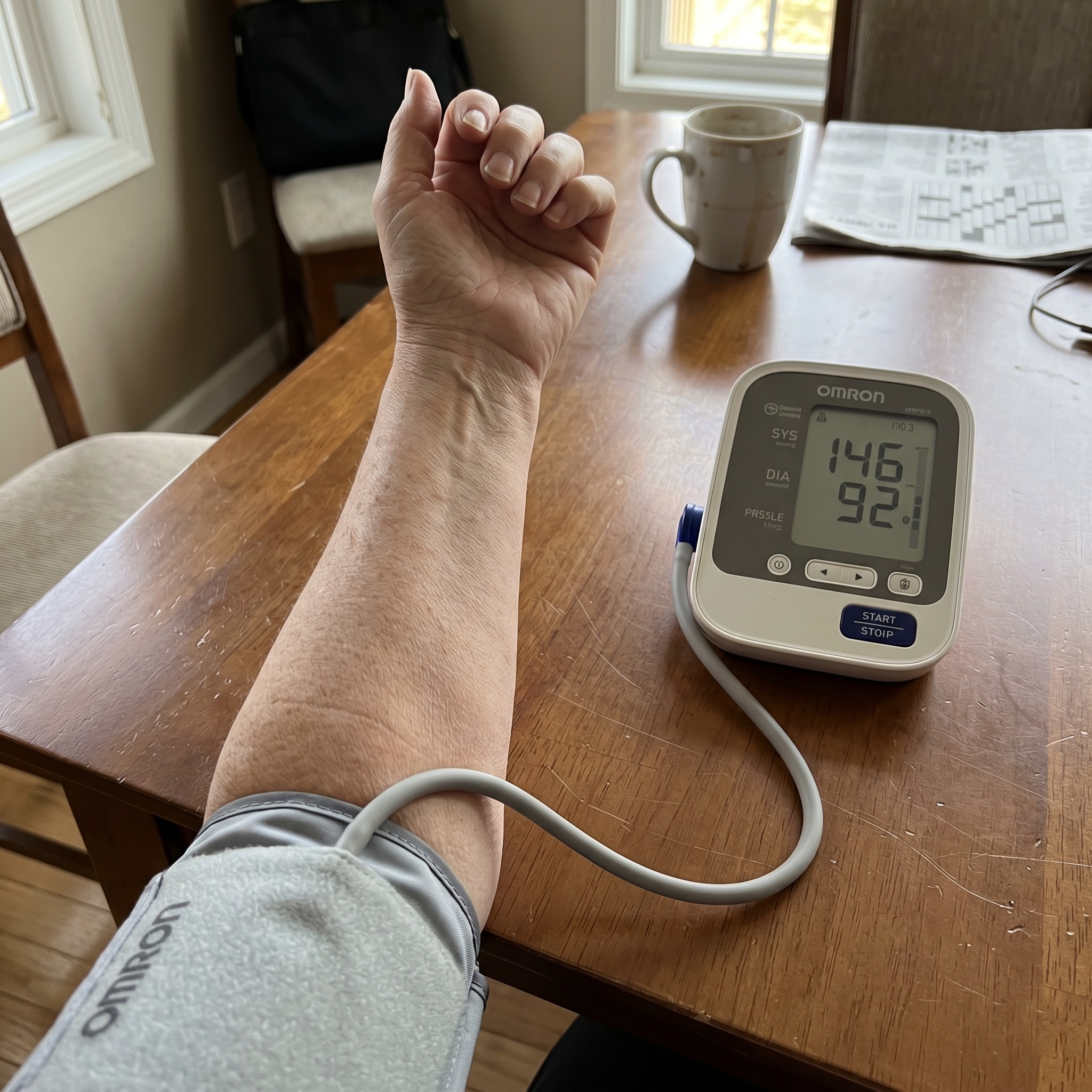
I got a postcard from Florida last October that just said "I'm sorry I haven't called. I've been scared." That was the whole message. Six words. Signed with a single curly K. K is my older sister Karen. She lives in Sarasota with her second husband Bill, who used to sell boats and now mostly fishes off a pier and complains about the snowbirds even though they are themselves snowbirds. Karen and I have not gotten along since 1987 over something I don't even remember anymore. We send Christmas cards. We call on birthdays. That's the whole relationship. So a postcard out of season, with that message on it, in her handwriting that wasn't her handwriting because it was shakier than I'd ever seen it, sat me down at my kitchen table for 40 minutes. I'm Diane. I'm 61. I live in Erie, Pennsylvania, in the same brick two-bedroom my husband Dennis and I bought in 1992. Dennis passed in 2021. Pancreatic. Six weeks from diagnosis to the funeral. I haven't moved his recliner. I haven't moved his coffee mug from the shelf above the sink. Some women clear things out. Some women don't. I'm a don't. I read the postcard three times. Then I read it a fourth time. Then I went and got my reading glasses and read it a fifth time even though I'd had them on for the first four. I'm sorry I haven't called. I've been scared. Karen doesn't say things like that. Karen is the older sister. Karen is the one who, when our father died in 1998, called all 14 of his cousins herself instead of letting our mother do it. Karen is the one who got divorced at 41 and threw a divorce party. Karen does not write postcards that say I've been scared. I called her that night. It rang 8 times and went to voicemail. I called her the next morning. Same thing. I called Bill's cell phone, which I'd had for an emergency years ago. He picked up on the second ring and his voice was the kind of tired that doesn't come from a bad night's sleep, it comes from a bad year. He said, "Diane. I was wondering when you'd call." I said, "Bill, what is going on with my sister." He was quiet for a long time. Then he said, "I think you better come down." I told him I'd be there Friday. He said, "Diane, don't tell her you're coming." I'm going to back up here because I want you to understand what kind of person my sister Karen is. Karen was the kind of girl who, at 12 years old, taught herself to play the piano because our parents wouldn't pay for lessons. She taught herself by ear. She got good enough that by 16 she was playing weddings for $40 a wedding, which in 1979 was real money. She put herself through Penn State on piano money and a partial scholarship and a job at a diner in State College that she worked 5 nights a week for 4 years. She married her first husband Joel at 24 and had two kids by 28. Joel was a contractor who drank. Karen left him on a Tuesday in 1995 with two kids in the back of a Honda Accord and $1,400 in a savings account and she did not look back. She raised those kids alone for 11 years before she met Bill at a church fish fry in 2006. They got married 14 months later. Bill is a good man. He's not Joel. Karen was the strong one. Karen was always the strong one. So when Bill told me on the phone not to tell her I was coming, I understood what he was telling me. He was telling me she would say no. He was telling me she would say she was fine. He was telling me she would put on a voice and tell me I didn't need to make the trip. And he was telling me to come anyway. I drove down on a Friday in late October. 22 hours from Erie to Sarasota with one night in a Hampton Inn outside of Knoxville. I packed a small suitcase. I left a note for my neighbor to get the mail. I want to tell you what I saw when I walked through their front door. Bill answered. He looked thinner than the last time I'd seen him. He held the door open and just nodded at me like he'd been waiting for a long time. The house was the same. The same beige carpet, the same little tiled entry, the same kitchen with the pass-through to the dining room. Karen had decorated this house herself in 2009 and it had looked the same for 15 years. She was at the kitchen table. She was wearing a robe at 2:30 in the afternoon. Her hair, which Karen has dyed every 5 weeks for 30 years to keep the grey out, had grey roots an inch and a half deep. There was a blood pressure cuff on the table next to a glass of water and a notepad. The cuff was plugged in. She'd been using it. She looked up when I walked in. She looked at me for a long second and her face did the thing faces do when they can't decide whether to be angry or to cry. Then she said, very quietly, "You weren't supposed to come." Bill said, "Karen." She said, "Bill." Then she put her face in her hands and started crying. Not loud. Just shoulders. The kind of crying where the person doesn't make any noise because they've been doing it for so long they've learned how not to. I sat down across from her. I picked up the notepad. It had her blood pressure readings written down in her handwriting. Three a day. Sometimes four. Going back, I flipped through the pages, going back to early 2023. The numbers on the most recent pages were 198 over 112. 204 over 115. 196 over 109. 211 over 118. I'm not a nurse. But I'd watched my mother spend her last 8 years on blood pressure medication and I knew what those numbers meant. Those numbers meant stroke. Those numbers meant heart attack. Those numbers meant my sister had been sitting at this kitchen table for 2 years watching the cuff inflate and deflate, writing the readings down in a notepad, telling no one. I said, "Karen. Honey. Why are you not in a hospital." She didn't look up. She said, "Diane. I've been to 7 doctors." That sentence cracked open the whole story. She told me everything over the next 4 hours. We moved from the kitchen to the screened porch. Bill made coffee. The Florida light went from sharp afternoon to soft gold to something pink and slow over the canal behind their house. Her blood pressure had started creeping up in 2018. She'd been on her first medication by 2019. It hadn't worked, so they'd added a second. By 2020 she was on three. By 2022 she was on four. By 2023, none of them were working. Her readings were climbing into territory the doctors couldn't explain. She'd seen a cardiologist in Sarasota. He'd added a fifth pill. It made her cough so badly she couldn't sleep. He took it off and added a different one. That one made her ankles swell to the size of small grapefruits. He told her she had "treatment-resistant hypertension," which is doctor-speak for we don't know what to do with you, and that she should just keep trying combinations. She'd flown to Tampa to see a specialist. He'd ordered three rounds of bloodwork, an MRI of her adrenal glands, a 24-hour urine collection, and a sleep study. Everything came back normal. He told her some people are just like this. He told her to come back in 6 months. She'd flown to Atlanta to see a doctor a friend had recommended. He'd put her on a 7th medication. It dropped her pressure to 90 over 60 for 4 days and then it climbed back up to 195 over 110 and stayed there. By the spring of 2024 she'd stopped going to the doctor. She told me she'd stopped going because she couldn't stand the conversation anymore. Walk in. Get the cuff put on. Watch the nurse's face change. Watch the doctor come in with a clipboard. Watch them shake their head. Watch them add a pill. Watch the pill not work. Drive home. She said, "Diane, I started thinking about it as a death sentence." She said it just like that. She said she'd started writing letters. To Bill. To her kids. To me. She had a folder in her dresser drawer with 9 letters in it. She hadn't told anyone because she didn't want anyone to talk her out of being afraid. She wanted to be afraid. She wanted to be ready. Because she knew, in the way the body knows, that one of these mornings the cuff was going to read something that wasn't going to be a number anymore, it was going to be the end. I cried with her on that porch. I had not cried like that since Dennis. After she went to bed I sat with Bill in the kitchen. I asked him what he'd done. He said, "Diane. I have begged her. I have driven her to 7 doctors. I have gone with her into the appointments. I have done everything a man can do for his wife when the medical system has thrown its hands up." He said, "I have been losing her in slow motion for two years. And I didn't know who else to tell." I stayed in Sarasota for 11 days. The first 4 days I just watched. I watched Karen take her cuff out three times a day. I watched her write the numbers down. I watched her face when the numbers were bad, which they were every time. I watched Bill's face when he saw her face. I watched the way they moved around each other like two people trying not to wake up a baby that was already awake. On day 5 I called my niece Sarah, Karen's daughter, who lives in Chicago and is a physical therapist. I told her everything. She cried. Then she said something that stopped me cold. She said, "Aunt Diane. There's something I want to tell you. I've been treating an older man at the clinic for 9 months for hip pain. He's 64. He came in two weeks ago and his physical therapist, that's me, told him his blood pressure looked better than it had since he started coming. He told me he hadn't done anything different except start taking some berry from India that his daughter in law had pushed him to try." I said, what's it called. She said, "Aunt Diane. I wrote it down because I was curious. Hold on." She put me on hold. She came back. She said, "It's called Amla. A-M-L-A. The brand he was taking was Alevia. Alevia Amla." I want to slow down here because the next part of the story is the part where I'd usually feel skeptical. If somebody told me on the phone that a berry from India had brought down a 64-year-old man's blood pressure when 7 medications hadn't, I would not believe them. I would think they were trying to sell me something. I would think the patient was confused. But I was sitting in my sister's guest bedroom in Sarasota, Florida, with a notepad full of readings in my hand, after I'd watched her cry on a screened porch and tell me she'd written 9 letters to her family because she thought she was about to die. When you are at that point, you do not have the luxury of skepticism. You have research. I spent the next two nights on my laptop in that guest bedroom. Here's what I learned, in the plainest language I can put it. The inside of your blood vessels has a living inner wall. It's called the endothelium. It's one cell thick. It is the most important layer of your vascular system and most people, including me, have never heard of it. That wall has a job. Its job is to tell your blood vessels when to relax and open up so blood can flow through easily. It does that job by producing a tiny molecule called nitric oxide. When the wall makes plenty of nitric oxide, your vessels relax, your blood flows freely, and your pressure stays normal. When the wall is worn down, it can't make enough nitric oxide. The vessels stay tight. Blood has to force its way through. The harder it forces, the more it stresses the already-worn wall. The wall gets worse. The pressure goes up. The cycle feeds itself. That is what high blood pressure actually is, at the level where it lives. Now here is the part that sat me down on the bed and made me say a word my mother would not approve of out loud. The pills my sister was on, all 7 of them she'd tried over 6 years, do not touch the wall. They force the vessels open from the outside. They are doing the wall's job for it. Which means while the pill is working, the wall is still worn down. The wall is still not making nitric oxide. The wall keeps deteriorating. And eventually you reach a point where the pills can't force enough opening to overcome the deterioration. That's the moment doctors call "treatment-resistant." Karen wasn't unusual. Karen wasn't a freak case. Karen was a woman whose wall had been deteriorating for 20 years and nothing in her medical chart had ever once been aimed at the wall. Amla, I read, contains compounds called emblicanins. Emblicanins have been studied for what they do to that inner wall. When the wall is supported, it can start producing more of its own nitric oxide, the way it did when she was younger. The vessels can relax more naturally. The pressure on the wall eases. When the pressure eases, the wall isn't getting beaten up anymore. The cycle that has been feeding itself can start to slow down. Pressure can come down. Not because something forced it. Because the wall has been given a chance to do its own job again. I read that and I closed the laptop and I sat on the edge of the guest bed and I thought, dear Lord. She has been treated for the symptom for 6 years. Nobody ever treated the wall. The next morning I came out to the kitchen and Karen was at the table with the cuff. I sat down. I said, "Karen. I want you to try one thing. One. If it doesn't help, I will fly down here every two weeks and sit with you until I die too. I will not leave you alone in this. But I want you to try one thing." She looked at me. I told her about Sarah's patient. I told her about the wall. I told her about the nitric oxide. I told her what I'd read. She didn't say anything for a long time. Then she said, "Diane. I have tried 7 medications. I have flown to Tampa and Atlanta. I have spent $4,400 out of pocket on specialists. Why on God's green earth would I think a berry is going to do anything." I said, "Because nobody has touched the wall yet." She looked at me. Then she looked at Bill. Bill nodded. We ordered it that afternoon from her kitchen table. I want to tell you what happened over the next 11 weeks, because I went home to Erie after day 11 and I called Karen every single morning at 9:15, and I want to tell you what she told me on those calls. Week 1, nothing. The numbers were still 198 over 110, 201 over 112. She was discouraged. I told her to stay on it. Week 2, the morning readings started coming down first. 184 over 105. 179 over 102. Still high. But moving. Week 3, she slept through the night for the first time in 18 months. Bill told me that on the phone. He said, "Diane. She slept until 6:40 in the morning. She used to wake up at 2 with her heart pounding and stay up. She slept." Week 5, her morning reading hit 152 over 89. We both cried on the phone. Week 7, she went to her cardiologist for a routine appointment. She did not tell him she was taking anything. He took her reading himself. 148 over 86. He looked at the chart. He looked at her. He looked at the chart again. He said, "Karen. What did you change?" She told him. He wrote it down. Not the brand. Just the word Amla. He said, "I'm going to look into this." Week 9, her cardiologist took her off two of her medications because her pressure was steady in the 140s over 80s and he didn't want her dropping too low. Two pills. Off. After 6 years of only adding. Week 11, I flew down to Sarasota again. I walked in the front door. Karen met me at it. She was wearing real clothes. Her hair was dyed. She had on lipstick. She hugged me and she said, "Diane. I dyed my hair. I went to the salon. I sat in the chair for 90 minutes. I read a magazine. I drank a coffee. And I did not think about my blood pressure once." She said, "I didn't realize how much of my brain it had been taking until it gave it back." We went to dinner that night at a restaurant on the water. She ordered fish. She ate it. She had a glass of wine. She laughed at something Bill said and she put her hand on his hand and she left it there for the rest of dinner. I watched my sister come back to life over plates of grouper. The letters in her dresser drawer are gone now. I asked her what she did with them. She said she'd shredded them in May. She said she didn't want them sitting there anymore because they were a version of her she was no longer planning to be. I started taking Alevia Amla too, about 4 months ago. My pressure has never been bad, but I'm 61 and I watched my husband die in six weeks and I figured if there's something that supports the wall, I'd rather support it now than treat it later. I am not a doctor. I have already told you everything I know. But if you are a woman sitting somewhere in America with a notepad and a cuff and a husband who doesn't know what to do anymore, or you are a husband with a wife whose readings have gotten quietly worse for years while the medications added up to nothing, or you are anyone in that house where the conversation has gotten too tired to have, I want you to know what my sister knows now. Your medications are doing one job. They are forcing your vessels open. They are not touching the wall. The wall is what's worn out. The wall is why nothing has worked. And the wall has not, in 6 years and 7 medications and $4,400 in specialists, been the target of a single thing my sister was given. Alevia Amla supports the wall. That is the whole sentence. The wall is what's been worn down. Support the wall, and your body can do what it already knows how to do, which is run your blood pressure the way it ran it when you were younger. Alevia is a small company. They ship out of the United States. The capsules are made here too. You take two a day with breakfast. There's no powder, no tea, no protocol. Two capsules. A glass of water. That's it. It comes with a 90-day money-back guarantee. You send the bottle back, full refund, no paperwork, no arguing. You have 3 months to find out whether your wall can come back online. If it can't, you've lost nothing but the postage. My sister wrote me a postcard last October that said I'm sorry I haven't called, I've been scared. I am writing this in February, 4 months later, because she is not scared anymore. She has not been scared since week 5. If somebody in your life has gone quiet on you the way my sister went quiet on me, please don't wait for the next postcard. Please don't wait for the next reading. Please don't wait for the cardiologist to throw up his hands. The wall is the thing. Nobody told us. Now you know. 👉 alevia.com/amla/33 P.S. I want to say one more thing about Karen. The night before I flew home from my second trip, she said something I have not been able to stop thinking about. She said, "Diane. The worst part wasn't the numbers. The worst part was being treated like a difficult patient. Every doctor's office in 6 years. Every cardiologist. Every specialist. I started feeling like the problem was me. Like there was something wrong with me as a person, not just as a body. Like I was a failure at being a patient." She said, "I didn't even know how much I was carrying that until it lifted." If you are a person who has been told you are treatment-resistant, please understand that you are not the problem. The pills were not aimed at the right thing. That's not your fault. P.P.S. You'll know it's working before your cuff confirms it. The sleep changes first. Then the mornings. Then the headache that has been there for so long you forgot it was there starts to go. Then the cuff confirms what your body already told you. Don't quit at week 2. Week 2 is the wall starting to come back online. Weeks 3 through 6 are when the pressure starts to follow. P.P.P.S. Alevia Amla has that 90-day money-back guarantee I mentioned. Just send the bottle back. Full refund. No arguing. Think about what that tells you about a company. Seven medications did not come with a money-back guarantee for my sister. Seven specialists did not refund her for the appointments that didn't help. The pharmaceutical industry doesn't do refunds. Alevia does. That tells you who's confident in what they sell. P.P.P.P.S. Alevia is small. They run out. I learned that last month when I tried to order Karen's third bottle and they were 6 days behind shipping. I keep two bottles in the kitchen drawer now, one open and one waiting. If this story has felt like somebody finally describing what's been going on in your house, please do not put off ordering for another month. Karen lost 6 years to specialists who couldn't help her. She wrote 9 letters to her family from her dresser drawer. She drove herself to a place where she was preparing to die. You can save the months she lost by ordering a bottle tonight and taking two with your coffee tomorrow. P.P.P.P.P.S. Don't forget about the 90-day money-back guarantee. You are risking nothing. Karen was risking everything. 👉 alevia.com/amla/33
Like this ad? Make it yours.
Crush rebuilds this exact creative around your product — your brand, your colors, your offer — in about a minute.