
Active· since Jul 28, 2026
- 48
- days running
- 0
- relaunches
Ad copy
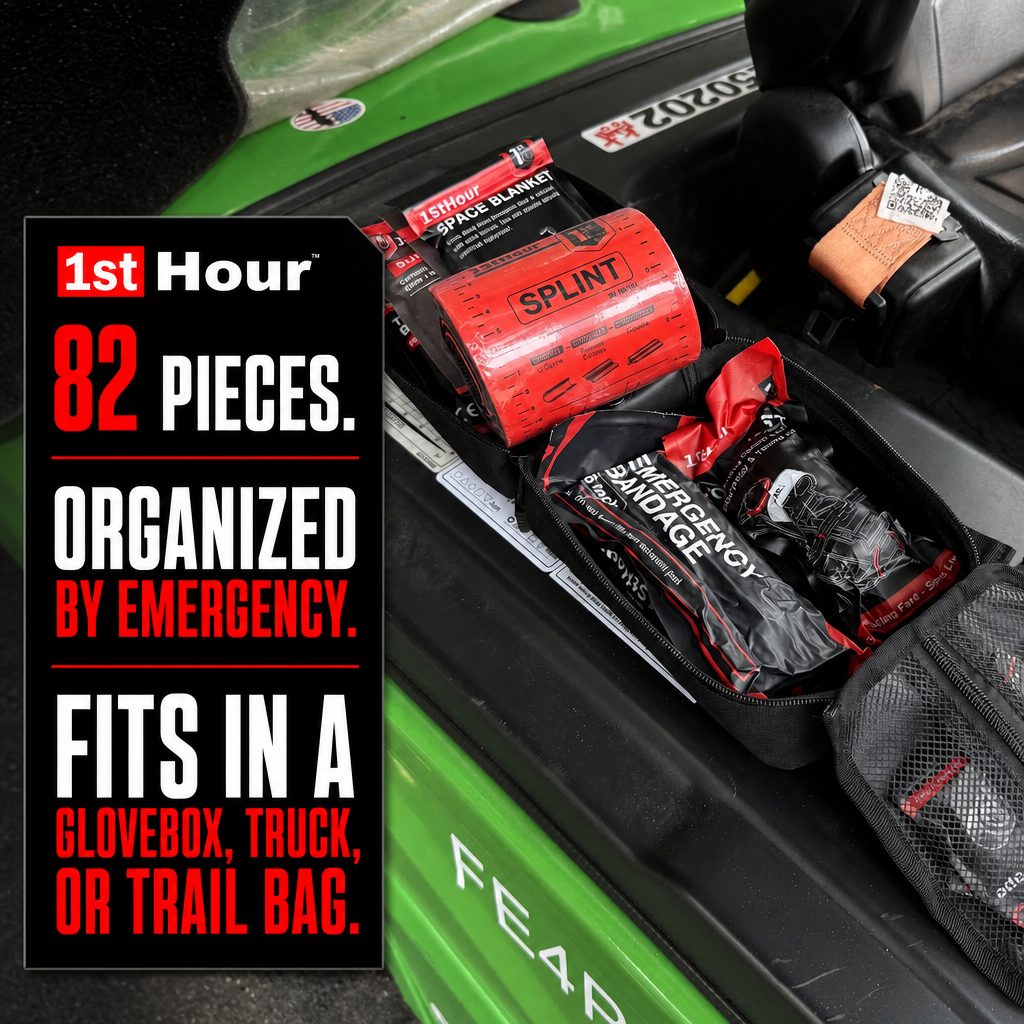
Dispatch asked me to go unlock the yard gate for the ambulance. I was the only officer on site, and I was the one bleeding. I have been a licensed contract security officer for nine years. Nine years of night shifts. A warehouse chain, a hospital annex for a while, two construction sites, and for the last three years a pipe and steel yard out past the county line. I know how to sound calm on a radio. I know how to write an incident report that holds up six months later in somebody's deposition. I know every hinge, every blind corner, and every bad light on that property. And on the one night it mattered, I did not own a single thing that stops bleeding. Not one. That is the part I still cannot get past. It was not that I had never heard of this stuff. I had heard about it for years. There was a guy on our rotation named Reggie. Ex Army. He worked the yard with me on the alternating schedule for almost three years. Reggie was the gear guy. Every shop has one. He came in twenty minutes early, sat on the corner of the desk in the guard shack, and talked about pouches. He said the brand names like they were people's names. He knew which windlass tourniquet the medics actually carried and which ones were junk plastic. He had a flat pouch on his belt and a bigger one behind the seat of his truck. He was always after the rest of us to get one. I never wrote a single name down. I did not have to. Reggie was there. That is the ugly little truth of it, and it took me forty five minutes on a gravel road to finally understand it. I had made a coworker my medical plan. In June they moved Reggie to a hospital contract downtown. Better hours, better rate, no argument from anybody. We shook hands in the lot at shift change and I told him we would get lunch. Nobody replaced him at the yard. The post is one officer. It was always one officer. Reggie was just the guy who happened to be that officer half the time. Saturday the twenty fifth of July, I clocked in at six in the evening. It was ninety one degrees at eleven o'clock at night. The gravel was still throwing heat up at my legs through my uniform pants. Perimeter rounds every ninety minutes. Fourteen hundred feet of chain link on the back line, the rail spur, the pipe racks, the tool crib, the fuel tank. Then back to the shack, log it, sit down, do it again. On my third round I came around the racks and my flashlight caught something wrong on the back fence. Somebody had cut a section of the chain link with bolt cutters and peeled it back like a page in a book. About three feet of it. They wanted copper. They always want copper. I called it in. Our dispatch is not a person in a building down the road. It is a national call center. That night the voice belonged to a woman in a different state, eleven hundred miles away, who had never seen this yard and never would. She logged it. She told me to observe and report. But I could not tell her whether anybody was still inside the fence, and that is the whole job. So I reached down with my left hand and folded the cut flap back to put my light through the gap. That flap had spring in it. Chain link that has been cut leaves a row of little steel points where every wire ends. Not a smooth edge. A row of barbs. It kicked back at me and raked the inside of my left forearm from below the elbow almost to the wrist. I did not feel it the way you would think. It felt cold, like somebody dragged an ice cube down my arm. Then I put my light on it. It was running down my hand and off the tip of my middle finger in a line. Not drops. A steady line, like a faucet with a bad washer. I want to say I did something smart in that first minute. I took my shirt off and wrapped my arm in it. That is what I did. A polyester uniform shirt with a sewn on patch. Six hundred yards of gravel back to the guard shack, and by the time I got there the shirt was heavy and I could feel it running down the inside of my elbow again. There is a first aid box screwed to the wall of that shack. The company provides it. It has an inspection tag on the front with a date on it. I have looked at that box for three years. Inside there were adhesive bandages in four sizes, alcohol wipes, a tube of burn cream, tweezers, an eye wash bottle, and two gauze pads you could have covered over with a business card. I put both of the pads on and they were soaked before I got the tape off the roll. I called dispatch back and this time my voice was not the calm radio voice. She heard it and she stopped being a queue and started being a person, and she got an ambulance rolling. Then she said the sentence I still hear. "Sir, can you get down to the gate and unlock it for them?" Because of course I could not just lie down. That yard is chained and padlocked from the inside. I carry the key. I am the access control. That is literally my job title on the post orders. There is no one else. There is no one on the other end of that chain who can cut it. So I walked down there holding my own arm against my chest and I worked a padlock one handed with blood on the shackle and blood on the chain and blood on the little brass key. Then I sat down on the bumper of the patrol truck and waited. Eighteen minutes. Eighteen minutes is not the worst number in the world. I have read worse. I went and found the actual numbers later, the way you do when you cannot sleep. Mell and colleagues published theirs in 2017, in JAMA Surgery, measuring the clock from the 911 call to the truck reaching you. Rural median, thirteen minutes. Then their own sentence, which is the one that stuck: nearly 1 of 10 encounters in rural areas waited almost a half hour for EMS personnel to arrive. Almost a half hour. I have worked posts where that would have been optimistic, because the truck still cannot get through a locked gate. And here is what got in my head sitting on that bumper. If that cut had been two inches deeper, or three inches higher and inside, the eighteen minutes would have been the whole story. There would not have been anything else to tell. Sixteen stitches. No tendon. The doctor called it lucky twice while he was working. I did not feel lucky. I felt stupid, and there is a difference. I lay awake that Sunday doing something I had never bothered to do in nine years. I added up my own gear. Guard card course, one hundred eighty five dollars. State license and renewal, ninety two. Boots, one hundred forty eight. Duty belt and keepers, eighty four. Flashlight, seventy nine. Cuffs and case, sixty one. External vest carrier, one hundred fourteen. Three uniform shirts, seventy five. Eight hundred thirty eight dollars. Eight hundred thirty eight dollars, out of my own pocket, so that I would look like a security officer. And zero dollars on anything that would keep me alive long enough for the ambulance to reach the gate I was holding the key to. Something turned over in me on that bumper, and it never turned back. I stopped being a guy something happened to. Monday I did what Reggie had been telling me to do since 2023, except now I actually understood why he was so annoying about it. Here is the thing I had wrong for years. I thought a belt would work. Every officer thinks that, because we are all wearing one. A duty belt is not a tourniquet. It is too wide and too stiff to squeeze an artery shut, and there is nothing on it that will hold the tension once you get it there. You need something that keeps tightening after you let go. That is what a windlass does for you. You wind the rod, you seat the rod, and the pressure holds there with nobody's hand on it. That is the entire mechanism, and it is why the ones with a real windlass stop the bleed 92 percent of the time. I did not want to shop for six weeks and I did not want to guess. I wanted the whole thing in one pouch, already picked. I ended up on 1stHour. Eighty two pieces. Windlass tourniquet, a six in one Israeli bandage, compressed gauze, chest seals, an absorbent pad, a splint roll, a burn dressing, medical tape, shears that actually cut a uniform sleeve, gloves, a CPR mask, a rescue blanket. Waterproof lining, because mine lives in a truck that sits in the sun all day in July. Five year shelf life. And this was the part that mattered most to a guy who had just tried to work a padlock one handed: every item has the instructions printed right on it. You are not reading a booklet at midnight with one working hand. You are reading three lines on the package while you do it. I ordered two. Two of them ran a hundred fourteen dollars, so fifty seven a piece. Take one on its own and you are at fifty nine ninety five. The regular ticket on it reads a hundred forty nine, so what they are taking off is sixty percent. Eight hundred thirty eight dollars to look the part. Fifty seven dollars to be able to hold my own post. I will admit I sat at that desk and ran the math a second time before I believed the shape of it. They came the next day from New York in a plain box. I opened it on the desk in the guard shack, on the same desk Reggie used to sit on the corner of. The weight got me before anything else did. A pouch that size has no business sitting that heavy in your palm. The nylon has a smell to it, that new webbing smell, and the zippers are the fat kind that do not fold over on you. Then I put every one of the eighty two pieces out across the desk under the shack light, because I wanted my hands on each of them before I trusted any of it. The tourniquet is black and there is no cartoon anywhere on it. Nothing in that pouch is cheerful. It is not supposed to be. One of them went behind the seat of my truck. The other one went in the duty bag I actually carry into every site, the one that goes with me whether I am at the yard or covering a shift somewhere I have never been. Because the pouch that saves you is the one that is on the property with you, not the one at home in a closet. If you are thinking the company should be buying this, you are right, and it does not matter. Read your own post orders. Mine say render aid. Then go look in the wall box and count what is in it. Ours held two gauze pads the size of a business card. If you are thinking you will build one cheaper, I priced it out that same night. The pieces on their own run over a hundred fifty dollars, and that is if you get real ones. And that is the actual trap. There are a lot of cheap knockoff kits floating around out there with tourniquets that snap when you twist them. This one never sits on a retail shelf, and the big online marketplaces do not stock it either. It ships direct from the company, which is exactly why I trusted it. So here is the question I would ask you, officer to officer. Tonight, when you are alone on a post with a locked gate and a dispatcher in another state, what is on your belt that stops blood? Not your radio. Not your flashlight. Not your report writing. Blood. You already know the answer. You knew it before you got to the end of this sentence. There are two kinds of officers doing this job right now. One of them made somebody else the medical guy. The other one carries it himself. I was the first kind for nine years and it cost me sixteen stitches and a shirt I threw in a dumpster. You do not need the company to approve this and you do not need to ask anybody. It is fifty seven dollars and it is your own arm. Their store opens from the card under this post. There were 143 left the night I ordered two. Eight times they have had none at all. EDITED TO ADD: Reggie called me Tuesday. Somebody at the hospital sent him this. He did not say I told you so, which I appreciated more than I expected to. He asked which one I got and I told him and he said that is the same one half his new crew carries. He also told me to move the one in my truck to the bag, and I already had. EDITED AGAIN: My supervisor came out to the yard Thursday to look at the fence repair and saw the pouch sitting open on the desk. He asked what it cost. I told him fifty seven a piece in twos, or fifty nine ninety five for one, and that they knock it down from a hundred forty nine. He wrote it on the back of a work order. Four of the guys on our contract have ordered since. Two of them are at sites further out than mine. They give you a thirty day window to return the thing and get your money if you unzip it and want no part of it, but nobody who has opened one has sent it back yet, and I do not think you will either. Get it before you need it. That is the only order those two things ever come in.
Why First Aid Kits Kill
Prepare for emergencies with the Tacright Trauma First Aid Kit, designed for rapid response in critical situations. This compact and durable kit includes all the essential tools needed for trauma care, making it perfect for outdoor enthusiasts, tactical professionals, and anyone who values safety an...
LEARN MORELike this ad? Make it yours.
Crush rebuilds this exact creative around your product — your brand, your colors, your offer — in about a minute.